Last updated: August 6, 2026
Ritalin LA is a mature extended-release methylphenidate product with limited remaining commercial exclusivity. Novartis developed and marketed the brand in the United States, but the product’s economic position has shifted from patent-protected innovation to a generic-exposed, supply-sensitive ADHD medicine. Ritalin LA has no separately reported public revenue line, and its financial contribution is substantially smaller than Novartis’s major growth products.
The principal market drivers are ADHD diagnosis and treatment growth, generic substitution, controlled-substance supply constraints, competing long-acting stimulants, payer formularies, and physician preference for delivery profiles. The main commercial risk is continued erosion by generic methylphenidate extended-release capsules and branded alternatives such as Concerta, Vyvanse, Adderall XR, and Focalin XR.
What is Ritalin LA and how does it work?
Ritalin LA contains methylphenidate hydrochloride, a central nervous system stimulant approved for the treatment of attention-deficit/hyperactivity disorder, or ADHD, in children and adults. It is supplied as extended-release capsules using a dual-pulse delivery system intended to provide two releases of methylphenidate approximately four hours apart.[1]
Ritalin LA is available in 10 mg, 20 mg, 30 mg, and 40 mg capsules. The capsules can be swallowed whole or opened and sprinkled on applesauce under the prescribing information. The formulation is designed to provide coverage across the school or work day while retaining a delivery profile different from once-daily osmotic products such as Concerta.[1]
| Attribute |
Ritalin LA |
| Active ingredient |
Methylphenidate hydrochloride |
| Dosage form |
Extended-release capsule |
| FDA application |
NDA 021284 |
| Initial U.S. approval |
2002 |
| Indication |
ADHD |
| Key strengths |
10 mg, 20 mg, 30 mg, 40 mg |
| Drug class |
CNS stimulant |
| Controlled-substance schedule |
Schedule II |
| Original developer/marketer |
Novartis |
| Current market position |
Mature brand with generic competition |
What patents protect Ritalin LA?
Ritalin LA’s original protection centered on extended-release methylphenidate formulation technology rather than a new active pharmaceutical ingredient. The underlying methylphenidate molecule has been off patent for decades. Commercial protection therefore depended on formulation patents, regulatory exclusivity, trademarks, and the ability to differentiate the product’s release profile.
The principal patent-era protection for Ritalin LA has expired. Publicly available FDA and patent records do not establish a current, commercially meaningful Orange Book patent barrier that would prevent abbreviated new drug application, or ANDA, competition for the core Ritalin LA product.[2][3]
| Protection category |
Ritalin LA status |
| Active ingredient patent |
Expired long before Ritalin LA launch |
| Core extended-release formulation patents |
Expired |
| New chemical entity exclusivity |
Not applicable |
| Pediatric exclusivity |
Historical, expired |
| Current Orange Book barrier |
No material active barrier identified |
| Trademark |
Ritalin and Ritalin LA remain brand identifiers |
| Generic pathway |
ANDA approvals available |
What formulations are protected by Ritalin LA patents?
The historical formulation claims covered multiparticulate delivery systems that released methylphenidate in more than one pulse. This technology differentiated Ritalin LA from immediate-release Ritalin tablets and from other extended-release methylphenidate products.
Formulation patents can create meaningful commercial protection when they cover a clinically relevant release profile and remain enforceable through generic launch. For Ritalin LA, that protection has run its course. Current competition is based primarily on bioequivalence, manufacturing capability, supply reliability, payer access, and prescriber familiarity.
Does Ritalin LA have method-of-use patent protection?
Ritalin LA does not have a current method-of-use patent position comparable to products protected by narrow dosing, disease-subtype, or administration patents. The ADHD indication is established and does not provide a durable exclusivity platform for the brand.
When did Ritalin LA lose exclusivity?
Ritalin LA lost effective market exclusivity after expiration of its principal formulation protection and the subsequent approval of generic methylphenidate extended-release capsules. The exact commercial erosion date varied by generic applicant, launch timing, litigation outcomes, and supply availability.
| Milestone |
Approximate timing |
| Ritalin LA FDA approval |
2002 |
| Original patent protection period |
Primarily mid-2000s to mid-2010s |
| Generic development and ANDA activity |
2010s |
| Broad generic competition |
Late 2010s onward |
| Current status |
Mature, generic-exposed market |
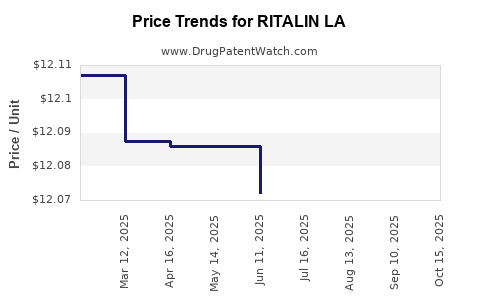
The brand’s commercial exclusivity is therefore historical rather than current. Any remaining price premium depends on payer policy, product availability, patient continuity, and physician preference.
What is the Orange Book status of Ritalin LA?
Ritalin LA is listed in the FDA’s Approved Drug Products with Therapeutic Equivalence Evaluations, commonly called the Orange Book. The relevant reference product is methylphenidate hydrochloride extended-release capsules under NDA 021284.[2]
The Orange Book’s practical significance is limited because the primary patent estate has expired. Generic applicants can rely on the reference product through the ANDA pathway if they demonstrate pharmaceutical equivalence and bioequivalence. The competitive issue is therefore less about a live patent block and more about whether a generic manufacturer can sustain production of a Schedule II product.
Which companies challenge Ritalin LA with generics?
Competition has come from manufacturers of methylphenidate hydrochloride extended-release capsules, including large generic companies and contract manufacturers. Generic availability has varied by strength, manufacturer, wholesaler inventory, and controlled-substance quota.
The most important competitive groups are:
- Generic methylphenidate extended-release capsules that reference Ritalin LA.
- Other methylphenidate products, including Concerta, generic Concerta equivalents, Ritalin, Metadate CD, and Focalin XR.
- Amphetamine-based products, including Adderall XR and Vyvanse.
- Nonstimulants such as atomoxetine, viloxazine, and extended-release guanfacine.
The competitive distinction is not limited to active ingredient. Physicians and patients compare duration, onset, rebound symptoms, appetite effects, abuse potential, titration flexibility, capsule handling, insurance coverage, and pharmacy availability.
What generic entry risks exist for Ritalin LA?
Generic entry risk is high because the core product is mature, the active ingredient is well characterized, and the brand has no current composition-of-matter protection. Generic substitution can reduce average selling price and compress brand prescription volume.
The main residual risks are:
| Risk |
Commercial effect |
| Generic price discounting |
Reduces net price and reimbursement |
| Automatic substitution |
Diverts prescriptions from the brand |
| Multiple generic suppliers |
Increases payer negotiating leverage |
| Shortages |
Can temporarily redirect patients between manufacturers |
| Product-specific release profile |
May preserve some physician preference |
| Schedule II quota limits |
Restrict supply across both brand and generic channels |
| Formulary exclusions |
Accelerate brand volume loss |
Shortages can temporarily benefit an available brand or generic, but they do not restore durable exclusivity. Patients may switch to any available methylphenidate or amphetamine product, and some remain on the substitute after supply normalizes.
What FDA regulatory factors affect Ritalin LA?
Ritalin LA is regulated as a Schedule II controlled substance in the United States. Manufacturers and distributors must comply with Drug Enforcement Administration requirements governing production quotas, procurement, distribution, recordkeeping, and diversion control.[4]
FDA regulatory factors include:
- Bioequivalence requirements for generic extended-release capsules.
- Manufacturing controls for multiparticulate release systems.
- Labeling requirements for stimulant risks and abuse potential.
- Postmarket adverse-event monitoring.
- Drug shortage reporting and supply-chain coordination.
- Child and adult ADHD prescribing trends.
- Formulation integrity and dose uniformity.
The controlled-substance framework creates a supply barrier that affects the whole category. It is not an exclusivity barrier, but it can limit market participation and create intermittent product shortages.
How strong is the Ritalin LA patent estate?
The current patent estate is weak from an exclusionary standpoint. Its historical strength came from formulation differentiation, but the relevant protection has expired. Ritalin LA has greater commercial resilience as a recognized delivery system than as a patent-protected asset.
| Patent-estate factor |
Assessment |
| Composition-of-matter protection |
None |
| Current formulation exclusivity |
Limited or absent |
| Method-of-use protection |
Limited or absent |
| Generic substitutability |
High |
| Brand recognition |
Established |
| Manufacturing complexity |
Moderate |
| Regulatory barrier to generic entry |
Moderate |
| Long-term pricing power |
Low |
Manufacturing remains relevant because extended-release multiparticulate capsules require consistent drug release, coating, encapsulation, and quality control. Those requirements raise execution risk but do not normally prevent capable generic manufacturers from entering.
What patent litigation and Paragraph IV activity affect Ritalin LA?
Ritalin LA is no longer characterized by an active patent litigation cycle comparable to recently launched specialty medicines. Historical patent disputes and Paragraph IV certifications were relevant during the transition from branded exclusivity to generic availability, but the market has moved into the post-litigation generic phase.
A Paragraph IV certification asserts that a listed patent is invalid, unenforceable, or would not be infringed by the proposed generic. Such certifications can trigger litigation under the Hatch-Waxman Act and may delay approval or launch. For Ritalin LA, the commercial importance of Paragraph IV challenges has diminished because the principal formulation protection has expired.[3]
No current settlement agreement is the central market determinant for Ritalin LA. Generic access is governed mainly by approved ANDAs, supply conditions, and payer substitution.
How does Ritalin LA compare with Concerta, Vyvanse, and Adderall XR?
Ritalin LA competes in the long-acting ADHD stimulant segment but has a different pharmacologic and commercial profile from leading alternatives.
| Product |
Active ingredient |
Delivery profile |
Competitive position |
| Ritalin LA |
Methylphenidate |
Two-pulse extended release |
Mature brand and generic market |
| Concerta |
Methylphenidate |
Osmotic extended release |
Strong historical brand recognition; generic competition |
| Vyvanse |
Lisdexamfetamine |
Prodrug converted to dextroamphetamine |
Premium branded positioning before generic entry |
| Adderall XR |
Mixed amphetamine salts |
Extended release |
Large installed base; supply volatility |
| Focalin XR |
Dexmethylphenidate |
Biphasic extended release |
Niche methylphenidate alternative |
| Atomoxetine |
Atomoxetine |
Nonstimulant |
Alternative where stimulants are unsuitable |
Ritalin LA can be favored when clinicians want methylphenidate rather than amphetamine, a twice-daily pulse profile, or a capsule that can be opened and sprinkled. Its disadvantages are shorter perceived duration for some patients, generic substitution, and competition from products with stronger insurance positioning.
What is the financial trajectory of Ritalin LA?
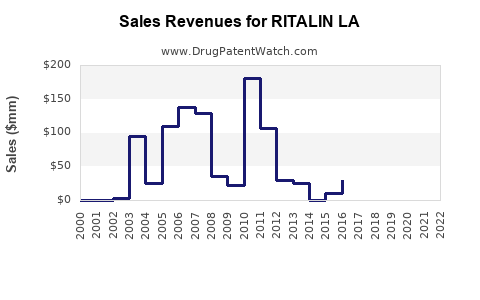
Novartis does not publicly report Ritalin LA revenue as a standalone product in its principal financial disclosures. The brand is therefore best analyzed as a mature established-medicines asset rather than as a separately valued growth franchise.[5]
The financial trajectory has four phases:
Launch and adoption: 2002 to late 2000s
Ritalin LA benefited from expanding ADHD diagnosis, demand for once-daily or extended-release treatment, and the shift away from multiple immediate-release doses. The product generated branded pricing and formulation differentiation during this period.
Patent-transition phase: 2010s
Generic development and patent expiry reduced the product’s ability to sustain premium pricing. Prescription volume became increasingly sensitive to formulary placement and generic availability.
Mature generic market: late 2010s to early 2020s
Net sales likely declined relative to the protected period, although Novartis did not disclose a standalone figure. Revenue was supported by residual brand demand, patients requiring a specific release profile, and temporary supply disruptions affecting generic alternatives.
Current trajectory
The expected long-term direction is low or declining branded revenue, with intermittent volume support from shortages and patient continuity. The commercial value of Ritalin LA is more likely to reside in established manufacturing, distribution, and brand-recognition economics than in patent-based pricing power.
How do ADHD market dynamics affect Ritalin LA revenue?
The ADHD market has expanded through increased diagnosis among children, adolescents, and adults, while stimulant treatment remains the dominant pharmacologic approach in the United States. Epidemiological growth supports category demand, but it does not translate directly into Ritalin LA growth because patients can switch among many stimulant and nonstimulant products.[6]
Key market forces include:
- Increased adult ADHD diagnosis and treatment.
- Greater use of extended-release formulations.
- Generic substitution and formulary controls.
- Persistent shortages of amphetamine and methylphenidate products.
- Telehealth prescribing and changing monitoring practices.
- Physician preference for individualized duration and tolerability.
- Payer pressure on branded stimulant products.
- Regulatory scrutiny of controlled-substance distribution.
Ritalin LA’s addressable market is therefore large, but its defensible share is limited.
What licensing deals affect Ritalin LA?
No major current licensing transaction is required to explain Ritalin LA’s market position. The product originated from Novartis’s branded CNS portfolio and is not known as a recent platform licensing asset. Its economic value is primarily operational and commercial rather than transaction-driven.
A future licensing or divestiture assessment would focus on:
- Rights by geography.
- Manufacturing and supply obligations.
- Controlled-substance permits.
- Generic and authorized-generic rights.
- Trademark ownership.
- Product liability exposure.
- Remaining pediatric or adult market share.
- Historical recall and shortage records.
What is the geographic coverage of Ritalin LA?
Ritalin LA has been marketed in the United States and related methylphenidate extended-release products have been sold in other jurisdictions under different brand names, formulations, or regulatory classifications. Patent and regulatory status must be assessed country by country because approval, reimbursement, controlled-substance rules, and generic substitution differ across markets.
The United States remains the most commercially relevant market because of its large ADHD treatment population, high stimulant utilization, and developed generic substitution system. Europe and other markets generally have more restrictive reimbursement and controlled-substance frameworks, limiting direct extrapolation from U.S. performance.
Key Takeaways
- Ritalin LA is a mature extended-release methylphenidate product approved in the United States in 2002.
- Its original formulation-based patent protection has expired.
- No current patent estate provides a material barrier to generic competition.
- Generic methylphenidate extended-release capsules create high price and volume pressure.
- The brand has no separately disclosed public revenue line.
- Long-term branded revenue is expected to remain low or decline, with temporary support from shortages and patient preference.
- Supply reliability, payer access, and delivery-profile differentiation matter more than patents.
- The principal competitors are Concerta, Adderall XR, Vyvanse, Focalin XR, other methylphenidate products, and nonstimulants.
- Ritalin LA remains commercially relevant as an established product, but it is not a high-growth or patent-protected asset.
FAQs about Ritalin LA patents, revenue, and generic competition
Is Ritalin LA still patent protected?
The principal formulation protection associated with Ritalin LA has expired. The product does not have a current composition-of-matter patent because methylphenidate is an old active ingredient.
Is generic Ritalin LA the same as brand Ritalin LA?
FDA-approved generic methylphenidate extended-release capsules must meet applicable pharmaceutical equivalence and bioequivalence requirements. Patients can still experience differences in release profile, excipients, tolerability, or availability between manufacturers.
Why is Ritalin LA sometimes unavailable even after patent expiry?
Ritalin LA and its generics are Schedule II products. DEA production quotas, manufacturing interruptions, API availability, distribution controls, and pharmacy inventory constraints can produce shortages despite the absence of patent protection.
Does Ritalin LA have biosimilar competition?
No. Ritalin LA is a small-molecule drug, not a biologic. Its competitors are generic drugs approved through the ANDA pathway, not biosimilars approved under the Public Health Service Act.
Is Ritalin LA a valuable licensing or acquisition target?
Its value is more consistent with a mature branded-generic asset than with a protected innovation asset. A transaction would depend on net price, residual prescription volume, supply reliability, manufacturing cost, geographic rights, and portfolio fit rather than patent duration.
References
-
U.S. Food and Drug Administration. (2023). Ritalin LA (methylphenidate hydrochloride) extended-release capsules prescribing information. FDA.
-
U.S. Food and Drug Administration. (2024). Approved drug products with therapeutic equivalence evaluations. FDA Orange Book.
-
U.S. Congress. (1984). Drug Price Competition and Patent Term Restoration Act of 1984, Pub. L. No. 98-417, 98 Stat. 1585.
-
Drug Enforcement Administration. (2024). Controlled substance quotas and regulatory requirements. U.S. Department of Justice.
-
Novartis AG. (2024). Annual report 2023. Novartis.
-
Danielson, M. L., Bitsko, R. H., Ghandour, R. M., Holbrook, J. R., Kogan, M. D., & Blumberg, S. J. (2022). Prevalence of parent-reported ADHD diagnosis and associated treatment among U.S. children and adolescents, 2016-2019. Journal of Clinical Child & Adolescent Psychology, 51(2), 135-152.