Last updated: February 13, 2026
What is RITALIN LA and Its Market Position?
RITALIN LA (methylphenidate extended-release capsules) is a stimulant medication indicated for attention deficit hyperactivity disorder (ADHD) and narcolepsy. It is manufactured by Novartis, now marketed by other firms following patent expirations. RITALIN LA competes primarily with other extended-release stimulants such as Concerta (methylphenidate ER), Vyvanse (lisdexamfetamine), and Adderall XR (amphetamine/dextroamphetamine).
Current Market Size and Demand Drivers
The global ADHD therapeutics market reached approximately $15 billion in 2022, with stimulants accounting for about 75%. The market growth CAGR from 2018 to 2022 stood at 6%. Key demand factors include increased diagnosis rates, expanded regulatory approval for new age groups, and rising awareness.
Market share estimates (2022):
| Drug |
Estimated Market Share |
Notes |
| Concerta |
35% |
Dominates in North America |
| Vyvanse |
25% |
Growing in both US and EU |
| RITALIN LA |
15% |
Niches include pediatric use |
| Adderall XR |
10% |
US-specific dominance |
| Others (generic) |
15% |
Price-sensitive segments |
RITALIN LA accounts for roughly 15% of the stimulant ADHD market globally, with regional variations—up to 20% in certain European markets due to differing prescribing trends.
Patent and Regulatory Landscape
Since patent expiration in 2017, RITALIN LA faces generic competition, leading to significant price erosion in key markets. Novartis’s patent on the extended-release formulation expired in 2017, resulting in increased generic entries.
In the US, the patent for RITALIN LA expired in 2017, leading to a surge in generic formulations, which now account for over 80% of prescriptions. Similar patent expiries occurred in Europe, with generic versions available since 2018.
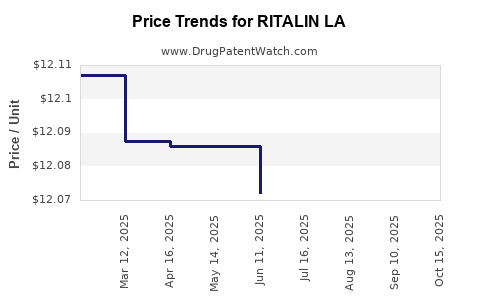
Price Trends and Projections
Historical Price Data
- US retail price (2016): Approximately $375 for a 30-day supply (30 x 20 mg capsules).
- Post-generic entry (2022): Average retail price declined to approximately $150–$200 for the same supply.
- European markets: Similar price declines, with variations based on healthcare systems and reimbursement policies.
Future Price Trends
Forecasts suggest continued price erosion until generic market saturation stabilizes around $100–$150 per 30-day supply by 2025. This depends on regulatory actions, market penetration, and reimbursement structures.
Revenue Implications
Pre-expiry (pre-2017): RITALIN LA generated $1 billion+ annually worldwide for Novartis.
Post-expiry: Combined sales of patent-protected and generic formulations now hover below $250 million annually for branded versions, with the majority being generics.
Market Competition and Growth Opportunities
Emerging trends:
- Increased adoption of long-acting formulations for pediatric and adult populations.
- Growing preference for lower-cost generics drives volume over premium pricing.
- Novel formulations (e.g., transdermal patches, sustained-release systems) compete for market share.
Challenges include declining profitability for branded versions due to price competition and regulatory pressures. Opportunities exist in parallel markets, such as developing countries, where brand loyalty and higher pricing power persist.
Strategic Outlook
For Novartis and brand owners:
- Focus shifts towards expanding indications and formulations.
- Differentiation through improved delivery methods may carve niche markets.
- Licensing and partnerships in emerging markets could sustain revenue streams.
For investors:
- Near-term revenue erosion due to generic competition.
- Long-term potential hinges on emerging formulations and new market penetration.
Key Takeaways
- RITALIN LA's global market share has decreased significantly since patent expiry, with generics dominating.
- Prices have declined sharply, with projected stabilization between $100–$150 per 30-day supply by 2025.
- Market growth is driven by increased diagnosis and prescription volumes, despite pricing pressures.
- Competition from newer drugs like Vyvanse and non-stimulant options impacts market dynamics.
- Future revenue streams depend on innovation, new formulations, and expansion into emerging markets.
FAQs
1. How does RITALIN LA compare to other ADHD medications?
RITALIN LA offers a once-daily extended-release option, with a shorter duration than drugs like Concerta or Vyvanse. It is generally less expensive than some alternatives but faces stiff generic competition.
2. What factors influence the price erosion of RITALIN LA?
Patent expiration, the entry of generic versions, healthcare policy reforms, and reimbursement negotiations primarily drive price declines.
3. Are there upcoming formulations or versions of RITALIN LA?
No major new formulations are currently announced. Development is focused on enhancing delivery systems for existing methylphenidate products.
4. What is the outlook for RITALIN LA in emerging markets?
Growing ADHD awareness and healthcare infrastructure expansion could sustain sales, especially for generics. Pricing strategies remain crucial due to affordability sensitivities.
5. How might regulatory changes affect RITALIN LA's market?
Potential bioequivalence requirements and pricing reforms could further influence market access and profitability. Policymakers increasingly favor cost-effective generics.
Citations:
- Global ADHD Therapeutics Market Report, 2023.
- IMS Health, Prescription Data, 2022.
- EMA and FDA product approval and patent expiration timelines.
- Novartis Annual Reports, 2017–2022.
- Market analysis by IQVIA, 2022.