Last Updated: September 24, 2026

REYVOW Drug Patent Profile


✉ Email this page to a colleague

« Back to Dashboard


When do Reyvow patents expire, and what generic alternatives are available?

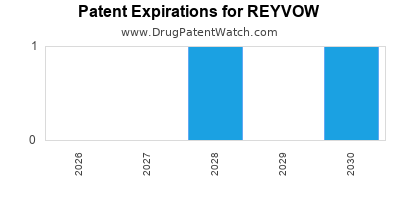
Reyvow is a drug marketed by Eli Lilly And Co and is included in one NDA. There are four patents protecting this drug and one Paragraph IV challenge.

The generic ingredient in REYVOW is lasmiditan succinate. There is one drug master file entry for this compound. One supplier is listed for this compound. Additional details are available on the lasmiditan succinate profile page.

DrugPatentWatch® Generic Entry Outlook for Reyvow

Reyvow was eligible for patent challenges on January 31, 2024.

By analyzing the patents and regulatory protections it appears that the earliest date for generic entry will be July 6, 2040. This may change due to patent challenges or generic licensing.

There have been two patent litigation cases involving the patents protecting this drug, indicating strong interest in generic launch. Recent data indicate that 63% of patent challenges are decided in favor of the generic patent challenger and that 54% of successful patent challengers promptly launch generic drugs.

Indicators of Generic Entry

< Available with Subscription >

  Start Trial

AI Deep Research
Questions you can ask:
  • What is the 5 year forecast for REYVOW?
  • What are the global sales for REYVOW?
  • What is Average Wholesale Price for REYVOW?
DrugPatentWatch® Estimated Loss of Exclusivity (LOE) Date for REYVOW
Generic Entry Date for REYVOW*:
Constraining patent/regulatory exclusivity:
NDA:
Dosage:

TABLET;ORAL

*The generic entry opportunity date is the latter of the last compound-claiming patent and the last regulatory exclusivity protection. Many factors can influence early or later generic entry. This date is provided as a rough estimate of generic entry potential and should not be used as an independent source.

Paragraph IV (Patent) Challenges for REYVOW
Tradename Dosage Ingredient Strength NDA ANDAs Submitted Submissiondate
REYVOW Tablets lasmiditan succinate 50 mg and 100 mg 211280 1 2024-01-31

US Patents and Regulatory Information for REYVOW

REYVOW is protected by four US patents.

Based on analysis by DrugPatentWatch, the earliest date for a generic version of REYVOW is ⤷  Start Trial.

This potential generic entry date is based on patent 12,071,423.

Generics may enter earlier, or later, based on new patent filings, patent extensions, patent invalidation, early generic licensing, generic entry preferences, and other factors.

Applicant Tradename Generic Name Dosage NDA Approval Date TE Type RLD RS Patent No. Patent Expiration Product Substance Delist Req. Exclusivity Expiration
Eli Lilly And Co REYVOW lasmiditan succinate TABLET;ORAL 211280-001 Jan 31, 2020 DISCN Yes No 7,423,050 ⤷  Start Trial Y Y ⤷  Start Trial
Eli Lilly And Co REYVOW lasmiditan succinate TABLET;ORAL 211280-002 Jan 31, 2020 DISCN Yes No 11,053,214 ⤷  Start Trial Y Y ⤷  Start Trial
Eli Lilly And Co REYVOW lasmiditan succinate TABLET;ORAL 211280-001 Jan 31, 2020 DISCN Yes No 12,071,423 ⤷  Start Trial Y ⤷  Start Trial
Eli Lilly And Co REYVOW lasmiditan succinate TABLET;ORAL 211280-002 Jan 31, 2020 DISCN Yes No 12,071,423 ⤷  Start Trial Y ⤷  Start Trial
Eli Lilly And Co REYVOW lasmiditan succinate TABLET;ORAL 211280-001 Jan 31, 2020 DISCN Yes No 12,257,246 ⤷  Start Trial ⤷  Start Trial
Eli Lilly And Co REYVOW lasmiditan succinate TABLET;ORAL 211280-001 Jan 31, 2020 DISCN Yes No 11,053,214 ⤷  Start Trial Y Y ⤷  Start Trial
>Applicant >Tradename >Generic Name >Dosage >NDA >Approval Date >TE >Type >RLD >RS >Patent No. >Patent Expiration >Product >Substance >Delist Req. >Exclusivity Expiration

Expired US Patents for REYVOW

Applicant Tradename Generic Name Dosage NDA Approval Date Patent No. Patent Expiration
Eli Lilly And Co REYVOW lasmiditan succinate TABLET;ORAL 211280-001 Jan 31, 2020 8,748,459 ⤷  Start Trial
Eli Lilly And Co REYVOW lasmiditan succinate TABLET;ORAL 211280-003 Dec 18, 2020 8,748,459 ⤷  Start Trial
Eli Lilly And Co REYVOW lasmiditan succinate TABLET;ORAL 211280-002 Jan 31, 2020 8,748,459 ⤷  Start Trial
>Applicant >Tradename >Generic Name >Dosage >NDA >Approval Date >Patent No. >Patent Expiration

International Patents for REYVOW

When does loss-of-exclusivity occur for REYVOW?

Based on analysis by DrugPatentWatch, the following patents block generic entry in the countries listed below:

Argentina

Patent: 9319
Estimated Expiration: ⤷  Start Trial

Australia

Patent: 20310852
Estimated Expiration: ⤷  Start Trial

Patent: 23201473
Estimated Expiration: ⤷  Start Trial

Brazil

Patent: 2021026219
Estimated Expiration: ⤷  Start Trial

Canada

Patent: 46129
Estimated Expiration: ⤷  Start Trial

Patent: 01026
Estimated Expiration: ⤷  Start Trial

Chile

Patent: 22000018
Estimated Expiration: ⤷  Start Trial

Patent: 23003040
Estimated Expiration: ⤷  Start Trial

China

Patent: 4144408
Estimated Expiration: ⤷  Start Trial

Patent: 0441536
Estimated Expiration: ⤷  Start Trial

Colombia

Patent: 22000062
Estimated Expiration: ⤷  Start Trial

Costa Rica

Patent: 220005
Estimated Expiration: ⤷  Start Trial

Croatia

Patent: 0250049
Estimated Expiration: ⤷  Start Trial

Denmark

Patent: 96713
Estimated Expiration: ⤷  Start Trial

Dominican Republic

Patent: 024000099
Estimated Expiration: ⤷  Start Trial

Ecuador

Patent: 22001538
Estimated Expiration: ⤷  Start Trial

European Patent Office

Patent: 96713
Estimated Expiration: ⤷  Start Trial

Patent: 10784
Estimated Expiration: ⤷  Start Trial

Finland

Patent: 96713
Estimated Expiration: ⤷  Start Trial

Hungary

Patent: 70451
Estimated Expiration: ⤷  Start Trial

Israel

Patent: 9226
Estimated Expiration: ⤷  Start Trial

Patent: 4421
Estimated Expiration: ⤷  Start Trial

Japan

Patent: 01209
Estimated Expiration: ⤷  Start Trial

Patent: 60604
Estimated Expiration: ⤷  Start Trial

Patent: 22540140
Estimated Expiration: ⤷  Start Trial

Patent: 23089110
Estimated Expiration: ⤷  Start Trial

Patent: 25066745
Estimated Expiration: ⤷  Start Trial

Jordan

Patent: 0220002
Estimated Expiration: ⤷  Start Trial

Patent: 0240254
Estimated Expiration: ⤷  Start Trial

Lithuania

Patent: 96713
Estimated Expiration: ⤷  Start Trial

Malaysia

Patent: 1447
Patent: PROCESSES AND INTERMEDIATE FOR THE LARGE-SCALE PREPARATION OF 2,4,6-TRIFLUORO-N-[6-(1-METHYL-PIPERIDINE-4-CARBONYL)-PYRIDIN-2-YL]-BENZAMIDE HEMISUCCINATE, AND PREPARATION OF 2,4,6-TRIFLUORO-N-[6-(1-METHYL-PIPERIDINE-4-CARBONYL)-PYRIDIN-2-YL]-BENZAMIDE ACETATE
Estimated Expiration: ⤷  Start Trial

Mexico

Patent: 22000372
Patent: PROCESOS E INTERMEDIARIO PARA LA PREPARACION A GRAN ESCALA DE HEMISUCCINATO DE 2,4,6-TRIFLUORO-N-[6-(1-METIL-PIPERIDINA-4-CARBON IL)-PIRIDIN-2-IL]-BENZAMIDA Y PREPARACION DE ACETATO DE 2,4,6-TRIFLUORO-N-[6-(1-METIL-PIPERIDINA-4-CARBONIL)-PIRIDIN-2-IL ]-BENZAMIDA.
Estimated Expiration: ⤷  Start Trial

Patent: 23003230
Patent: PROCESOS E INTERMEDIARIO PARA LA PREPARACION A GRAN ESCALA DE HEMISUCCINATO DE 2,4,6-TRIFLUORO-N-[6-(1-METIL-PIPERIDINA-4-CARBON IL)-PIRIDIN-2-IL]-BENZAMIDA Y PREPARACION DE ACETATO DE 2,4,6-TRIFLUORO-N-[6-(1-METIL-PIPERIDINA-4-CARBONIL)-PIRIDIN-2-IL ]-BENZAMIDA.
Estimated Expiration: ⤷  Start Trial

Moldova, Republic of

Patent: 96713
Estimated Expiration: ⤷  Start Trial

Morocco

Patent: 350
Estimated Expiration: ⤷  Start Trial

New Zealand

Patent: 3764
Patent: Processes and intermediate for the large-scale preparation of 2,4,6-trifluoro-n-[6-(1-methyl-piperidine-4-carbonyl)-pyridin-2-yl]-benzamide hemisuccinate, and preparation of 2,4,6-trifluoro-n-[6-(1-methyl-piperidine-4-carbonyl)-pyridin-2-yl]-benzamide acetate
Estimated Expiration: ⤷  Start Trial

Peru

Patent: 220811
Patent: PROCESOS E INTERMEDIARIO PARA LA PREPARACION A GRAN ESCALA DE HEMISUCCINATO DE 2,4,6-TRIFLUORO-N-[6-(1-METIL-PIPERIDINA-4-CARBONIL)-PIRIDIN-2-IL]-BENZAMIDA Y PREPARACION DE ACETATO DE 2,4,6-TRIFLUORO-N-[6-(1-METIL-PIPERIDINA-4-CARBONIL)-PIRIDIN-2-IL]-BENZAMIDA
Estimated Expiration: ⤷  Start Trial

Philippines

Patent: 022550031
Patent: PROCESSES AND INTERMEDIATE FOR THE LARGE-SCALE PREPARATION OF 2,4,6-TRIFLUORO-N-[6-(l-METHYL-PIPERIDIN E-4-CARBONYL)-PYRIDIN-2-YL]-BENZAMIDE HEMISUCCINATE, AND PREPARATION OF 2,4,6-TRIFLUORO-N-[6-(l-METHYL-PIPERIDIN E-4-CARBONYL)-PYRIDIN-2-YL]-BENZAMIDE ACETATE.
Estimated Expiration: ⤷  Start Trial

Poland

Patent: 96713
Estimated Expiration: ⤷  Start Trial

Portugal

Patent: 96713
Estimated Expiration: ⤷  Start Trial

Saudi Arabia

Patent: 2431304
Patent: عمليات تحضير اللاسميديتان وملح الأسيتات منه (PROCESSES FOR PREPARATION OF LASMIDITAN AND ACETATE SALT THEREOF)
Estimated Expiration: ⤷  Start Trial

Serbia

Patent: 403
Patent: PROCESI I INTERMEDIJER ZA PRIPREMU 2,4,6-TRIFLUORO-N-[6-(1-METIL-PIPERIDIN-4-KARBONIL)-PIRIDIN-2-IL]-BENZAMID HEMISUKCINATA U VELIKIM RAZMERAMA (PROCESSES AND INTERMEDIATE FOR THE LARGE-SCALE PREPARATION OF 2,4,6-TRIFLUORO-N-[6-(1-METHYL-PIPERIDINE-4-CARBONYL)-PYRIDIN-2-YL]-BENZAMIDE HEMISUCCINATE)
Estimated Expiration: ⤷  Start Trial

Slovenia

Patent: 96713
Estimated Expiration: ⤷  Start Trial

South Africa

Patent: 2110805
Patent: PROCESSES AND INTERMEDIATE FOR THE LARGE-SCALE PREPARATION OF 2,4,6-TRIFLUORO-N-[6-(1-METHYL-PIPERIDINE-4-CARBONYL)-PYRIDIN-2-YL]-BENZAMIDE HEMISUCCINATE, AND PREPARATION OF 2,4,6-TRIFLUORO-N-[6-(1-METHYL-PIPERIDINE-4-CARBONYL)-PYRIDIN-2-YL]-BENZAMIDE ACETATE
Estimated Expiration: ⤷  Start Trial

Patent: 2303699
Patent: PROCESSES AND INTERMEDIATE FOR THE LARGE-SCALE PREPARATION OF 2,4,6-TRIFLUORO-N-[6-(1-METHYL-PIPERIDINE-4-CARBONYL)-PYRIDIN-2-YL]-BENZAMIDE HEMISUCCINATE, AND PREPARATION OF 2,4,6-TRIFLUORO-N-[6-(1-METHYL-PIPERIDINE-4-CARBONYL)-PYRIDIN-2-YL]-BENZAMIDE ACETATE
Estimated Expiration: ⤷  Start Trial

South Korea

Patent: 220019772
Estimated Expiration: ⤷  Start Trial

Patent: 240027877
Estimated Expiration: ⤷  Start Trial

Patent: 240162595
Estimated Expiration: ⤷  Start Trial

Spain

Patent: 06888
Estimated Expiration: ⤷  Start Trial

Taiwan

Patent: 2116749
Patent: Processes and intermediate for the large-scale preparation of 2,4,6-trifluoro-N-[6-(1-methyl-piperidine-4-carbonyl)-pyridin-2-yl]-benzamide hemisuccinate, and preparation of 2,4,6-trifluoro-N-[6-(1-methyl-piperidine-4-carbonyl)-pyridin-2-yl]-benzamide
Estimated Expiration: ⤷  Start Trial

Patent: 2225148
Patent: Processes and intermediate for the large-scale preparation of 2,4,6-trifluoro-N-[6-(1-methyl-piperidine-4-carbonyl)-pyridin-2-yl]-benzamide hemisuccinate, and preparation of 2,4,6-trifluoro-N-[6-(1-methyl-piperidine-4-carbonyl)-pyridin-2-yl]-benzamide acetate
Estimated Expiration: ⤷  Start Trial

Patent: 76175
Estimated Expiration: ⤷  Start Trial

Patent: 29107
Estimated Expiration: ⤷  Start Trial

Generics may enter earlier, or later, based on new patent filings, patent extensions, patent invalidation, early generic licensing, generic entry preferences, and other factors.

See the table below for additional patents covering REYVOW around the world.

Country Patent Number Title Estimated Expiration
Australia 2017373784 ⤷  Start Trial
Brazil 112019010934 ⤷  Start Trial
Canada 3043772 ⤷  Start Trial
Chile 2019001426 ⤷  Start Trial
China 110291079 ⤷  Start Trial
China 115385893 ⤷  Start Trial
>Country >Patent Number >Title >Estimated Expiration

Supplementary Protection Certificates for REYVOW

Patent Number Supplementary Protection Certificate SPC Country SPC Expiration SPC Description
2413933 PA2023502 Lithuania ⤷  Start Trial PRODUCT NAME: LASMIDITANAS ARBA JO FARMACINIU POZIURIU PRIIMTINA DRUSKA; REGISTRATION NO/DATE: EU/1/21/1587 20220817
2413933 301214 Netherlands ⤷  Start Trial PRODUCT NAME: LASMIDITAN EN FARMACEUTISCH AANVAARDBARE ZOUTEN DAARVAN; REGISTRATION NO/DATE: EU/1/21/1587 20220819
2413933 CA 2023 00001 Denmark ⤷  Start Trial PRODUCT NAME: LASMIDITAN ELLER ET FARMACEUTISK ACCEPTABELT SALT DERAF; REG. NO/DATE: EU/1/21/1587 20220819
2413933 2023C/503 Belgium ⤷  Start Trial PRODUCT NAME: LASMIDITAN; AUTHORISATION NUMBER AND DATE: EU/1/21/1587 20220819
2413933 LUC00295 Luxembourg ⤷  Start Trial PRODUCT NAME: LASMIDITAN ET SES DERIVES PHARMACEUTIQUEMENT ACCEPTABLES (RAYVOW); AUTHORISATION NUMBER AND DATE: EU/1/21/1587 20220819
2413933 1/2023 Austria ⤷  Start Trial PRODUCT NAME: LASMIDITAN; REGISTRATION NO/DATE: EU/1/21/1587 (MITTEILUNG) 20220819
>Patent Number >Supplementary Protection Certificate >SPC Country >SPC Expiration >SPC Description

REYVOW (Lasmiditan) Market Dynamics and Financial Trajectory

Last updated: August 2, 2026

REYVOW, Eli Lilly’s lasmiditan product for acute migraine treatment, achieved FDA approval but did not develop into a major commercial migraine franchise. Its market position was constrained by payer competition, the eight-hour driving restriction, established triptan use, and rapid adoption of newer oral CGRP antagonists. Lilly later reduced U.S. commercial activity, limiting the product’s long-term revenue potential despite continuing FDA approval.

What is REYVOW and how does it work?

REYVOW is the brand name for lasmiditan, a selective 5-HT1F serotonin receptor agonist approved by the U.S. Food and Drug Administration in October 2019 for the acute treatment of migraine with or without aura in adults. It is not indicated for preventive migraine treatment.[1]

Unlike triptans, lasmiditan does not cause vasoconstriction through 5-HT1B activity. That pharmacology was intended to address patients with cardiovascular contraindications to triptan therapy. The product is available in 50-milligram and 100-milligram tablets.[1]

The principal commercial limitation is the product label’s warning that patients must not drive or operate machinery for at least eight hours after taking REYVOW. The restriction applies even when the patient feels capable of driving and can materially limit use by employed patients or those without alternative transportation.[1]

REYVOW product profile

Attribute REYVOW
Active ingredient Lasmiditan
Manufacturer Eli Lilly and Company
FDA approval October 11, 2019
Indication Acute treatment of migraine with or without aura
Dosage forms 50 mg and 100 mg tablets
Preventive indication None
Drug class Selective 5-HT1F receptor agonist
Controlled-substance status DEA removed lasmiditan from Schedule V in 2022
Key label restriction No driving or machinery operation for at least eight hours

When did REYVOW lose commercial momentum?

REYVOW’s commercial momentum weakened during the first years after launch. The product entered a crowded migraine market with three major barriers:

  1. Triptans were inexpensive, familiar and widely available as generics.
  2. Ubrelvy and Nurtec ODT offered non-vasoconstrictive CGRP-based alternatives without the same eight-hour driving warning.
  3. Payers had strong incentives to require generic triptan use before covering newer branded products.

The product’s clinical differentiation was strongest in patients who could not use triptans because of cardiovascular risk. That population was commercially narrower than the broader acute-migraine market targeted by CGRP antagonists.

Lilly’s 2020 launch also coincided with pandemic-related reductions in physician visits, elective care and drug sampling. Those factors affected new-patient initiation across specialty pharmaceuticals, including migraine therapies.

What were REYVOW’s reported sales and financial trajectory?

Lilly did not establish REYVOW as a separately disclosed growth product comparable with Emgality, Trulicity, Mounjaro or Verzenio. Public financial reporting provided limited product-level visibility, and later filings treated the product as immaterial or did not report a standalone figure.

Available Lilly filings indicate that REYVOW remained a small-revenue product relative to the company’s commercial portfolio. Sales did not approach the scale required to offset the cost of a large national sales and marketing infrastructure.

Commercial and financial timeline

Period Event Financial implication
2017 Lilly acquired CoLucid Pharmaceuticals for approximately $960 million, obtaining lasmiditan High upfront strategic valuation based on clinical and patent potential
2019 FDA approved REYVOW Established regulatory access but not commercial success
2020 U.S. launch Entry occurred during pandemic-related disruption
2021 Continued market development Uptake remained limited relative to competing migraine products
2022 DEA removed lasmiditan from Schedule V Reduced controlled-substance friction but did not eliminate driving restrictions
2023 Lilly reduced or ended active U.S. commercialization activities Lower future revenue visibility and limited investment rationale
2024 onward FDA approval remained in place, but standalone sales disclosure was limited Product became a low-priority commercial asset

Lilly’s acquisition of CoLucid represented a large strategic commitment. The transaction included approximately $960 million in cash consideration and gave Lilly control of lasmiditan during late-stage development.[2] The economics were based on the possibility that a non-vasoconstrictive acute migraine therapy would capture patients who were unsuitable for triptans.

The commercial outcome was weaker. REYVOW had clinical utility, but its market did not support the same revenue trajectory as Lilly’s successful migraine-prevention product Emgality. The product’s restricted use after dosing reduced repeat use and weakened its position in employer-sponsored insurance markets.

How does REYVOW compare with Ubrelvy and Nurtec ODT?

REYVOW competes primarily with triptans, Ubrelvy and Nurtec ODT. Its most important competitive disadvantage is administration-related impairment rather than lack of efficacy.

Product Active ingredient Mechanism Acute use Preventive use Main commercial distinction
REYVOW Lasmiditan 5-HT1F agonist Yes No Non-vasoconstrictive, but eight-hour driving restriction
Ubrelvy Ubrogepant CGRP receptor antagonist Yes No No driving restriction comparable to REYVOW label
Nurtec ODT Rimegepant CGRP receptor antagonist Yes Yes Acute and preventive positioning
Imitrex and other triptans Various triptan ingredients 5-HT1B/1D agonists Yes No Low-cost generic availability
Qulipta Atogepant CGRP receptor antagonist No Yes Preventive treatment

Ubrelvy and Nurtec ODT benefited from the broader commercial attractiveness of CGRP antagonism. They could be positioned for patients who did not respond to triptans, could not tolerate them or required a non-vasoconstrictive option without an eight-hour prohibition on driving.

Nurtec ODT also had a preventive-treatment indication, allowing manufacturers and payers to view it as part of a broader migraine-management strategy. REYVOW remained limited to acute treatment.

What is REYVOW’s FDA regulatory status?

REYVOW remains an FDA-approved acute migraine therapy unless the FDA takes a separate withdrawal action. Lilly’s commercial decisions do not automatically revoke the approval.

The FDA label includes several clinically important restrictions:

  • It is intended for acute treatment, not prevention.
  • The maximum recommended frequency is one dose in 24 hours.
  • Patients should not drive or operate machinery for at least eight hours.
  • Common adverse reactions include dizziness, somnolence, numbness and fatigue.
  • The drug can cause central nervous system depression and serotonin-related adverse effects.[1]

The removal of lasmiditan from Schedule V in 2022 eliminated a regulatory burden associated with prescribing and dispensing. DEA stated that the decision followed review of the drug’s abuse potential and medical use.[3] The action improved administrative access but did not alter the FDA driving warning.

What patent and exclusivity protections cover REYVOW?

REYVOW’s protection has depended on several potential layers:

  • Active-ingredient and chemical composition patents covering lasmiditan.
  • Pharmaceutical composition patents covering tablets and dosage forms.
  • Method-of-use patents covering acute migraine treatment.
  • Regulatory exclusivity associated with the original FDA approval.
  • Patent-term adjustment or extension, where available.

FDA Orange Book listings determine the patents that a generic applicant must address in an ANDA. The relevant legal risk is not the number of patents alone. The commercial question is whether a generic applicant can certify that the listed patents are invalid, unenforceable or not infringed, or instead must wait until the relevant patent barriers expire.[4]

Formulation and method-of-use risk

The product’s relatively simple oral-tablet presentation reduces manufacturing complexity compared with injectable or device-based products. That makes formulation patents less likely to create a durable manufacturing barrier unless they cover a technically necessary feature.

Method-of-use patents could provide more relevant protection if they cover specific lasmiditan dosing regimens, patient populations or treatment protocols. Their value depends on whether the FDA-approved labeling and generic use instructions would induce infringement.

Generic entrants could also seek a Paragraph IV certification against Orange Book-listed patents. A Paragraph IV filing would permit the patent holder to bring litigation within the statutory period, potentially triggering a 30-month stay of ANDA approval under the Hatch-Waxman framework.[5]

No major public commercial litigation involving REYVOW became a defining feature of the product’s market trajectory. The absence of a high-profile settlement does not establish that generic entry is imminent. It indicates that the product’s limited commercial scale may reduce the incentive for aggressive patent litigation by both the innovator and generic manufacturers.

Which companies are challenging REYVOW commercially?

The strongest competitive pressure has come from branded alternatives rather than direct generic lasmiditan competition.

CGRP antagonist manufacturers

AbbVie markets Ubrelvy through its Allergan migraine portfolio. Pfizer markets Nurtec ODT following its acquisition of Biohaven’s commercial migraine business. These products have benefited from strong physician awareness of the CGRP mechanism and broad positioning across acute and preventive care.[6][7]

Generic triptan manufacturers

Generic manufacturers compete on price. Sumatriptan, rizatriptan, eletriptan and other triptans are available at a fraction of the cost of branded REYVOW. For many payers, a generic triptan step-edit requirement makes REYVOW a later-line treatment.

Emerging generic risk

The commercial risk from generic lasmiditan is asymmetric. A generic could erode the remaining REYVOW business quickly, but the addressable revenue available to entrants may be modest. That limits the incentive for some manufacturers to invest in Paragraph IV litigation or large-scale launch preparation.

What licensing deals affect REYVOW?

The principal transaction was Lilly’s 2017 acquisition of CoLucid Pharmaceuticals. CoLucid developed lasmiditan and had advanced the product into late-stage clinical development. Lilly acquired the company for approximately $46.50 per share in cash, representing an equity value of roughly $960 million.[2]

The transaction gave Lilly:

  • Global control of lasmiditan development and commercialization.
  • Access to a non-vasoconstrictive acute migraine mechanism.
  • A potential product for patients unable to use triptans.
  • Patent and regulatory rights associated with the program.

No later licensing transaction became a major driver of REYVOW’s commercial trajectory. Lilly’s subsequent reduction in commercialization suggests that the company prioritized other migraine assets with stronger growth prospects.

How strong is the REYVOW patent estate?

REYVOW’s patent estate appears commercially moderate rather than exceptionally strong. The active ingredient and approved indication had meaningful protection, but the product lacked the manufacturing complexity and platform breadth associated with biologics, long-acting injectables or device-linked therapies.

Patent strength is limited by four factors:

  1. The dosage form is a conventional oral tablet.
  2. Generic manufacturers can potentially develop bioequivalent products without reproducing complex delivery technology.
  3. Method-of-use claims may be narrower than composition claims.
  4. The product’s modest revenue reduces the economic value of prolonged litigation.

The key business risk is therefore not only patent expiration. It is the possibility that branded competitors capture the majority of commercially valuable patients before patent expiry.

What generic launch scenarios exist for REYVOW?

Three scenarios are commercially plausible under the Hatch-Waxman framework:

Scenario Trigger Market effect
At-risk launch Generic applicant prevails in litigation or launches before final resolution Rapid price erosion and potential damages exposure
First generic after patent resolution Patent expiry, settlement date or court decision permits approval Substantial price decline, with initial share concentrated among first entrants
Delayed generic entry Remaining patents or regulatory barriers block approval REYVOW retains nominal exclusivity but may still have limited sales

A generic launch would likely produce steep price erosion because REYVOW has no preventive indication and limited delivery differentiation. Payers could substitute generic lasmiditan where the eight-hour driving warning is clinically acceptable, but CGRP antagonists would remain strong alternatives.

What is the revenue exposure from REYVOW?

REYVOW represents limited direct revenue exposure for Lilly compared with the company’s large diabetes, obesity, oncology and immunology franchises. The greater financial significance is the return on the CoLucid acquisition investment.

The acquisition thesis assumed that lasmiditan could become a meaningful branded migraine therapy. Its subsequent trajectory reduced the likelihood of recovering that strategic value through product sales alone. The opportunity cost was also significant because Lilly’s migraine commercial infrastructure could be directed toward Emgality and other higher-growth assets.

For investors, REYVOW is therefore best analyzed as:

  • A small legacy product.
  • A limited contributor to Lilly revenue.
  • A case study in the commercial cost of an unfavorable label restriction.
  • A product with declining strategic priority.
  • A potential low-value generic opportunity rather than a major branded growth asset.

Key Takeaways

  • REYVOW is FDA-approved lasmiditan for acute migraine treatment in adults.
  • Its non-vasoconstrictive mechanism addresses patients who cannot use triptans.
  • The eight-hour no-driving warning is the product’s largest commercial disadvantage.
  • Ubrelvy and Nurtec ODT offered stronger commercial positioning in the non-triptan migraine segment.
  • DEA removal of Schedule V status reduced prescribing friction but did not remove the driving restriction.
  • Lilly’s acquisition of CoLucid cost approximately $960 million and produced a product with limited commercial scale.
  • Lilly reduced U.S. commercialization activity, and later standalone revenue visibility became limited.
  • Generic risk depends on Orange Book patents, Paragraph IV activity and the remaining economic value of the product.
  • REYVOW’s patent estate is less commercially defensible than complex biologic or device-based franchises.
  • The product’s primary financial importance is the underperformance of the original acquisition thesis, not current revenue exposure.

FAQs About REYVOW Market Dynamics

Is REYVOW still being marketed in the United States?

Lilly reduced or ended active U.S. commercialization activities after the product failed to achieve major market scale. FDA approval and commercial promotion are separate matters.

Can patients drive after taking REYVOW?

No. The FDA label requires patients to avoid driving or operating machinery for at least eight hours after taking lasmiditan.[1]

Is REYVOW a CGRP inhibitor?

No. REYVOW is a selective 5-HT1F receptor agonist. Ubrelvy and Nurtec ODT are CGRP-pathway therapies.

Does REYVOW treat migraine prevention?

No. REYVOW is approved only for acute treatment of migraine with or without aura in adults.

Why did Lilly’s REYVOW acquisition underperform?

The product faced a narrow target population, strong generic triptan competition, payer restrictions, the eight-hour driving warning and rapid adoption of CGRP antagonists with broader commercial positioning.

References

  1. U.S. Food and Drug Administration. (2024). REYVOW (lasmiditan) prescribing information.
  2. Eli Lilly and Company. (2017, January 18). Lilly to acquire CoLucid Pharmaceuticals, adding late-stage migraine medicine lasmiditan.
  3. Drug Enforcement Administration. (2022). Schedules of controlled substances: Placement of lasmiditan in schedule V; removal of certain restrictions.
  4. U.S. Food and Drug Administration. (2024). Approved drug products with therapeutic equivalence evaluations: Orange Book.
  5. U.S. Congress. (1984). Drug Price Competition and Patent Term Restoration Act of 1984, 21 U.S.C. §355(j).
  6. AbbVie Inc. (2024). Annual report and Ubrelvy product information.
  7. Pfizer Inc. (2024). Annual report and Nurtec ODT product information.

More… ↓

⤷  Start Trial

DrugChatter Q&A for REYVOW

Make Better Decisions: Try a trial or see plans & pricing

Drugs may be covered by multiple patents or regulatory protections. All trademarks and applicant names are the property of their respective owners or licensors. Although great care is taken in the proper and correct provision of this service, thinkBiotech LLC does not accept any responsibility for possible consequences of errors or omissions in the provided data. The data presented herein is for information purposes only. There is no warranty that the data contained herein is error free. We do not provide individual investment advice. This service is not registered with any financial regulatory agency. The information we publish is educational only and based on our opinions plus our models. By using DrugPatentWatch you acknowledge that we do not provide personalized recommendations or advice. thinkBiotech performs no independent verification of facts as provided by public sources nor are attempts made to provide legal or investing advice. Any reliance on data provided herein is done solely at the discretion of the user. Users of this service are advised to seek professional advice and independent confirmation before considering acting on any of the provided information. thinkBiotech LLC reserves the right to amend, extend or withdraw any part or all of the offered service without notice.