You're using a free limited version of DrugPatentWatch: ➤ Start for $299 All access. No Commitment.

Last Updated: December 14, 2025

RAVICTI Drug Patent Profile


✉ Email this page to a colleague

« Back to Dashboard


Which patents cover Ravicti, and when can generic versions of Ravicti launch?

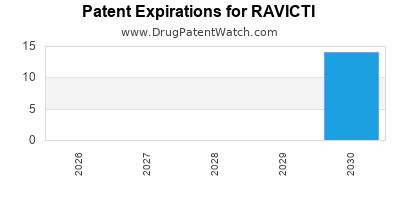
Ravicti is a drug marketed by Horizon Therap Us and is included in one NDA. There are fifteen patents protecting this drug and one Paragraph IV challenge.

This drug has one hundred and fifteen patent family members in thirty countries.

The generic ingredient in RAVICTI is glycerol phenylbutyrate. There are fifty-one drug master file entries for this compound. Three suppliers are listed for this compound. Additional details are available on the glycerol phenylbutyrate profile page.

AI Deep Research
Questions you can ask:
  • What is the 5 year forecast for RAVICTI?
  • What are the global sales for RAVICTI?
  • What is Average Wholesale Price for RAVICTI?
Drug patent expirations by year for RAVICTI
Drug Prices for RAVICTI

See drug prices for RAVICTI

Recent Clinical Trials for RAVICTI

Identify potential brand extensions & 505(b)(2) entrants

SponsorPhase
Assistance Publique - Hpitaux de ParisPHASE2
Weizmann Institute of SciencePhase 2/Phase 3
Kaplan Medical CenterPhase 2/Phase 3

See all RAVICTI clinical trials

Pharmacology for RAVICTI
Paragraph IV (Patent) Challenges for RAVICTI
Tradename Dosage Ingredient Strength NDA ANDAs Submitted Submissiondate
RAVICTI Oral Liquid glycerol phenylbutyrate 1.1 g/mL 203284 1 2013-11-19

US Patents and Regulatory Information for RAVICTI

RAVICTI is protected by fifteen US patents.

Applicant Tradename Generic Name Dosage NDA Approval Date TE Type RLD RS Patent No. Patent Expiration Product Substance Delist Req. Exclusivity Expiration
Horizon Therap Us RAVICTI glycerol phenylbutyrate LIQUID;ORAL 203284-001 Feb 1, 2013 AA RX Yes Yes 9,962,359 ⤷  Get Started Free ⤷  Get Started Free
Horizon Therap Us RAVICTI glycerol phenylbutyrate LIQUID;ORAL 203284-001 Feb 1, 2013 AA RX Yes Yes 8,642,012 ⤷  Get Started Free ⤷  Get Started Free
Horizon Therap Us RAVICTI glycerol phenylbutyrate LIQUID;ORAL 203284-001 Feb 1, 2013 AA RX Yes Yes 10,183,002 ⤷  Get Started Free ⤷  Get Started Free
Horizon Therap Us RAVICTI glycerol phenylbutyrate LIQUID;ORAL 203284-001 Feb 1, 2013 AA RX Yes Yes 10,183,005 ⤷  Get Started Free ⤷  Get Started Free
Horizon Therap Us RAVICTI glycerol phenylbutyrate LIQUID;ORAL 203284-001 Feb 1, 2013 AA RX Yes Yes 10,045,959 ⤷  Get Started Free ⤷  Get Started Free
Horizon Therap Us RAVICTI glycerol phenylbutyrate LIQUID;ORAL 203284-001 Feb 1, 2013 AA RX Yes Yes 10,045,958 ⤷  Get Started Free ⤷  Get Started Free
>Applicant >Tradename >Generic Name >Dosage >NDA >Approval Date >TE >Type >RLD >RS >Patent No. >Patent Expiration >Product >Substance >Delist Req. >Exclusivity Expiration

EU/EMA Drug Approvals for RAVICTI

Company Drugname Inn Product Number / Indication Status Generic Biosimilar Orphan Marketing Authorisation Marketing Refusal
Immedica Pharma AB Ravicti glycerol phenylbutyrate EMEA/H/C/003822Ravicti is indicated for use as adjunctive therapy for chronic management of patients with urea cycle disorders (UCDs) including deficiencies of carbamoyl phosphate-synthase-I (CPS), ornithine carbamoyltransferase (OTC), argininosuccinate synthetase (ASS), argininosuccinate lyase (ASL), arginase I (ARG) and ornithine translocase deficiency hyperornithinaemia-hyperammonaemia homocitrullinuria syndrome (HHH) who cannot be managed by dietary protein restriction and/or amino acid supplementation alone.Ravicti must be used with dietary protein restriction and, in some cases, dietary supplements (e.g., essential amino acids, arginine, citrulline, protein-free calorie supplements). Authorised no no yes 2015-11-26
>Company >Drugname >Inn >Product Number / Indication >Status >Generic >Biosimilar >Orphan >Marketing Authorisation >Marketing Refusal

International Patents for RAVICTI

See the table below for patents covering RAVICTI around the world.

Country Patent Number Title Estimated Expiration
Poland 2330892 ⤷  Get Started Free
United Kingdom 0915545 ⤷  Get Started Free
Australia 2018200163 Methods of therapeutic monitoring of phenylacetic acid prodrugs ⤷  Get Started Free
European Patent Office 2760479 AGENT D'ÉLIMINATION D'AZOTE POUR L'UTILISATION DANS UN PROCÉDÉ DE THÉRAPIE D'UN SYNDROME DE RÉTENTION D'AZOTE (NITROGEN SCAVENGING DRUG FOR USE IN A METHOD OF TREATING A NITROGEN RETENTION DISORDER) ⤷  Get Started Free
Mexico 2014012694 METODOS DE MONITOREO TERAPEUTICO DE PROFARMACOS DE ACIDO FENILACETICO. (METHODS OF THERAPEUTIC MONITORING OF PHENYLACETIC ACID PRODRUGS.) ⤷  Get Started Free
Croatia P20171063 ⤷  Get Started Free
>Country >Patent Number >Title >Estimated Expiration

Supplementary Protection Certificates for RAVICTI

Patent Number Supplementary Protection Certificate SPC Country SPC Expiration SPC Description
2330892 2016023 Norway ⤷  Get Started Free PRODUCT NAME: GLYCEROLFENYLBUTYRAT; REG. NO/DATE: EU/1/15/1062 20151210
2330892 SPC/GB17/001 United Kingdom ⤷  Get Started Free PRODUCT NAME: GLYCEROL PHENYLBUTYRATE; REGISTERED: UK EU/1/15/1062 20151201; UK PLGB53487/0001 20151201
2330892 635 Finland ⤷  Get Started Free
2330892 PA2016041,C2330892 Lithuania ⤷  Get Started Free PRODUCT NAME: GLICEROLIO FENILBUTIRATAS; REGISTRATION NO/DATE: EU/1/15/1062 20151127
2330892 300854 Netherlands ⤷  Get Started Free DETAILS ASSIGNMENT: CHANGE OF OWNER(S), ASSIGNMENT
2330892 122016000107 Germany ⤷  Get Started Free PRODUCT NAME: GLYCEROLPHENYLBUTYRAT; REGISTRATION NO/DATE: EU/1/15/1062 20151127
>Patent Number >Supplementary Protection Certificate >SPC Country >SPC Expiration >SPC Description

Market Dynamics and Financial Trajectory for RAVICTI (Glycerol Phenylbutyrate)

Last updated: July 27, 2025

Introduction

RAVICTI (glycerol phenylbutyrate) is a pharmaceutical sanctioned for the management of adult and pediatric patients with urea cycle disorder (UCD), a rare genetic metabolic disease characterized by inability to eliminate ammonia efficiently. Since its FDA approval in 2013, RAVICTI has established itself as a vital therapeutic, marking significant strides in the domain of nitrogen metabolism. This analysis explores its market dynamics, competitive landscape, regulatory influence, and financial trajectory, providing stakeholders with comprehensive insights to gauge future opportunities and risks.

Market Overview and Rationale

Therapeutic Need and Market Penetration

Urea cycle disorder affects approximately 1 in 35,000 live births globally, with a higher prevalence in North America and Europe[1]. The limited therapeutic options before RAVICTI included sodium phenylbutyrate and other ammonia scavengers, often associated with adverse effects and compliance challenges. RAVICTI's favorable pharmacokinetics, oral formulation, and improved tolerability have driven its clinical adoption, particularly among pediatric populations.

Market Size and Growth Potential

The initial U.S. prevalence of UCD positions the market at a niche segment, yet the expanding diagnostic awareness and neonatal screening initiatives are expected to increase diagnosed cases. The global UCD market, including therapy sales, is projected to grow from approximately $50 million in 2022 to over $100 million by 2030, reflecting a compound annual growth rate (CAGR) of around 8%[2].

Furthermore, FDA approvals for RAVICTI extend into select off-label uses and combination therapies, potentially expanding revenue streams. The growing emphasis on personalized medicine in rare diseases is underpinning the lifecycle extension of drugs like RAVICTI.

Competitive Landscape

Key Competitors

RAVICTI's primary competitors include:

  • Sodium phenylbutyrate (generic formulations)

  • Buphenyl (phenylbutyrate capsules), a branded alternative: although less used due to tolerability issues, it remains a competitor in cost-sensitive markets.

  • Emerging therapies, such as Amino acid-based gene therapy approaches, are under clinical development but face hurdles related to cost, approval timelines, and safety profiles[3].

Market Differentiation

RAVICTI distinguishes itself through:

  • Enhanced tolerability and compliance: Oral, liquid formulation enhances ease of administration, especially in pediatric patients.
  • Extended dosing intervals: Increased patient adherence.
  • Regulatory endorsements: FDA approval and orphan drug designation secure market exclusivity until 2030, providing a judicial monopoly.

Pricing and Reimbursement

The U.S. wholesale acquisition cost (WAC) for RAVICTI approximates $300,000 annually per patient, reflecting pricing strategies aligned with scarce disease treatments. Reimbursement agencies, including Medicare and Medicaid, typically cover such innovative therapies, although patient access may vary due to formulary restrictions and cost-sharing structures.

Regulatory and Patent Landscape

Regulatory Milestones

RAVICTI benefits from orphan drug status, granting seven-year exclusivity in the U.S. upon approval, alongside potential exclusivity extensions for pediatric studies[4].

Patent Position

Patents broadly cover the compound formulation and manufacturing processes, with expiration dates slated post-2029. Patent expirations could usher in generic competition, potentially impacting revenue trajectories.

Financial Trajectory Analysis

Historical Performance

Takeda Pharmaceuticals and its predecessor companies have seen RAVICTI generate peak annual sales exceeding $150 million in North America by 2018[5]. However, sales have plateaued post-2018 due to market saturation, limited awareness, and competition from off-patent alternatives.

Revenue Drivers

Key factors influencing RAVICTI's financial performance include:

  • Patient Population Stability: With approximately 1,200 diagnosed UCD patients in the U.S., growth hinges on increased diagnosis rates and treatment initiation.
  • Market Penetration: Expanding into international markets, particularly Europe and Asia, where UCD prevalence is similar but therapeutic awareness is lower, presents significant scope.
  • Pricing Strategy and Reimbursement: Maintaining premium pricing amidst patent expiry risks necessitates efficiency and value demonstration.

Forecasting Future Revenue

Considering the patent cliffs and increasing diagnosis rates, revenue forecasts show a potential decline aligned with generic entry starting around 2030 unless robust market expansion occurs. For example, a conservative estimate suggests:

  • A CAGR of 3-5% in North America from 2023-2029, driven by increased awareness and enhanced treatment access[6]
  • Post-expiry, revenues may decline by 70-80% unless replaced or complemented by next-generation therapies.

Impact of Regulatory Changes and Pipeline Developments

The ongoing approvals of gene therapies and alternative ammonia scavengers could impact future sales. However, given the rarity and complexity of UCD, RAVICTI's niche positioning may sustain a specialized customer base.

Market Dynamics Outlook

Emerging Opportunities

  • Gene Therapy Advancements: As gene editing techniques mature, curative options could diminish the long-term demand for enzyme replacement therapies like RAVICTI.
  • Extending Indications: Beyond UCD, exploratory uses in related metabolic disorders could open new revenue channels.
  • International Expansion: Growing healthcare infrastructure in emerging markets offers avenues for market share growth, contingent on regulatory approvals and pricing negotiations.

Challenges and Risks

  • Patent Cliff: Expiry of exclusivity in the late 2020s risks rapid erosion of sales.
  • Pricing Pressures: Payers and policymakers increasingly scrutinize high-cost orphan drugs, necessitating demonstrable value.
  • Competition: Development of innovative therapies and generics could undermine RAVICTI’s market share.
  • Clinical Adoption: Variability in diagnosis and treatment protocols across regions complicates market expansion.

Conclusion

RAVICTI's journey illustrates a typical trajectory of niche orphan drugs: robust initial growth driven by therapeutic innovation, plateauing due to patent expiration, and potential resurgence via market expansion and indication broadening. Its financial future depends on proactive market strategies, ongoing clinical developments, and navigating patent landscapes amidst evolving regulatory climates.


Key Takeaways

  • RAVICTI remains a critical therapy for UCD, with stable but limited current market size.
  • Patent expirations post-2029 pose significant revenue risks, emphasizing the need for pipeline development and international expansion.
  • Competitive pressures from generics and emerging therapies necessitate strategic pricing and value demonstration.
  • Market growth hinges on increased diagnosis rates, especially through neonatal screening, and entry into emerging markets.
  • Stakeholders should monitor regulatory shifts and pipeline innovations influencing RAVICTI's lifecycle and positioning.

FAQs

1. When will RAVICTI face generic competition?
Patent exclusivity for RAVICTI is expected to expire around 2030, after which generic formulations could enter the market, likely reducing prices and sales.

2. How does RAVICTI compare to other ammonia scavengers?
RAVICTI offers improved tolerability, oral liquid formulation, and convenience over older therapies like sodium phenylbutyrate, resulting in better compliance, especially in pediatric populations.

3. Are there any ongoing clinical trials for RAVICTI?
Primarily, no new trials are underway; focus shifts toward expanding indications and optimizing existing therapies rather than RAVICTI development.

4. What are the growth opportunities beyond North America?
International markets, especially in Europe and Asia, present opportunities driven by increasing diagnosis and healthcare infrastructure, contingent on regulatory approvals and reimbursement landscapes.

5. How might upcoming gene therapies influence RAVICTI’s market?
While gene therapies could potentially provide curative solutions, their high costs and long development timelines mean RAVICTI will likely remain relevant for the foreseeable future, particularly in cases where gene therapy is not accessible or suitable.


References

[1] National Organization for Rare Disorders. Urea Cycle Disorders. 2021.
[2] Market Research Future. Urea Cycle Disorder Market Prognosis, 2022.
[3] ClinicalTrials.gov. Investigational Therapies for Urea Cycle Disorders. 2023.
[4] U.S. FDA. Orphan Drug Designation and Incentives. 2022.
[5] Takeda Pharmaceuticals. Annual Reports 2018-2022.
[6] EvaluatePharma. 2023 Data on Rare Disease Therapies.

More… ↓

⤷  Get Started Free

Make Better Decisions: Try a trial or see plans & pricing

Drugs may be covered by multiple patents or regulatory protections. All trademarks and applicant names are the property of their respective owners or licensors. Although great care is taken in the proper and correct provision of this service, thinkBiotech LLC does not accept any responsibility for possible consequences of errors or omissions in the provided data. The data presented herein is for information purposes only. There is no warranty that the data contained herein is error free. We do not provide individual investment advice. This service is not registered with any financial regulatory agency. The information we publish is educational only and based on our opinions plus our models. By using DrugPatentWatch you acknowledge that we do not provide personalized recommendations or advice. thinkBiotech performs no independent verification of facts as provided by public sources nor are attempts made to provide legal or investing advice. Any reliance on data provided herein is done solely at the discretion of the user. Users of this service are advised to seek professional advice and independent confirmation before considering acting on any of the provided information. thinkBiotech LLC reserves the right to amend, extend or withdraw any part or all of the offered service without notice.