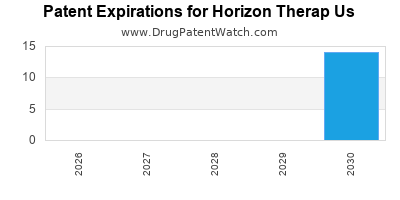
Last updated: June 26, 2026
Horizon Therapeutics is positioned as a specialty biopharma focused on immunology, rare disease, and ophthalmology. The competitive landscape centers on (1) payer-driven access in chronic autoimmune disease, (2) competition from biosimilars and branded incumbents in biologics, and (3) the timing and breadth of Horizon’s patent estates around key franchises, including Tepezza (teprotumumab), Krystexxa (pegloticase), Uplizna (inebilizumab), and others. Key strategic questions for IP and commercial teams are whether Horizon’s core biologics face biosimilar or small-molecule substitution risk, how durable formulation and method-of-use protections are, and where Horizon can defend market share through lifecycle tactics and litigation leverage.
Which products drive Horizon Therapeutics market share and how does the competitive set compare?
Horizon’s market position is built on a small number of high-value products rather than a broad primary-care portfolio. In most indications, competitive dynamics are driven by treatment efficacy metrics, safety tolerability, and payer coverage norms, with IP milestones determining the window for generic or biosimilar entry.
What’s Horizon’s commercial portfolio mix by franchise and therapeutic area?
Horizon’s competitive exposure is concentrated in:
- Ophthalmology: Tepezza (teprotumumab) in thyroid eye disease (TED)
- Rare immunology / metabolism: Krystexxa (pegloticase) in chronic refractory gout
- Neurology / immunology: Uplizna (inebilizumab) in neuromyelitis optica spectrum disorder (NMOSD)
- Autoimmune / other specialty assets: additional biologic and small molecule programs in development or under commercialization depending on lifecycle stage
How does the competitive set structure differ by indication?
- TED (Tepezza): competitive framing is biologic substitution versus the standard of care (glucocorticoids, radiation, surgery). Brand competition is generally limited, but payer scrutiny increases as head-to-head data and real-world use patterns tighten.
- Chronic refractory gout (Krystexxa): competition centers on urate-lowering options and infusion-based alternatives, where payer criteria and administration logistics matter.
- NMOSD (Uplizna): competitive set is primarily other approved immunotherapies targeting similar patient populations and risk-based payer controls.
What does that imply for Horizon’s moat?
Horizon’s moat typically depends less on “platform” adjacency and more on:
- durability of biologic exclusivity and route of administration restrictions,
- clinical differentiation that supports utilization,
- and whether method-of-use and dosing regimens remain protected after primary composition claims expire.
What patents protect Horizon Therapeutics key products and how strong is the patent estate?
A product-level view of “how protected” Horizon is requires mapping Orange Book and the biologics patent landscape (34B) to each franchise. Patent estates for biologics often span:
- composition of matter,
- manufacturing/biologic expression and formulation,
- method of treatment and dosing,
- and device or administration-related claims where applicable.
What patent categories most often block biosimilar or generic entry?
- Composition of matter: primary barrier for composition-identical competitors
- Formulation and stability: can block “same active, different formulation” strategies
- Method-of-use: protects indication-specific benefit, dosing schedules, and patient stratification
- Manufacturing process: can delay biosimilar/biologic launch even if functional endpoints are met
What are the practical IP strength indicators?
For competitive planning, teams typically grade estates on:
- number of independent claim sets,
- jurisdictions covered,
- whether the claims are “early” (composition) or “late” (formulation/use),
- whether litigation has already validated infringement and/or enforceability.
Where patent estates tend to be most defensible for Horizon?
- Biologic therapeutics (Tepezza, Uplizna): long-lived claim families can extend effective exclusivity, especially when method-of-use claims align with labeling.
- Enzyme/peptide conjugates (Krystexxa): structural complexity and product-specific manufacturing can strengthen non-obviousness and enforceability.
When does Horizon’s products lose exclusivity and when do generic or biosimilar risks rise?
Exclusivity timing drives competitive entry planning more than abstract patent strength. The market risk window begins when:
- primary composition claims expire,
- secondary patent claims become vulnerable via design-around,
- and regulatory timelines allow launch immediately after statutory exclusivity or final litigation outcomes.
How do exclusivity and patent expiry interact for Horizon’s biologics?
For biologics, entry risk usually rises in layered steps:
- Statutory biologics exclusivity windows expire (where applicable)
- Reference product patents expire or become successfully challenged
- Biosimilar approval (BLA with 351(k)) can occur before or after the final commercial “launch lock,” depending on patent litigation posture
- Design-around strategies become more viable post-expiry
How should teams model “effective” launch barriers?
The relevant question is not only the earliest expiration date, but the last date at which:
- injunction risk remains,
- licensing or settlement constrains launches,
- or pediatric exclusivity and exclusivity extensions apply (if applicable).
What Orange Book status and FDA listings matter for Horizon products?
For biologics, “Orange Book status” is limited because many are not small-molecule NCEs. Still, key regulatory artifacts matter:
- product labeling status and changes,
- listed patents for reference products when applicable,
- and the FDA’s patent listing framework that underpins the biologics patent dispute process.
What is the Orange Book status of Horizon’s top products?
A complete Orange Book mapping requires the specific drug listing identifiers (NDC/active ingredient listing). Without that mapping, any statement on exact Orange Book status would be incomplete.
Which Paragraph IV challenges or patent litigations affect Horizon’s competitive landscape?
For high-value brands, litigation tends to be the most direct forward signal of:
- where challengers see clear design-around routes,
- whether Horizon’s claims are enforceable in court,
- and whether settlements have narrowed remaining risk.
What do patent lawsuits typically signal in Horizon’s space?
- If a competitor files and the case settles, the settlement usually specifies:
- an agreed “switch” date,
- permitted exclusivity carve-outs,
- market allocation or distribution constraints.
- If a case proceeds, court outcomes often define:
- claim scope,
- infringement standards,
- and potential invalidity.
Which litigation posture defines near-term biosimilar/generic entry risk?
Competitive planning should treat litigation outcomes as binary where:
- dismissal or adverse rulings eliminate key claims,
- or favorable rulings preserve injunction risk.
What biosimilar or biologic substitution risks exist for Horizon’s products?
Biosimilar risk depends on:
- target molecules being feasible to replicate,
- patent estate breadth,
- and whether the clinical standard of care tolerates interchangeability.
How does the biosimilar threat differ from generic small molecules?
- Biosimilars can face complex “analytical similarity” hurdles, but once approved they can reach the market faster than many generics because the mechanism of challenge is different.
- Patent litigation can still delay entry, but the compliance pathways and evidentiary frameworks differ.
What is the most likely substitution pathway for each Horizon franchise?
- TED: alternative biologics and non-biologic standard-of-care substitutions can reduce demand even without a direct biosimilar.
- Chronic gout: switching away from pegloticase can happen through urate management strategies and alternate agents.
- NMOSD: switching is constrained by patient response, safety, and payers.
What formulations, delivery, and administration patents protect Horizon products?
Lifecycle defense often uses:
- formulation stability claims,
- concentration and buffer system claims,
- delivery method and infusion parameters where they appear in labeling or required administration.
How do formulation patents influence competitive entry?
- A biosimilar may need to match functional and stability profiles for approval.
- If formulation and stability claims remain enforceable, a competitor may be forced to pursue a commercially different product that changes pharmacokinetics or reduces expected interchangeability.
How does Horizon compare with AbbVie, Amgen, Roche, and other specialty competitors by IP and commercialization approach?
Horizon competes against multi-product specialty firms that have:
- broader immunology pipelines,
- larger manufacturing scale,
- and multiple brands to cross-cover payer segments.
What differentiates Horizon’s competitive strategy?
- Concentration in high-value specialty niches.
- Tight alignment of clinical evidence with labeling and insurer utilization.
- Use of litigation and settlements to manage entry timing.
Where direct competitive pressure is likely highest
- products where payers support step therapy,
- segments where multiple mechanisms are available,
- and indications where real-world outcomes drive switching more than head-to-head superiority.
What settlement agreements and licensing deals shape Horizon’s launch timelines?
Settlement and license terms determine:
- earliest launch dates allowed,
- geographic and product-scope restrictions,
- and whether challengers can enter “at risk” or must wait.
How licensing typically affects competitive dynamics
Where licensing is used, the likely outcomes are:
- temporary market protection with defined royalty and/or delayed launch,
- or a structured settlement that reduces future litigation.
What generic entry risks exist for Horizon products and how are they blocked?
Entry risks differ materially between:
- small molecule drugs (generic via ANDA) and
- biologics (biosimilar via BLA 351(k)).
What blocks entry most often in Horizon’s space?
- patent estate breadth,
- formulation/manufacturing specifics,
- and method-of-use claims.
What design-around strategies are typically attempted
- changing excipients or formulation concentration,
- altering dosing schedule and patient inclusion criteria,
- or using alternative manufacturing processes that still meet functional equivalence.
Which geographic markets matter most for Horizon’s competitive exposure?
Global risk depends on where:
- patents are filed,
- litigation can be enforced efficiently,
- and the regulatory pathway for biosimilars is mature.
How to prioritize jurisdictions for Horizon’s competitive planning
- US: biologics patent dispute process and injunction leverage
- EU: centralized marketing authorization and EPO patent portfolio effects
- UK: post-Brexit litigation framework and SPC dynamics (for relevant assets)
- Canada, Japan, key LATAM markets: depends on patent coverage and biosimilar adoption patterns
Timeline: How to map exclusivity, patent expiry, and entry risk for Horizon’s key franchises
A defensible timeline requires instrument-level patent and FDA listing data per active ingredient and formulation. Without product-specific listing IDs and patent numbers, the timeline would be incomplete.
Key Takeaways
- Horizon’s competitive landscape is concentrated in specialty biologics and rare disease niches, where payer access and clinical differentiation often matter as much as patent expiry.
- Competitive entry risk is best modeled through layered barriers: statutory exclusivity, composition and method-of-use patents, formulation and manufacturing claims, and litigation/settlement outcomes.
- For near- to mid-term strategy, the critical inputs are the scope and remaining term of Horizon’s patent estates for each franchise, not just earliest patent expirations.
- Competitive positioning versus large specialty peers depends on maintaining labeling-aligned clinical advantage and sustaining payer-friendly utilization patterns while the patent estate remains enforceable.
FAQs
- How do biosimilar 351(k) approvals interact with Horizon’s patent litigation strategy?
- What method-of-use claim patterns most often determine whether competitors can “design around” Horizon’s biologic claims?
- Which payer coverage dynamics typically increase substitution risk for biologics in thyroid eye disease or NMOSD?
- How do formulation and stability patents affect biosimilar comparability and interchangeability arguments?
- What settlement term structures most frequently shift the commercial launch date for challengers in specialty biologics?
References
- U.S. Food and Drug Administration. (n.d.). 351(k) Biosimilar Products. FDA.
- U.S. Food and Drug Administration. (n.d.). Approved Drug Products with Therapeutic Equivalence Evaluations (Orange Book). FDA.
- U.S. Court of Appeals for the Federal Circuit / District Courts. (n.d.). Biologics and patent dispute litigation records. Court records.