QUVIVIQ Drug Patent Profile
✉ Email this page to a colleague
When do Quviviq patents expire, and when can generic versions of Quviviq launch?
Quviviq is a drug marketed by Idorsia and is included in one NDA. There are three patents protecting this drug.
The generic ingredient in QUVIVIQ is daridorexant hydrochloride. There is one drug master file entry for this compound. One supplier is listed for this compound. Additional details are available on the daridorexant hydrochloride profile page.
DrugPatentWatch® Generic Entry Outlook for Quviviq
Quviviq was eligible for patent challenges on April 7, 2026.
By analyzing the patents and regulatory protections it appears that the earliest date
for generic entry will be December 2, 2034. This may change due to patent challenges or generic licensing.
Indicators of Generic Entry
AI Deep Research
Questions you can ask:
- What is the 5 year forecast for QUVIVIQ?
- What are the global sales for QUVIVIQ?
- What is Average Wholesale Price for QUVIVIQ?
Summary for QUVIVIQ
| US Patents: | 3 |
| Applicants: | 1 |
| NDAs: | 1 |
| Finished Product Suppliers / Packagers: | 1 |
| Raw Ingredient (Bulk) Api Vendors: | 3 |
| Clinical Trials: | 1 |
| Patent Applications: | 24 |
| Drug Prices: | Drug price information for QUVIVIQ |
| What excipients (inactive ingredients) are in QUVIVIQ? | QUVIVIQ excipients list |
| DailyMed Link: | QUVIVIQ at DailyMed |
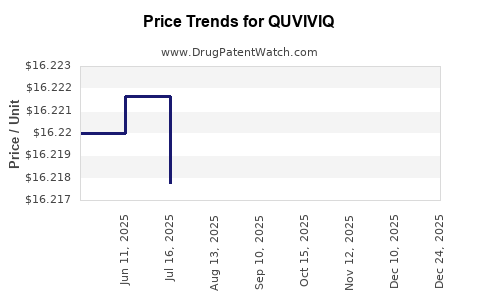
DrugPatentWatch® Estimated Loss of Exclusivity (LOE) Date for QUVIVIQ
Generic Entry Date for QUVIVIQ*:
Constraining patent/regulatory exclusivity:
NDA:
Dosage:
TABLET;ORAL |
*The generic entry opportunity date is the latter of the last compound-claiming patent and the last regulatory exclusivity protection. Many factors can influence early or later generic entry. This date is provided as a rough estimate of generic entry potential and should not be used as an independent source.
Recent Clinical Trials for QUVIVIQ
Identify potential brand extensions & 505(b)(2) entrants
| Sponsor | Phase |
|---|---|
| Idorsia Pharmaceuticals Ltd. | Phase 1 |
Pharmacology for QUVIVIQ
| Drug Class | Orexin Receptor Antagonist |
| Mechanism of Action | Orexin Receptor Antagonists |
US Patents and Regulatory Information for QUVIVIQ
QUVIVIQ is protected by three US patents and three FDA Regulatory Exclusivities.
Based on analysis by DrugPatentWatch, the earliest date for a generic version of QUVIVIQ is ⤷ Start Trial.
This potential generic entry date is based on patent ⤷ Start Trial.
Generics may enter earlier, or later, based on new patent filings, patent extensions, patent invalidation, early generic licensing, generic entry preferences, and other factors.
| Applicant | Tradename | Generic Name | Dosage | NDA | Approval Date | TE | Type | RLD | RS | Patent No. | Patent Expiration | Product | Substance | Delist Req. | Exclusivity Expiration |
|---|---|---|---|---|---|---|---|---|---|---|---|---|---|---|---|
| Idorsia | QUVIVIQ | daridorexant hydrochloride | TABLET;ORAL | 214985-001 | Apr 7, 2022 | RX | Yes | No | ⤷ Start Trial | ⤷ Start Trial | Y | Y | ⤷ Start Trial | ||
| Idorsia | QUVIVIQ | daridorexant hydrochloride | TABLET;ORAL | 214985-002 | Apr 7, 2022 | RX | Yes | Yes | ⤷ Start Trial | ⤷ Start Trial | Y | Y | ⤷ Start Trial | ||
| Idorsia | QUVIVIQ | daridorexant hydrochloride | TABLET;ORAL | 214985-001 | Apr 7, 2022 | RX | Yes | No | ⤷ Start Trial | ⤷ Start Trial | ⤷ Start Trial | ||||
| Idorsia | QUVIVIQ | daridorexant hydrochloride | TABLET;ORAL | 214985-002 | Apr 7, 2022 | RX | Yes | Yes | ⤷ Start Trial | ⤷ Start Trial | ⤷ Start Trial | ||||
| >Applicant | >Tradename | >Generic Name | >Dosage | >NDA | >Approval Date | >TE | >Type | >RLD | >RS | >Patent No. | >Patent Expiration | >Product | >Substance | >Delist Req. | >Exclusivity Expiration |
International Patents for QUVIVIQ
When does loss-of-exclusivity occur for QUVIVIQ?
Based on analysis by DrugPatentWatch, the following patents block generic entry in the countries listed below:
Australia
Patent: 14358743
Patent: Crystalline salt form of (S)-(2-(6-chloro-7-methyl-1 H-benzo[d]imidazol-2-yl)-2-methylpyrrolidin-1 -yl)(5-methoxy-2-(2H-1,2,3-triazol-2-yl)phenyl)methanone as orexin receptor antagonist
Estimated Expiration: ⤷ Start Trial
Brazil
Patent: 2016012625
Estimated Expiration: ⤷ Start Trial
Canada
Patent: 29720
Patent: FORME DE SEL CRISTALLINE DE (S)-(2-(6-CHLORO-7-METHYL-1 H-BENZO[D]IMIDAZOL- 2-YL)-2-METHYLPYRROLIDIN-1-YL)(5-METHOXY-2-(2H-1,2,3-TRIAZOL-2-YL)PHENYL)METHANONE COMME ANTAGONISTE DES RECEPTEURS A L'OREXINE (CRYSTALLINE SALT FORM OF (S)-(2-(6-CHLORO-7-METHYL-1 H-BENZO[D]IMIDAZOL-2-YL)-2-METHYLPYRROLIDIN-1 -YL)(5-METHOXY-2-(2H-1,2,3-TRIAZOL-2-YL)PHENYL)METHANONE AS OREXIN RECEPTOR ANTAGONIST)
Estimated Expiration: ⤷ Start Trial
Chile
Patent: 16001348
Patent: Forma cristalina de clorhidrato de (s)-(2-(6-cloro-7-metil-1h-benzo[d]imidazol-2-il)-2-metilpirrolidin-1-il)(5-metoxi-2-(2h-1,2,3-triazol-2-il)fenil)metanona; composición farmacéutica que la comprende; y su uso para el tratamiento o prevención de trastornos del sueño, tales como disomnias, parasomnias, entre otras.
Estimated Expiration: ⤷ Start Trial
China
Patent: 5793258
Estimated Expiration: ⤷ Start Trial
Croatia
Patent: 0171772
Estimated Expiration: ⤷ Start Trial
Cyprus
Patent: 19687
Estimated Expiration: ⤷ Start Trial
Denmark
Patent: 77390
Estimated Expiration: ⤷ Start Trial
Eurasian Patent Organization
Patent: 0109
Patent: КРИСТАЛЛИЧЕСКАЯ СОЛЕВАЯ ФОРМА (S)-(2-(6-ХЛОР-7-МЕТИЛ-1H-БЕНЗО[d]ИМИДАЗОЛ-2-ИЛ)-2-МЕТИЛПИРРОЛИДИН-1-ИЛ)(5-МЕТОКСИ-2-(2H-1,2,3-ТРИАЗОЛ-2-ИЛ)ФЕНИЛ)МЕТАНОНА И ЕЕ ПРИМЕНЕНИЕ В КАЧЕСТВЕ АНТАГОНИСТОВ ОРЕКСИНОВОГО РЕЦЕПТОРА (CRYSTALLINE SALT FORM OF (S)-(2-(6-CHLORO-7-METHYL-1H-BENZO[d]IMIDAZOL-2-YL)-2-METHYLPYRROLIDIN-1-YL)(5-METHOXY-2-(2H-1,2,3-TRIAZOL-2-YL)PHENYL)METHANONE AND USE THEREOF AS OREXIN RECEPTOR ANTAGONISTS)
Estimated Expiration: ⤷ Start Trial
Patent: 1600436
Patent: КРИСТАЛЛИЧЕСКАЯ СОЛЕВАЯ ФОРМА (S)-(2-(6-ХЛОР-7-МЕТИЛ-1H-БЕНЗО[D]ИМИДАЗОЛ-2-ИЛ)-2-МЕТИЛПИРРОЛИДИН-1-ИЛ)(5-МЕТОКСИ-2-(2H-1,2,3-ТРИАЗОЛ-2-ИЛ)ФЕНИЛ)МЕТАНОНА И ЕЕ ПРИМЕНЕНИЕ В КАЧЕСТВЕ АНТАГОНИСТОВ ОРЕКСИНОВОГО РЕЦЕПТОРА
Estimated Expiration: ⤷ Start Trial
European Patent Office
Patent: 77390
Patent: FORME DE SEL CRISTALLINE DE (S)-(2-(6-CHLORO-7-MÉTHYL-1 H-BENZO[D]IMIDAZOL- 2-YL)-2-MÉTHYLPYRROLIDIN-1-YL)(5-MÉTHOXY-2-(2H-1,2,3-TRIAZOL-2-YL)PHÉNYL)MÉTHANONE COMME ANTAGONISTE DES RÉCEPTEURS À L'ORÉXINE (CRYSTALLINE SALT FORM OF (S)-(2-(6-CHLORO-7-METHYL-1H-BENZO[D]IMIDAZOL-2-YL)-2-METHYLPYRROLIDIN-1-YL)(5-METHOXY-2-(2H-1,2,3-TRIAZOL-2-YL)PHENYL)METHANONE AS OREXIN RECEPTOR ANTAGONIST)
Estimated Expiration: ⤷ Start Trial
Hong Kong
Patent: 25736
Estimated Expiration: ⤷ Start Trial
Hungary
Patent: 34656
Estimated Expiration: ⤷ Start Trial
Israel
Patent: 5922
Patent: צורת מלח גבישית של (s)-(2-(6-כלורו-7-מתיל-1h-בנזו[d]אימידאזול-2-איל)-2-מתילפירולידין-1-איל)(5-מתוקסי-2-(2h-3,2,1-טריאזול-2-איל)פניל)מתאנון כאנטגוניסטים לקולטן אורקסין (Crystalline salt form of (s)-(2-(6-chloro-7-methyl-1 h-benzo[d]imidazol-2-yl)-2-methylpyrrolidin-1 -yl)(5-methoxy-2-(2h-1,2,3-triazol-2-yl)phenyl)methanone as orexin receptor antagonist)
Estimated Expiration: ⤷ Start Trial
Japan
Patent: 91716
Estimated Expiration: ⤷ Start Trial
Patent: 16539135
Patent: オレキシン受容体アンタゴニストとしての(S)−(2−(6−クロロ−7−メチル−1H−ベンゾ[D]イミダゾール−2−イル)−2−メチルピロリジン−1−イル)(5−メトキシ−2−(2H−1,2,3−トリアゾール−2−イル)フェニル)メタノンの塩結晶形
Estimated Expiration: ⤷ Start Trial
Lithuania
Patent: 77390
Estimated Expiration: ⤷ Start Trial
Malaysia
Patent: 6244
Patent: CRYSTALLINE SALT FORM OF (S)-(2-(6-CHLORO-7-METHYL-1H-BENZO[D]IMIDAZOL-2-YL)-2-METHYLPYRROLIDIN-1-YL)(5-METHOXY-2-(2H-1,2,3-TRIAZOL-2-YL)PHENYL)METHANONE AS OREXIN RECEPTOR ANTAGONIST
Estimated Expiration: ⤷ Start Trial
Mexico
Patent: 2701
Patent: FORMA DE SAL CRISTALINA DE (S)-(2-(6-CLORO-7-METIL-1H-BENZO[D]IMID AZOL-2-IL)-2-METIL-PIRROLIDIN-1-IL) (5-METOXI-2-(2H-1,2,3-TRIAZOL- 2-IL)FENIL) METANONA COMO ANTAGONISTAS DE RECEPTOR DE OREXINA. (CRYSTALLINE SALT FORM OF (S)-(2-(6-CHLORO-7-METHYL-1 H-BENZO[D]IMIDAZOL-2-YL)-2-METHYLPYRROLIDIN-1 -YL)(5-METHOXY-2-(2H-1,2,3-TRIAZOL-2-YL)PHENYL)METHANONE AS OREXIN RECEPTOR ANTAGONIST.)
Estimated Expiration: ⤷ Start Trial
Patent: 16007216
Patent: FORMA DE SAL CRISTALINA DE (S)-(2-(6-CLORO-7-METIL-1H-BENZO[D]IMID AZOL-2-IL)-2-METIL-PIRROLIDIN-1-IL) (5-METOXI-2-(2H-1,2,3-TRIAZOL- 2-IL)FENIL) METANONA COMO ANTAGONISTAS DE RECEPTOR DE OREXINA. (CRYSTALLINE SALT FORM OF (S)-(2-(6-CHLORO-7-METHYL-1 H-BENZO[D]IMIDAZOL-2-YL)-2-METHYLPYRROLIDIN-1 -YL)(5-METHOXY-2-(2H-1,2,3-TRIAZOL-2-YL)PHENYL)METHANONE AS OREXIN RECEPTOR ANTAGONIST.)
Estimated Expiration: ⤷ Start Trial
Morocco
Patent: 164
Patent: Forme de sel cristalline de (s)-(2-(6-chloro-7-méthyl-1 h-benzo[d]imidazol- 2-yl)-2-méthylpyrrolidin-1-yl)(5-méthoxy-2-(2h-1,2,3-triazol-2-yl)phényl)méthanone comme antagoniste des récepteurs à l'oréxine
Estimated Expiration: ⤷ Start Trial
New Zealand
Patent: 1493
Patent: Crystalline salt form of (s)-(2-(6-chloro-7-methyl-1h-benzo[d]imidazol-2-yl)-2-methylpyrrolidin-1-yl)(5-methoxy-2-(2h-1,2,3-triazol-2-yl)phenyl)methanone as orexin receptor antagonist
Estimated Expiration: ⤷ Start Trial
Norway
Patent: 77390
Estimated Expiration: ⤷ Start Trial
Philippines
Patent: 016500989
Patent: CRYSTALLINE FORM OF (S)-(2-(6-CHLORO-7-METHYL-1H-BENZO[D]IMIDAZOL-2-YL)-2-METHYLPYRROLIDIN-1 -YL)(5-METHOXY-2-(2H-1,2,3-TRIAZOL-2-YL)PHENYL)METHANONE AS OREXIN RECEPTOR ANTAGONISTS
Estimated Expiration: ⤷ Start Trial
Poland
Patent: 77390
Estimated Expiration: ⤷ Start Trial
Portugal
Patent: 77390
Estimated Expiration: ⤷ Start Trial
Saudi Arabia
Patent: 6371248
Patent: صورة ملح متبلورة من (s)-(2-(6-كلورو-7-ميثيل-1h-بنزو[d]إميدازول-2-يل)-2-ميثيل بيروليدين-1-يل)(5-ميثوكسي-2-(2h-1، 2، 3-تريازول-2-يل)فينيل)ميثانون كمضادات مستقبل أوريكسين (Crystalline salt form of (S)-(2-(6-chloro-7-methyl-1H-benzo[d]imidazol-2-YL)-2-methylpyrrolidin-1-YL)(5-methoxy-2-(2H-1,2,3-triazol-2-L)phenyl)methanone as orexin receptor antagonist)
Estimated Expiration: ⤷ Start Trial
Singapore
Patent: 201604541W
Patent: CRYSTALLINE SALT FORM OF (S)-(2-(6-CHLORO-7-METHYL-1 H-BENZO[D]IMIDAZOL-2-YL)-2-METHYLPYRROLIDIN-1 -YL)(5-METHOXY-2-(2H-1,2,3-TRIAZOL-2-YL)PHENYL)METHANONE AS OREXIN RECEPTOR ANTAGONIST
Estimated Expiration: ⤷ Start Trial
Slovenia
Patent: 77390
Estimated Expiration: ⤷ Start Trial
South Africa
Patent: 1604501
Patent: CRYSTALLINE SALT FORM OF (S)-(2-(6-CHLORO-7-METHYL-1 H-BENZO[D]IMIDAZOL-2-YL)-2-METHYLPYRROLIDIN-1 -YL)(5-METHOXY-2-(2H-1,2,3-TRIAZOL-2-YL)PHENYL)METHANONE AS OREXIN RECEPTOR ANTAGONIST
Estimated Expiration: ⤷ Start Trial
South Korea
Patent: 1839716
Estimated Expiration: ⤷ Start Trial
Patent: 160093683
Patent: 오렉신 수용체 길항제로서의 (S)-(2-(6-클로로-7-메틸-1H-벤조[D]이미다졸-2-일)-2-메틸피롤리딘-1-일)(5-메톡시-2-(2H-1,2,3-트리아졸-2-일)페닐)메타논의 결정성 염 형태 (CRYSTALLINE SALT FORM OF (S)-(2-(6-CHLORO-7-METHYL-1H-BENZO[D]IMIDAZOL-2-YL)-2-METHYLPYRROLIDIN-1-YL)(5-METHOXY-2-(2H-1,2,3-TRIAZOL-2-YL)PHENYL)METHANONE AS OREXIN RECEPTOR ANTAGONIST)
Estimated Expiration: ⤷ Start Trial
Spain
Patent: 51508
Estimated Expiration: ⤷ Start Trial
Taiwan
Patent: 1605839
Patent: Crystalline salt form
Estimated Expiration: ⤷ Start Trial
Patent: 36982
Estimated Expiration: ⤷ Start Trial
Ukraine
Patent: 9151
Patent: КРИСТАЛІЧНА СОЛЬОВА ФОРМА (S)-(2-(6-ХЛОР-7-МЕТИЛ-1H-БЕНЗО[d]ІМІДАЗОЛ-2-ІЛ)-2-МЕТИЛПІРОЛІДИН-1-ІЛ)(5-МЕТОКСИ-2-(2H-1,2,3-ТРИАЗОЛ-2-ІЛ)ФЕНІЛ)МЕТАНОНУ ЯК АНТАГОНІСТ ОРЕКСИНОВОГО РЕЦЕПТОРА (CRYSTALLINE SALT FORM OF (S)-(2-(6-CHLORO-7-METHYL-1 H-BENZO[D]IMIDAZOL-2-YL)-2-METHYLPYRROLIDIN-1 -YL)(5-METHOXY-2-(2H-1,2,3-TRIAZOL-2-YL)PHENYL)METHANONE AS OREXIN RECEPTOR ANTAGONIST)
Estimated Expiration: ⤷ Start Trial
Generics may enter earlier, or later, based on new patent filings, patent extensions, patent invalidation, early generic licensing, generic entry preferences, and other factors.
See the table below for additional patents covering QUVIVIQ around the world.
| Country | Patent Number | Title | Estimated Expiration |
|---|---|---|---|
| Australia | 2014358743 | ⤷ Start Trial | |
| Brazil | 112016012625 | ⤷ Start Trial | |
| Canada | 2929720 | ⤷ Start Trial | |
| Chile | 2016001348 | ⤷ Start Trial | |
| >Country | >Patent Number | >Title | >Estimated Expiration |
Supplementary Protection Certificates for QUVIVIQ
| Patent Number | Supplementary Protection Certificate | SPC Country | SPC Expiration | SPC Description |
|---|---|---|---|---|
| 2855453 | PA2022518 | Lithuania | ⤷ Start Trial | PRODUCT NAME: DARIDOREKSANTAS; REGISTRATION NO/DATE: 1/22/1638/001-006 20220429 |
| 2855453 | 301197 | Netherlands | ⤷ Start Trial | PRODUCT NAME: DARIDOREXANT OF EEN FARMACEUTISCH AANVAARDBAAR ZOUT DAARVAN, IN HET BIJZONDER DARIDOREXANTHYDROCHLORIDE; REGISTRATION NO/DATE: EU/1/22/1638 20220502 |
| 2855453 | 2022C/543 | Belgium | ⤷ Start Trial | PRODUCT NAME: DARIDOREXANT OU UN SEL PHARMACEUTIQUEMENT ACCEPTABLE DE CELUI-CI, EN PARTICULIER LE CHLORHYDRATE DE DARIDOREXANT; AUTHORISATION NUMBER AND DATE: EU/1/22/1638 20220502 |
| 2855453 | 122022000059 | Germany | ⤷ Start Trial | PRODUCT NAME: DARIDOREXANT ODER EIN PHARMAZEUTISCH AKZEPTABLES SALZ DAVON, INSBESONDERE DARIDOREXANT-HYDROCHLORID; REGISTRATION NO/DATE: EU/1/22/1638 20220429 |
| >Patent Number | >Supplementary Protection Certificate | >SPC Country | >SPC Expiration | >SPC Description |
More… ↓
DrugChatter Q&A for QUVIVIQ
Make Better Decisions: Try a trial or see plans & pricing
Drugs may be covered by multiple patents or regulatory protections. All trademarks and applicant names are the property of their respective owners or licensors. Although great care is taken in the proper and correct provision of this service, thinkBiotech LLC does not accept any responsibility for possible consequences of errors or omissions in the provided data. The data presented herein is for information purposes only. There is no warranty that the data contained herein is error free. We do not provide individual investment advice. This service is not registered with any financial regulatory agency. The information we publish is educational only and based on our opinions plus our models. By using DrugPatentWatch you acknowledge that we do not provide personalized recommendations or advice. thinkBiotech performs no independent verification of facts as provided by public sources nor are attempts made to provide legal or investing advice. Any reliance on data provided herein is done solely at the discretion of the user. Users of this service are advised to seek professional advice and independent confirmation before considering acting on any of the provided information. thinkBiotech LLC reserves the right to amend, extend or withdraw any part or all of the offered service without notice.
ISSN: 2162-2639

Privacy and Cookies
Terms & Conditions
Site Map
DrugPatentWatch Alternatives
LOE / Major Patent Expirations 2026 - 2027
NCE-1 Patent Challenge Dates 2026 - 2027
Friedman, Yali. "DrugPatentWatch" DrugPatentWatch, thinkBiotech, 2026, www.DrugPatentWatch.com.
See Primary Research Papers Citing DrugPatentWatch