Idorsia Company Profile
✉ Email this page to a colleague
What is the competitive landscape for IDORSIA
IDORSIA has two approved drugs.
There are nine US patents protecting IDORSIA drugs.
Summary for Idorsia
| US Patents: | 9 |
| Tradenames: | 2 |
| Ingredients: | 2 |
| NDAs: | 2 |
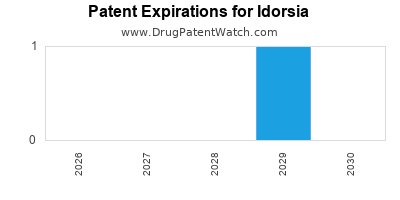
Drugs and US Patents for Idorsia
| Applicant | Tradename | Generic Name | Dosage | NDA | Approval Date | TE | Type | RLD | RS | Patent No. | Patent Expiration | Product | Substance | Delist Req. | Exclusivity Expiration |
|---|---|---|---|---|---|---|---|---|---|---|---|---|---|---|---|
| Idorsia | QUVIVIQ | daridorexant hydrochloride | TABLET;ORAL | 214985-002 | Apr 7, 2022 | RX | Yes | Yes | ⤷ Start Trial | ⤷ Start Trial | |||||
| Idorsia | QUVIVIQ | daridorexant hydrochloride | TABLET;ORAL | 214985-002 | Apr 7, 2022 | RX | Yes | Yes | 10,023,560 | ⤷ Start Trial | ⤷ Start Trial | ||||
| Idorsia | TRYVIO | aprocitentan | TABLET;ORAL | 217686-001 | Mar 19, 2024 | RX | Yes | Yes | 10,919,881 | ⤷ Start Trial | Y | Y | ⤷ Start Trial | ||
| Idorsia | TRYVIO | aprocitentan | TABLET;ORAL | 217686-001 | Mar 19, 2024 | RX | Yes | Yes | 11,680,058 | ⤷ Start Trial | ⤷ Start Trial | ||||
| Idorsia | QUVIVIQ | daridorexant hydrochloride | TABLET;ORAL | 214985-001 | Apr 7, 2022 | RX | Yes | No | 10,023,560 | ⤷ Start Trial | ⤷ Start Trial | ||||
| Idorsia | QUVIVIQ | daridorexant hydrochloride | TABLET;ORAL | 214985-001 | Apr 7, 2022 | RX | Yes | No | ⤷ Start Trial | ⤷ Start Trial | |||||
| Idorsia | QUVIVIQ | daridorexant hydrochloride | TABLET;ORAL | 214985-002 | Apr 7, 2022 | RX | Yes | Yes | ⤷ Start Trial | ⤷ Start Trial | |||||
| >Applicant | >Tradename | >Generic Name | >Dosage | >NDA | >Approval Date | >TE | >Type | >RLD | >RS | >Patent No. | >Patent Expiration | >Product | >Substance | >Delist Req. | >Exclusivity Expiration |
International Patents for Idorsia Drugs
| Country | Patent Number | Estimated Expiration |
|---|---|---|
| Norway | 2024053 | ⤷ Start Trial |
| Croatia | P20241461 | ⤷ Start Trial |
| Brazil | PI0815360 | ⤷ Start Trial |
| Argentina | 091257 | ⤷ Start Trial |
| Portugal | 3077390 | ⤷ Start Trial |
| South Korea | 20190121827 | ⤷ Start Trial |
| Cyprus | 1119687 | ⤷ Start Trial |
| >Country | >Patent Number | >Estimated Expiration |
Supplementary Protection Certificates for Idorsia Drugs
| Patent Number | Supplementary Protection Certificate | SPC Country | SPC Expiration | SPC Description |
|---|---|---|---|---|
| 2855453 | 22C1047 | France | ⤷ Start Trial | PRODUCT NAME: DARIDOREXANT OU LE SEL PHARMACEUTIQUEMENT ACCEPTABLE DE CELUI-CI, EN PARTICULIER LE CHLORHYDRATE DE DARIDOREXANT; REGISTRATION NO/DATE: EU/1/22/1638 20220502 |
| 2855453 | C02855453/01 | Switzerland | ⤷ Start Trial | PRODUCT NAME: DARIDOREXANTUM; REGISTRATION NO/DATE: SWISSMEDIC-ZULASSUNG 68481 01.12.2022 |
| 2190837 | C20240041 | Finland | ⤷ Start Trial | PRODUCT NAME: MATSITENTAAN/TADALAFIIL;REG NO/DATE: EU/1/24/1859 30.09.2024 |
| 2190837 | 301304 | Netherlands | ⤷ Start Trial | PRODUCT NAME: APROCITENTAN OF EEN FARMACEUTISCH AANVAARDBAAR ZOUT DAARVAN; REGISTRATION NO/DATE: EU/1/24/1818 20240628 |
| 2855453 | 301197 | Netherlands | ⤷ Start Trial | PRODUCT NAME: DARIDOREXANT OF EEN FARMACEUTISCH AANVAARDBAAR ZOUT DAARVAN, IN HET BIJZONDER DARIDOREXANTHYDROCHLORIDE; REGISTRATION NO/DATE: EU/1/22/1638 20220502 |
| 2855453 | 122022000059 | Germany | ⤷ Start Trial | PRODUCT NAME: DARIDOREXANT ODER EIN PHARMAZEUTISCH AKZEPTABLES SALZ DAVON, INSBESONDERE DARIDOREXANT-HYDROCHLORID; REGISTRATION NO/DATE: EU/1/22/1638 20220429 |
| 2855453 | 2290037-7 | Sweden | ⤷ Start Trial | PRODUCT NAME: DARIDOREXANT OR A PHARMACEUTICALLY ACCEPTABLE SALT THEREOF, IN PARTICULAR DARIDOREXANT HYDROCHLORIDE; REG. NO/DATE: EU/1/22/1638/001-006 20220502 |
| >Patent Number | >Supplementary Protection Certificate | >SPC Country | >SPC Expiration | >SPC Description |
Similar Applicant Names
Applicants may be listed under multiple names.
Here is a list of applicants with similar names.
Here is a list of applicants with similar names.
