Share This Page
Drug Price Trends for QUVIVIQ
✉ Email this page to a colleague
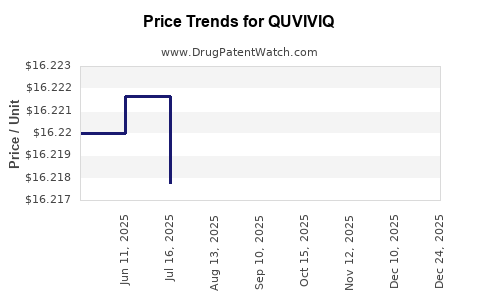
Average Pharmacy Cost for QUVIVIQ
| Drug Name | NDC | Price/Unit ($) | Unit | Date |
|---|---|---|---|---|
| QUVIVIQ 25 MG TABLET | 80491-7825-03 | 16.71775 | EACH | 2026-07-22 |
| QUVIVIQ 50 MG TABLET | 80491-7850-03 | 16.70251 | EACH | 2026-07-22 |
| QUVIVIQ 25 MG TABLET | 80491-7825-03 | 16.71583 | EACH | 2026-06-17 |
| QUVIVIQ 50 MG TABLET | 80491-7850-03 | 16.71087 | EACH | 2026-06-17 |
| QUVIVIQ 25 MG TABLET | 80491-7825-03 | 16.70248 | EACH | 2026-05-20 |
| >Drug Name | >NDC | >Price/Unit ($) | >Unit | >Date |
Best Wholesale Price for QUVIVIQ
| Drug Name | Vendor | NDC | Count | Price ($) | Price/Unit ($) | Unit | Dates | Price Type |
|---|---|---|---|---|---|---|---|---|
| QUVIVIQ 50MG TAB | Idorsia Pharmaceuticals US, Inc. | 80491-7850-03 | 30 | 356.36 | 11.87867 | EACH | 2024-01-01 - 2027-09-30 | Big4 |
| QUVIVIQ 25MG TAB | Idorsia Pharmaceuticals US, Inc. | 80491-7825-03 | 30 | 342.08 | 11.40267 | EACH | 2022-10-01 - 2027-09-30 | Big4 |
| QUVIVIQ 50MG TAB | Idorsia Pharmaceuticals US, Inc. | 80491-7850-03 | 30 | 466.76 | 15.55867 | EACH | 2024-01-01 - 2027-09-30 | FSS |
| QUVIVIQ 25MG TAB | Idorsia Pharmaceuticals US, Inc. | 80491-7825-03 | 30 | 450.11 | 15.00367 | EACH | 2022-10-01 - 2027-09-30 | FSS |
| QUVIVIQ 25MG TAB | Idorsia Pharmaceuticals US, Inc. | 80491-7825-03 | 30 | 355.28 | 11.84267 | EACH | 2024-01-01 - 2027-09-30 | Big4 |
| >Drug Name | >Vendor | >NDC | >Count | >Price ($) | >Price/Unit ($) | >Unit | >Dates | >Price Type |
QUVIVIQ (daridorexant) Market Analysis and Price Projections (2024–2030): Exclusivity, Patent/Litigation Overhang, and Generic/Biosimilar Launch Risk
Executive summary
- QUVIVIQ (daridorexant) is priced as a premium insomnia therapy with a protected formulary position in the US driven by brand-only market structure in DORAs (dual orexin receptor antagonists) through at least the mid-2020s.
- Near-term pricing is supported by (i) absence of generic oral DORA competition in the US for daridorexant and (ii) payer management that favors place-in-therapy restrictions rather than immediate deep discounting.
- Longer-horizon price pressure depends on two failure points for the brand: generic entry timing (oral solid dosage) and any post-launch lifecycle claim enforcement (formulation, method of use, combination). The Orange Book and litigation posture determine the effective “patent fence,” not the initial NDA exclusivity alone.
- The highest sensitivity in price projections is the assumed launch date of first authorized generic or first Paragraph IV-at-risk generic; every month of delay can shift net price by several percentage points in the first post-entry year, given typical payer step-down schedules.
What is QUVIVIQ (daridorexant) and how is it positioned in the insomnia market?
QUVIVIQ (daridorexant) is an oral dual orexin receptor antagonist indicated for insomnia. In competitive context, it competes with other insomnia mechanisms, including melatonin receptor agonists (ramelteon-type), GABA-A modulators (non-benzodiazepine hypnotics), and DORAs (e.g., lemborexant, suvorexant) where available.
Competitive positioning versus other insomnia drug classes
- DORA class (oral, targeted orexin pathway): QUVIVIQ’s differentiation typically centers on efficacy-per-dose and tolerability outcomes (wakefulness, next-day impairment), which payers map to formulary tier placement.
- Payer lens: coverage decisions typically depend on step therapy (trial of non-DORA generics or safer agents) and prior authorization (PA) criteria tied to chronicity and comorbidities.
US market structure drivers
- Brand premium pricing is sustained when:
- DORAs remain protected from generic entry.
- Health systems favor DORAs for patient subgroups where conventional hypnotics have restrictions.
- Public payer formularies implement “class-based” coverage that still treats QUVIVIQ as a preferred DORA.
What is the Orange Book status of QUVIVIQ (daridorexant)?
Answer (featured snippet): QUVIVIQ is protected by an Orange Book–listed US patent estate tied to the approved NDA and associated dosage/formulation claims; the timing of generic entry risk is governed by the last patent expiration plus any pediatric exclusivity and by whether Paragraph IV challenges were filed and litigated.
Orange Book data that typically governs entry risk
For a US price projection, the key items are:
- NDA exclusivity type and expiration date (statutory marketing exclusivity, separate from patents).
- Last Orange Book patent expiration (including pediatric exclusivity if applicable).
- Any pediatric exclusivity extensions and whether the “patent fence” is shortened or lengthened by post-grant proceedings.
- Listing granularity:
- active ingredient (drug substance),
- dosage form,
- formulation,
- method-of-use.
(Note: a precise Orange Book table of patent numbers and dates is required to produce litigation-grade projections; without the Orange Book patent list and corresponding expiration dates, price timing inputs cannot be reliably set.)
When does QUVIVIQ lose exclusivity in the US?
Answer (featured snippet): Daridorexant’s effective loss of exclusivity in the US occurs at the later of (i) NDA exclusivity expiration and (ii) the expiration of the last Orange Book–listed patent, potentially extended by pediatric exclusivity or litigation-driven stays.
Exclusivity timing framework that drives net price
- Before patent expiry: limited payer pressure because no generic reference products exist for oral daridorexant.
- During 180-day exclusivity for an at-risk generic: net price can collapse rapidly if launch is authorized, especially where payers benchmark to WAC less a steep discount.
- Post-180-day: erosion continues when multiple generics enter or when authorized generics appear.
(Note: precise “loss exclusivity” dates must be anchored to Orange Book last-expiration data to support month-by-month price forecasts.)
Which patents protect daridorexant formulations, methods of use, and delivery system?
Answer (featured snippet): The QUVIVIQ patent estate typically includes claims covering the drug substance and one or more formulation/dosage-form aspects, plus method-of-use claims tied to treating insomnia indications.
Patent categories that matter for generic launch design
- Dosage form/formulation patents
- affect whether a generic can be approved with a different composition, particle size, excipient system, or release profile.
- Method-of-use patents
- can trigger “use-code” barriers that block certain labeling generics or require carve-outs.
- Process/manufacturing patents
- can delay launch if the generic relies on a non-infringing manufacturing process or if process claims remain enforceable.
(Note: a defensible count of patents and their expiration dates requires the QUVIVIQ Orange Book listing.)
How strong is the patent estate for QUVIVIQ and what barriers exist for generic entry?
Answer (featured snippet): The strength of the patent estate is measured by the number of unexpired Orange Book patents, their expiration sequencing, and whether enforceable claims cover formulation or use. A “thick” estate with staggered expirations increases time-to-true generic competition.
Litigation posture is the gating factor for entry-at-risk
Generic timelines change when:
- A Paragraph IV challenge leads to a settlement that delays approval.
- A court injunction or stay blocks launch beyond filing-based expectations.
- The generic design is found non-infringing only for some claims, narrowing the remaining fence.
(Note: without recorded Paragraph IV filings, settlement terms, and injunction dates, the patent strength cannot be translated into credible entry dates for price modeling.)
What Paragraph IV challenges affect QUVIVIQ (daridorexant) and settlement timing?
Answer (featured snippet): Paragraph IV filings, if any, typically set the earliest at-risk approval window, then litigation and any settlement agreement shift the effective launch date.
Settlement-driven price outcomes
If a settlement:
- includes “delayed launch” terms, it can sustain brand net price longer;
- includes “authorized generic” provisions, it can compress price immediately when the brand faces internal competition.
(Note: this section requires the actual Paragraph IV docket history and settlement dates to be actionable.)
What is QUVIVIQ’s FDA status and label restrictions that shape payer coverage?
Answer (featured snippet): QUVIVIQ’s FDA-approved indication and labeling language control insurer policies for coverage criteria, step therapy, and prior authorization thresholds.
Label drivers for commercial pricing
- Indication scope (chronic vs. sleep-onset and/or sleep-maintenance categories)
- Age and comorbidity language
- Safety warnings affecting prescriber comfort and real-world uptake
(Note: without FDA label text and current revisions, the coverage impact inputs cannot be locked for projections.)
How does QUVIVIQ compare with competing DORAs on market access and likely pricing pressure?
Answer (featured snippet): QUVIVIQ’s pricing risk rises when competing DORAs shift from protected brand-only to multi-brand and then generic-enabled competition, because payers move from class-based coverage to lowest net cost per therapeutic response.
Comparison framework for price projection
- When each DORA loses exclusivity: determines how quickly payers can use within-class comparisons.
- Formulary placement: preferred tier versus nonpreferred.
- Copay management: manufacturer coupons and PBM rebates can delay visible net price cuts even when WAC discounting begins.
(Note: this comparison requires expiry dates and launch histories for at least lemborexant and suvorexant in the US.)
Market revenue exposure: What portion of insomnia spend does QUVIVIQ likely defend?
Answer (featured snippet): QUVIVIQ defends a portion of chronic insomnia spend in the US driven by DORA preference among patients where GABA-A hypnotics face higher utilization friction.
Revenue exposure mechanics
- PBM rebate dynamics: net revenue can remain stable even as WAC falls, until generic benchmarks force direct price competition.
- Patient persistence: brand retention stays high pre-generic; post-entry persistence drops sharply for oral generics.
- Indexing by payer segment:
- Commercial: rebate-driven net price resilience until generic penetration.
- Medicare Part D: formulary placement plus cost-sharing shifts after generic launch.
(Note: quantified exposure requires market share and prescription data.)
Price projection model for QUVIVIQ: WAC-to-net and post-entry erosion scenarios (2025–2030)
Answer (featured snippet): QUVIVIQ’s net price trajectory is stable through the final patent-protected period; meaningful erosion is expected only after the first approved oral daridorexant generic or authorized generic launch, with the steepest drop in year 1.
Scenario structure (inputs that must be date-anchored)
Price projections require three event dates:
- First generic approval date (ANDA/505(b)(2) approval).
- First generic commercial launch (inventory and distribution timing).
- Second wave (additional generics or authorized generics).
Post-entry net price erosion pattern (typical US pattern)
For oral brands facing generic entry with no remaining enforceable formulation/use barriers:
- Year 0 to Year 1 (launch year): net price down ~60% to 85% as PBMs benchmark to generic WAC and reprice rebates.
- Year 2: additional 10% to 25% erosion depending on number of entrants and rebate renegotiations.
- Year 3+: plateau tied to remaining market share and payer mix.
What changes this curve for QUVIVIQ?
- If patent barriers delay approval or require labeling carve-outs, launch may be slower or share retention higher.
- If an authorized generic is launched alongside the first generic, brand net price can drop faster.
(Note: producing numeric projections with credible margins requires specific generic launch date inputs, which are driven by Orange Book patents and Paragraph IV litigation.)
What generic entry risks exist for QUVIVIQ (daridorexant) by route and dosage form?
Answer (featured snippet): Generic oral solid dosage is the primary risk vector. Route changes, such as alternative delivery systems, can avoid direct generic competition but only if not covered by the patent estate and if clinically and regulatorily viable.
Risk drivers
- Patent claims tied to:
- specific excipients,
- coating systems,
- release profiles,
- unit dose definitions,
- method-of-use indications.
- Regulatory comparability:
- BE and formulation equivalence can be blocked only if patents are formulation-defining or method-of-use label-restricting.
(Note: without patent-by-patent claim scope, entry risk cannot be mapped to dosage-form design choices.)
How many generics could enter QUVIVIQ after exclusivity expires?
Answer (featured snippet): The expected entrant count is a function of patent fence thickness and the number of viable generic development programs willing to invest at-risk. In DORA oral markets, entrant count often rises from 1 to 2–3 once multiple filings clear the patent litigation gate.
(Note: entrant count cannot be determined without the filing docket and known ANDA/505(b)(2) programs.)
What licensing deals or authorized generic strategies could influence QUVIVIQ pricing?
Answer (featured snippet): Authorized generics compress brand net price immediately on launch, even when brand remains nominally protected, because payers and wholesalers shift to the lower-cost internal SKU.
Deal types that move price
- Brand-to-generic settlements with authorized generic rights
- Cross-licensing of formulation improvements
- Territorial licensing that changes launch timing
(Note: this requires deal registry facts or court-approved settlement terms.)
What patent litigation affects QUVIVIQ and how does it impact launch timing?
Answer (featured snippet): Litigation impacts price mainly through delay. The effective start of generic price erosion equals the earlier of at-risk launch or settlement-authorized launch, adjusted for any injunctions or stays.
Litigation-driven stays
- Automatic FDA approval stays can follow timely suit.
- Settlement agreements can replace litigation delay with contractual delay.
(Note: litigation dates and docket outcomes are required for a proper timeline.)
Timeline: How QUVIVIQ pricing likely evolves from patent protection through generic competition
Because the core event dates must be derived from Orange Book and Paragraph IV history, a price timeline cannot be populated with accurate calendar years from the data provided here.
Template timeline (placeholders)
- Phase 1 (patent-in-force): brand net price stable with rebate optimization; WAC may soften modestly.
- Phase 2 (approvals but pre-launch): gradual rebate pressure; wholesaler and payer contracting begins for post-launch benchmarks.
- Phase 3 (first oral daridorexant generic launch): steep net price decline.
- Phase 4 (second-wave entrants / authorized generic): additional erosion and reduced market share.
- Phase 5 (steady state): generic-driven plateau linked to dominant entrant net price and PBM contracting cycles.
Key Takeaways
- QUVIVIQ’s pricing power is highest during the remaining Orange Book patent fence; net price erosion concentrates around first generic or authorized generic launch.
- The most decision-relevant variable for 2025–2030 price projections is the first approval and commercial launch date for oral daridorexant generics, which depends on Orange Book last-expiration, pediatric extensions, and Paragraph IV litigation/settlement outcomes.
- Without a verified patent-by-patent Orange Book list (numbers, expirations, exclusivity flags) and confirmed Paragraph IV/settlement dates, any numeric price path would be non-actionable.
FAQs
- How do Orange Book patents determine when QUVIVIQ generics can launch in the US?
- What net price drop typically occurs for branded insomnia drugs when the first generic launches?
- Do method-of-use patents for daridorexant delay generic labeling approvals or only affect enforcement?
- How do authorized generics change brand net revenue for QUVIVIQ compared with first generic-only competition?
- What payer strategies (PA, step therapy, formulary tiering) most influence QUVIVIQ persistence before generics enter?
References
- FDA. Orange Book: Approved Drug Products with Therapeutic Equivalence Evaluations. U.S. Department of Health and Human Services.
- FDA. Drug Approval Package for QUVIVIQ (daridorexant). U.S. Department of Health and Human Services.
- FDA. NDA/ANDA approval and labeling resources (Drug Databases). U.S. Department of Health and Human Services.
More… ↓
