Last Updated: August 10, 2026

QULIPTA Drug Patent Profile


✉ Email this page to a colleague

« Back to Dashboard


Which patents cover Qulipta, and when can generic versions of Qulipta launch?

Qulipta is a drug marketed by Abbvie and is included in one NDA. There are nine patents protecting this drug and one Paragraph IV challenge.

This drug has one hundred and forty-one patent family members in forty-seven countries.

The generic ingredient in QULIPTA is atogepant. One supplier is listed for this compound. Additional details are available on the atogepant profile page.

DrugPatentWatch® Generic Entry Outlook for Qulipta

Qulipta was eligible for patent challenges on September 28, 2025.

By analyzing the patents and regulatory protections it appears that the earliest date for generic entry will be January 30, 2035. This may change due to patent challenges or generic licensing.

There have been nine patent litigation cases involving the patents protecting this drug, indicating strong interest in generic launch. Recent data indicate that 63% of patent challenges are decided in favor of the generic patent challenger and that 54% of successful patent challengers promptly launch generic drugs.

Indicators of Generic Entry

< Available with Subscription >

  Start Trial

AI Deep Research
Questions you can ask:
  • What is the 5 year forecast for QULIPTA?
  • What are the global sales for QULIPTA?
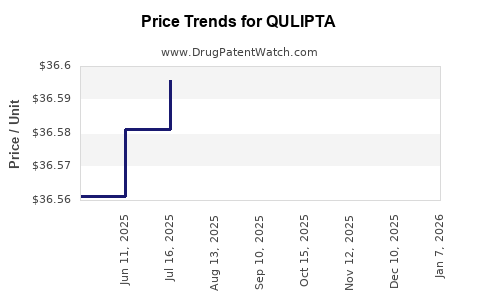
  • What is Average Wholesale Price for QULIPTA?
DrugPatentWatch® Estimated Loss of Exclusivity (LOE) Date for QULIPTA
Generic Entry Date for QULIPTA*:
Constraining patent/regulatory exclusivity:
NDA:
Dosage:

TABLET;ORAL

*The generic entry opportunity date is the latter of the last compound-claiming patent and the last regulatory exclusivity protection. Many factors can influence early or later generic entry. This date is provided as a rough estimate of generic entry potential and should not be used as an independent source.

Recent Clinical Trials for QULIPTA

Identify potential brand extensions & 505(b)(2) entrants

SponsorPhase
AbbViePhase 1
AbbViePhase 3
AllerganPhase 4

See all QULIPTA clinical trials

Paragraph IV (Patent) Challenges for QULIPTA
Tradename Dosage Ingredient Strength NDA ANDAs Submitted Submissiondate
QULIPTA Tablets atogepant 10 mg, 30 mg and 60 mg 215206 6 2025-09-29

US Patents and Regulatory Information for QULIPTA

QULIPTA is protected by nine US patents and two FDA Regulatory Exclusivities.

Based on analysis by DrugPatentWatch, the earliest date for a generic version of QULIPTA is ⤷  Start Trial.

This potential generic entry date is based on patent ⤷  Start Trial.

Generics may enter earlier, or later, based on new patent filings, patent extensions, patent invalidation, early generic licensing, generic entry preferences, and other factors.

Applicant Tradename Generic Name Dosage NDA Approval Date TE Type RLD RS Patent No. Patent Expiration Product Substance Delist Req. Exclusivity Expiration
Abbvie QULIPTA atogepant TABLET;ORAL 215206-003 Sep 28, 2021 RX Yes Yes ⤷  Start Trial ⤷  Start Trial ⤷  Start Trial
Abbvie QULIPTA atogepant TABLET;ORAL 215206-001 Sep 28, 2021 RX Yes No ⤷  Start Trial ⤷  Start Trial ⤷  Start Trial
Abbvie QULIPTA atogepant TABLET;ORAL 215206-002 Sep 28, 2021 RX Yes No ⤷  Start Trial ⤷  Start Trial Y ⤷  Start Trial
Abbvie QULIPTA atogepant TABLET;ORAL 215206-003 Sep 28, 2021 RX Yes Yes ⤷  Start Trial ⤷  Start Trial ⤷  Start Trial
Abbvie QULIPTA atogepant TABLET;ORAL 215206-001 Sep 28, 2021 RX Yes No ⤷  Start Trial ⤷  Start Trial ⤷  Start Trial
Abbvie QULIPTA atogepant TABLET;ORAL 215206-002 Sep 28, 2021 RX Yes No ⤷  Start Trial ⤷  Start Trial ⤷  Start Trial
>Applicant >Tradename >Generic Name >Dosage >NDA >Approval Date >TE >Type >RLD >RS >Patent No. >Patent Expiration >Product >Substance >Delist Req. >Exclusivity Expiration

EU/EMA Drug Approvals for QULIPTA

Company Drugname Inn Product Number / Indication Status Generic Biosimilar Orphan Marketing Authorisation Marketing Refusal
AbbVie Deutschland GmbH & Co. KG Aquipta atogepant EMEA/H/C/005871Aquipta is indicated for prophylaxis of migraine in adults who have at least 4 migraine days per month Authorised no no no 2023-08-11
>Company >Drugname >Inn >Product Number / Indication >Status >Generic >Biosimilar >Orphan >Marketing Authorisation >Marketing Refusal

International Patents for QULIPTA

When does loss-of-exclusivity occur for QULIPTA?

Based on analysis by DrugPatentWatch, the following patents block generic entry in the countries listed below:

Australia

Patent: 15214502
Estimated Expiration: ⤷  Start Trial

Patent: 19226239
Estimated Expiration: ⤷  Start Trial

Patent: 21245229
Estimated Expiration: ⤷  Start Trial

Patent: 21409718
Estimated Expiration: ⤷  Start Trial

Patent: 23258317
Estimated Expiration: ⤷  Start Trial

Patent: 25220825
Estimated Expiration: ⤷  Start Trial

Brazil

Patent: 2016017999
Estimated Expiration: ⤷  Start Trial

Canada

Patent: 37315
Estimated Expiration: ⤷  Start Trial

Patent: 37942
Estimated Expiration: ⤷  Start Trial

Patent: 06184
Estimated Expiration: ⤷  Start Trial

China

Patent: 5939715
Estimated Expiration: ⤷  Start Trial

Patent: 5960397
Estimated Expiration: ⤷  Start Trial

Patent: 2022818
Estimated Expiration: ⤷  Start Trial

European Patent Office

Patent: 02188
Estimated Expiration: ⤷  Start Trial

Patent: 02210
Estimated Expiration: ⤷  Start Trial

Patent: 02211
Estimated Expiration: ⤷  Start Trial

Patent: 02564
Patent: FORMULATION DE COMPRIMÉ POUR COMPOSÉS ACTIFS VIS-À-VIS DU CGRP (TABLET FORMULATION FOR CGRP-ACTIVE COMPOUNDS)
Estimated Expiration: ⤷  Start Trial

Patent: 37412
Estimated Expiration: ⤷  Start Trial

Hong Kong

Patent: 32218
Estimated Expiration: ⤷  Start Trial

Israel

Patent: 6828
Estimated Expiration: ⤷  Start Trial

Japan

Patent: 91669
Estimated Expiration: ⤷  Start Trial

Patent: 66490
Estimated Expiration: ⤷  Start Trial

Patent: 17505306
Estimated Expiration: ⤷  Start Trial

Patent: 19108366
Estimated Expiration: ⤷  Start Trial

Mexico

Patent: 3378
Patent: FORMULACIÓN DE TABLETA PARA COMPUESTOS ACTIVOS DE PÉPTIDO RELACIONADO CON EL GEN DE CALCITONINA. (TABLET FORMULATION FOR CGRP-ACTIVE COMPOUNDS)
Estimated Expiration: ⤷  Start Trial

Patent: 16010169
Patent: FORMULACION DE TABLETA PARA COMPUESTOS ACTIVOS DE PEPTIDO RELACIONADO CON EL GEN DE CALCITONINA. (TABLET FORMULATION FOR CGRP-ACTIVE COMPOUNDS.)
Estimated Expiration: ⤷  Start Trial

Patent: 21006790
Patent: FORMULACION DE TABLETA PARA COMPUESTOS ACTIVOS DE PEPTIDO RELACIONADO CON EL GEN DE CALCITONINA. (TABLET FORMULATION FOR CGRP-ACTIVE COMPOUNDS.)
Estimated Expiration: ⤷  Start Trial

Patent: 23007575
Patent: TRATAMIENTO DE LA MIGRAÑA. (TREATMENT OF MIGRAINE.)
Estimated Expiration: ⤷  Start Trial

Russian Federation

Patent: 96578
Patent: ТЕХНОЛОГИЯ ПРИГОТОВЛЕНИЯ ТАБЛЕТОК ДЛЯ CGRP-АКТИВНЫХ СОЕДИНЕНИЙ (TABLETS PREPARATION TECHNOLOGY FOR CGRP-ACTIVE COMPOUNDS)
Estimated Expiration: ⤷  Start Trial

Patent: 19123406
Patent: ТЕХНОЛОГИЯ ПРИГОТОВЛЕНИЯ ТАБЛЕТОК ДЛЯ CGRP-АКТИВНЫХ СОЕДИНЕНИЙ
Estimated Expiration: ⤷  Start Trial

Saudi Arabia

Patent: 6371613
Patent: CGRP صيغة قرص لمركبات نشطة تجاه (Tablet Formulation for CGRP-Active Compounds)
Estimated Expiration: ⤷  Start Trial

South Korea

Patent: 2448369
Estimated Expiration: ⤷  Start Trial

Patent: 160113296
Patent: CGRP-활성 화합물에 대한 정제 제제 (CGRP- TABLET FORMULATION FOR CGRP-ACTIVE COMPOUNDS)
Estimated Expiration: ⤷  Start Trial

Patent: 220136460
Patent: CGRP-활성 화합물에 대한 정제 제제 (CGRP- TABLET FORMULATION FOR CGRP-ACTIVE COMPOUNDS)
Estimated Expiration: ⤷  Start Trial

Patent: 230107902
Patent: CGRP-활성 화합물에 대한 정제 제제 (CGRP- TABLET FORMULATION FOR CGRP-ACTIVE COMPOUNDS)
Estimated Expiration: ⤷  Start Trial

Patent: 260066189
Patent: CGRP-활성 화합물에 대한 정제 제제 (CGRP- TABLET FORMULATION FOR CGRP-ACTIVE COMPOUNDS)
Estimated Expiration: ⤷  Start Trial

Generics may enter earlier, or later, based on new patent filings, patent extensions, patent invalidation, early generic licensing, generic entry preferences, and other factors.

See the table below for additional patents covering QULIPTA around the world.

Country Patent Number Title Estimated Expiration
Australia 2015214502 ⤷  Start Trial
Australia 2019226239 ⤷  Start Trial
Australia 2021245229 ⤷  Start Trial
Australia 2021409718 ⤷  Start Trial
Australia 2023258317 ⤷  Start Trial
Australia 2025220825 ⤷  Start Trial
Brazil 112016017999 ⤷  Start Trial
>Country >Patent Number >Title >Estimated Expiration

Supplementary Protection Certificates for QULIPTA

Patent Number Supplementary Protection Certificate SPC Country SPC Expiration SPC Description
2638042 301248 Netherlands ⤷  Start Trial PRODUCT NAME: ATOGEPANT OF EEN FARMACEUTISCH AANVAARDBAAR ZOUT DAARVAN; REGISTRATION NO/DATE: EU/1/23/1750 20230814
2638042 PA2023532 Lithuania ⤷  Start Trial PRODUCT NAME: ATOGEPANTAS ARBA FARMACINIU POZIURIU PRIIMTINA JO DRUSKA; REGISTRATION NO/DATE: EU/1/23/1750 20230811
2638042 CR 2023 00033 Denmark ⤷  Start Trial PRODUCT NAME: ATOGEPANT OR A PHARMACEUTICALLY ACCEPTABLE SALT THEREOF; REG. NO/DATE: EU/1/23/1750 20230814
2638042 2023C/541 Belgium ⤷  Start Trial PRODUCT NAME: ATOGEPANT OF EEN FARMACEUTISCH AANVAARDAAR ZOUT DAARVAN; AUTHORISATION NUMBER AND DATE: EU/1/23/1750 20230814
2638042 LUC00321 Luxembourg ⤷  Start Trial PRODUCT NAME: ATOGEPANT OU UN DE SES SELS PHARMACEUTIQUEMENT ACCEPTABLES; AUTHORISATION NUMBER AND DATE: EU/1/23/1750 20230814
2638042 122023000058 Germany ⤷  Start Trial PRODUCT NAME: ATOGEPANT ODER PHARMAZEUTISCH ANNEHMBARES SALZ DAVON; REGISTRATION NO/DATE: EU/1/23/1750 20230811
2638042 34/2023 Austria ⤷  Start Trial PRODUCT NAME: ATOGEPANT ODER EIN PHARMAZEUTISCH ANNEHMBARES SALZ DAVON; REGISTRATION NO/DATE: EU/1/23/1750 (MITTEILUNG) 20230814
>Patent Number >Supplementary Protection Certificate >SPC Country >SPC Expiration >SPC Description

Qulipta (atogepant) Market Dynamics and Financial Trajectory (Revenue, Pricing, Growth, and Patent/Generic Risk)

Last updated: July 26, 2026

Qulipta is a CGRP receptor antagonist (gepant) for migraine prevention. Commercial trajectory is driven by formulary access and persistence in a competitive class (Nurtec ODT, Vyepti, Aimovig/Ajovy/Emgality, and branded gepants). Near-to-midterm financial momentum depends on (1) expansion to additional patient segments and dosing settings (2) payer step edits versus premium continuation criteria and (3) ongoing label growth, while long-term revenue risk is shaped by exclusivity timing and the quality of Orange Book patent coverage for atogepant formulations and methods.


What is Qulipta (atogepant) and how does it compete in chronic episodic migraine prevention?

Qulipta is marketed for prevention of episodic migraine and chronic migraine (brand-to-indication breadth affects payer controls and channel mix). As a daily oral therapy, it competes against:

  • CGRP monoclonal antibodies (erenumab, fremanezumab, galcanezumab, eptinezumab)
  • Other oral CGRP antagonists (rimegepant for prevention and acute use; zavegepant for acute)
  • Traditional migraine preventives (beta blockers, anticonvulsants, antidepressants) where formulary preferences still vary by managed care design

How does Qulipta’s mechanism affect payer behavior versus monoclonal antibodies?

Payers typically manage migraine biologics around specialty pharmacy utilization, prior authorization, and “step-through” to high-cost therapy. Qulipta’s oral format can reduce infusion/site-of-care friction but can still trigger quantity limits, step therapy, or discontinuation criteria based on response thresholds.

Competitive positioning to watch (commercial dynamics)

Key competitive variables that shape uptake and revenue trajectory:

  • Line-of-therapy placement (how quickly Qulipta is used after older preventives)
  • Persistence and dose-switching (patient retention at target dose is critical for daily oral brands)
  • Payer criteria: continuation requirements, PA renewal windows, and denial rates by plan
  • Wholesale acquisition cost (WAC) vs net pricing, given heavy rebate dynamics in migraine

What drives Qulipta market share growth: payer access, persistence, or label expansion?

Short answer: Qulipta’s commercial trajectory is primarily shaped by payer adoption and persistence in migraine prevention, with label and patient segment expansion acting as a multiplier once access is secured.

Payer access dynamics

For migraine prevention, access is typically mediated by:

  • Prior authorization gating (documented diagnosis, frequency, prior preventive failures)
  • Step therapy for plan members who have not tried older preventives
  • Exclusion criteria related to concurrent CGRP mAbs or other gepants
  • Renewal criteria tied to clinical response (headache days reduction)

If plans treat oral gepants as interchangeable within class, net revenue can become pricing-leverage dependent. If Qulipta maintains distinct outcomes in subgroups used by payers to justify coverage, it sustains premium net pricing.

Persistence and discontinuation

For daily oral migraine preventives, the profit profile depends on:

  • Time-to-discontinuation by plan and patient segment
  • Treatment switching to CGRP mAbs after inadequate response
  • Restart rates after discontinuation (some plans allow re-initiation after a defined washout)

These factors can improve or erode the “net revenue per member-year” metric even if gross script counts hold steady.

Brand-to-brand switching patterns

In the gepant class, competitive dynamics can compress net pricing. Qulipta’s growth tends to be strongest when it captures:

  • Patients who prefer oral therapy over injections
  • Patients who experienced inadequate response or intolerance to CGRP mAbs
  • Members with formulary designs that favor one gepant over another based on rebate contracts

How does Qulipta compare with Nurtec ODT (rimegepant) and CGRP monoclonal antibodies on commercial outcomes?

Featured-snippet framing: Oral gepants compete on formulary placement and net price, while mAbs compete on specialty access frameworks and dosing convenience.

Qulipta vs Nurtec ODT (rimegepant)

  • Both are oral CGRP antagonists used for migraine prevention.
  • The competitive battleground is managed care contracting: rebates, formulary tiering, and PA algorithms.
  • Net price pressure rises when payers can justify either drug under the same clinical criteria.

Commercial impact drivers

  • Plan preference (preferred gepant)
  • Net-to-gross relationship by contract
  • Prescriber habits after initial trials and early discontinuation

Qulipta vs CGRP monoclonal antibodies

  • mAbs have high brand visibility and long-established specialty frameworks.
  • Qulipta’s daily oral regimen competes for patients who avoid injections.
  • Payer uses may favor mAbs for patients who failed oral preventives, but oral adoption can increase if plans simplify PA for oral gepants.

What is the financial trajectory for Qulipta: revenue growth, margin profile, and distribution channel mix?

Short answer: Qulipta’s financial trajectory is determined by script growth plus net pricing discipline, with profitability influenced by rebate levels and mix between commercial and specialty channels.

What typically shapes revenue growth for a migraine prevention brand

  • Script growth: new patient starts and persistence
  • Treatment duration: impact of discontinuations and dose adjustments
  • Net pricing: rebate and contract terms with major PBMs
  • Mix shift: commercial vs Medicare vs Medicaid, and mail-order vs specialty pharmacy fulfillment

Margin profile considerations

Migraine brands often show:

  • Meaningful gross-to-net compression due to payer rebates and managed care contracting
  • Operating leverage hinges on how fast sales scale without proportional increases in promotional spend and contracting costs

For business planning, the most predictive KPI set is:

  • Net sales growth rate (quarterly trend)
  • Net-to-gross percentage by period
  • Persistence (median days on therapy by cohort) and discontinuation rate
  • Specialty vs retail/mail mix and channel expansion

When does Qulipta lose exclusivity, and what does the patent clock mean for revenue risk?

Featured-snippet framing: Revenue risk accelerates when Orange Book-listed patents and any relevant exclusivity periods approach expiration or are targeted by Paragraph IV challenges.

This section focuses on the exclusivity and patent clock concept for atogepant:

  • Orange Book patent expirations set the hard barrier for generic entry (unless litigation results in earlier carve-outs)
  • Exclusivity can add “regulatory moat” beyond the earliest patent expiration depending on FDA approval pathway and exclusivity grants

Patent-expiration and generic-entry mapping (what to model)

For a launch-risk model, use three dates:

  1. Earliest Orange Book patent expiration (mechanism, composition, formulation, or method-of-use)
  2. Any additional listed patents expiring later that block generic approvals
  3. Court outcomes that could trigger “carve-out” effective entry

Commercial translation: The closer the earliest blocking patent expiration, the higher the probability of:

  • Heightened settlement activity and licensing
  • Paragraph IV litigation
  • Reduced payer confidence and increased market share volatility as biosimilar/generic expectations rise

What patents protect Qulipta (atogepant), and how strong is the patent estate for generics?

Short answer: Qulipta’s generic barrier depends on the breadth of Orange Book-listed patents across composition, formulations, and methods of use, plus the history and outcomes of any Paragraph IV challenges.

How to evaluate “estate strength” for business decisions

A high-barrier estate typically has:

  • Multiple overlapping patent families listed in the Orange Book for key product claims
  • Claims that cover dosing regimens and patient-treatment methods
  • Formulation or process patents that complicate generic “design-around”

A weaker estate is one where:

  • Only narrow formulation claims are listed for the marketed dosage forms
  • Method-of-use claims are limited by interpretation or prosecution history
  • Litigation history shows easy invalidation or non-infringement

What formulations can change the risk profile?

If Orange Book coverage includes:

  • Tablet strength-specific patents
  • Pharmacokinetic-enhanced or stability-related formulations
  • Manufacturing/process claims then the generic risk rises slower and may require line extensions, which can delay entry.

Have any generic or biosimilar challenges been filed against Qulipta under Paragraph IV or similar pathways?

Short answer: The presence and timing of Paragraph IV filings drive expected generic entry timing and influence both payer behavior and investor expectations.

Paragraph IV frameworks matter because:

  • Filing date can signal entry intent and trigger settlement negotiations
  • Court decisions can accelerate or delay first generic launch
  • Settlements can include “at-risk” periods, delayed entry, and license terms

What is the Orange Book status of Qulipta (atogepant), including listed patents and expiration landscape?

Featured-snippet framing: The Orange Book is the controlling source for which patents block generic approval for atogepant, and the expiration cadence defines the practical horizon for generic entry.

For a business analysis, the Orange Book status should be summarized as:

  • Patent numbers and types (composition, formulation, method-of-use, manufacturing)
  • Expiration dates
  • Whether any patents have multiple dosage strengths or are claim-dependent
  • Whether any patents are later-than-earliest in a “stacked” expiration landscape

What patent litigation affects Qulipta, and how have settlements changed expected generic entry dates?

Short answer: Litigation outcomes determine whether Qulipta faces earlier generic entry through invalidation/non-infringement rulings, design-around workarounds, or settlement-driven delayed entry.

What to model in settlement and litigation terms

  • The “effective entry date” used in financial modeling, which can differ from statutory expiration due to settlements
  • Scope of covered strengths and formulations
  • Terms that permit an authorized generic, partial entry, or launch restrictions

How does Qulipta’s regulatory path (FDA label, approvals, and post-marketing changes) affect sales?

Short answer: Regulatory events that expand or clarify labeling can widen eligible patient populations and reduce PA friction, supporting script growth.

Commercially relevant regulatory levers include:

  • Label expansions (new patient subsets, expanded indication language)
  • Safety communications that do not disrupt use
  • Dosing regimen changes that simplify prescribing

What generic entry risks exist for Qulipta: market disruption scenarios and timeline impact?

Short answer: Generic entry risk spikes near patent expiry and settlement windows, with disruption depending on the number of blocking patents, strength of method-of-use coverage, and likelihood of “first-to-file” launch.

Market disruption scenarios (for planning)

Plan for at least three scenarios:

  1. Delayed entry: multiple later-expiring patents hold, and first generic entry is pushed back
  2. Segmented entry: some strengths/forms enter first while others remain blocked
  3. Accelerated entry: early loss of key patents or broad settlement windows allow faster launch

What happens to pricing and share after entry?

If multiple generics enter quickly, Qulipta net price typically declines through:

  • PBM switching to lowest net price options
  • Higher rebate pressure to maintain preferred formulary status
  • Increased use of quantity limits or step edits to slow switching

How does Qulipta’s demand outlook interact with overall migraine market growth?

Short answer: Migraine prevention is a long-duration market where demand grows through diagnosis awareness, adherence, and payer adoption of novel preventives.

Revenue trajectory depends on:

  • The size of the treatable eligible population (episodic vs chronic)
  • New start rates vs switches from CGRP mAbs and oral preventives
  • The fraction of patients who remain on therapy after the initial period

Key competitor and payer landscape: which companies are most exposed to Qulipta’s share shifts?

Short answer: Competitors most exposed include other CGRP preventives where payers can shift within class: Nurtec ODT and CGRP mAbs, plus generic market participants facing the atogepant exclusivity window.

Competitive exposure map (conceptual)

  • High exposure: branded class competitors with similar payer criteria and overlapping patient selection
  • Medium exposure: older oral preventives where switching is payer-guided
  • High exposure at exclusivity edges: generic entrants planning for first-to-file strategy

What manufacturing and supply risks could affect Qulipta availability and financial results?

Short answer: Supply interruptions can immediately distort scripts, while recovery can take quarters due to re-establishment of pharmacy channel inventory and prescriber confidence.

Key risk points in modeling:

  • Contract manufacturing continuity and regulatory compliance
  • Pharmacy benefit distribution stability (mail order and specialty partner capacity)
  • Lead times for scaling production near anticipated demand surges

Key Takeaways

  • Qulipta’s financial trajectory is driven by payer access, persistence, and net pricing in migraine prevention, with competition from both gepants and CGRP monoclonal antibodies.
  • Revenue risk rises as the Orange Book patent clock approaches its earliest expirations and as Paragraph IV litigation and settlements clarify “effective entry dates.”
  • Business planning should model generic disruption under delayed, segmented, and accelerated entry scenarios using Orange Book expiration cadence and litigation outcomes.
  • Near-term commercial execution depends on reducing PA friction and maximizing retention, since daily oral migraine preventives are persistence-sensitive.

FAQs

  1. How does Qulipta net pricing typically change when a preferred-contract status is lost on PBM formularies?
  2. Which patient subgroups (episodic vs chronic) tend to drive the fastest Qulipta script growth under payer step-edit rules?
  3. What Orange Book patent types (composition vs method-of-use vs formulation) usually create the longest generic barriers for atogepant?
  4. How do settlement agreements in CGRP inhibitor litigation commonly affect the effective launch date for authorized generics?
  5. What demand signals best predict whether Qulipta will sustain growth after the initial dose ramp-up period?

References

  1. FDA. Orange Book: Approved Drug Products with Therapeutic Equivalence Evaluations. U.S. Food and Drug Administration.
  2. FDA. Drugs@FDA: Qulipta (atogepant). U.S. Food and Drug Administration.

More… ↓

⤷  Start Trial

Make Better Decisions: Try a trial or see plans & pricing

Drugs may be covered by multiple patents or regulatory protections. All trademarks and applicant names are the property of their respective owners or licensors. Although great care is taken in the proper and correct provision of this service, thinkBiotech LLC does not accept any responsibility for possible consequences of errors or omissions in the provided data. The data presented herein is for information purposes only. There is no warranty that the data contained herein is error free. We do not provide individual investment advice. This service is not registered with any financial regulatory agency. The information we publish is educational only and based on our opinions plus our models. By using DrugPatentWatch you acknowledge that we do not provide personalized recommendations or advice. thinkBiotech performs no independent verification of facts as provided by public sources nor are attempts made to provide legal or investing advice. Any reliance on data provided herein is done solely at the discretion of the user. Users of this service are advised to seek professional advice and independent confirmation before considering acting on any of the provided information. thinkBiotech LLC reserves the right to amend, extend or withdraw any part or all of the offered service without notice.