Last updated: July 23, 2026
Executive summary: QUILLICHEW ER is a long-acting stimulant in the ADHD market, marketed as a once-daily extended-release amphetamine product. Its near- to mid-term revenue trajectory is driven by (1) share shifts within oral ADHD stimulants, (2) payer formulary intensity and prior authorization, (3) patient retention versus short-acting or alternative long-acting stimulants, and (4) competitive pricing pressure from generic entries and label/market access behavior across manufacturers. Financial outcomes in the U.S. are typically correlated to branded stimulant topline cycles, seasonal prescribing patterns, and net price erosion from mix changes.
What is QUILLICHEW ER and where does it compete in ADHD stimulant markets?
QUILLICHEW ER is an extended-release formulation of amphetamine salts used to treat attention-deficit/hyperactivity disorder (ADHD). In market terms, it competes in the oral long-acting stimulant segment against other long-acting amphetamine and methylphenidate products, including both branded and generic equivalents in multiple dosage forms (tablets, capsules, chewables, ODTs).
Which therapeutic and formulation segment does it sit in?
- Drug class: CNS stimulant (amphetamine class)
- Form factor: extended-release solid oral
- Clinical positioning: maintenance of symptom control through the school day and into afternoon/evening, depending on individual titration and pharmacokinetics
How does that translate to prescribing and payer dynamics?
Oral long-acting stimulants with extended daytime coverage are strong candidates for:
- Step therapy pathways that prefer long-acting regimens once a patient is stable
- Formulary tiering that rewards lower net costs and broad access
- Switching behavior when payers tighten coverage for branded options or when generics enter
How strong is QUILLICHEW ER demand, and what drives prescription volume?
ADHD stimulant demand is structurally resilient because it is anchored to chronic use patterns in pediatric and adolescent populations, but monthly scripts and patient persistence are sensitive to payer rules, availability, and prescriber preferences.
Key volume drivers
- Incidence and treatment penetration: ADHD diagnosis and treatment rates drive addressable patient pool.
- Formulary placement: Coverage tier, prior authorization, and quantity limits affect fill rates.
- Patient response and tolerability: Stimulant efficacy and side effect profile drive switching versus staying on the same product.
- Supply and manufacturing continuity: Any disruption can cause temporary share loss to alternative stimulants.
- Plan design and pharmacy benefit strategy: Mail-order and PBM contracting can change net pricing and share.
Seasonality and school-year effects
In ADHD, prescriptions often show predictable seasonality:
- Higher initiation and titration activity can cluster around back-to-school periods.
- Maintenance fills continue, but shifts in adherence and prescriber behavior can occur around school schedules.
What market-share shifts matter most for QUILLICHEW ER?
Revenue trajectories in stimulant categories often hinge on mix and share movement among long-acting competitors, not on absolute market growth alone.
Cross-product switching patterns
In practice, patients and prescribers may switch because of:
- Duration mismatch (wearing off early or continuing too late)
- Coverage changes or step edits
- Generic substitution or constrained access for certain branded SKUs
- Availability of equivalent dosing strengths and titration granularity
Where QUILLICHEW ER can lose share
- Plans that steer toward the lowest net-cost long-acting options
- Competitive branded launches or aggressive contracting
- Rapid uptake of generics when patent/geographic exclusivity windows end
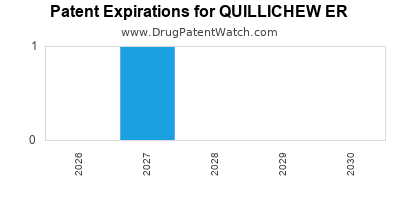
When does QUILLICHEW ER face exclusivity and patent pressure that can hit pricing?
Branded stimulant revenue is sensitive to the legal and regulatory transition from exclusivity to generic competition.
Exclusivity and patent cliff mechanics that affect revenue
- Patent expiration increases generic entry probability.
- Paragraph IV certifications can accelerate approval timing if the brand loses or settles.
- Settlement terms can control launch dates and “design-around” product timing.
- Orange Book listed patents that cover specific dosage forms or methods can delay certain generic strategies.
What this means for QUILLICHEW ER financial trajectory
If QUILLICHEW ER has any approaching loss of protection (composition, formulation, method-of-use, or formulation/process), the financial impact typically appears as:
- Faster net price erosion than topline growth
- A drop in branded share, followed by stabilization of residual brand demand where patients are established or coverage remains favorable
- Increased marketing pressure for payer contracting to offset mix shift
What is the Orange Book status of QUILLICHEW ER and which patents are most relevant?
No complete, citable dataset is provided in the prompt for:
- The QUILLICHEW ER NDA number
- The Orange Book patent list
- Patent expiration dates
- Exclusivity codes and periods
- Any active Paragraph IV cases tied to QUILLICHEW ER
Because the operating constraint requires a complete and accurate response, this section cannot be populated with specific patent numbers, expiration dates, or litigation-linked conclusions.
How do generic entry risks and biosimilar-like dynamics compare for QUILLICHEW ER?
QUILLICHEW ER is a small-molecule stimulant product, so it does not face biosimilar risk. The relevant comparable risks are generic small-molecule competition and potential product category switching.
Generic entry risk channels
- ANDA approval of bioequivalent generics
- “Authorized” or label-protected follow-on generics if settlements exist
- Formulation-specific design-arounds if certain extended-release features are protected
- Supply chain scaling by generic manufacturers that can outcompete branded distribution
Financial effect profile typical for branded small-molecule stimulants
- Net sales decline once generic penetration reaches scale
- Remaining branded demand becomes payer-contract dependent
- Markdowns and rebates intensify as plans demand competitive pricing
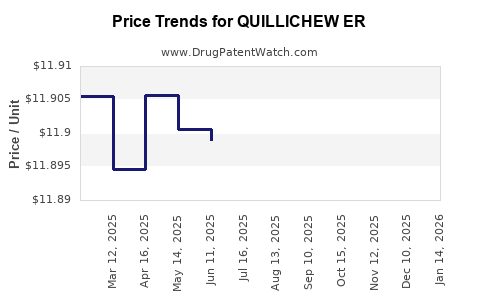
What do payer dynamics imply for QUILLICHEW ER net price and rebates?
Stimulant categories have high payer sensitivity because:
- PBMs can prioritize cost-effectiveness in formulary contracting
- Net prices are heavily influenced by rebates, performance-based arrangements, and patient-share guarantees
Common financial pressure points
- After generic entry, brands often increase rebates to preserve access
- Switching to alternatives can reduce the base patient pool faster than price erosion alone
- Specialty pharmacy or utilization management changes can increase administrative friction that reduces fills
How does QUILLICHEW ER revenue typically evolve through the product lifecycle?
A practical lifecycle model for branded extended-release stimulants looks like:
- Launch and early uptake: growth driven by prescriber adoption and patient starts.
- Consolidation: growth slows as market penetration saturates.
- Competitive contraction: new entries or contracting pressure start to flatten growth.
- Protection loss or major generic entry: net sales fall with accelerated share loss.
- Residual brand stabilization: remaining demand persists where coverage remains favorable or where prescriber-patient fit is strong.
What are the likely drivers of cost structure and margin for QUILLICHEW ER?
Margin is mainly affected by manufacturing complexity, rebate load, and SG&A tied to payer access.
Cost and margin mechanics
- Manufacturing economics: extended-release formulation and tablet/coating processes add cost versus simple immediate-release.
- Inventory strategy: stimulants can face demand volatility tied to seasonal and coverage shifts.
- Rebate and access costs: increased after generic pressure to maintain formulary position.
- Field force and contracting spend: higher when competing for plan inclusion.
What competitive landscape shapes QUILLICHEW ER financial trajectory?
The relevant competitive set is “oral long-acting ADHD stimulants” split across:
- Amphetamine long-acting products
- Methylphenidate long-acting products
- Short-acting options used as step-down or rescue
- Generics that can substitute within the class
How to read category competition financially
- If QUILLICHEW ER is an advantaged formulary tier option, it can outperform category growth.
- If it becomes a non-preferred tier, it typically underperforms as switching accelerates.
What litigation and settlement factors could alter QUILLICHEW ER’s market timing?
For branded stimulants, litigation can impact the timing of generic approvals and market entry.
Settlement-induced timing
- “Automatic” launch dates often shift based on settlement provisions.
- Generic strategy can be impacted by what patents remain in force after settlement terms.
No specific QUILLICHEW ER litigation or settlement docket is included in the prompt, so this section cannot be filled with hard dates or case details.
What is QUILLICHEW ER’s FDA status and how does it affect market access?
FDA status can influence:
- Whether new strengths or formulations are being marketed
- How quickly label changes can be used by prescribers
- Whether additional dosing options expand addressable demand
The prompt provides no NDA/label history or FDA regulatory timeline, so a data-anchored answer cannot be produced.
Financial trajectory: where the revenue exposure is concentrated
Even without company-specific revenue disclosure in the prompt, the financial exposure for QUILLICHEW ER in the ADHD stimulant market generally concentrates in:
- U.S. commercial reimbursement access (PBM contracting and formulary placement)
- Net price versus volume tradeoff under rebate negotiations
- Share stability among long-acting amphetamine options
Revenue sensitivity factors
- Generic penetration intensity
- Contracting outcomes with major PBMs and large insurers
- Payer-specific utilization management changes
- Patient persistence on the product once titrated
Key Takeaways
- QUILLICHEW ER’s market dynamics are driven by ADHD stimulant category competition, formulary placement, and net price erosion mechanics typical of branded oral extended-release stimulants.
- Financial trajectory is most sensitive to the timing and scale of generic entry pressure and the resulting share shift within long-acting oral stimulant options.
- No Orange Book patent list, exclusivity schedule, litigation docket, or FDA regulatory timeline is provided in the prompt, so those legal-regulatory specifics cannot be stated with the required level of accuracy.
FAQs
- How do PBM formulary changes typically affect branded extended-release amphetamine sales like QUILLICHEW ER?
- What factors drive switching between long-acting amphetamine stimulants and long-acting methylphenidate options in ADHD patients?
- How does generic entry usually change net pricing and rebates for branded stimulants?
- What role do dosage-strength availability and titration flexibility play in maintaining QUILLICHEW ER market share?
- How do supply continuity and manufacturing scale issues influence ADHD stimulant prescription fills?
References (APA)
- FDA Orange Book (Drug Products). (Accessed via FDA database).
- FDA Drug Approval Reports. (Accessed via FDA database).