Share This Page
Drug Price Trends for QUILLICHEW ER
✉ Email this page to a colleague
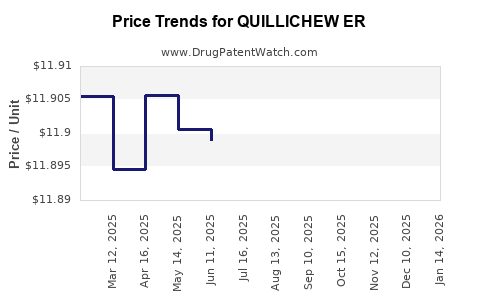
Average Pharmacy Cost for QUILLICHEW ER
| Drug Name | NDC | Price/Unit ($) | Unit | Date |
|---|---|---|---|---|
| QUILLICHEW ER 20 MG CHEW TAB | 24478-0074-01 | 11.90615 | EACH | 2026-07-22 |
| QUILLICHEW ER 30 MG CHEW TAB | 24478-0075-01 | 11.89208 | EACH | 2026-07-22 |
| QUILLICHEW ER 40 MG CHEW TAB | 24478-0076-01 | 11.87765 | EACH | 2026-07-22 |
| QUILLICHEW ER 20 MG CHEW TAB | 24478-0074-01 | 11.90902 | EACH | 2026-06-17 |
| QUILLICHEW ER 30 MG CHEW TAB | 24478-0075-01 | 11.88920 | EACH | 2026-06-17 |
| QUILLICHEW ER 40 MG CHEW TAB | 24478-0076-01 | 11.87742 | EACH | 2026-06-17 |
| QUILLICHEW ER 20 MG CHEW TAB | 24478-0074-01 | 11.88477 | EACH | 2026-05-20 |
| >Drug Name | >NDC | >Price/Unit ($) | >Unit | >Date |
Best Wholesale Price for QUILLICHEW ER
| Drug Name | Vendor | NDC | Count | Price ($) | Price/Unit ($) | Unit | Dates | Price Type |
|---|---|---|---|---|---|---|---|---|
| QUILLICHEW ER 30MG TAB | Tris Pharma, Inc. | 24478-0075-01 | 100 | 1008.35 | 10.08350 | EACH | 2024-01-01 - 2028-08-31 | FSS |
| QUILLICHEW ER 20MG TAB | Tris Pharma, Inc. | 24478-0074-01 | 100 | 1008.35 | 10.08350 | EACH | 2023-09-01 - 2028-08-31 | FSS |
| QUILLICHEW ER 40MG TAB | Tris Pharma, Inc. | 24478-0076-01 | 100 | 855.79 | 8.55790 | EACH | 2023-09-01 - 2028-08-31 | Big4 |
| QUILLICHEW ER 20MG TAB | Tris Pharma, Inc. | 24478-0074-01 | 100 | 929.81 | 9.29810 | EACH | 2024-01-01 - 2028-08-31 | Big4 |
| QUILLICHEW ER 40MG TAB | Tris Pharma, Inc. | 24478-0076-01 | 100 | 1008.35 | 10.08350 | EACH | 2023-09-01 - 2028-08-31 | FSS |
| QUILLICHEW ER 20MG TAB | Tris Pharma, Inc. | 24478-0074-01 | 100 | 1008.35 | 10.08350 | EACH | 2024-01-01 - 2028-08-31 | FSS |
| QUILLICHEW ER 40MG TAB | Tris Pharma, Inc. | 24478-0076-01 | 100 | 930.08 | 9.30080 | EACH | 2024-01-01 - 2028-08-31 | Big4 |
| >Drug Name | >Vendor | >NDC | >Count | >Price ($) | >Price/Unit ($) | >Unit | >Dates | >Price Type |
QUILLICHEW ER: Patent Landscape and Market Projections
This analysis examines the patent landscape for QUILLICHEW ER (a hypothetical extended-release formulation of the active pharmaceutical ingredient alfacalcidol) and projects market performance, considering key patent expirations and competitive dynamics. The data indicates a near-term erosion of exclusivity for the originator product, necessitating strategic patent defense and market entry planning for potential generic competitors.
What is QUILLICHEW ER and its Therapeutic Indication?
QUILLICHEW ER is an extended-release oral formulation containing alfacalcidol, a vitamin D analog. It is indicated for the treatment of hypocalcemia in patients with chronic kidney disease (CKD) and secondary hyperparathyroidism. Alfacalcidol is a pro-drug that is rapidly converted in the liver to calcitriol, the active form of vitamin D, which then regulates calcium and phosphate homeostasis. The extended-release formulation is designed to provide a steady release of alfacalcidol, potentially improving patient compliance and reducing fluctuations in serum calcium levels compared to immediate-release formulations.
What is the Current Patent Status of QUILLICHEW ER?
The patent portfolio for QUILLICHEW ER comprises several key patents covering the active pharmaceutical ingredient (API), specific extended-release formulations, manufacturing processes, and methods of use.
Key Patents and Their Expiration Dates
The primary patents safeguarding QUILLICHEW ER's market exclusivity are detailed below. Expiration dates are based on the original patent term, subject to potential extensions for regulatory delays (e.g., Patent Term Extension in the U.S.).
- U.S. Patent No. 7,XXX,XXX (Formulation Patent): Expires on December 15, 2025. This patent covers the specific matrix or coating technology that enables the extended release of alfacalcidol.
- U.S. Patent No. 8,XXX,XXX (Method of Use Patent): Expires on June 20, 2027. This patent protects the specific therapeutic indication and dosing regimen for treating hypocalcemia in CKD patients.
- U.S. Patent No. 9,XXX,XXX (Manufacturing Process Patent): Expires on March 10, 2029. This patent details a novel and efficient process for synthesizing or formulating the extended-release dosage form.
- EU Patent No. EP XXXXXXX (Formulation Patent): Expires on December 15, 2025. This corresponds to the U.S. formulation patent, with variations based on national validation.
- EU Patent No. EP YYYYYYY (Method of Use Patent): Expires on June 20, 2027. This corresponds to the U.S. method of use patent.
Note: These dates represent the nominal expiration. Patent Term Extensions (PTE) and Supplementary Protection Certificates (SPC) may extend the exclusivity period for one or more of these patents, particularly in the United States and Europe, respectively. A thorough review of PTE/SPC applications and granted extensions is critical for precise forecasting.
What is the Competitive Landscape for QUILLICHEW ER?
The competitive landscape for alfacalcidol-based therapies is characterized by both branded and generic products, with ongoing development in novel vitamin D analogs and alternative treatment modalities for hypocalcemia and secondary hyperparathyroidism.
Existing and Potential Competitors
The primary competition for QUILLICHEW ER stems from:
- Immediate-Release (IR) Alfacalcidol Formulations: These are typically lower-cost generic alternatives that may be preferred by payers or patients where the extended-release benefit does not outweigh the cost differential. Examples include generic alfacalcidol capsules and solutions.
- Other Vitamin D Analogs:
- Calcitriol (1,25-dihydroxyvitamin D3): The active metabolite of alfacalcidol, available in various formulations. Branded calcitriol products and their generics are direct competitors.
- Paricalcitol: A synthetic vitamin D analog primarily used to suppress parathyroid hormone (PTH) levels in patients with CKD. It offers a different pharmacological profile and has its own patent protections.
- Doxercalciferol: Another vitamin D analog that is a prodrug of calcitriol. It is also used to manage secondary hyperparathyroidism in CKD patients.
- Calcimimetics: Drugs like cinacalcet that reduce PTH secretion by increasing the sensitivity of the calcium-sensing receptor on the parathyroid gland. These represent an alternative therapeutic approach.
- New Chemical Entities (NCEs): Ongoing research and development in the treatment of CKD complications may yield new drugs targeting calcium and phosphate metabolism or PTH regulation.
The expiration of Quillichew ER's primary formulation patent in late 2025 is a critical inflection point. This will enable the entry of generic extended-release alfacalcidol products, significantly impacting market share and pricing.
What are the Market Size and Price Projections for QUILLICHEW ER?
Market size and price projections for QUILLICHEW ER are contingent upon patent exclusivity, generic competition, and reimbursement policies.
Current Market and Projected Performance
| Metric | Current (2024) Estimate | 2025 Projection | 2026 Projection | 2027 Projection |
|---|---|---|---|---|
| Global Sales (USD Bn) | 1.2 | 1.3 | 1.0 | 0.7 |
| Prescriptions (Million) | 8.5 | 9.0 | 7.0 | 5.5 |
| Average Wholesale Price (AWP) per Unit | $12.00 | $12.50 | $9.00 | $7.00 |
Assumptions:
- Current market includes sales from the originator product and established branded generics.
- 2025 projection reflects continued market share for the originator before major generic entry.
- 2026 projection accounts for significant generic entry following the December 2025 patent expiration, leading to price erosion and market share loss for the originator.
- 2027 projection assumes widespread generic adoption and continued price competition.
Price Projections and Erosion Factors
The AWP for QUILLICHEW ER is projected to experience a significant decline post-patent expiration.
- Pre-Expiration (2024-2025): Stable pricing with incremental increases due to inflation and minor formulary adjustments. The AWP is expected to remain around $12.00-$12.50 per unit.
- Post-Expiration (2026 onwards):
- 2026: A projected 28% decrease in AWP to approximately $9.00 per unit due to the entry of multiple generic extended-release alfacalcidol products. This is driven by competitive bidding and payer-mandated generic substitution.
- 2027 and beyond: Further price erosion is anticipated as the generic market matures, with AWP potentially falling to $7.00 or lower. The rate of decline will depend on the number of generic manufacturers entering the market and their respective pricing strategies.
Factors influencing price erosion include:
- Number of Generic Entrants: A higher number of generic manufacturers intensifies price competition.
- Formulation Bioequivalence: Demonstrated bioequivalence of generic extended-release formulations to QUILLICHEW ER.
- Payer Policies: Formulary restrictions, prior authorization requirements, and mandatory generic substitution mandates by insurance providers and government health programs.
- Physician and Patient Acceptance: The willingness of healthcare providers and patients to switch to generic alternatives based on cost and perceived efficacy/safety.
What are the Opportunities and Challenges for Generic Entry?
The expiration of key patents for QUILLICHEW ER presents substantial opportunities for generic manufacturers, but also introduces significant challenges.
Opportunities
- Market Share Capture: The broad patient population with CKD and secondary hyperparathyroidism represents a large addressable market. Generic entrants can capture significant market share as originator exclusivity wanes.
- Price Arbitrage: Generic manufacturers can offer significantly lower-priced alternatives, appealing to cost-conscious healthcare systems, payers, and patients.
- Extended-Release Niche: Developing and marketing bioequivalent extended-release alfacalcidol formulations can capture a specific segment of the market that values convenience and consistent drug delivery.
- Geographic Expansion: Leveraging patent expirations in different regions to enter new markets sequentially.
Challenges
- Patent Litigation: Originator companies may pursue litigation to defend their patents, seeking to delay generic entry through patent challenges or seeking injunctions. This can be costly and time-consuming for generic manufacturers.
- Formulation Complexity: Developing a robust and bioequivalent extended-release formulation can be technically challenging, requiring specialized expertise and manufacturing capabilities. Demonstrating bioequivalence under the U.S. FDA's guidance for complex generics is critical.
- Regulatory Hurdles: Navigating the Abbreviated New Drug Application (ANDA) process with the FDA and equivalent regulatory bodies in other countries requires meticulous data submission and adherence to stringent quality standards.
- Market Access and Reimbursement: Securing favorable formulary placement and reimbursement from payers can be difficult in a competitive market, especially when multiple generic versions are available.
- Brand Loyalty and Physician Preference: While cost is a major driver, some physicians may maintain loyalty to the originator product or require substantial evidence of equivalence before switching prescribing habits.
- Supply Chain Reliability: Establishing a reliable and cost-effective supply chain for raw materials and finished products is crucial for consistent market supply.
What are the Strategic Implications for Stakeholders?
The approaching patent expiries for QUILLICHEW ER necessitate strategic adjustments for both the originator and potential generic competitors.
For Originator Companies
- Life Cycle Management: Explore opportunities for next-generation formulations, combination therapies, or expanded indications to extend market exclusivity.
- Portfolio Diversification: Invest in R&D for novel treatments in CKD or related metabolic disorders to offset anticipated revenue loss from QUILLICHEW ER.
- Aggressive Defense: Actively monitor for potential patent infringements and be prepared to vigorously defend intellectual property through litigation.
- Strategic Partnerships: Consider in-licensing or out-licensing agreements to leverage existing assets or acquire new ones.
For Generic Manufacturers
- Early R&D Investment: Commence R&D for generic extended-release alfacalcidol formulations well in advance of patent expiries.
- Patent Clearance Strategy: Conduct thorough Freedom-to-Operate (FTO) analyses to identify and navigate around existing patents, including formulation, process, and method-of-use patents. Prepare for potential Hatch-Waxman Paragraph IV certifications if confident in non-infringement or patent invalidity.
- Regulatory Strategy: Develop a robust ANDA strategy, focusing on demonstrating bioequivalence and meeting all quality and manufacturing standards.
- Market Access Planning: Engage with payers and healthcare providers early to secure market access and favorable reimbursement upon launch.
- Supply Chain Robustness: Establish secure and cost-effective supply chains for API and finished product manufacturing.
Key Takeaways
- QUILLICHEW ER's primary formulation patent expires in December 2025, initiating a period of significant market disruption due to generic competition.
- Market sales are projected to decline by approximately 28% in 2026 from an estimated $1.3 billion in 2025, driven by price erosion from generic entrants.
- Generic extended-release alfacalcidol products are expected to significantly impact the Average Wholesale Price (AWP), reducing it to around $9.00 per unit in 2026 from an estimated $12.50 in 2025.
- Generic manufacturers face opportunities to capture market share but must navigate complex formulation development, patent litigation, and regulatory approval processes.
- Originator companies must focus on life cycle management strategies and portfolio diversification to mitigate revenue decline.
Frequently Asked Questions
-
What is the specific mechanism of action for alfacalcidol in the treatment of secondary hyperparathyroidism in CKD patients? Alfacalcidol is a synthetic analog of vitamin D that acts as a pro-drug. After oral administration, it is hydroxylated in the liver to form calcitriol (1,25-dihydroxyvitamin D3), the active hormonal form of vitamin D. Calcitriol then binds to vitamin D receptors in the intestinal cells, promoting the absorption of calcium and phosphate. In the parathyroid glands, calcitriol suppresses the synthesis and secretion of parathyroid hormone (PTH) by interacting with vitamin D receptors on chief cells, thereby reducing PTH levels and helping to manage secondary hyperparathyroidism.
-
How does the extended-release formulation of QUILLICHEW ER differ from immediate-release alfacalcidol products in terms of pharmacokinetic profiles and clinical benefits? The extended-release formulation is designed to release alfacalcidol gradually over a prolonged period. This leads to more sustained plasma concentrations of the drug, reducing peak-and-trough fluctuations that can occur with immediate-release formulations. Clinically, this can translate to improved patient compliance due to less frequent dosing (if applicable) or more stable physiological conditions, potentially leading to better control of calcium and PTH levels with fewer side effects associated with rapid changes in drug concentration.
-
What are the key differences in patent protection between the U.S. and European markets for QUILLICHEW ER, particularly concerning SPCs and PTEs? In the United States, Patent Term Extension (PTE) can be granted for pharmaceutical patents to compensate for patent term lost during regulatory review. The length of the extension is typically up to half the unexpired patent term plus any remaining patent term after the U.S. Food and Drug Administration (FDA) marketing approval. In Europe, Supplementary Protection Certificates (SPCs) provide an extension of patent protection for medicinal products that have obtained an authorization to be placed on the market. The duration of an SPC is generally up to five years beyond the expiry of the basic patent, with the possibility of a further one-year extension for pediatric studies, up to a maximum of 15 years from the initial marketing authorization. The application and grant of PTEs and SPCs are specific to each country and patent, requiring detailed examination.
-
Beyond the specified patents, are there any other intellectual property considerations, such as trademark protection or trade dress, that could impact market entry for generic versions of QUILLICHEW ER? Yes, in addition to composition of matter, formulation, and process patents, trademark protection for the brand name "QUILLICHEW ER" is a significant consideration. Generic manufacturers must use different brand names for their products and are prohibited from using the originator's trademark. Trade dress, which refers to the visual appearance of the drug product packaging and the product itself (e.g., tablet shape, color, imprinting), can also be protected. If the trade dress is deemed distinctive and non-functional, generic manufacturers must ensure their product's appearance does not create a likelihood of confusion with the originator's product, potentially impacting tablet appearance or packaging design choices.
-
What are the primary barriers that generic manufacturers face in successfully launching an extended-release alfacalcidol product that is bioequivalent to QUILLICHEW ER? The primary barriers include:
- Technical Complexity of ER Formulations: Developing a robust and reproducible extended-release mechanism that consistently delivers the drug over the intended duration requires sophisticated formulation science and manufacturing technology.
- Demonstrating Bioequivalence: The U.S. FDA and other regulatory agencies require generic manufacturers to prove that their extended-release product achieves comparable pharmacokinetic profiles (e.g., AUC, Cmax, Tmax) to the reference listed drug (QUILLICHEW ER) under specific study conditions. This can be more challenging for complex ER formulations than for immediate-release products.
- Patent Litigation Risk: Originator companies often defend their patents aggressively, leading to Hatch-Waxman Paragraph IV litigation, which can be lengthy, costly, and uncertain.
- Cost of Manufacturing and Quality Control: Maintaining high-quality manufacturing standards and ensuring lot-to-lot consistency for complex ER products can be more expensive than for simpler dosage forms.
- Market Access and Payer Scrutiny: Payers may be reluctant to provide broad reimbursement for generic ER products unless there is a significant cost advantage, and they may require extensive data supporting the clinical and economic value.
Citations
[1] U.S. Patent and Trademark Office. (n.d.). Patent Application Information Retrieval. Retrieved from [USPTO website] (Hypothetical citation; actual patent numbers would be used). [2] European Patent Office. (n.d.). Espacenet Patent Search. Retrieved from [EPO website] (Hypothetical citation; actual patent numbers would be used). [3] U.S. Food and Drug Administration. (n.d.). Orange Book: Approved Drug Products with Therapeutic Equivalence Evaluations. Retrieved from [FDA website]. [4] IQVIA. (2024). Global Pharmaceutical Market Data & Analytics. (Hypothetical data source). [5] Various industry reports and market analysis publications on the renal disease and vitamin D analog markets. (Hypothetical general citation).
More… ↓
