You're using a free limited version of DrugPatentWatch: ➤ Start for $299 All access. No Commitment.

Last Updated: December 14, 2025

PROVENTIL Drug Patent Profile


✉ Email this page to a colleague

« Back to Dashboard


Which patents cover Proventil, and what generic alternatives are available?

Proventil is a drug marketed by Schering and Kindeva and is included in six NDAs.

The generic ingredient in PROVENTIL is albuterol sulfate. There are thirty-eight drug master file entries for this compound. Forty-eight suppliers are listed for this compound. Additional details are available on the albuterol sulfate profile page.

DrugPatentWatch® Litigation and Generic Entry Outlook for Proventil

A generic version of PROVENTIL was approved as albuterol sulfate by SUN PHARM INDUSTRIES on December 5th, 1989.

  Get Started Free

AI Deep Research
Questions you can ask:
  • What is the 5 year forecast for PROVENTIL?
  • What are the global sales for PROVENTIL?
  • What is Average Wholesale Price for PROVENTIL?
Drug patent expirations by year for PROVENTIL
Drug Prices for PROVENTIL

See drug prices for PROVENTIL

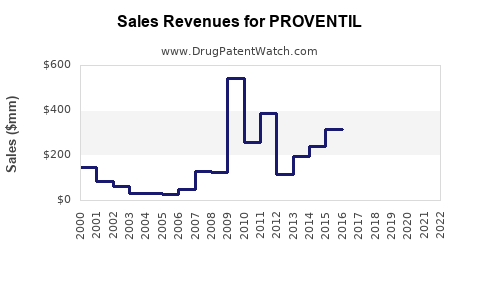
Drug Sales Revenue Trends for PROVENTIL

See drug sales revenues for PROVENTIL

Recent Clinical Trials for PROVENTIL

Identify potential brand extensions & 505(b)(2) entrants

SponsorPhase
AstraZenecaPhase 2
University Medical Center of Southern NevadaN/A
Merck Sharp & Dohme Corp.Phase 4

See all PROVENTIL clinical trials

US Patents and Regulatory Information for PROVENTIL

Applicant Tradename Generic Name Dosage NDA Approval Date TE Type RLD RS Patent No. Patent Expiration Product Substance Delist Req. Exclusivity Expiration
Schering PROVENTIL albuterol AEROSOL, METERED;INHALATION 017559-001 Approved Prior to Jan 1, 1982 DISCN No No ⤷  Get Started Free ⤷  Get Started Free ⤷  Get Started Free
Schering PROVENTIL albuterol sulfate TABLET;ORAL 017853-002 May 7, 1982 DISCN Yes No ⤷  Get Started Free ⤷  Get Started Free ⤷  Get Started Free
Schering PROVENTIL albuterol sulfate SYRUP;ORAL 018062-001 Jan 19, 1983 DISCN Yes No ⤷  Get Started Free ⤷  Get Started Free ⤷  Get Started Free
>Applicant >Tradename >Generic Name >Dosage >NDA >Approval Date >TE >Type >RLD >RS >Patent No. >Patent Expiration >Product >Substance >Delist Req. >Exclusivity Expiration

Expired US Patents for PROVENTIL

Applicant Tradename Generic Name Dosage NDA Approval Date Patent No. Patent Expiration
Schering PROVENTIL albuterol sulfate SYRUP;ORAL 018062-001 Jan 19, 1983 3,644,353 ⤷  Get Started Free
Schering PROVENTIL albuterol sulfate TABLET;ORAL 017853-002 May 7, 1982 3,705,233 ⤷  Get Started Free
Schering PROVENTIL albuterol sulfate TABLET;ORAL 017853-001 May 7, 1982 3,644,353 ⤷  Get Started Free
>Applicant >Tradename >Generic Name >Dosage >NDA >Approval Date >Patent No. >Patent Expiration

International Patents for PROVENTIL

See the table below for patents covering PROVENTIL around the world.

Country Patent Number Title Estimated Expiration
Czechoslovakia 167875 ⤷  Get Started Free
Germany 2032642 1-PHENYL-2-AMINOAETHANOL-DERIVATE, VERFAHREN ZU IHRER HERSTELLUNG UND DIESE VERBINDUNGEN ENTHALTENDE ARZNEIMITTEL ⤷  Get Started Free
Sweden 354061 ⤷  Get Started Free
>Country >Patent Number >Title >Estimated Expiration

Market Dynamics and Financial Trajectory for PROVENTIL

Last updated: July 28, 2025

Introduction

PROVENTIL (albuterol sulfate) has established itself as a leading bronchodilator primarily used to treat bronchospasm associated with asthma, chronic obstructive pulmonary disease (COPD), and other respiratory conditions. As a cornerstone in respiratory therapy, its market dynamics are shaped by evolving regulatory landscapes, shifting healthcare paradigms, competitive pressures, and innovation trajectories. This analysis evaluates PROVENTIL’s current market standing, anticipated growth trajectory, competitive environment, and influencing factors that will shape its financial future.


Market Overview

The global respiratory pharmaceuticals market, estimated to be valued at approximately USD 39 billion in 2022, is projected to grow at a compound annual growth rate (CAGR) of around 4% through 2030 ([1]). Within this landscape, short-acting beta-agonists (SABAs), including PROVENTIL, remain essential, accounting for a significant share due to their quick relief capabilities.
The rising prevalence of respiratory diseases—such as asthma, which affects an estimated 262 million individuals globally ([2])—continues to sustain demand. Additionally, increasing aging populations, urbanization, and environmental pollution exacerbate respiratory health issues, reinforcing PROVENTIL’s market relevance.


Market Drivers

1. Increasing Respiratory Disease Prevalence

The global burden of respiratory diseases underscores a consistent demand for bronchodilators. Asthma prevalence has surged in both developed and developing countries—most notably in Asia-Pacific, Africa, and Latin America—driving sustained consumption of inhaled therapies like PROVENTIL.

2. Rising Awareness and Diagnosis

Enhanced diagnostic capabilities and growing health awareness facilitate earlier and more frequent prescriptions. Healthcare providers increasingly recognize the importance of quick-relief medications, supporting steady demand for inhalers such as PROVENTIL.

3. Regulatory Approvals and Label Expansions

The favorable regulatory environment, especially in emerging markets where inhaled medications are becoming widely adopted, amplifies market access. Approvals for pediatric and emergency use formulations further expand PROVENTIL's application scope.

4. Innovations and Formulation Enhancements

Development of new delivery mechanisms—metered-dose inhalers (MDIs), dry powder inhalers (DPIs), and nebulized formulations—improve patient adherence and treatment efficacy. Such innovations typically boost sales by expanding patient populations.


Market Challenges

1. Patent Expiry and Generic Competition

While older formulations of PROVENTIL are off-patent, generics significantly impact pricing and margins. The entry of generic albuterol inhalers reduces exclusivity benefits for brand owners, leading to intensified price competition ([3]).

2. Pricing Pressures and Cost-Containment Policies

Government and private payers increasingly emphasize cost-effectiveness, often favoring lower-cost generic options. This trend pressures brand-name drug prices and margins.

3. Regulatory and Environmental Concerns

Environmental regulations targeting propellants used in inhalers (e.g., chlorofluorocarbon substitutes) demand innovation in device design. Transition to low-GWP (Global Warming Potential) inhalers could entail R&D investments affecting short-term revenue.


Competitive Landscape

PROVENTIL faces competition from several inhaled bronchodilators, including:

  • Generic Albuterol Inhalers: Leading the market due to cost advantage.
  • Combination Inhalers: Such as Symbicort (budesonide/formoterol) and Advair (fluticasone/salmeterol), which provide both preventive and reliever therapies.
  • Innovative Devices: Smart inhalers equipped with digital tracking improving adherence.

Major players like Pfizer, Teva, and generic manufacturers dominate the market, with Pfizer’s PROVENTIL experiencing revenue declines post-patent expiry but maintaining a significant market share via generics ([4]).


Financial Trajectory and Future Outlook

Revenue Trends

Historically, PROVENTIL generated peak revenues during patent exclusivity, but profits have waned with generic competition. Currently, the market relies heavily on volume rather than premium pricing. However, geographic expansion into emerging markets and new formulations can stabilize revenues.

Growth Opportunities

  • Expanding Use in COPD: While primarily for asthma, albuterol is increasingly prescribed for COPD exacerbations, broadening its application.
  • Development of Abuse-Deterrent Formulations: To mitigate misuse and improve safety profiles.
  • Conjugation with Digital Technologies: Smart inhalers enhancing adherence and providing real-time data can augment market share.

Risks

  • Market Saturation: High penetration levels limit growth potential in mature markets.
  • Regulatory Changes: Stricter environmental and pharmaceutical regulations could increase R&D costs.
  • Competitive Pricing: Intense price competition among generics constricts profit margins.

Projected Financial Pathway

Based on current trends, a gradual decline in branded PROVENTIL revenues is expected, with stabilization rooted in generic sales volumes. Industry forecasts suggest a compound annual decline of approximately 2-3% in branded forms over the next 5 years. However, revenues from emerging markets and new formulations could offset declines to some extent, supporting a modest overall revenue stabilization or slight growth in specialized segments.


Regulatory and Policy Influences

Regulatory agencies like the FDA and EMA continue to streamline approval pathways for generic and biosimilar respiratory products, enabling swift market entry. Environmental policies targeting inhaler propellants necessitate reformulations, potentially delaying product launches but aligning with sustainability goals.

Health policy shifts emphasizing value-based care and reduced medication costs favor generic proliferation, and payers are pushing for price negotiations, putting further pressure on profit margins.


Key Market Trends

  • Digitalization: Integration of IoT and digital health tools with inhalers is emerging as a differentiator.
  • Personalized Medicine: Emphasis on tailored respiratory therapies based on genetic and phenotypic profiles.
  • Global Expansion: Focus on penetrating low- and middle-income countries where respiratory disease burden is rising.

Conclusion

The financial trajectory of PROVENTIL hinges on navigating patent transitions, fostering innovation, and expanding into high-growth regions. While mature markets face declining revenues due to generic competition, emerging markets and innovative delivery systems present significant upside potential. Strategic investments in device technology and digital health integration are essential to sustain market relevance.


Key Takeaways

  • Market Decline in Established Markets: Patent expiries and generics have reduced revenues, emphasizing the importance of geographic diversification.
  • Growth in Emerging Markets: Rapidly increasing respiratory disease prevalence and healthcare infrastructure development present lucrative opportunities.
  • Innovation as a Revenue Driver: New formulations, delivery mechanisms, and digital integration can restore growth.
  • Regulatory and Environmental Concerns: Future formulations must address environmental regulations, influencing product development and costs.
  • Competitive Pricing: Price pressures from generics require strategic positioning to maintain profitability.

FAQs

1. How has patent expiration affected PROVENTIL’s market?
Patent expiration led to the entry of low-cost generics, decreasing brand-name revenues and intensifying price competition, especially in developed markets.

2. Are there upcoming formulations that could revive PROVENTIL’s market share?
Yes. Innovations like environmentally friendly inhalers and smart inhalers equipped with digital features aim to improve adherence and cater to environmental standards, potentially revitalizing the product’s market position.

3. What markets present the most growth opportunities for PROVENTIL?
Emerging markets in Asia, Africa, and Latin America hold significant growth potential due to rising disease prevalence and expanding healthcare access.

4. How do environmental regulations impact PROVENTIL’s future?
Regulations targeting inhaler propellants prompt a shift toward low-GWP formulations, requiring R&D investments that may temporarily affect profitability but align with sustainability goals.

5. What role does digital health play in PROVENTIL’s future?
Integration of IoT with inhalers enhances patient engagement, adherence, and real-time monitoring, offering new avenues for revenue growth and improved health outcomes.


References

[1] MarketsandMarkets, "Respiratory Drugs Market," 2022.
[2] Global Initiative for Asthma (GINA), "Global Strategy for Asthma Management and Prevention," 2022.
[3] IQVIA, "Global Trends in Respiratory Drug Sales," 2022.
[4] Pfizer Annual Report, 2022.

More… ↓

⤷  Get Started Free

Make Better Decisions: Try a trial or see plans & pricing

Drugs may be covered by multiple patents or regulatory protections. All trademarks and applicant names are the property of their respective owners or licensors. Although great care is taken in the proper and correct provision of this service, thinkBiotech LLC does not accept any responsibility for possible consequences of errors or omissions in the provided data. The data presented herein is for information purposes only. There is no warranty that the data contained herein is error free. We do not provide individual investment advice. This service is not registered with any financial regulatory agency. The information we publish is educational only and based on our opinions plus our models. By using DrugPatentWatch you acknowledge that we do not provide personalized recommendations or advice. thinkBiotech performs no independent verification of facts as provided by public sources nor are attempts made to provide legal or investing advice. Any reliance on data provided herein is done solely at the discretion of the user. Users of this service are advised to seek professional advice and independent confirmation before considering acting on any of the provided information. thinkBiotech LLC reserves the right to amend, extend or withdraw any part or all of the offered service without notice.