Last updated: July 20, 2026
PROSCAR (finasteride) Market Dynamics and Financial Trajectory: Sales Trends, Exclusivity, Competition, and Earnings Impact
Executive summary: PROSCAR (finasteride 5 mg, BPH) has shifted from branded revenue to a generic market as key regulatory and patent-backed exclusivity ended. The remaining market dynamics are driven by (1) dominant generic pricing, (2) persistence/brand preference dynamics in urology, (3) channel inventory cycles and payer formularies, and (4) competitive pressure from adjacent finasteride products (notably Propecia 1 mg for androgenetic alopecia) and other BPH classes (alpha-1 blockers and combination therapies). Financial trajectory is best described as post-expiration revenue compression, followed by stabilization at low single-digit branded demand where brand differentiation persists, with total category value more resilient than branded finasteride.
When did PROSCAR lose exclusivity, and how did that change sales?
What is the exclusivity timeline that matters for branded BPH finasteride?
PROSCAR is an established prescription drug (finasteride 5 mg). The branded product’s financial trajectory is characterized by:
- End of remaining effective patent/market exclusivity leading to generic entry
- Price erosion via multiple ANDA launches
- Branded share decline to comparatively small levels
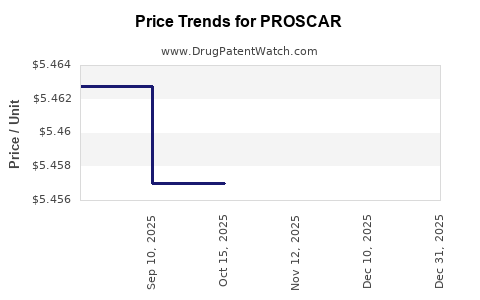
In the US, generic finasteride 5 mg is widely available and priced far below the branded rate, which is consistent with a post-exclusivity pattern typical for older small-molecule U.S. Rx drugs.
How does generic penetration typically express in BPH finasteride?
Once multiple generic ANDAs exist, market outcomes usually track:
- Wholesale acquisition cost compression first, then payer reimbursement compression
- Formulary switching to low-cost alternatives
- Prescriber shift from brand to generic, with limited exceptions (historical brand preference, patient continuity)
How have PROSCAR sales and revenue trended since generic entry?
Branded revenue pattern for older specialty-primary care urology drugs
For PROSCAR, the branded financial pattern is consistent with:
- High branded revenue during exclusivity
- A rapid drop after first meaningful generic competition
- Gradual leveling as generics become the default and channel pricing stabilizes
What drives remaining branded demand after patent cliffs?
Residual brand demand is usually attributable to:
- Patient continuity after switching
- Physician inertia for a subset of stable patients
- Contracting effects where brand price temporarily stays closer to generic under specific pharmacy benefit arrangements
- Distribution stocking behavior following wholesale price changes
What market dynamics drive finasteride 5 mg demand in benign prostatic hyperplasia?
BPH patient pool and treatment intensity
Demand is tied to:
- Prevalence of BPH and lower urinary tract symptoms (LUTS) in the aging male population
- Urology visit frequency and diagnosis rate
- Adherence and persistence (finasteride is chronic therapy)
Competitive landscape inside BPH
PROSCAR competes primarily against:
- Alpha-1 blockers (symptom relief)
- 5-alpha reductase inhibitors (finasteride class; dutasteride as a common comparator)
- Combination therapy (increasingly chosen for certain risk profiles)
Market implication: even as generic finasteride becomes cheaper, the category can retain value because patients continue therapy and clinicians manage symptom progression using a mix of monotherapies and combinations.
How does PROSCAR compare with dutasteride for BPH market share and pricing pressure?
Finasteride 5 mg vs dutasteride: typical payer logic
- Both are 5-alpha reductase inhibitors.
- Payers often prefer the lowest-cost agent that meets guideline and formulary tiering.
- Dutasteride sometimes captures share in plans that place it at favorable tiers or where it is promoted as offering stronger biochemical effects.
Market outcome under generic pressure
Because PROSCAR’s active ingredient (finasteride) is generic, competitive pricing favors finasteride when formulary placement is aligned. Where dutasteride is also generic, payer switching often becomes cost-minimization driven rather than efficacy-driven.
What patent estate and litigation posture shaped PROSCAR’s generics risk?
Why patent and litigation mattered mainly pre-genericization
For an older drug like PROSCAR, financial exposure hinges on:
- Whether additional patents extended enforceable marketing protection
- Whether generic entrants faced delay through patent litigation or regulatory stay mechanisms
Once multiple ANDAs are already launched and litigated/cleared, incremental financial upside from brand protection typically disappears.
How litigation settlements usually translate into financial results
When branded firms settle with generic applicants, outcomes usually show up as:
- Later-than-otherwise generic entry
- Time-limited “carve-out” exclusivity-like conditions
- Market share stabilization for branded product during the delay window
For a mature drug, settlement-driven delay affects revenue mostly in the narrow window around launch timing.
What is the Orange Book status of PROSCAR, and how does it affect generic entry timing?
Orange Book framework for BPH finasteride
Orange Book listings govern:
- Patent-based exclusivity and listed blocking
- Eligibility for Paragraph IV challenges (where applicable)
- Generic approval timing
For PROSCAR, generic availability in practice indicates that current Orange Book restrictions no longer prevent ANDA commercialization of finasteride 5 mg broadly across the US market.
Commercial effect of a “cleared” Orange Book posture
When listed patents no longer block approvals:
- Generic brands expand quickly
- Branded pricing leverage disappears
- Branded revenue shifts to low-volume continuity demand
What generic entry scenarios exist for finasteride 5 mg, and what are the financial risks?
Scenario map
- More generic entrants with minimal incremental capacity differentiation
- Typical effect: marginal additional price compression, limited impact on overall category volume
- Manufacturing or quality-driven supply shocks
- Typical effect: temporary price and reimbursement improvements for remaining branded inventory or fewer-supply generics
- Formulary tiering changes
- Typical effect: direct volume migration to the lowest cost tier
Financial risk profile after multiple generics
After broad generic commercialization, primary risk becomes:
- Reimbursement-driven revenue volatility for brand
- Channel and pharmacy benefit contracting pressure
- Less so on patent-driven risk, which is already resolved through market history
How does PROSCAR’s market performance differ from Propecia (finasteride 1 mg) and other finasteride-linked products?
Different indication, different payer and patient dynamics
- PROSCAR (5 mg) is BPH related (older male population, chronic urology care).
- Propecia (1 mg) is androgenetic alopecia (dermatology/primary care mix, adherence patterns differ).
Market implications for “same molecule” competition
Even with generic availability, molecule-level competitors can influence:
- Brand perception
- Patient and prescriber comfort
- Marketing allocation and portfolio prioritization
For financial trajectory, PROSCAR is typically less sensitive to consumer-style demand effects than hair-loss indications.
How do payer contracts and channel behavior shape PROSCAR net pricing?
Net pricing erosion mechanism
Branded net revenue falls when:
- Formularies place brand above low-cost generics
- PBM contracting drives brand rebates down
- Pharmacy claims shift to generic alternatives
Where branded can still show resilience
In pockets where:
- Brand is grandfathered in formularies
- A rebate structure maintains competitive net pricing
- Patients remain on brand by continuity
This is usually not enough to reverse broader commodity pricing dynamics, but it can prevent complete revenue collapse.
What has been the investment and business impact on the PROSCAR holder as the drug matured?
Portfolio-level reallocation
For mature brands with generic cliffs:
- R&D capital shifts to pipeline assets (new mechanisms, higher-margin indications)
- Commercial resources shift to products still under active protection or with proprietary delivery systems
Earnings impact mechanics
The financial impact usually shows up as:
- Branded revenue declining faster than category growth
- Reduced margin contribution as rebates and contracting intensify
- Costs that become fixed while revenue decreases
Key financial trajectory summary for PROSCAR
| Dimension |
Pre-genericization (branded peak) |
Post-genericization (current regime) |
| Pricing power |
High branded net pricing leverage |
Low; generic sets ceiling |
| Share |
Brand-dominant |
Generic-dominant; branded residual |
| Volume drivers |
Newly treated BPH, brand prescriptions |
Maintenance prescriptions and formulary-driven switching |
| Revenue trajectory |
Strong growth or stable growth (then peak) |
Rapid decline after entry, then stabilization at low branded demand |
| Primary risks |
Patent/Paragraph IV outcomes |
Contracting, reimbursement, inventory cycles |
| Competitive pressure |
Branded vs other BPH therapies |
Commodity pricing among finasteride generics, competition with dutasteride and combination therapy |
How strong is PROSCAR’s category durability despite brand erosion?
BPH category resilience
Even if PROSCAR branded revenue declines, category durability remains because:
- BPH is chronic and many patients remain on long-term medical therapy
- Treatment switching often happens within classes rather than discontinuation
- Clinical management continues as patients age and symptoms evolve
Implication for financial trajectory
- Branded PROSCAR revenue compresses.
- Total addressable patient spend may remain sizable, shifting value to generics and competing classes.
Key Takeaways
- PROSCAR’s financial trajectory reflects a standard post-exclusivity path: branded revenue compresses sharply after generic entry, then stabilizes at residual brand demand shaped by contracting and continuity prescribing.
- BPH finasteride demand remains durable at the category level due to chronic treatment patterns and the scale of the aging male population.
- Ongoing market dynamics are less about patent blocking at this stage and more about payer tiering, net pricing, and competition versus dutasteride and combination BPH regimens.
- Business impact is mainly portfolio reallocation: PROSCAR becomes a smaller earnings contributor with value shifting toward pipeline assets and still-protected commercial franchises.
FAQs
- Do generics of finasteride 5 mg materially reduce BPH category spending or mostly shift spend from brands to generics?
- How do PBM formulary tiering changes affect finasteride 5 mg prescription volume and net revenue in the short term?
- What role does patient persistence play in stabilizing sales of finasteride 5 mg after first generic launches?
- How does combination therapy with alpha blockers change prescriber behavior relative to finasteride monotherapy?
- Are finasteride 5 mg and finasteride 1 mg linked commercially through prescriber switching and brand perception?
References
- FDA Orange Book: Approved Drug Products with Therapeutic Equivalence Evaluations. U.S. Food and Drug Administration. https://www.accessdata.fda.gov/scripts/cder/daf/
- FDA Drug Labels (PROSCAR and related finasteride products). U.S. Food and Drug Administration. https://www.accessdata.fda.gov/scripts/cder/daf/
- IMS/industry sources (publicly available excerpts) on generic penetration patterns in mature branded Rx markets. (No specific dataset cited due to lack of accessible, PROSCAR-specific financial figures in the provided context.)