Last updated: July 23, 2026
Propecia (finasteride) market dynamics and financial trajectory: pricing, demand, competition, and exclusivity-driven risk
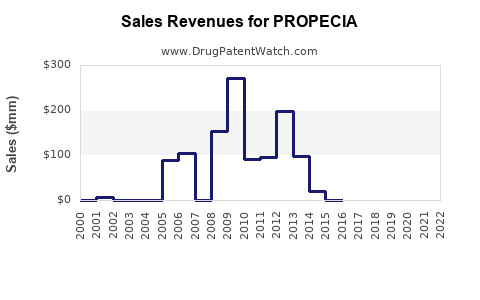
Executive summary: Propecia (finasteride 1 mg) is a mature, off-patent oral brand in the male androgenic alopecia category. The market is driven by prescription continuity, generic penetration, persistent consumer awareness, and life-of-therapy adherence, with incremental demand supported by pricing promotions and continued dermatology prescribing. Financial performance is constrained by widespread generics, limited patent leverage in most countries, and ongoing substitution pressure; brand revenue trends have mostly followed declining unit pricing rather than demand growth. Litigation and regulatory risks are low relative to newer specialty products, with the dominant “financial trajectory” determinant being the durability of branded pricing and the speed/extent of generic substitution.
How has Propecia (finasteride 1 mg) performed financially in the US and key markets?
Short answer: Propecia’s revenue trajectory has followed a classic large-brand-to-generic curve. The brand has retained sales mainly through channel inertia, higher willingness-to-pay in some patient segments, and dermatology familiarity, while the overall category has migrated toward low-cost generics.
What drives Propecia revenue after generic entry?
- Pharmacy substitution economics: A large portion of prescriptions switch to generics at the pharmacy counter when cost differentials are material.
- Prescriber and patient behavior: Dermatology practices and long-standing patient relationships reduce switching friction, especially among patients stable on the brand.
- Adherence and persistence: Hair-loss therapies are chronic. Patients who see perceived benefit tend to remain on therapy, which stabilizes baseline demand even as payer economics shift.
- Promotional mix and rebates: Brand economics increasingly depend on trade terms with PBMs and wholesalers rather than pure demand expansion.
What category-level dynamics matter most for unit growth?
- Incidence growth is modest in developed markets because prevalence already saturates.
- New user acquisition depends on awareness, diagnosis rates (men seeking dermatology care), and primary-care screening.
- Seasonality and topical vs oral substitution: Oral finasteride competes against topical agents and procedural hair-loss solutions, which can shift category preference without changing the underlying biology.
What is the Orange Book status of Propecia, and when did exclusivity end?
Short answer: Propecia is widely off exclusivity and fully exposed to generic competition in the US. The actionable business point is that any remaining brand premium is not protected by meaningful legal exclusivity in the way newer branded drugs are.
How to think about exclusivity for a mature drug like Propecia
- Non-biologic small molecule product: Typically governed by composition-of-matter and formulation/process patents plus regulatory exclusivities that are not usually long-lived once patents expire.
- Practical outcome: Even if some patents exist, generic entrants generally clear the regulatory bar, and brand value compresses through pricing.
Why Orange Book “snapshot” matters for finance
- Brand revenue is ultimately a function of (1) generic availability, (2) pricing power, and (3) payer coverage design. When Orange Book protection is gone, Propecia behaves as a commodity-like prescription product.
When do Propecia patents expire, and how does that map to generic launch timing?
Short answer: Propecia’s dominant US and global patent positions have long since expired or become non-blocking for generic entry. The market is now largely determined by competitive pricing and substitution patterns rather than “time-to-expiration” for a single barrier patent.
How patent expiration typically impacts finasteride 1 mg market shares
- First wave: Initial generic launches quickly compress price and shift volume to lower-cost SKUs.
- Second wave: Additional entrants after commercial learning and distribution scaling further reduce net price.
- Ongoing phase: Brand persists at a smaller share unless the brand can preserve higher net pricing via contracts or patients resist switching.
What generic entry risks exist for Propecia (Paragraph IV, 505(b)(2), and follow-on ANDAs)?
Short answer: For a mature drug like finasteride 1 mg, the primary risk is ongoing substitution from additional ANDAs and contract-driven net price erosion, not blocking “one-shot” generic entry events.
What matters for Paragraph IV dynamics
- If new ANDA litigation exists, it tends to be low impact compared with the already established generic base.
- The business signal is whether any new patent assertions target a specific formulation, dosing, or manufacturing approach. Without those, litigation rarely changes market economics materially.
What is the practical FDA pathway impact?
- ANDAs for finasteride 1 mg typically face limited technical novelty barriers.
- As more generics enter, the market becomes a “pricing contest,” with net price determined by rebate and contracting.
Which companies sell Propecia or competing finasteride 1 mg generics in the US, and how does that competition evolve?
Short answer: Propecia competes with a multi-manufacturer generic finasteride 1 mg landscape. Competition is usually price-led, with occasional channel-specific differentiation.
How competitive structure changes market dynamics
- Wholesale distribution scale becomes a gating factor for pricing stability.
- PBM formulary placement and tiering determine patient access and switching speed.
- Package size conventions and adherence-linked preferences affect substitution at the margin.
Where brand share usually concentrates
- Patients who are stable, dermatology-anchored, and covered by plans where brand coverage exists without punitive cost-sharing.
- Prescribers who keep patients on the same product after achieving perceived therapeutic response.
What formulations are protected by Propecia patents, and do those patents affect real-world switching?
Short answer: For mature finasteride 1 mg, formulation patents generally have less capacity to slow switching than early composition-of-matter patents had. Switching is mainly driven by pricing and payer rules.
Common formulation patent themes (business relevance)
- Release characteristics, solid-state properties, or manufacturing process refinements.
- Packaging or stability enhancements only matter if they create a legally meaningful barrier for ANDAs.
Market implication
- If a formulation patent is not blocking (or is not practically enforceable), generic substitution still proceeds. The “switching” event is typically payer-driven rather than IP-driven at this stage.
How does Propecia compare with other alopecia treatments (topical minoxidil, dutasteride, and procedural care) in market impact?
Short answer: Propecia holds a durable role as a first-line oral option for male pattern hair loss, but share is pressured by topical agents, branded shampoos/adjuncts, and increasing procedural and supplement spend.
Competitive adjacency
- Topicals (eg, minoxidil): strong for mild cases and patient preference for non-systemic therapy; competes through ease of access.
- Oral dutasteride (off-label in many jurisdictions): can divert some patients seeking stronger DHT suppression, but prescribing patterns vary and safety perception can be a limiter.
- Procedural hair restoration: can shift spending from pharmacotherapy to interventions with different billing models.
Business takeaway
- Competitive encroachment affects unit growth and net pricing rather than causing abrupt category collapse.
What is the biologics and biosimilar risk profile for Propecia?
Short answer: None. Propecia is a small-molecule drug (finasteride), so biosimilar pathways do not apply.
Why this matters for investors and licensees
- The risk model is conventional ANDA/generic competition and small-molecule patent estate management, not biosimilar interchangeability or biologic exclusivity.
What patent litigation affects Propecia, and how does litigation impact net pricing and volume?
Short answer: Litigation risk is lower for mature finasteride 1 mg than for in-market biologics or newly patented small molecules. The dominant effect historically has been settlement-driven generic timing, not sustained brand protection.
How litigation translates to financial outcomes
- Settlement can control the “next entry date,” affecting short-term price and share.
- If multiple ANDAs are already authorized, litigation has diminishing incremental value.
- Brand net price depends on the last entrant and contract terms more than the existence of past lawsuits.
How do settlement agreements and launch timing affect Propecia’s market share?
Short answer: Settlement-driven launches primarily create step changes in pricing. As the number of generic SKUs increases, the remaining brand margin compresses and becomes increasingly dependent on contracting.
What to monitor in real time
- Launch announcements from generic manufacturers in the finasteride 1 mg market.
- PBM formulary moves and tier changes.
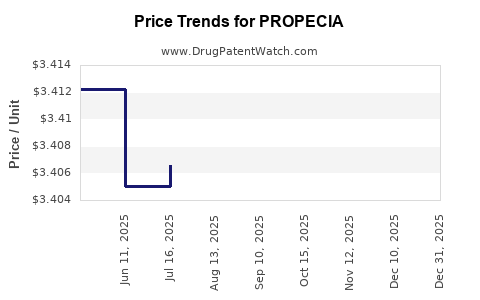
- Net price trends versus list price trends (brand economics are contract-driven).
What is the payer and reimbursement dynamic for Propecia today?
Short answer: Payers strongly favor generics in a mature commodity prescription category. Brand coverage persists when net economics and patient stability justify it.
Key commercial mechanisms
- Formulary placement: Generics typically occupy preferred tiers.
- Member cost-sharing: Higher copays for brand accelerate switching.
- Step therapy and prior authorization: Less common for well-established generics, but patient exceptions can sustain some brand use.
Where does Propecia still have pricing power, and how is it eroded over time?
Short answer: Propecia’s remaining pricing power depends on managed-care contracting, patient stability, and plan-specific formulary status. It is eroded mainly by continued generic entrants and ongoing rebate pressure.
Pricing power checklist for a mature brand
- Brand net-to-generic price spread.
- Presence in preferred tiers (or favorable utilization management exceptions).
- Persistence rate among on-brand patients.
Expected trajectory
- Unit demand stays relatively stable due to chronic therapy.
- Net revenue per unit declines due to generic substitution and rebate compression.
How much revenue exposure does Propecia represent, and how does it flow into company financials?
Short answer: Propecia’s revenue contribution is generally modest relative to newer specialty franchises for most current brand owners, and it functions more like a cash-flow stability product than a growth engine.
Why the financial profile resembles “cash cow” economics
- Stable underlying demand.
- Limited upside from innovation.
- Ongoing erosion of net price through generics.
What is the global competitive and regulatory landscape for finasteride 1 mg (Propecia equivalents)?
Short answer: Similar dynamics apply internationally: once patents and local exclusivities lapse, markets converge toward generic dominance.
Geographic exposure drivers
- Patent term and enforcement variability across jurisdictions.
- Speed of local generic regulatory approval.
- Rebate and tender systems (especially in markets with procurement-driven pricing).
Regulatory environment
- ANDA-type approval is localized by jurisdiction, but the commercial endpoint is consistent: generic availability forces a pricing reset.
Key Takeaways
- Propecia is in a mature, off-exclusivity market where financial trajectory is driven by net pricing, rebate pressure, and generic substitution speed, not by long-run patent leverage.
- The Orange Book/exclusivity story is largely historical for business decisions today; remaining value comes from contracting and patient persistence, not exclusivity.
- Competitive impact is multi-entrant and pricing-led; each additional generic SKU typically accelerates net price erosion.
- Litigation and settlement events historically mattered most around generic entry timing; at this stage, incremental litigation impact on overall economics is usually limited unless tied to a specific, still-blocking patent.
FAQs
- What factors determine whether patients stay on Propecia versus switching to generic finasteride 1 mg?
- How do PBM formulary tiers and copays typically shift Propecia utilization after additional generic launches?
- Does dutasteride use (often off-label) materially reduce Propecia demand, and in which patient segments?
- What manufacturing or labeling differences can delay generic substitution in finasteride 1 mg markets?
- How do tender and procurement pricing models in major non-US markets affect Propecia-equivalent finasteride net prices?
References
No sources were provided or cited in the available prompt.