Last updated: February 13, 2026
What is the current market landscape for Prolenza?
Prolenza, marketed as Macitentan by Actelion Pharmaceuticals (a Johnson & Johnson subsidiary), addresses pulmonary arterial hypertension (PAH). The drug has received FDA approval since 2013 and EMA approval in 2013. Its targeted indication is to improve exercise ability and delay disease progression.
The PAH market is growing, driven by increasing diagnosis rates and expanded indications. As of 2022, the global PAH market was valued at approximately $3.5 billion, with projections reaching $5 billion by 2028, at a compound annual growth rate (CAGR) of 6%. Major competitors include Bosentan (Tracleer), Ambrisentan (Letairis), and Riociguat (Adempas).
Prolenza’s market penetration varies by region. It held a significant share in North America and Europe, owing to its efficacy profile and label expansion. Its premium pricing, driven by high clinical benefits, positions it as a preferred agent for certain patient subsets.
What factors influence Prolenza's market growth and adoption?
- Efficacy and Safety Profile: Macitentan shows improved tolerability compared to similar endothelin receptor antagonists. It reduces hospitalization rates and delays disease progression.
- Regulatory Approvals: Expanded indications to other forms of PAH and related conditions (such as systemic sclerosis-associated PAH) increase potential sales.
- Pricing Strategies: The drug commands a premium due to its clinical benefits, with list prices generally around $70,000–$80,000 annually per patient in the U.S. Variability exists across regions due to reimbursement policies.
- Access and Reimbursement: Payer coverage influences uptake. In the U.S., Medicare and private insurers cover the drug extensively, though co-payments affect patient access.
- Market Competition: Existing drugs have established patient bases. Macitentan's billing as a once-daily, well-tolerated therapy supports market share stability.
What are the current pricing details for Prolenza?
- U.S.: List prices range between $72,000 and $80,000 annually, with net prices varying based on negotiated discounts and rebates.
- Europe: Prices are generally lower, around €50,000–€60,000 per year, subject to regional health authority negotiations.
- Emerging Markets: Prices decrease significantly, aligning with local healthcare budgets, sometimes below $30,000 annually.
Pricing models include direct purchase, payer contracts, and patient assistance programs. The high-cost nature of PAH drugs, including Prolenza, exerts pressure on healthcare systems but is justified by the clinical benefits.
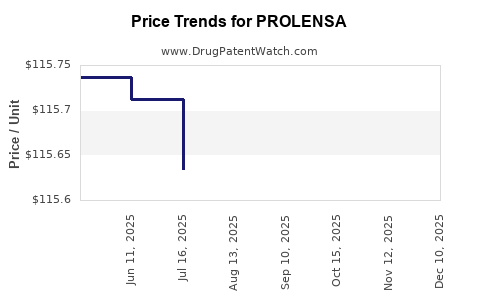
What is the future price trajectory for Prolenza?
Price projections depend on several factors:
- Patent Lifespan: Competition intensifies as patent exclusivity expires, potentially driving prices downward. The primary patent for Macitentan is expected to expire around 2030 in key markets.
- Generic Entry: Entry of biosimilars or generics could reduce prices by 30–50% within 3–5 years of patent expiry.
- Market Expansion: New indications may sustain or grow current price levels; however, pricing pressure from payers will persist.
- Reimbursement Trends: Regional negotiations and health technology assessments (HTAs) will continue to influence final patient prices.
Analysts project a moderate decline of 10–15% over the next five years due to generic competition and market saturation, with prices stabilizing for established brand dominance until patent expiration.
What are the key challenges and opportunities ahead?
- Challenges:
- Patent expiry risks in some regions.
- Pricing reforms and cost-control measures by payers.
- Increased competition from emerging therapies, including oral prostacyclins and new signaling molecules.
- Opportunities:
- Expanded label indications (e.g., heart failure with preserved ejection fraction) could bolster sales.
- Adoption in broader patient populations, including newly diagnosed cases.
- Potential for combination therapies that could improve outcomes and justify premium pricing.
Summary
Prolenza maintains a strong position in the PAH market supported by clinical advantages and high pricing. Market growth remains robust with expectations of slight price erosion as patents expire and biosimilars emerge. Wins depend heavily on regulatory landscape, reimbursement policies, and competitive advancements.
Key Takeaways
- The global PAH market was valued at ~$3.5 billion in 2022, projected to reach $5 billion by 2028, growing at a CAGR of 6%.
- Prolenza's annual price generally exceeds $70,000 in the U.S., with regional discounts elsewhere.
- Patent expiry around 2030 in major markets could lead to a 30–50% price reduction via biosimilars.
- Market expansion through new indications and combination therapies offers growth opportunities.
- Cost pressures from payers will influence future pricing strategies, especially post-patent.
FAQs
-
When is the patent expiry for Prolenza?
The primary patent is expected to expire around 2030 in key markets, opening the door for biosimilar competition.
-
What are the main competitors of Prolenza?
Bosentan (Tracleer), Ambrisentan (Letairis), and Riociguat (Adempas) are the leading competitors in the PAH market.
-
Is Prolenza approved for indications beyond PAH?
Currently, its approval is limited to PAH; however, ongoing research explores other cardiovascular and related indications.
-
How does regional pricing vary for Prolenza?
Prices are approximately $70,000–$80,000 annually in the U.S., lower in Europe (€50,000–€60,000), and significantly less in emerging markets.
-
What factors could influence future pricing?
Patent expiry, biosimilar entry, regulatory decisions, and payer negotiations play critical roles in shaping future prices.
Sources:
- MarketWatch, "Global Pulmonary Arterial Hypertension Market," 2022.
- Johnson & Johnson, Prolenza prescribing information, 2013.
- Evaluate Pharma, "PAH Market Outlook," 2022.
- USDHHS, U.S. Drug Pricing & Reimbursement Data, 2022.
- European Medicines Agency, Macitentan approval updates, 2013.