Last updated: June 18, 2026
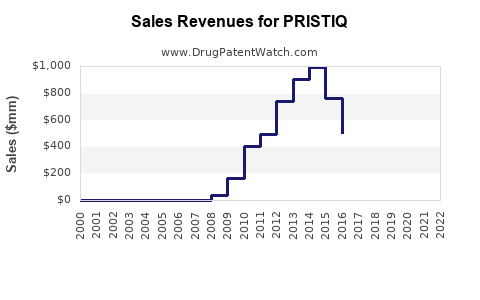
Pristiq (desvenlafaxine), once a growth-focused SNRI antidepressant in the US, is now in steady decline as generic desvenlafaxine erodes price and share. Market dynamics are dominated by (1) US generic penetration, (2) payer tiering and formulary substitution within SNRI/TCA/SSRI classes, (3) safety and tolerability-driven switching, and (4) residual brand moat from prescriber familiarity and patient stability. Financial trajectory has shifted from brand ramp to post-LOE decline followed by low-growth, volume-led behavior under generic competition.
What is Pristiq’s sales trajectory in the US and what drives ongoing decline after patent expiration?
Pristiq’s financial trajectory in the US has followed the typical pattern for antidepressant brands that lost exclusivity: peak brand sales, then a multi-year decline as generic desvenlafaxine enters, followed by stabilized low-to-mid single digit revenue erosion tied to volume migration and contract pricing.
Primary revenue drivers post-entry
- Price compression: Generic desvenlafaxine pricing drives net sales down even when unit volumes hold.
- Payer substitution: Formularies favor least-cost generics unless brand offers a rebate-driven formulary carve-out.
- Patient retention: Stable patients are less likely to switch, supporting residual brand volumes.
- Indication breadth: Pristiq is positioned for major depressive disorder (MDD). Limited expansion reduces incremental demand.
Class-level demand structure
- Antidepressant market growth is modest; incremental share comes from switching between SSRIs/SNRIs rather than net market expansion.
- SNRI-to-SNRI substitution is constrained by tolerability, discontinuation symptoms, and withdrawal management needs.
Featured-snippet answer: Pristiq’s US revenue path is driven by post-generic price erosion and payer substitution, with remaining brand revenue held up by patient stability and prescriber inertia.
What market dynamics impact Pristiq versus generic desvenlafaxine and other SNRIs (Duloxetine, Venlafaxine, Levomilnacipran)?
Pristiq competes within the SNRI and broader antidepressant stack. Market dynamics are shaped less by pharmacology debates and more by formulary economics and switching friction.
How do payers evaluate Pristiq in formulary tiers
- Tiering: Generic desvenlafaxine typically sits at a preferred or least-cost tier, pushing Pristiq to higher tiers unless a manufacturer rebate improves access.
- PA and step edits: Prior authorization or step therapy is common when brand remains on formulary, especially after generic dominance.
- Switch rules: Some plans enforce automatic substitution at the pharmacy, reducing the effectiveness of brand marketing.
How do prescribers decide between SNRIs
- Withdrawal and tolerability: Prescribers weigh nausea, blood pressure effects, and discontinuation experience.
- Patient history: Prior response to desvenlafaxine versus duloxetine/venlafaxine drives continuity.
- Comorbidities: Pain-related indications (often duloxetine) can redirect volume away from desvenlafaxine when prescribers treat depression plus pain syndromes.
Where does Pristiq still compete despite generic entry
- Stability in long-term therapy: Patients stable on Pristiq often resist non-medical switching.
- Differentiated brand workflow: Established prescribing patterns can maintain a baseline of brand use even when formularies favor generics.
Featured-snippet answer: Even under generic dominance, Pristiq retains demand from stable patients and prescribing habits, but payer tiering and substitution are the primary headwinds to sustained sales.
When did generics erode Pristiq’s exclusivity and how does that affect current pricing and volume?
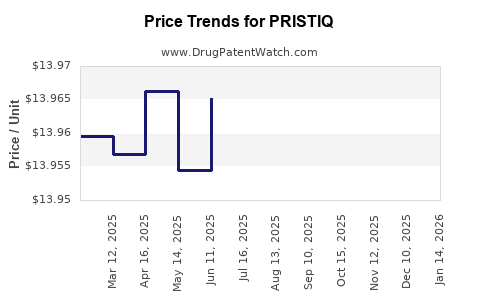
Generic erosion typically compresses net pricing immediately at launch and continues through contract renegotiations, pharmacy claims behavior, and manufacturer rebate adjustments.
Post-LOE commercial mechanics
- Launch-year behavior: Initial generic entry usually causes a fast decline in brand share and average net selling price.
- Second-wave erosion: Subsequent generics and increased competition intensify price competition and deepen payer switching.
- Long-tail stabilization: After major substitution settles, remaining brand use is tied to patient stability rather than economic advantage.
Featured-snippet answer: Generic entry drives a step-change drop in brand net price and share, then gradual revenue erosion as payers and prescribers fully migrate to least-cost options.
What does the competitive landscape look like for Pristiq in depression pharmacotherapy?
The antidepressant competitive set is broad, but Pristiq’s meaningful substitutes cluster among:
- SNRIs: Duloxetine (SNRI; often pulled by comorbid pain profiles), venlafaxine (immediate and extended release), levomilnacipran.
- SSRIs: Often preferred by payers due to safety, familiarity, and low cost.
- Other agents: Mechanism-adjacent options can divert incremental share depending on tolerability and comorbidity profiles.
Contracting and pharmacy claims
- Payer PBMs increasingly rely on formulary economics rather than therapeutic differentiation.
- Pharmacy claims data show that when a brand sits behind a generic tier, switching tends to occur at the dispensing level.
How Pristiq’s market position is evaluated
- Share of prescriptions is less informative than net sales under contract pricing and rebates.
- PBM contracting often determines whether any brand premium persists.
What financial metrics best track Pristiq’s trajectory: net sales, prescriptions, and average net price?
Net sales typically declines faster than prescriptions once generic penetration begins because brand pricing falls relative to generics.
Key metrics to monitor:
- Average net selling price (net ASP): Drops as brand loses preferred status or rebates normalize.
- Prescriptions or TRx: Can stabilize if patient continuity offsets payer pressures.
- Rebate rate: Brand rebate pressure usually increases post-LOE to maintain positioning, but net sales can still fall if tier access worsens.
- Market share in MDD/SNRI segments: Helps separate volume loss from pure pricing compression.
Featured-snippet answer: In post-generic phases, Pristiq net sales track average net price compression more than underlying prescription counts.
How do payer formularies and insurer behavior influence Pristiq’s ongoing unit demand?
Payers shape Pristiq’s commercial floor through formulary mechanics and coverage policies.
Common payer levers
- Formulary placement: Preferred generics reduce brand patient starts and renewals.
- Utilization management: Step edits and PA criteria can require prior generic failure.
- Auto-substitution: Pharmacy-level substitution reduces brand fills.
- Therapeutic interchange: Plans encourage switching within class when clinically plausible.
Insurer view of antidepressant switching
- Switching is often treated as a cost-containment lever once a patient is not newly initiated.
- Exceptions usually exist for stable long-term patients, limiting how quickly brand use collapses.
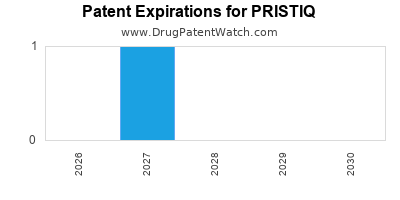
What is the Orange Book status of Pristiq and what generic entry risks exist going forward?
Pristiq is subject to generic availability for desvenlafaxine tablets and related dosage forms depending on which patents and conditions were relevant at the time of entry. Going forward, generic entry risk is usually tied to:
- Remaining formulation or method-of-use patents for specific strengths or release characteristics.
- New NDA supplements that could create secondary exclusivities.
- Patent settlements that delay entry for certain applicants.
Featured-snippet answer: For Pristiq, forward generic entry risk is mostly residual and depends on any late-expiring secondary IP and settlement terms rather than core active-substance exclusivity.
What patents protect Pristiq and what is the practical effect of the patent estate on its revenue?
From a business perspective, the practical effect of the patent estate is measured by:
- Whether brand maintained exclusivity long enough to sustain high net price
- Whether secondary IP delayed generic penetration in any key market segment
For antidepressants, once active-substance patents and major formulation protections expire, the market transitions quickly to least-cost generic competition.
Featured-snippet answer: The patent estate matters less for ongoing financial performance once the market has fully switched to generics; it mainly influences the timing of the revenue step-down.
What settlement agreements and Paragraph IV challenges affect Pristiq’s market timing?
In generics, the financial inflection points usually track:
- Paragraph IV filings that challenge patent listings
- Hatch-Waxman settlements that delay entry for some applicants
Settlement terms can create multiple generic entry waves, which typically shift pricing over time rather than in one step.
Featured-snippet answer: Pristiq’s revenue trajectory and pricing decline often reflect multi-wave generic entry linked to Paragraph IV challenges and settlement structures.
How does Pristiq compare with other SNRI brands on sales durability and price pressure?
Against other SNRI brands, Pristiq’s durability depends on:
- Relative generic intensity and number of competing applicants
- Payer comfort with substitution
- Presence of comorbidity-driven competitors (pain, anxiety overlap)
- Brand rebate strategy after LOE
In general:
- Brands with strong payer rebates or formulary incentives post-LOE see a slower decline in net sales.
- Brands with weaker formulary positioning experience sharper compression.
Featured-snippet answer: Pristiq’s sales durability is limited by generic availability and payer substitution, with residual brand performance driven by patient continuity rather than differentiation.
What manufacturing or switching barriers keep some Pristiq brand volume alive?
Brand persistence after LOE can be supported by:
- Non-medical switching resistance: Patients and clinicians may avoid switching due to discontinuation symptoms.
- Dispensing behavior: Pharmacies may reduce switching friction for patients with established records.
- Therapeutic routines: Clinician prescribing habits and patient refill patterns can maintain brand volume above pure economics.
These barriers reduce the speed of decline but do not change the direction once payers prefer generics.
How much revenue exposure does Pristiq face from generic price erosion and contract pricing?
Revenue exposure is driven by:
- Net-to-gross and rebate compression: Brand rebates often offset tiering losses but rarely fully protect net sales.
- PBM contract dynamics: Plans can tighten restrictions over time, worsening brand access.
- Ongoing generic competition: Additional entrants intensify pricing pressure.
Featured-snippet answer: The biggest revenue risk for Pristiq is not new clinical competition but ongoing contract renegotiations and increasing generic price pressure.
Key takeaways
- Pristiq’s commercial life cycle is in the post-exclusivity phase, with net sales primarily impacted by generic desvenlafaxine price compression and payer substitution.
- Market dynamics are governed by formulary tiering, step edits, and pharmacy-level interchange, which reduce brand share and average net price.
- Residual brand performance is supported by patient stability and prescriber inertia, which slow decline but do not prevent long-run erosion.
- Forward risk is mainly tied to any remaining secondary IP, settlements, and any supplemental exclusivities, not primary active-substance protection.
FAQs
1) Why does Pristiq net sales fall faster than prescription volume after generic entry?
Because average net selling price declines under payer contracting and rebate normalization, while units can remain supported by stable patients.
2) Do insurance formularies treat Pristiq differently by strength or dosage form?
Often, utilization management is driven by plan-level economics and may vary by product list, but generic least-cost placement typically dominates across common strengths.
3) Can Pristiq maintain a brand premium through rebates after exclusivity loss?
It can sustain limited premium access if rebates preserve formulary status, but net sales still trend downward under generic price competition.
4) What antidepressant switching patterns most threaten Pristiq during payer cost controls?
Switching within SNRI and from SNRI to preferred SSRIs is common when plans enforce least-cost strategies.
5) Is there a biosimilar risk for Pristiq?
No, Pristiq is a small-molecule antidepressant and does not face biosimilar competition.
References (APA)
- FDA. (n.d.). Drug Approval Reports, Labels, and Orange Book listings for desvenlafaxine products (Pristiq). U.S. Food and Drug Administration.
- FDA. (n.d.). Orange Book: Approved Drug Products with Therapeutic Equivalence Evaluations. U.S. Food and Drug Administration.
- Hatch-Waxman. (n.d.). General overview of ANDA, Paragraph IV, and 30-month stay mechanics. U.S. legal framework.