Last updated: September 2, 2026
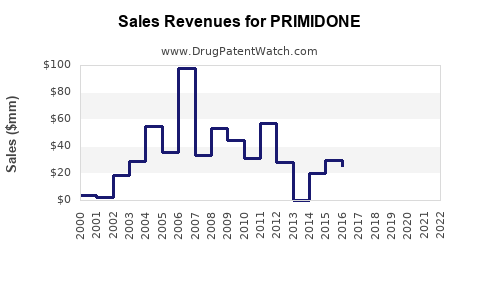
Primidone is a mature, off-patent anticonvulsant with limited commercial growth potential. The U.S. market is driven by low-cost generic tablets, recurring prescriptions for epilepsy and essential tremor, and supply reliability rather than brand differentiation. Pfizer’s legacy Mysoline brand has little apparent pricing power, while generic manufacturers compete in a low-margin market with modest barriers to entry. Public companies generally do not report primidone revenue separately, preventing a precise product-level market-size estimate.
What is primidone and how is it used?
Primidone is an oral antiseizure medicine approved in the United States for generalized tonic-clonic and complex partial seizures. It is also widely used for essential tremor, although essential tremor use is generally considered off-label in the United States. Primidone is metabolized in part to phenobarbital and phenylethylmalonamide, which contribute to its pharmacologic activity (National Library of Medicine, 2024).
The product is available primarily as immediate-release tablets. Common strengths include:
| Strength |
Typical commercial role |
| 50 mg |
Dose initiation and titration |
| 125 mg |
Intermediate dosing where available |
| 250 mg |
Maintenance dosing |
Primidone requires gradual titration because sedation, dizziness, nausea, ataxia, and cognitive effects can limit treatment. Enzyme induction and drug interactions also affect its use relative to newer antiseizure medicines.
What is the FDA regulatory status of primidone?
The U.S. Food and Drug Administration approved primidone decades ago. Mysoline was historically marketed by AstraZeneca and is now associated with legacy brand ownership and licensing arrangements rather than an active branded growth strategy. Generic primidone tablets have been approved under abbreviated new drug applications.
The FDA regulatory profile is mature:
| Regulatory attribute |
Primidone status |
| U.S. approval |
Approved |
| FDA pathway for current generics |
ANDA |
| Dosage form |
Immediate-release oral tablets |
| Reference brand |
Mysoline |
| Primary indications |
Seizures |
| Essential tremor use |
Common off-label use |
| Biologic status |
Not applicable |
| Biosimilar exposure |
None |
Because primidone is a small-molecule drug, competitors enter through the generic ANDA pathway rather than the biosimilar pathway. The product does not require biologic comparability studies or manufacturing controls associated with complex biologics.
What patents protect primidone?
No commercially meaningful composition-of-matter patent protection remains for primidone. The active ingredient was developed and approved in the mid-20th century, placing any original compound protection far beyond its statutory term.
The relevant intellectual-property position is summarized below:
| IP category |
Current commercial relevance |
| Primidone compound patent |
Expired |
| Original Mysoline patent estate |
Expired or commercially immaterial |
| Immediate-release tablet patents |
No material barrier publicly evident |
| Method-of-use patents |
No material exclusivity protecting core seizure use |
| Manufacturing patents |
Potentially relevant at an individual supplier level, but not a market-wide barrier |
| Orange Book patent protection |
No material listed patent protection expected to prevent generic competition |
The commercial market is therefore governed by FDA approval, manufacturing economics, supply continuity, and distributor access. Patent litigation is not the principal competitive risk.
What is the Orange Book status of primidone?
The FDA Orange Book provides therapeutic-equivalence information and patent listings for approved drug products. Primidone’s market status is consistent with a mature multisource generic product. The central commercial question is not whether generic entry is permitted, but whether a manufacturer can maintain reliable supply at acceptable margins.
Mysoline and generic primidone products do not have the exclusivity profile associated with newer branded medicines. Any historical Orange Book listings connected with the original product would not be expected to restrict current ANDA competition after expiration.
Orange Book-related considerations include:
- Generic products may receive an “AB” therapeutic-equivalence rating when the applicable FDA requirements are met.
- No active New Chemical Entity exclusivity remains.
- No pediatric exclusivity is commercially relevant.
- No meaningful patent-based delayed entry mechanism is apparent.
- Paragraph IV litigation is not a major current feature of the market.
When did primidone lose exclusivity?
Primidone lost practical exclusivity decades ago. The original product was approved in the 1950s, and the market has operated as a generic product category for many years.
| Exclusivity type |
Current status |
| New Chemical Entity exclusivity |
Expired |
| Orphan-drug exclusivity |
Not material to current market access |
| Pediatric exclusivity |
Expired or not applicable |
| Core patent exclusivity |
Expired |
| Brand-only commercial period |
Ended decades ago |
| Generic competition |
Established |
Unlike products facing a scheduled loss of exclusivity, primidone has no identifiable future “patent cliff.” Its financial trajectory is a steady mature-product curve rather than a sharp post-expiration collapse.
How many companies manufacture primidone?
Multiple manufacturers and marketing authorization holders have supplied generic primidone tablets in the United States and international markets. Supplier participation can change because of product discontinuations, facility economics, contract manufacturing, and distributor decisions.
The principal competitive groups include:
- Large U.S. generic companies with broad oral-solid portfolios.
- Specialty generic manufacturers focused on low-volume or legacy medicines.
- Contract manufacturers supplying private-label distributors.
- International manufacturers serving non-U.S. markets.
- Authorized generic or legacy-brand channels where commercially available.
Company-level primidone revenue is generally not disclosed. Large manufacturers report broader segments such as “Generics,” “Established Pharmaceuticals,” or “North America,” making product-specific market-share calculations unreliable without prescription and channel datasets.
What are the market dynamics for primidone?
Primidone operates in a price-sensitive, mature generic market. Demand is relatively stable because patients with epilepsy and essential tremor often remain on therapy for extended periods. Volume growth is constrained by the availability of newer medicines and by tolerability concerns.
The main market drivers are:
- Persistent treatment demand in epilepsy.
- Continued use in essential tremor, especially where low acquisition cost matters.
- Physician familiarity with a long-established medicine.
- Low generic prices and broad reimbursement coverage.
- Availability of 50 mg and 250 mg strengths for titration and maintenance.
The principal constraints are:
- Sedation and neurocognitive adverse effects.
- Drug interactions caused by enzyme induction.
- Competition from levetiracetam, lamotrigine, valproate, topiramate, gabapentin, and other therapies.
- Reduced use when clinicians prefer newer medicines with simpler interaction profiles.
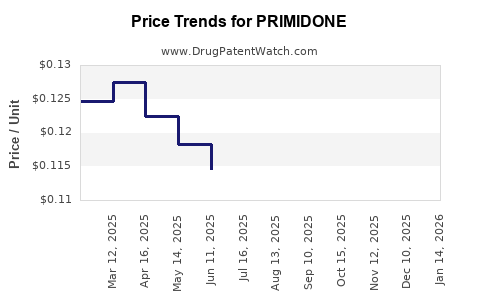
- Limited opportunity to raise price without triggering payer or substitution pressure.
Primidone has a relatively inelastic core demand base but highly elastic manufacturer economics. Small changes in manufacturing cost, wholesaler discounts, or reimbursement can materially affect supplier profitability.
What is the financial trajectory for primidone?
Primidone’s financial trajectory is best characterized as stable-to-declining in nominal commercial importance, with recurring generic demand and limited pricing power.
| Financial factor |
Expected effect |
| Prescription volume |
Stable in chronic-use segments |
| Average selling price |
Low and subject to generic erosion |
| Branded revenue |
Minimal relative to modern specialty drugs |
| Generic revenue pool |
Distributed among multiple suppliers |
| Gross margin |
Vulnerable to manufacturing and compliance costs |
| R&D spending |
Very limited |
| Promotional spending |
Low |
| Market growth |
Likely low single digit or negative in mature markets |
| Cash-flow profile |
Recurring but modest |
Public market data do not support a reliable standalone global revenue figure for primidone. Commercial estimates from syndicated datasets may differ materially depending on whether they include hospital purchasing, retail prescriptions, tender markets, branded sales, or active pharmaceutical ingredient transactions.
The economic value is concentrated in operating efficiency. A manufacturer with an established oral-solid manufacturing network can generate recurring revenue without meaningful clinical-development expense. The same manufacturer may exit the product if annual revenue falls below the threshold needed to cover validation, pharmacovigilance, quality systems, and inventory costs.
What generic entry risks exist for primidone?
Generic entry risk is already realized rather than prospective. The market has multiple generic suppliers, and therapeutic substitution is established. The main risk to incumbents is not a Paragraph IV launch but additional price competition or a new supplier winning pharmacy and wholesaler contracts.
Generic competition affects primidone through:
- Lower reimbursement ceilings.
- Pharmacy substitution.
- Wholesaler purchasing concentration.
- Periodic supplier exits.
- Inventory shortages if one or more manufacturers reduce production.
- Contract repricing during annual procurement cycles.
Because the product is inexpensive, regulatory compliance and supply continuity can be more important than manufacturing scale alone. A facility disruption may temporarily improve pricing for remaining suppliers, but the long-term market still tends toward low margins.
Are there Paragraph IV challenges or patent litigation involving primidone?
No current, material Paragraph IV campaign is associated with primidone’s core U.S. market. The reason is structural: the relevant compound and product protections expired long ago, and generic manufacturers already compete.
Patent litigation risk is therefore low. Potential disputes would more likely involve:
- Manufacturing process rights.
- Trademark or trade dress.
- Contract manufacturing.
- Product liability.
- Supply agreements.
- Regulatory status or ANDA documentation.
These issues differ from the patent litigation typically seen before launch of a high-value branded medicine.
What formulations are protected by primidone patents?
The commercial product is an immediate-release tablet. There is no known active formulation patent estate that materially protects the standard primidone tablet market.
Potential technical differentiation is limited to:
- Tablet strength and score configuration.
- Excipients.
- Packaging.
- Dissolution performance.
- Manufacturing process controls.
- Supply-chain quality systems.
These features may support regulatory approval or operational efficiency but are unlikely to create durable market exclusivity. A modified-release formulation could theoretically differentiate treatment, but no widely commercialized, patent-protected primidone extended-release franchise has become a major market factor.
How does primidone compare with competing antiseizure drugs?
Primidone competes mainly on cost and clinical familiarity. Newer agents compete on tolerability, dosing convenience, interaction profile, and broader physician adoption.
| Drug |
Market position versus primidone |
| Levetiracetam |
Broad use, simple dosing, limited enzyme induction |
| Lamotrigine |
Strong use in several seizure types; titration and rash risk |
| Valproate |
Broad efficacy; safety restrictions in pregnancy |
| Topiramate |
Seizure and migraine positioning; cognitive and metabolic effects |
| Gabapentin |
Used in selected seizure and pain settings; weaker broad seizure role |
| Propranolol |
Important essential-tremor competitor, not an antiseizure drug |
| Primidone |
Low cost, established efficacy, greater sedation and interaction burden |
For essential tremor, primidone competes directly with propranolol and, in selected patients, newer procedural or device-based interventions. This creates a separate demand base from epilepsy but does not create meaningful patent value for primidone manufacturers.
What manufacturing and intellectual-property barriers affect the market?
Manufacturing barriers are moderate operationally but low legally. Primidone is a conventional small molecule, and the finished dosage form does not require advanced delivery technology. The principal requirements are validated tablet production, assay and impurity control, dissolution compliance, stability data, and reliable supply of active pharmaceutical ingredient.
Potential barriers include:
- Maintaining an FDA-compliant manufacturing site.
- Securing qualified API suppliers.
- Managing low-volume production economics.
- Meeting annual demand without excessive inventory.
- Avoiding quality-related import or manufacturing restrictions.
- Maintaining product availability across multiple strengths.
These barriers can reduce the number of active suppliers even when patent barriers are absent.
What licensing deals affect primidone?
No major recent licensing transaction has reshaped the primidone market. Legacy brand rights, generic distribution agreements, and contract manufacturing arrangements may exist, but they do not create a material strategic moat.
The commercial structure is more likely to involve routine arrangements covering:
- Product distribution.
- Private-label supply.
- Regional marketing rights.
- API sourcing.
- Portfolio acquisitions involving multiple mature generic medicines.
Primidone is unlikely to be a standalone target for a major licensing transaction because its revenue contribution is modest and its IP position is weak.
What generic launch scenarios are possible?
The most likely scenarios are:
Base case
Existing suppliers continue serving stable chronic demand. Prices remain low, and market share shifts gradually among manufacturers based on availability, reimbursement, and contracting.
Consolidation case
One or more suppliers exit because of low margins or manufacturing costs. Remaining manufacturers gain temporary volume and may experience modest price improvement.
Supply-disruption case
A manufacturing or API problem reduces availability of one or more strengths. Pharmacies and wholesalers shift orders to remaining suppliers, creating short-term volatility.
Competitive-entry case
A new ANDA holder enters with conventional tablets. The entrant must compete on price, supply reliability, and distribution rather than patent timing.
What is the geographic coverage of the primidone market?
Primidone is marketed in the United States and other countries, although product availability, brand names, strengths, and reimbursement differ by jurisdiction. The U.S. market has the clearest generic framework and the strongest substitution dynamics.
International revenue is affected by:
- National tender systems.
- Public reimbursement policies.
- Local registration requirements.
- Domestic manufacturing preferences.
- Pharmacy substitution rules.
- Availability of phenobarbital and other low-cost alternatives.
The product has broader clinical relevance in markets where cost containment remains central and older antiseizure medicines retain a significant role.
How strong is the primidone patent estate?
The patent estate is weak from an exclusivity perspective and immaterial as a barrier to generic entry. Its strengths are limited to the historical validity of expired rights and any narrow, non-market-blocking process claims held by individual parties.
| Patent-strength dimension |
Assessment |
| Composition-of-matter protection |
None remaining |
| Formulation protection |
Weak or immaterial |
| Method-of-use protection |
No meaningful core-market barrier |
| Generic blocking power |
Very low |
| Litigation leverage |
Very low |
| Manufacturing know-how |
Moderate operational value |
| Regulatory moat |
Low |
Key Takeaways
- Primidone is a mature, generic small-molecule anticonvulsant.
- Mysoline has no meaningful brand-driven growth profile.
- Core patents and regulatory exclusivity expired decades ago.
- Paragraph IV and patent litigation risk are low.
- The market is driven by stable chronic demand, low prices, and supplier reliability.
- Essential tremor provides an important off-label demand segment.
- Newer antiseizure medicines limit volume growth.
- Product-level revenue is not separately disclosed by most manufacturers.
- Financial value lies in efficient manufacturing and dependable distribution, not intellectual property.
- The principal commercial risks are price erosion, supplier exit, and intermittent supply disruption.
Frequently Asked Questions
Is primidone still commercially profitable for generic manufacturers?
It can be profitable when produced efficiently, but margins are constrained by low prices, wholesaler negotiations, quality costs, and limited market growth.
Does primidone have a patent-protected extended-release formulation?
No widely commercialized extended-release primidone franchise has become a material protected market. Standard immediate-release tablets dominate commercial use.
Can a generic company launch primidone without a patent settlement?
Yes. The core patent estate is expired, so a new applicant generally does not need a settlement to enter the established generic market.
Is primidone vulnerable to replacement by newer epilepsy drugs?
Yes, particularly where sedation, cognitive effects, or drug interactions are concerns. Its low cost and long clinical history preserve demand in selected patients.
Does primidone have biosimilar competition?
No. Primidone is a small-molecule drug and competes through conventional generic approvals, not biosimilar development.
References
-
Food and Drug Administration. (2024). Approved drug products with therapeutic equivalence evaluations. U.S. Department of Health and Human Services.
-
Food and Drug Administration. (2024). Drugs@FDA: FDA-approved drugs. U.S. Department of Health and Human Services.
-
National Library of Medicine. (2024). Primidone: Drug information. MedlinePlus.
-
National Library of Medicine. (2024). Primidone. DailyMed.
-
U.S. Food and Drug Administration. (2024). Abbreviated new drug application (ANDA) process. U.S. Department of Health and Human Services.