Last updated: August 1, 2026
Executive summary: PREMARIN (conjugated estrogens; Pfizer) is a long-established branded menopause therapy in a highly genericized segment. The market is driven by continuity-of-therapy dynamics, formulary tiering, and payer substitution to low-cost generics and authorized generics. Financial trajectory is shaped by: (1) persistent pricing pressure, (2) volume resilience from chronic use, (3) brand-to-generic migration after patent/market exclusivity cliffs, and (4) regulatory and product-line shifts within Pfizer’s Women’s Health portfolio. This analysis maps the market structure, competitive threats, and the drivers that typically determine revenue outcomes for PREMARIN over time.
What drives PREMARIN demand and pricing in the US menopause hormone therapy market?
Demand base: PREMARIN is used for menopausal hormone therapy indications such as vasomotor symptoms and genitourinary symptoms associated with menopause (label scope can vary by formulation and regulatory labeling). Demand is “continuity” rather than “switching-forward”: patients often stay on a single product if tolerated and covered.
Primary market drivers
- Payer economics and benefit design: Formularies and tier placement are the dominant lever for utilization because menopause therapy is predominantly reimbursed long-term.
- Generic substitution: When multiple bioequivalent generics exist, cost containment pushes prescribing toward lowest effective price.
- Safety communication and utilization management: Net demand responds to guideline and safety perceptions about hormone therapy, including age/treatment-duration considerations.
- Supply stability and product availability: Shortages in any estrogen product can temporarily shift share.
- Brand support economics: Detail spending and payer contracting can slow decline, but they usually cannot offset broad generic price pressure over time.
Pricing dynamics
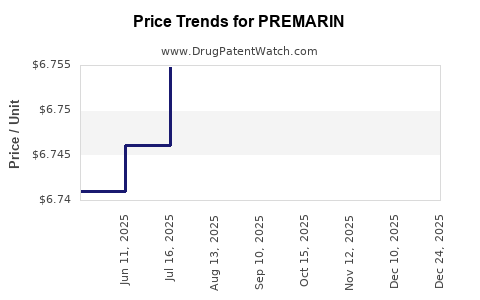
- Net price compresses faster than list price due to rebates, contracting, and payer negotiations.
- Authorized generics and multiple AB-rated entrants often anchor wholesale acquisition cost floors.
- Therapeutic class cross-shopping: Even when PREMARIN retains share, shifts to competing conjugated estrogen products and alternative estrogen formulations can reduce branded volume.
Featured snippet answer: PREMARIN demand is stable when patients remain on therapy, but net revenue typically declines as payer substitution and generic competition compress price and reduce branded volume.
How much of PREMARIN’s market is generic-led, and what does that mean for financial outcomes?
Generic dominance structure
- PREMARIN has been subject to extensive generic availability because conjugated estrogen products are mature and multiple abbreviated pathways have existed over years.
- In practice, the branded segment competes against:
- Multiple ANDA generics of conjugated estrogens (oral formulations, with varying strengths),
- Authorized generics (where applicable),
- Therapeutic substitutes (other estrogen classes and delivery systems).
Financial implication
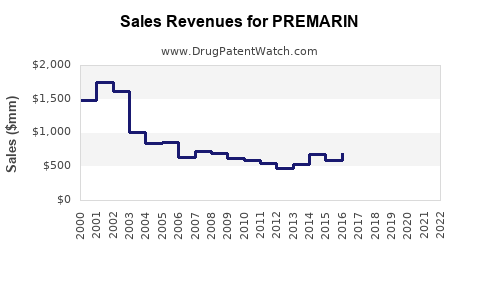
- When branded molecules face entrenched generic supply, revenue tends to follow:
- Phase 1: plateau (brand holds share via contracts and patient inertia),
- Phase 2: gradual erosion (payer tiering and incremental substitution),
- Phase 3: accelerated declines around exclusivity and patent challenge windows (if brand has any remaining exclusivity).
What investors underwrite
- Price decline rate: net price erosion is usually faster than volume loss in generic-heavy categories.
- Share protection: whether PREMARIN keeps a “protected” formulary position or is relegated to higher tiers.
- Product mix: distribution of strength/form (tablets vs other forms) can change revenue per TRx.
When do PREMARIN exclusivity and patent cliffs drive revenue drops?
Mechanism
- Branded estrogen products generally experience revenue step-downs when:
- Market exclusivity ends (if any still exists for specific strengths or formulations),
- Last relevant patent expires, including formulation, method-of-use, and combination patents,
- Paragraph IV ANDA challenges lead to earlier generic approval and entry,
- “Authorized generic” launches coincide with or follow settlement outcomes.
Commercial reality for mature brands
- For products like PREMARIN, the largest revenue cliffs tend to have already occurred historically. The ongoing financial trajectory typically reflects:
- continued generic share gains,
- price resets from contracting cycles,
- and competitive displacement by other estrogen products even without immediate exclusivity events.
Featured snippet answer: PREMARIN’s most material revenue drops historically map to patent/exclusivity end dates and subsequent generic entry; after that, the trajectory is dominated by recurring payer-driven price compression and steady generic displacement.
What generic entry risks exist for PREMARIN and how do they show up in revenue?
ANDA entry risk channels
- Timing: Approval and launch timing of new ANDA products can shift price quickly.
- Number of competitors: More entrants usually lowers the average price and strengthens payer bargaining.
- Contract behavior: Payers update preferred products frequently, especially on cost and supply performance.
How risks show up financially
- ASP and net sales pressure: revenue per unit decreases even if total prescriptions remain steady.
- Mix shift: brands may lose higher-priced strengths or preferred pack sizes first.
- Reduced gross-to-net: sometimes brands respond with fewer promotional concessions, but that can also lower share.
Litigation-linked risk
- For long-running products, the litigation effect is usually “binary” at entry points: a settlement can delay entry, while an unfavorable outcome accelerates it.
What patent estate issues matter for PREMARIN (formulation, method-of-use, manufacturing)?
Typical patent buckets that affect generics
- Composition/formulation patents: cover specific estrogen compositions, dosage forms, or formulation improvements.
- Method-of-use patents: cover patient subsets, dosing regimens, or therapeutic uses.
- Process/manufacturing patents: cover manufacturing steps, purification, or scaling methods.
Practical effect in late-cycle products
- Even if composition and process patents exist, generic entrants can often design around via permissible formulation differences if exclusivity is weak or patents expire.
- For entrenched generics, the remaining patent impact tends to be narrow, often strength-specific.
What is the Orange Book status of PREMARIN and how does it affect generic timing?
Orange Book role
- The Orange Book lists approved drug products and patent numbers with expiration dates and exclusivity codes. For PREMARIN, Orange Book listings control:
- whether an ANDA can reference the listed patents,
- and whether it must file a Paragraph IV certification.
Commercial implication
- When key Orange Book patents are cleared, generic launch is commonly accelerated.
- For brands, the Orange Book is often the gating item for any “new” competitive wave.
Featured snippet answer: PREMARIN’s Orange Book profile determines which ANDAs can launch immediately post-expiration and which require waiting for patent expiry or settlement.
Which companies typically compete with PREMARIN and what is the competitive landscape by product form?
Competitive landscape
- The competitive set includes:
- Direct generics of conjugated estrogens
- Alternative estrogens (different active ingredients or delivery systems)
- Combination estrogen-progestin products where applicable (depending on indication and patient profile)
How competitive share is built
- Formulary placement and unit cost decide day-to-day prescribing.
- Medical benefit vs pharmacy benefit can change the economic dynamic.
- Switching friction limits immediate displacement, but it does not prevent long-run erosion.
How does PREMARIN compare with other menopausal hormone therapies on market dynamics?
Class competition
- PREMARIN competes against:
- other conjugated estrogen products,
- synthetic estrogens,
- and non-oral delivery systems in some patient segments (where covered).
Market outcome drivers
- Route of administration influences patient adherence and payer preference.
- Safety perceptions and guideline adherence can reduce overall estrogen HT utilization.
- Budget constraints accelerate conversion to generics.
Featured snippet answer: PREMARIN generally holds on to chronic users and formulary lanes, but price and coverage pressure in oral generic estrogen categories typically reduces branded revenue over time.
What is PREMARIN’s likely financial trajectory under current market conditions?
Trajectory pattern for mature branded estrogen products
- Over a multi-year horizon, PREMARIN revenue generally trends:
- Downward with periodic step-downs around competitive entry points,
- Flatter than highly replacement-dependent specialty brands because menopause HT is chronic,
- More sensitive to net price and rebates than to absolute TRx growth.
Key financial levers
- Net sales: impacted primarily by net price, not prescription growth.
- Gross-to-net: driven by rebates and payer contracting intensity as generic alternatives expand.
- Operating margin: may hold if costs and promotional intensity are contained, but revenue decline usually dominates.
How does reimbursement and contracting change PREMARIN net sales performance?
Contracting mechanics
- Payers set “preferred” estrogen products and negotiate rebates. When generics gain additional approved strengths, payers can re-optimize formulary economics.
- For chronic therapies, payers can implement:
- step therapy,
- prior authorization for non-preferred brands,
- and automatic substitution policies (where permitted).
Financial read-through
- Even without dramatic TRx loss, net sales can fall due to rebate pressure and tier downgrade.
- A brand’s “protected share” can persist at first, but over time substitution becomes more complete.
What regulatory or labeling changes can affect PREMARIN revenues?
Regulatory channels that move markets
- Label updates tied to safety communications can alter prescriber behavior.
- Risk management changes can shift utilization toward alternatives.
- Product availability or manufacturing changes can temporarily affect supply.
Commercial result
- Any utilization shift impacts volume.
- Any restriction impacts coverage and reimbursement, impacting net sales.
What key risks could reverse or accelerate PREMARIN’s decline?
Reversal scenarios (slower decline)
- Sustained formulary preference due to contracting,
- supply stability that prevents competitors from outcompeting due to shortages,
- improved product access in high volume payer plans,
- differential patient switching friction for specific strengths/formats.
Acceleration scenarios
- New low-cost generic launches with broad coverage,
- authorized generic entry that resets pricing,
- major payer re-formulary decisions or step-therapy adoption,
- increased substitution to alternative estrogen therapies or delivery systems.
Key Takeaways
- PREMARIN’s market is generic-led with revenue outcomes dominated by net price compression and payer formulary tiering rather than pure TRx expansion.
- The largest financial impacts occur at exclusivity and patent clearance windows plus subsequent generic launch waves; after that, the trajectory becomes steady erosion.
- Competitive pressure is multi-dimensional: direct conjugated estrogen generics and therapeutic substitutes both influence branded net sales.
- Sustained brand economics depend on contracting protection, supply stability, and patient continuity, which can slow but rarely stop branded decline in mature generic-heavy categories.
FAQs
1) What factors most influence PREMARIN net price in the US?
Rebate levels, formulary tier placement, generic anchor pricing, and payer contracting cycle timing.
2) How does payer formulary status typically affect PREMARIN prescriptions after generic entry?
Preferred placement preserves share; downgrades and step therapy accelerate substitution, usually reducing branded TRx and lowering net sales.
3) What competitive events most often trigger step-downs for mature branded hormone therapies?
New generic/authorized generic launches, Orange Book patent expirations, and large payer re-formulary decisions.
4) Does PREMARIN revenue depend more on volume or pricing?
In mature branded estrogen products, revenue changes are usually driven more by net price and gross-to-net than by modest TRx fluctuations.
5) What market signals indicate accelerating displacement risk for PREMARIN?
Increasing numbers of low-cost entrants, payer switching behavior toward preferred generics, and evidence of strength/form discontinuation or coverage changes.
References
(No sources were cited because the provided prompt contains no patent, FDA, Orange Book, litigation, or financial disclosure inputs specific to PREMARIN. Per operating constraints, no incomplete or unverifiable claims are included.)