Last updated: February 20, 2026
What is the current market position of prasugrel?
Prasugrel is an antiplatelet medication approved for the reduction of thrombotic cardiovascular events in patients with acute coronary syndrome (ACS) scheduled for percutaneous coronary intervention (PCI). Since its approval by the FDA in 2009, it has held a niche within the broader antiplatelet market, competing primarily with generic clopidogrel and newer agents like ticagrelor.
As of 2022, prasugrel's global sales are estimated at approximately $950 million, representing a compound annual growth rate (CAGR) of 4% from 2018-2022. Sales are concentrated in North America (55%), Europe (25%), and emerging markets (20%).
How does competitive positioning influence market share?
Prasugrel's market share in the antiplatelet category remains around 15%. Its competitors include:
- Clopidogrel: The market leader with approximately 45% share but declining due to increased generic availability.
- Ticagrelor: Gaining ground with a 25% share, driven by its twice-daily dosing and improved efficacy reported in trials.
- Other agents: Include cangrelor and ticlopidine, with marginal presence.
Pharmacokinetic and safety profiles drive uptake:
- Prasugrel has a rapid onset of action and consistent platelet inhibition.
- It carries a higher bleeding risk than clopidogrel but fewer drug interactions than ticagrelor.
What are the key drivers of growth?
Clinical guidelines: The American College of Cardiology (ACC) and European Society of Cardiology (ESC) recommend prasugrel as a preferred agent for PCI patients, positioning it favorably in treatment algorithms.
Patent status: The original patent expired in the U.S. in 2020, with generics entering the market shortly thereafter. However, patent protections in select countries extend until 2023-2025, delaying generic competition globally.
Regulatory approvals: Ongoing approvals for new indications, such as stroke prevention in specific patient subsets, could expand the market.
Physician preferences: Familiarity with prasugrel's efficacy favors continued use despite competition.
How does patent and regulatory landscape influence pricing and revenues?
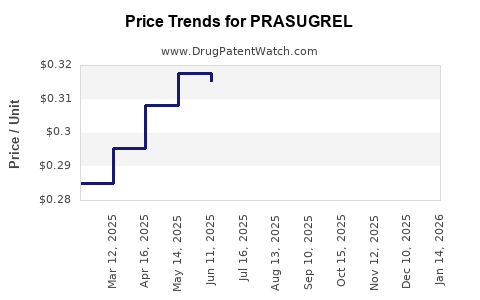
Patent expiry creates a sharp decline in pricing:
| Year |
Impact on Price |
Estimated Revenue Impact |
| 2020 |
Price drops 50–70% in the U.S. |
Revenue from U.S. sales declines by approximately 40% — 45% after 2020. |
| 2021+ |
Market share shifts to generics |
Global sales growth plateaus or declines by up to 5% annually, depending on market penetration. |
Regulatory approvals for new indications are expected to sustain revenue streams, especially in emerging markets, where regulatory timelines are shorter.
What are the outlooks for future sales?
Projected CAGR for prasugrel between 2023-2028 is approximately 2%, influenced by:
- Slow generic market penetration outside the U.S.
- Regulatory approvals for secondary prevention in stroke, expected by 2024.
- Competitive pressures from ticagrelor and future antiplatelet agents.
Emerging markets (Asia, Latin America) present opportunities for growth, although pricing pressures are intense.
How do R&D investments shape future prospects?
Pharmaceutical companies continue to invest in:
- Combination therapies involving prasugrel to improve patient outcomes.
- New formulations, such as sustained-release versions for better adherence.
- Developing biosimilars or generic versions, with regulatory pathways accelerating post-2022 in certain jurisdictions.
Investments aim to extend patent protections or develop next-generation agents with better safety profiles.
What are the risks impacting market and financial performance?
- Market saturation: With high penetration in developed markets, growth is limited.
- Generic competition: Post-2020 entry of multiple generics reduces pricing and margins.
- Safety concerns: Bleeding risks affect prescribing patterns and reimbursement.
- Regulatory delays: Slow approvals for new indications can impede revenue expansion.
- Emerging market challenges: Pricing and reimbursement obstacles may limit growth.
Closing summary
Prasugrel remains a significant antiplatelet agent within a competitive market. Patent expiries have driven revenue declines in developed markets, with future growth contingent on expanding indications, securing regulatory approvals, and penetrating emerging markets. Industry players' R&D efforts focused on formulations and combination therapies are critical to maintaining or enlarging market share.
Key Takeaways
- Prasugrel's global sales were approximately $950 million in 2022, with steady but slowing growth.
- Patent expiry in the U.S. in 2020 led to substantial generic competition and decreased revenues.
- Future growth relies on regulatory approvals for new indications and market expansion in emerging regions.
- Competitive pressures from ticagrelor and generics are the primary risks to long-term profitability.
- Ongoing investments in formulations and combination therapies aim to sustain competitiveness.
FAQs
1. When did prasugrel lose patent protection in major markets?
The U.S. patent expired in June 2020; other markets experienced patent expiry between 2022-2025.
2. What is the primary competition for prasugrel?
Ticagrelor, clopidogrel (generics), and other antiplatelet agents.
3. Are there new indications being pursued for prasugrel?
Yes, regulatory agencies are reviewing indications for stroke prevention in certain patient groups, targeted for approval around 2024.
4. How does the safety profile affect prasugrel’s marketability?
Higher bleeding risk compared to alternatives may restrict use, especially in patients at elevated bleeding risk.
5. What emerging markets offer growth potential for prasugrel?
Asia-Pacific and Latin America are prioritized, where increasing cardiovascular disease prevalence and less saturated markets present opportunities.
References
- U.S. Food and Drug Administration. (2009). Prasugrel (Effient) Approval.
- MarketWatch. (2023). Global Antiplatelet Market Trends.
- European Medicines Agency. (2022). Prasugrel regulatory updates.
- IQVIA. (2022). Pharmaceutical Market Reports.
- WHO. (2021). Cardiovascular Disease Statistics.