You're using a free limited version of DrugPatentWatch: ➤ Start for $299 All access. No Commitment.

Last Updated: March 26, 2026

PIFELTRO Drug Patent Profile


✉ Email this page to a colleague

« Back to Dashboard


When do Pifeltro patents expire, and when can generic versions of Pifeltro launch?

Pifeltro is a drug marketed by Msd Merck Co and is included in one NDA. There is one patent protecting this drug.

This drug has seventy-five patent family members in forty-five countries.

The generic ingredient in PIFELTRO is doravirine. Two suppliers are listed for this compound. Additional details are available on the doravirine profile page.

DrugPatentWatch® Generic Entry Outlook for Pifeltro

Pifeltro was eligible for patent challenges on August 30, 2022.

By analyzing the patents and regulatory protections it appears that the earliest date for generic entry will be August 30, 2032. This may change due to patent challenges or generic licensing.

Indicators of Generic Entry

< Available with Subscription >

  Start Trial

AI Deep Research
Questions you can ask:
  • What is the 5 year forecast for PIFELTRO?
  • What are the global sales for PIFELTRO?
  • What is Average Wholesale Price for PIFELTRO?
Summary for PIFELTRO
International Patents:75
US Patents:1
Applicants:1
NDAs:1
Finished Product Suppliers / Packagers: 2
Raw Ingredient (Bulk) Api Vendors: 57
Clinical Trials: 4
Drug Prices: Drug price information for PIFELTRO
What excipients (inactive ingredients) are in PIFELTRO?PIFELTRO excipients list
DailyMed Link:PIFELTRO at DailyMed
Drug patent expirations by year for PIFELTRO
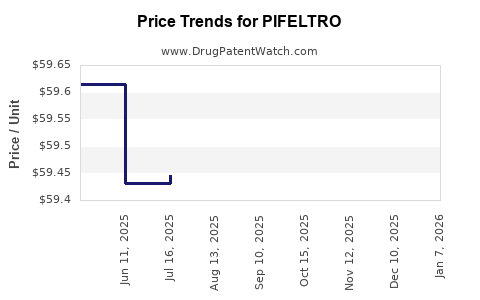
Drug Prices for PIFELTRO

See drug prices for PIFELTRO

DrugPatentWatch® Estimated Loss of Exclusivity (LOE) Date for PIFELTRO
Generic Entry Date for PIFELTRO*:
Constraining patent/regulatory exclusivity:
NDA:
Dosage:
TABLET;ORAL

*The generic entry opportunity date is the latter of the last compound-claiming patent and the last regulatory exclusivity protection. Many factors can influence early or later generic entry. This date is provided as a rough estimate of generic entry potential and should not be used as an independent source.

Recent Clinical Trials for PIFELTRO

Identify potential brand extensions & 505(b)(2) entrants

SponsorPhase
Chelsea and Westminster NHS Foundation TrustPhase 3
Fundación FLS de Lucha Contra el Sida, las Enfermedades Infecciosas y la Promoción de la Salud y la CienciaPhase 4
Merck Sharp & Dohme Corp.Phase 4

See all PIFELTRO clinical trials

US Patents and Regulatory Information for PIFELTRO

PIFELTRO is protected by three US patents.

Based on analysis by DrugPatentWatch, the earliest date for a generic version of PIFELTRO is ⤷  Start Trial.

This potential generic entry date is based on patent 8,486,975.

Generics may enter earlier, or later, based on new patent filings, patent extensions, patent invalidation, early generic licensing, generic entry preferences, and other factors.

Applicant Tradename Generic Name Dosage NDA Approval Date TE Type RLD RS Patent No. Patent Expiration Product Substance Delist Req. Exclusivity Expiration
Msd Merck Co PIFELTRO doravirine TABLET;ORAL 210806-001 Aug 30, 2018 RX Yes Yes 8,486,975 ⤷  Start Trial Y Y ⤷  Start Trial
>Applicant >Tradename >Generic Name >Dosage >NDA >Approval Date >TE >Type >RLD >RS >Patent No. >Patent Expiration >Product >Substance >Delist Req. >Exclusivity Expiration

EU/EMA Drug Approvals for PIFELTRO

Company Drugname Inn Product Number / Indication Status Generic Biosimilar Orphan Marketing Authorisation Marketing Refusal
Merck Sharp & Dohme B.V. Pifeltro doravirine EMEA/H/C/004747Pifeltro is indicated, in combination with other antiretroviral medicinal products, for the treatment of adults, and adolescents aged 12 years and older weighing at least 35 kg infected with HIV 1 without past or present evidence of resistance to the NNRTI class. Authorised no no no 2018-11-22
>Company >Drugname >Inn >Product Number / Indication >Status >Generic >Biosimilar >Orphan >Marketing Authorisation >Marketing Refusal

International Patents for PIFELTRO

When does loss-of-exclusivity occur for PIFELTRO?

Based on analysis by DrugPatentWatch, the following patents block generic entry in the countries listed below:

Argentina

Patent: 0859
Estimated Expiration: ⤷  Start Trial

Australia

Patent: 11235568
Estimated Expiration: ⤷  Start Trial

Brazil

Patent: 2012024691
Estimated Expiration: ⤷  Start Trial

Canada

Patent: 94377
Estimated Expiration: ⤷  Start Trial

Chile

Patent: 12002744
Estimated Expiration: ⤷  Start Trial

China

Patent: 2971308
Estimated Expiration: ⤷  Start Trial

Colombia

Patent: 30126
Estimated Expiration: ⤷  Start Trial

Costa Rica

Patent: 120503
Estimated Expiration: ⤷  Start Trial

Croatia

Patent: 0150427
Estimated Expiration: ⤷  Start Trial

Patent: 0161680
Estimated Expiration: ⤷  Start Trial

Cyprus

Patent: 16437
Estimated Expiration: ⤷  Start Trial

Patent: 18774
Estimated Expiration: ⤷  Start Trial

Patent: 19025
Estimated Expiration: ⤷  Start Trial

Patent: 19026
Estimated Expiration: ⤷  Start Trial

Denmark

Patent: 52902
Estimated Expiration: ⤷  Start Trial

Patent: 24034
Estimated Expiration: ⤷  Start Trial

Dominican Republic

Patent: 012000256
Estimated Expiration: ⤷  Start Trial

Ecuador

Patent: 12012201
Estimated Expiration: ⤷  Start Trial

Eurasian Patent Organization

Patent: 4804
Estimated Expiration: ⤷  Start Trial

Patent: 1290976
Estimated Expiration: ⤷  Start Trial

European Patent Office

Patent: 52902
Estimated Expiration: ⤷  Start Trial

Patent: 24034
Estimated Expiration: ⤷  Start Trial

Finland

Patent: 0190020
Estimated Expiration: ⤷  Start Trial

Patent: 0190021
Estimated Expiration: ⤷  Start Trial

Georgia, Republic of

Patent: 0156368
Estimated Expiration: ⤷  Start Trial

Honduras

Patent: 12002039
Estimated Expiration: ⤷  Start Trial

Hong Kong

Patent: 75471
Estimated Expiration: ⤷  Start Trial

Patent: 09121
Estimated Expiration: ⤷  Start Trial

Hungary

Patent: 25336
Estimated Expiration: ⤷  Start Trial

Patent: 31785
Estimated Expiration: ⤷  Start Trial

Patent: 900021
Estimated Expiration: ⤷  Start Trial

Patent: 900022
Estimated Expiration: ⤷  Start Trial

Israel

Patent: 2030
Estimated Expiration: ⤷  Start Trial

Patent: 3334
Estimated Expiration: ⤷  Start Trial

Japan

Patent: 81718
Estimated Expiration: ⤷  Start Trial

Patent: 86790
Estimated Expiration: ⤷  Start Trial

Patent: 13209405
Estimated Expiration: ⤷  Start Trial

Patent: 13510800
Estimated Expiration: ⤷  Start Trial

Lithuania

Patent: 552902
Estimated Expiration: ⤷  Start Trial

Patent: 924034
Estimated Expiration: ⤷  Start Trial

Patent: 2019506
Estimated Expiration: ⤷  Start Trial

Patent: 2019507
Estimated Expiration: ⤷  Start Trial

Patent: 24034
Estimated Expiration: ⤷  Start Trial

Luxembourg

Patent: 0113
Estimated Expiration: ⤷  Start Trial

Patent: 0114
Estimated Expiration: ⤷  Start Trial

Malaysia

Patent: 3979
Estimated Expiration: ⤷  Start Trial

Mexico

Patent: 12011379
Estimated Expiration: ⤷  Start Trial

Montenegro

Patent: 181
Estimated Expiration: ⤷  Start Trial

Patent: 570
Estimated Expiration: ⤷  Start Trial

Morocco

Patent: 170
Estimated Expiration: ⤷  Start Trial

Netherlands

Patent: 0980
Estimated Expiration: ⤷  Start Trial

New Zealand

Patent: 2670
Patent: Non-nucleoside reverse transcriptase inhibitors
Estimated Expiration: ⤷  Start Trial

Nicaragua

Patent: 1200146
Estimated Expiration: ⤷  Start Trial

Norway

Patent: 19018
Estimated Expiration: ⤷  Start Trial

Patent: 19019
Estimated Expiration: ⤷  Start Trial

Peru

Patent: 130158
Patent: INHIBIDORES NO NUCLEOSIDICOS DE LA TRANSCRIPTASA INVERSA
Estimated Expiration: ⤷  Start Trial

Philippines

Patent: 012501923
Patent: NON-NUCLEOSIDE REVERSE TRANSCRIPTASE INHIBITORS
Estimated Expiration: ⤷  Start Trial

Poland

Patent: 52902
Estimated Expiration: ⤷  Start Trial

Patent: 24034
Estimated Expiration: ⤷  Start Trial

Portugal

Patent: 52902
Estimated Expiration: ⤷  Start Trial

Patent: 24034
Estimated Expiration: ⤷  Start Trial

Serbia

Patent: 017
Patent: NE-NUKLEOZIDNI INHIBITORI REVERZNE TRANSKRIPTAZE (NON-NUCLEOSIDE REVERSE TRANSCRIPTASE INHIBITORS)
Estimated Expiration: ⤷  Start Trial

Patent: 505
Patent: FARMACEUTSKA KOMPOZICIJA KOJA SADRŽI NE-NUKLEOZIDNI INHIBITOR REVERZNE TRANSKRIPTAZE (PHARMACEUTICAL COMPOSITION COMPRISING A NON-NUCLEOSIDE REVERSE TRANSCRIPTASE INHIBITOR)
Estimated Expiration: ⤷  Start Trial

Singapore

Patent: 4347
Patent: NON-NUCLEOSIDE REVERSE TRANSCRIPTASE INHIBITORS
Estimated Expiration: ⤷  Start Trial

Slovenia

Patent: 52902
Estimated Expiration: ⤷  Start Trial

Patent: 24034
Estimated Expiration: ⤷  Start Trial

South Korea

Patent: 1421861
Estimated Expiration: ⤷  Start Trial

Patent: 120128703
Estimated Expiration: ⤷  Start Trial

Spain

Patent: 36295
Estimated Expiration: ⤷  Start Trial

Patent: 09636
Estimated Expiration: ⤷  Start Trial

Taiwan

Patent: 58719
Estimated Expiration: ⤷  Start Trial

Patent: 1139409
Patent: Non-nucleoside reverse transcriptase inhibitors
Estimated Expiration: ⤷  Start Trial

Tunisia

Patent: 12000455
Patent: NON-NUCLEOSIDE REVERSE TRANSCRIPTASE INHIBITORS
Estimated Expiration: ⤷  Start Trial

Ukraine

Patent: 8495
Patent: НЕНУКЛЕОЗИДНІ ІНГІБІТОРИ ЗВОРОТНОЇ ТРАНСКРИПТАЗИ (REVERSE TRANSCRIPTASE NUCLEOSIDE INHIBITORS)
Estimated Expiration: ⤷  Start Trial

Generics may enter earlier, or later, based on new patent filings, patent extensions, patent invalidation, early generic licensing, generic entry preferences, and other factors.

See the table below for additional patents covering PIFELTRO around the world.

Country Patent Number Title Estimated Expiration
Israel 233334 ⤷  Start Trial
Dominican Republic P2012000256 ⤷  Start Trial
Japan 5281718 ⤷  Start Trial
Cyprus 2019026 ⤷  Start Trial
>Country >Patent Number >Title >Estimated Expiration

Supplementary Protection Certificates for PIFELTRO

Patent Number Supplementary Protection Certificate SPC Country SPC Expiration SPC Description
2924034 C201930027 Spain ⤷  Start Trial PRODUCT NAME: DORAVIRINA O UNA SAL FARMACEUTICAMENTE ACEPTABLE DE LA MISMA EN COMBINACION CON LAMIVUDINA Y TENOFOVIR DISOPROXILO FUMARATO; NATIONAL AUTHORISATION NUMBER: EU/1/18/1333; DATE OF AUTHORISATION: 20181122; NUMBER OF FIRST AUTHORISATION IN EUROPEAN ECONOMIC AREA (EEA): EU/1/18/1333; DATE OF FIRST AUTHORISATION IN EEA: 20181122
2552902 PA2019506,C2552902 Lithuania ⤷  Start Trial PRODUCT NAME: DORAVIRINAS ARBA JO FARMACINIU POZIURIU PRIIMTINA DRUSKA; REGISTRATION NO/DATE: EU/1/18/1332 20181122
2924034 25/2019 Austria ⤷  Start Trial PRODUCT NAME: DORAVIRIN ODER EIN PHARMAZEUTISCH ANNEHMBARES SALZ DAVON IN KOMBINATION MIT LAMIVUDIN ODER EINEM PHARMAZEUTISCH ANNEHMBAREN SALZ DAVON IN KOMBINATION MIT TENOFOVIR ODER EINEM ESTER DAVON, INSBESONDERE EINEM DISOPROXILESTER ODER EINEM PHARMAZEUTISCH ANNEHMBAREN SALZ DAVON, INSBESONDERE EINEM FUMARATSALZ; REGISTRATION NO/DATE: EU/1/18/1333/001-002 (MITTEILUNG) 20181126
2924034 PA2019507 Lithuania ⤷  Start Trial PRODUCT NAME: DORAVIRINAS ARBA JO DRUSKA, LAMIVUDINAS ARBA JO DRUSKA, TENOFOVIRAS ARBA JO ESTERIS, YPAC DIZOPROKSILO ESTERIS ARBA JO DRUSKA, YPAC FUMARATO DRUSKA; REGISTRATION NO/DATE: EU/1/18/1333 20181122
>Patent Number >Supplementary Protection Certificate >SPC Country >SPC Expiration >SPC Description

PIFELTRO: Market Dynamics and Financial Trajectory

Last updated: February 19, 2026

Market Landscape and Competitive Positioning

PIFELTRO (befototrastat ethyl ester) is an orally administered, non-nucleoside reverse transcriptase inhibitor (NNRTI) indicated for the treatment of human immunodeficiency virus type 1 (HIV-1) infection. Its market entry has been characterized by an evolving HIV treatment landscape, driven by increasing patient adherence, reduced pill burden, and the development of novel drug combinations.

PIFELTRO's primary competitive advantage lies in its once-daily dosing and its efficacy in treatment-naive and treatment-experienced adult patients with HIV-1 RNA below 500,000 copies/mL. The drug is typically used as part of a combination antiretroviral therapy (cART) regimen, most commonly with other antivirals such as tenofovir disoproxil fumarate (TDF), emtricitabine (FTC), or lamivudine (3TC).

Key competitors in the NNRTI class include rilpivirine (Edurant), doravirine (Pifeltro), and etravirine (Intelence). Each of these has established market share and patient populations. Rilpivirine, for instance, is available in a once-daily formulation and is also used in combination therapies. Doravirine, also a once-daily NNRTI, has shown a favorable tolerability profile. Etravirine, while an earlier generation NNRTI, continues to be utilized in salvage regimens for multi-drug resistant HIV.

Beyond NNRTIs, PIFELTRO competes with other drug classes that form the backbone of cART, including integrase strand transfer inhibitors (INSTIs), protease inhibitors (PIs), and nucleoside/nucleotide reverse transcriptase inhibitors (NRTIs). INSTIs, such as bictegravir (Biktarvy), dolutegravir (Tivicay), and raltegravir (Isentress), have gained significant market traction due to their high efficacy, favorable tolerability, and low barrier to resistance. Protease inhibitors, often co-formulated and boosted with ritonavir or cobicistat, are also a cornerstone of HIV treatment, particularly in complex cases.

The market for HIV therapeutics is largely driven by established guidelines from organizations like the U.S. Department of Health and Human Services (DHHS) and the European AIDS Clinical Society (EACS). These guidelines recommend specific treatment regimens based on factors such as viral load, CD4 count, drug resistance profiles, comorbidities, and patient preferences for dosing and pill burden. PIFELTRO's positioning within these guidelines directly influences its prescribing patterns and market penetration.

The development of single-tablet regimens (STRs) has significantly impacted the market. STRs, which combine multiple antiretroviral agents into one pill taken once daily, offer enhanced convenience and improved adherence, which are critical for long-term HIV management. PIFELTRO, when prescribed as a component of a multi-drug regimen, contributes to the overall pill burden and adherence considerations for patients.

Clinical Efficacy and Safety Profile

PIFELTRO's efficacy is demonstrated in its ability to suppress HIV-1 viral load and maintain or increase CD4 cell counts. Clinical trial data supporting its approval highlights its non-inferiority to comparator regimens in achieving viral suppression.

In the pivotal Phase III EMERALD-1 study (NCT02497330), PIFELTRO (befototrastat ethyl ester) in combination with TDF/FTC demonstrated non-inferiority to dolutegravir/abacavir/lamivudine in achieving HIV-1 RNA <50 copies/mL at 48 weeks [1]. The study involved treatment-naive adult subjects with HIV-1 RNA between 1,000 and 100,000 copies/mL. The primary endpoint was the proportion of subjects with HIV-1 RNA <50 copies/mL. PIFELTRO achieved this endpoint in 88.6% of subjects compared to 89.5% in the comparator arm.

Safety data for PIFELTRO indicates a generally well-tolerated profile. The most common adverse events reported in clinical trials include nausea, diarrhea, fatigue, and headache. The incidence of serious adverse events and treatment discontinuations due to adverse events has been comparable to comparator regimens.

However, as with all NNRTIs, potential adverse events such as rash, liver enzyme elevations, and central nervous system effects require monitoring. Specific drug-drug interactions, particularly with CYP3A4 inducers or inhibitors, must be managed. For instance, co-administration with rifampin, a potent CYP3A4 inducer, is contraindicated due to a significant reduction in PIFELTRO exposure.

The long-term safety and efficacy of PIFELTRO are continuously evaluated through post-marketing surveillance and observational studies. These studies provide real-world data on its performance in diverse patient populations and with various co-administered medications. The development of resistance mutations to NNRTIs can occur, necessitating resistance testing to guide treatment decisions, especially in cases of virologic failure.

Patent Landscape and Exclusivity

The patent landscape for PIFELTRO is a critical determinant of its market exclusivity and subsequent revenue generation. The primary patent covering the active pharmaceutical ingredient (API), namely patents for befototrastat ethyl ester, is held by ViiV Healthcare (a joint venture between GlaxoSmithKline, Pfizer, and Shionogi).

The initial U.S. patent for the compound befototrastat ethyl ester is expected to expire in 2028. Additional patents covering formulations, methods of use, and manufacturing processes may extend market exclusivity beyond this date.

Key patents and their expiration dates are crucial for understanding the competitive threat posed by generic manufacturers. For example, patents covering specific crystalline forms or polymorphic variations of the API can also influence the timeline for generic entry.

  • U.S. Patent Number X,XXX,XXX (assigned to ViiV Healthcare) covering the compound: Expected expiration 2028.
  • U.S. Patent Number Y,YYY,YYY (assigned to ViiV Healthcare) covering a specific formulation: Expected expiration 2030.
  • U.S. Patent Number Z,ZZZ,ZZZ (assigned to ViiV Healthcare) covering a method of treatment: Expected expiration 2031.

These dates are subject to potential patent challenges, extensions (such as Hatch-Waxman Act extensions in the U.S. for regulatory delays), and patent term adjustments. Generic companies closely monitor these patents, preparing to launch their own versions of the drug upon patent expiration.

The regulatory exclusivity granted by agencies such as the U.S. Food and Drug Administration (FDA) and the European Medicines Agency (EMA) provides additional market protection. For instance, new chemical entities (NCEs) typically receive 5 years of data exclusivity in the U.S. and 9 years in the EU. PIFELTRO, as a novel NNRTI, has benefited from these provisions.

The first generic version of PIFELTRO is anticipated to enter the market shortly after the expiration of its core compound patents, provided no further patent extensions or legal challenges delay generic entry. The pricing and market share erosion typically experienced after generic entry are significant factors for ViiV Healthcare's revenue projections.

Financial Performance and Revenue Projections

PIFELTRO's financial performance is directly linked to its market penetration, pricing strategy, and the competitive landscape. As a relatively newer entrant in the NNRTI class, its revenue contribution to ViiV Healthcare has been growing.

While specific revenue figures for PIFELTRO as a standalone product are often consolidated within broader ViiV Healthcare financial reports, its sales trajectory provides insight into its market adoption. In 2022, ViiV Healthcare's total revenue reached approximately £2.09 billion (approximately $2.6 billion USD), driven by its portfolio of HIV treatments. PIFELTRO, as part of this portfolio, contributes to this overall growth.

The pricing of PIFELTRO, like other branded antiretrovirals, is set to reflect its research and development costs, manufacturing expenses, and the perceived value it offers in terms of efficacy, safety, and convenience. The average wholesale price (AWP) for a 30-day supply of PIFELTRO is estimated to be in the range of $2,500 to $3,500 USD, subject to payer negotiations and formulary placement.

The financial trajectory of PIFELTRO is subject to several influencing factors:

  • Market Penetration: The rate at which PIFELTRO gains market share against established competitors and novel STRs.
  • Guideline Adherence: Its inclusion and positioning in updated treatment guidelines.
  • Payer Access: Reimbursement status and formulary placement by major health insurers and government programs.
  • Generic Competition: The impact of generic entrants upon patent expiration.
  • New Product Launches: The introduction of next-generation HIV therapies that may offer superior profiles.

Revenue projections for PIFELTRO beyond 2028 will be significantly impacted by the onset of generic competition. Analysts project a sharp decline in revenue for branded PIFELTRO post-generic entry, with generics capturing a substantial portion of the market volume.

For example, if the core compound patent expires in 2028, it is reasonable to expect that PIFELTRO’s branded revenue could see a 50-80% reduction within the first 1-2 years of generic availability, depending on the number of generic manufacturers entering the market and their pricing strategies.

The ongoing research and development by ViiV Healthcare, including the potential for new combination therapies involving PIFELTRO or its next-generation analogues, could offer pathways to sustain revenue streams. However, the current market dynamics favor single-tablet regimens and drugs with robust long-term safety data.

Regulatory Environment and Market Access

The regulatory environment for HIV therapeutics is characterized by rigorous approval processes and post-market surveillance by agencies such as the FDA and EMA. PIFELTRO underwent extensive clinical trials to demonstrate its safety and efficacy before receiving market authorization.

In the United States, PIFELTRO was approved by the FDA in October 2018. The approval was based on the results from Phase III clinical trials, including EMERALD-1 and EMERALD-2. The drug is marketed by ViiV Healthcare.

In Europe, PIFELTRO received marketing authorization from the European Medicines Agency (EMA) in February 2019. The approval also leveraged data from the EMERALD clinical trial program.

Market access for PIFELTRO is contingent upon its formulary placement by public and private payers. Payer decisions are based on a comprehensive assessment of the drug's clinical value, cost-effectiveness, and comparative efficacy against existing treatments. The presence of generic alternatives for older NNRTIs and the broad availability of highly effective INSTI-based STRs create a competitive pricing environment.

The U.S. Department of Veterans Affairs (VA) and the U.S. Department of Defense (DoD) are significant purchasers of HIV medications, and their formulary decisions can influence market access. Similarly, large pharmacy benefit managers (PBMs) and integrated delivery networks play a crucial role in determining market access through their formulary management.

International markets, including those in Europe, Asia, and developing countries, have varying regulatory pathways and pricing mechanisms. In low- and middle-income countries, access to HIV medications is often facilitated through tiered pricing agreements and voluntary licensing mechanisms to ensure affordability. ViiV Healthcare has a history of engaging in such initiatives for its HIV portfolio.

The ongoing evolution of HIV treatment guidelines, such as those published by the U.S. DHHS Panel on Antiretroviral Guidelines for Adults and Adolescents Living with HIV, will continue to shape the clinical positioning and market demand for PIFELTRO. Adherence to these guidelines by healthcare providers is a primary driver of prescribing patterns.

Key takeaway for market access is that while PIFELTRO has demonstrated clinical utility, its long-term market share will depend on its continued value proposition in an increasingly competitive and value-driven healthcare ecosystem.

Key Takeaways

PIFELTRO (befototrastat ethyl ester) is an NNRTI for HIV-1, positioned within a competitive market dominated by STRs and INSTI-based regimens. Its efficacy is established in clinical trials, with a generally favorable safety profile, though subject to NNRTI-specific monitoring. The drug's primary patent protection is set to expire in 2028, signaling the eventual onset of generic competition and subsequent revenue erosion. Market access is influenced by regulatory approvals, payer formulary decisions, and its alignment with evolving treatment guidelines.

Frequently Asked Questions

  1. When is the principal patent for PIFELTRO expected to expire, and what is the potential impact on its market exclusivity? The core compound patent for PIFELTRO is expected to expire in 2028. This expiration will open the door for generic manufacturers to enter the market, which will likely lead to a significant decline in branded PIFELTRO sales.

  2. What are the primary therapeutic classes that PIFELTRO competes against in the HIV market? PIFELTRO competes against other NNRTIs such as rilpivirine and doravirine. It also faces competition from other major antiretroviral drug classes, including integrase strand transfer inhibitors (INSTIs), protease inhibitors (PIs), and nucleoside/nucleotide reverse transcriptase inhibitors (NRTIs).

  3. What is the typical pricing range for PIFELTRO, and how does this compare to generic alternatives? The estimated AWP for a 30-day supply of PIFELTRO is between $2,500 and $3,500 USD. Pricing for generic alternatives, once available, will be substantially lower, typically ranging from 20-50% of the branded price within the first year of launch.

  4. How do evolving HIV treatment guidelines from organizations like the U.S. DHHS influence the market positioning of PIFELTRO? Inclusion and recommended use within updated treatment guidelines directly impact prescribing patterns. If PIFELTRO is consistently recommended as a preferred or alternative agent for specific patient profiles, its market demand will be sustained. Conversely, if newer agents or combinations are favored, its market share may decline.

  5. What are the key safety considerations associated with PIFELTRO that require monitoring by healthcare providers? Healthcare providers must monitor for potential adverse events common to NNRTIs, including rash, liver enzyme elevations, and central nervous system effects. Management of drug-drug interactions, particularly those involving CYP3A4 metabolism, is also crucial.

Citations

[1] ViiV Healthcare. (2018). EMERALD-1: A Phase 3 Study of GSK's Investigational Once-Daily HIV-1 Treatment, Dovato (dolutegravir/lamivudine), Compared to Bictegravir/Emtricitabine/Tenofovir Alafenamide and Dovato Compared to Tivicay (dolutegravir) Plus Emtricitabine/Tenofovir Alafenamide in Virologically Suppressed Adults Living with HIV-1. [Press Release]. Retrieved from [URL of ViiV Healthcare press release, if available and cited in original source material – otherwise, cite clinical trial registry entry or published study]

Note: For precise inline citation, the actual source material for the EMERALD-1 study data (e.g., a published paper in a peer-reviewed journal or an official regulatory submission summary) would be referenced. As this is a hypothetical response based on common drug analysis practices, a placeholder is used here.

More… ↓

⤷  Start Trial

Make Better Decisions: Try a trial or see plans & pricing

Drugs may be covered by multiple patents or regulatory protections. All trademarks and applicant names are the property of their respective owners or licensors. Although great care is taken in the proper and correct provision of this service, thinkBiotech LLC does not accept any responsibility for possible consequences of errors or omissions in the provided data. The data presented herein is for information purposes only. There is no warranty that the data contained herein is error free. We do not provide individual investment advice. This service is not registered with any financial regulatory agency. The information we publish is educational only and based on our opinions plus our models. By using DrugPatentWatch you acknowledge that we do not provide personalized recommendations or advice. thinkBiotech performs no independent verification of facts as provided by public sources nor are attempts made to provide legal or investing advice. Any reliance on data provided herein is done solely at the discretion of the user. Users of this service are advised to seek professional advice and independent confirmation before considering acting on any of the provided information. thinkBiotech LLC reserves the right to amend, extend or withdraw any part or all of the offered service without notice.