Last updated: September 24, 2026
Perforomist, the brand name for formoterol fumarate inhalation solution, is a mature nebulized long-acting beta2-agonist for maintenance treatment of bronchoconstriction in patients with chronic obstructive pulmonary disease (COPD). Its commercial profile is defined by a large COPD treatment population, continued demand for nebulized delivery, and substantial generic erosion.
Viatris, through the legacy Mylan and Dey Pharma businesses, has commercial exposure to Perforomist. The company does not report Perforomist revenue as a separate line item. The drug is included within broader established-brand or North America product portfolios, preventing a reliable standalone revenue calculation from public filings.
What is Perforomist and how is it used?
Perforomist is formoterol fumarate inhalation solution, supplied as 20 micrograms in 2 mL unit-dose vials for nebulization twice daily. It is approved for the long-term maintenance treatment of bronchoconstriction in patients with COPD, including chronic bronchitis and emphysema. It is not indicated for the relief of acute bronchospasm or for asthma monotherapy.[1]
| Product attribute |
Perforomist |
| Active ingredient |
Formoterol fumarate |
| Dosage form |
Inhalation solution |
| Delivery system |
Jet nebulizer |
| Strength |
20 mcg/2 mL |
| Standard dose |
20 mcg twice daily |
| Therapeutic class |
Long-acting beta2-adrenergic agonist |
| Main indication |
COPD maintenance treatment |
| U.S. approval |
2007 |
| Reference product company |
Dey Pharma, later associated with Mylan and Viatris |
| Primary competitors |
Brovana, Yupelri, inhaled LABAs, LAMA/LABA combinations |
| Regulatory pathway for competition |
ANDA generic approval |
Perforomist is used mainly by COPD patients who have difficulty generating sufficient inspiratory flow for dry-powder inhalers or who prefer nebulized administration. The delivery format creates a durable niche but also limits the product’s growth potential relative to portable metered-dose and dry-powder inhalers.
What is the FDA regulatory status of Perforomist?
Perforomist received U.S. Food and Drug Administration approval in 2007 under New Drug Application 021929. The FDA-approved labeling identifies the product as a twice-daily maintenance bronchodilator for COPD.[1]
The product is not a rescue medication. The label warns against using Perforomist for acute symptom relief and states that patients requiring additional short-acting bronchodilator treatment should receive an appropriate rescue product.
Its regulatory status has three commercial implications:
- The indication is narrow and concentrated in COPD maintenance therapy.
- The product is administered through a nebulizer, creating device and patient-adherence dependencies.
- The product competes with both branded and generic nebulized bronchodilators.
Perforomist has no biologic component, so biosimilar substitution is not relevant. Competitive pressure arises from small-molecule generics, therapeutic alternatives and combination products.
When did Perforomist lose exclusivity?
Perforomist is a mature product with substantially eroded exclusivity. The relevant commercial loss occurred through generic entry rather than through a single publicly disclosed patent-expiration event.
The product was approved in 2007. Any original regulatory exclusivity associated with the NDA expired years ago. FDA approval of generic formoterol fumarate inhalation solution opened the market to lower-priced competition and reduced the economic value of the branded product.
| Milestone |
Approximate timing |
Commercial effect |
| FDA approval of Perforomist |
2007 |
Established branded market |
| Initial launch period |
2007-2008 |
Brand-led market formation |
| Original regulatory exclusivity period |
Expired in the early 2010s |
Removed FDA exclusivity protection |
| Generic formoterol inhalation-solution approvals |
Late 2010s to early 2020s |
Accelerated price and share erosion |
| Current status |
Mature, genericized market |
Limited brand pricing power |
A precise standalone patent-expiration date is not the main determinant of current competition. The commercial question is whether an applicant can obtain ANDA approval and supply a therapeutically substitutable nebulized solution at a lower price.
What patents protect Perforomist?
Perforomist’s original patent estate is no longer a major commercial barrier. Publicly available product information and FDA regulatory records identify Perforomist as a mature small-molecule inhalation product with generic competition. The core active ingredient, formoterol, is an established molecule with broad prior-art coverage, while the product’s market protection depended more heavily on formulation, manufacturing and regulatory exclusivity than on the underlying molecule.
The potentially relevant intellectual-property categories are:
| IP category |
Relevance to Perforomist |
Current commercial strength |
| Formoterol molecule patents |
Protect the active ingredient or chemical form |
Low; legacy protection expired or is commercially immaterial |
| Inhalation-solution formulation patents |
Could address concentration, excipients, stability or packaging |
Limited unless an enforceable, listed patent remains |
| Nebulizer-device patents |
Usually protect the device rather than the drug product |
Low for a generic solution using an approved nebulizer |
| Manufacturing patents |
Could cover synthesis, sterilization or filling processes |
Potentially relevant but difficult to use against routine ANDA entry |
| Method-of-use patents |
Could cover COPD maintenance use or dosing |
Weak where the use is already disclosed and label overlap is manageable |
| Regulatory exclusivity |
Protects the approved product for a defined period |
Expired |
The patent estate is therefore best characterized as weak from a current market-exclusion perspective. The central barrier to entry is no longer an active composition-of-matter patent. It is the ability to meet FDA requirements for a sterile inhalation solution, demonstrate pharmaceutical equivalence and maintain reliable manufacturing.
What is the Orange Book status of Perforomist?
Perforomist is an FDA-listed prescription drug product with an approved NDA. Orange Book relevance is primarily tied to any patents listed against the reference product and to the availability of approved ANDAs.
For a generic applicant, the principal pathways are:
- Paragraph IV certification against an allegedly invalid or non-infringed listed patent.
- Paragraph III certification accepting delayed approval until patent expiry.
- A section viii statement carving out a patented method of use, where permitted.
- An ANDA relying on the reference product’s safety and efficacy findings.
The existence of generic approvals indicates that any listed patents did not prevent market entry indefinitely. The current Orange Book position should be evaluated at the product-NDA level because patent listings and approval status can change through FDA updates. Viatris does not publicly report an active, economically material Perforomist patent barrier in its annual filings.[2]
Which companies are challenging Perforomist?
The competitive challenge comes primarily from generic manufacturers and alternative nebulized-bronchodilator suppliers. Public records support a market structure with multiple potential suppliers rather than a single challenger.
Generic formoterol suppliers
Generic formoterol fumarate inhalation solution competes directly with Perforomist. Generic suppliers can seek approval through an ANDA if they demonstrate pharmaceutical equivalence and satisfy the FDA’s requirements for the product and delivery system.
The principal competitive risks are:
- Lower generic acquisition cost.
- Pharmacy and wholesaler substitution.
- Managed-care formulary preference.
- Reduced patient out-of-pocket costs.
- Contracting pressure on the branded supplier.
Branded therapeutic competitors
Perforomist competes with:
| Product |
Active ingredient |
Delivery |
Market position |
| Brovana |
Arformoterol |
Nebulized solution |
Direct branded LABA competitor |
| Yupelri |
Revefenacin |
Nebulized solution |
Once-daily nebulized LAMA |
| Spiriva |
Tiotropium |
Inhaler |
Established LAMA alternative |
| Anoro Ellipta |
Umeclidinium/vilanterol |
Dry-powder inhaler |
Once-daily LAMA/LABA combination |
| Stiolto Respimat |
Tiotropium/olodaterol |
Soft-mist inhaler |
LAMA/LABA alternative |
| Generic albuterol/ipratropium |
Short-acting bronchodilators |
Nebulizer or inhaler |
Lower-cost symptomatic treatment |
Brovana is the closest branded pharmacologic competitor because it is also a nebulized long-acting beta2 agonist. Yupelri competes for the same nebulizer-dependent COPD population but offers once-daily dosing and a different mechanism.
What is the financial trajectory of Perforomist?
Perforomist’s financial trajectory is consistent with a mature branded product:
- Initial growth followed adoption of nebulized maintenance therapy.
- Revenue likely stabilized as the COPD treatment base expanded.
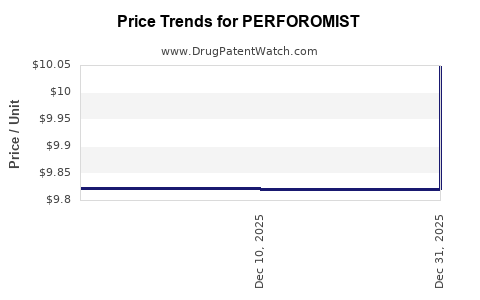
- Generic entry reduced volume captured by the brand and compressed net pricing.
- Current value depends on residual branded prescriptions, contracting, supply reliability and portfolio economics.
Viatris does not disclose Perforomist net sales separately in its annual reports. The product is reported within aggregated business segments, including established brands and regional portfolios. As a result, standalone revenue, gross margin and annual decline rates cannot be derived from company filings without proprietary prescription or channel data.[2]
Financial trajectory by phase
| Phase |
Revenue profile |
Margin profile |
Principal driver |
| 2007-2012 |
Brand expansion |
High relative margin |
New-product adoption |
| 2013-2017 |
Mature brand |
Stable but exposed to contracting |
COPD prevalence and nebulizer use |
| 2018-2021 |
Declining or volatile |
Pricing pressure begins |
Generic approvals and payer substitution |
| 2022 onward |
Mature residual brand |
Lower net price and higher erosion risk |
Generic penetration and portfolio rationalization |
Perforomist is unlikely to be a material growth driver for Viatris. Its economic role is more consistent with cash generation from a mature product portfolio. The product may retain value where physicians and patients prefer nebulized delivery, but that demand does not offset broad generic price compression.
How does Perforomist compare with Brovana and Yupelri?
Perforomist has a weaker growth profile than newer nebulized products because it is twice daily and competes with lower-priced generic formoterol. Yupelri has a differentiated once-daily regimen, while Brovana has a longer-established direct comparison in the nebulized LABA category.
| Factor |
Perforomist |
Brovana |
Yupelri |
| Mechanism |
LABA |
LABA |
LAMA |
| Dosing |
Twice daily |
Twice daily |
Once daily |
| Generic exposure |
High |
Lower or developing, depending on market |
Limited relative to Perforomist |
| Delivery |
Nebulizer |
Nebulizer |
Nebulizer |
| Differentiation |
Established formoterol product |
Arformoterol product |
Once-daily LAMA |
| Pricing power |
Low |
Moderate, subject to generic risk |
Higher while exclusivity remains |
| Growth outlook |
Mature to declining |
Mature |
Stronger relative potential |
Perforomist’s main commercial advantage is familiarity and availability. Its main disadvantages are generic competition, twice-daily dosing and limited differentiation from other long-acting nebulized bronchodilators.
What formulation patents and manufacturing barriers affect generic entry?
Sterile inhalation solutions create manufacturing requirements that are more demanding than those for conventional oral tablets. Generic suppliers must control:
- Active-ingredient identity and potency.
- Solution uniformity.
- Microbial limits and sterility-related controls.
- Container-closure integrity.
- Unit-dose vial performance.
- Stability throughout the labeled shelf life.
- Compatibility with approved nebulizer systems.
- Packaging, labeling and dose-delivery specifications.
These requirements can delay entry or limit the number of viable suppliers, but they do not provide the same exclusionary power as a valid composition-of-matter patent. Once multiple manufacturers qualify, price competition can become severe.
Formulation patents could protect excipient combinations, pH ranges, stability profiles or packaging configurations. Their value depends on whether the claims are listed in the Orange Book, survive Paragraph IV litigation and materially constrain non-infringing generic designs.
What Paragraph IV litigation affects Perforomist?
Paragraph IV litigation is the principal patent-litigation route for an ANDA applicant seeking approval before expiration of a listed patent. A generic applicant may certify that a listed patent is invalid, unenforceable or not infringed. The reference-product sponsor may then file an infringement action, potentially triggering a 30-month stay of final FDA approval under the Hatch-Waxman framework.[3]
No publicly disclosed, commercially material Perforomist patent dispute currently defines the market. The product’s genericized status indicates that any historical patent disputes did not preserve long-term exclusivity.
The litigation risk profile is therefore lower than for a recently approved inhaled product with active formulation or device patents. The more relevant risks are:
- Manufacturing deficiencies in an ANDA.
- Product-quality observations.
- Supply interruptions.
- Device or container-closure comparability.
- State substitution and reimbursement rules.
Are there licensing deals involving Perforomist?
Perforomist originated with Dey Pharma, a respiratory-focused company that was acquired by Mylan in 2010. Mylan later became part of Viatris through the 2020 combination with Pfizer’s Upjohn business.[4]
| Transaction |
Date |
Relevance |
| Mylan acquisition of Dey Pharma |
2010 |
Transferred Perforomist-related commercial assets to Mylan |
| Viatris formation through Mylan-Upjohn combination |
2020 |
Placed the product within Viatris’ portfolio |
| Generic supply and distribution arrangements |
Ongoing market practice |
May affect channel economics but are not separately disclosed |
Public filings do not identify a current Perforomist-specific licensing agreement that materially changes the product’s exclusivity outlook. The commercial asset is controlled within Viatris’ established-products portfolio, while generic products may be supplied by independent manufacturers or marketed through authorized-generic arrangements.
What generic launch scenarios exist for Perforomist?
The base case is continued generic penetration and declining branded share. Three market scenarios are relevant.
Base case: gradual branded erosion
Generic products gain formulary preference and pharmacy substitution. Perforomist remains available for patients whose prescribers prefer the branded product or whose coverage does not require substitution. Net sales decline at a moderate rate.
Downside case: rapid price compression
Multiple generic suppliers enter, wholesalers reduce branded purchases and payers impose mandatory substitution. Brand revenue falls sharply, with residual sales concentrated in specialty pharmacies, durable medical equipment channels or protected payer contracts.
Supply-constrained case: temporary brand resilience
One or more generic suppliers experience manufacturing or supply problems. Perforomist retains share temporarily and may gain channel demand. This scenario benefits revenue but does not restore durable exclusivity.
What geographic coverage and commercial exposure does Perforomist have?
Perforomist is primarily a U.S. commercial asset. Its value is tied to the U.S. COPD market, Medicare reimbursement, nebulizer utilization and Viatris’ North American distribution infrastructure.
Geographic factors include:
- U.S. Medicare Part D and durable medical equipment reimbursement.
- State-level generic substitution rules.
- Hospital and integrated-delivery-network purchasing.
- Pharmacy versus medical-benefit billing.
- Local availability of nebulizer equipment.
- International differences in regulatory approval and product branding.
The product’s geographic risk is concentrated rather than global. International revenue, if any, is not separately disclosed and should not be assumed to be material.
What generic entry risks exist for investors and licensees?
Perforomist has limited strategic attractiveness as a standalone licensing target because its principal value is mature-brand cash flow rather than protected innovation.
The key risks are:
| Risk |
Assessment |
| Patent invalidity or non-infringement |
High historical relevance, low current exclusionary value |
| Generic price erosion |
High |
| Brand-to-generic substitution |
High |
| Biosimilar competition |
Not applicable |
| Manufacturing interruption |
Moderate |
| Nebulizer-device obsolescence |
Moderate |
| COPD market contraction |
Low to moderate |
| Competition from once-daily nebulized therapy |
Moderate |
| Reimbursement pressure |
High |
| Standalone revenue visibility |
Low |
A buyer or licensee would need to underwrite Perforomist as a declining established brand. The investment case would depend on manufacturing efficiency, supply reliability, portfolio synergies and channel control rather than patent exclusivity.
How strong is the Perforomist patent estate?
The current patent estate is commercially weak. Perforomist has no evident active composition-of-matter advantage, no biosimilar barrier and no publicly disclosed patent position capable of blocking generic formoterol inhalation solution indefinitely.
Its remaining defensibility comes from:
- Brand recognition.
- Prescriber familiarity.
- Patient preference for nebulized treatment.
- Supply reliability.
- Contracting and distribution.
- Potential device or formulation complexity.
Those factors can preserve residual share but generally cannot support premium pricing after generic entry.
Key Takeaways
- Perforomist is a mature formoterol nebulizer product approved by the FDA in 2007 for COPD maintenance therapy.
- Viatris owns the relevant legacy commercial exposure through the Mylan and Dey Pharma businesses.
- Standalone Perforomist revenue is not disclosed in Viatris’ public filings.
- Generic formoterol inhalation solution has materially weakened the brand’s pricing power and long-term growth outlook.
- The product has no biosimilar risk because it is a small-molecule drug.
- The main competition comes from generic formoterol, Brovana, Yupelri and inhaled LABA/LAMA combinations.
- The current patent estate is commercially weak compared with newer inhaled products.
- Manufacturing quality, sterile filling, packaging and nebulizer compatibility remain practical barriers but are not durable exclusivity substitutes.
- Perforomist is best valued as a declining established brand with residual cash-flow potential, not as a growth or patent-protected asset.
FAQs
Is Perforomist still available in the United States?
Yes. Perforomist remains an FDA-approved product, although generic formoterol fumarate inhalation solution is available and may be preferred by payers or pharmacies.
Is Perforomist the same as Brovana?
No. Both are nebulized LABAs for COPD maintenance, but Perforomist contains formoterol fumarate while Brovana contains arformoterol tartrate.
Does Perforomist have a generic equivalent?
Yes. Generic formoterol fumarate inhalation solution competes directly with Perforomist and has materially reduced the product’s exclusivity and pricing power.
Is Perforomist covered by Medicare?
Coverage depends on the patient’s Medicare plan, formulary status and billing channel. Nebulized COPD drugs may be processed through pharmacy or durable medical equipment-related reimbursement arrangements.
Can Perforomist be used as a rescue inhaler?
No. Perforomist is a maintenance treatment and is not indicated for acute bronchospasm. Patients generally require a separate short-acting rescue bronchodilator.
References
- U.S. Food and Drug Administration. (2023). Perforomist (formoterol fumarate) inhalation solution prescribing information.
- Viatris Inc. (2024). Annual report pursuant to Section 13 or 15(d) of the Securities Exchange Act of 1934.
- U.S. Food and Drug Administration. (2024). Approved drug products with therapeutic equivalence evaluations: Orange Book.
- Viatris Inc. (2020). Viatris formed through the combination of Mylan and Upjohn.