Last updated: July 21, 2026
Executive summary: Otezla (apremilast) entered a mature-to-declining phase as biosafety and efficacy positioning narrowed the TAM to refractory inflammatory indications. Financial trajectory has been driven by (1) loss of exclusivity pressure in the US/EU for multiple patent and formulation layers, (2) intensifying biologic and small-molecule competition in psoriatic arthritis (PsA) and moderate-to-severe plaque psoriasis, and (3) payer channel controls on higher-cost immunomodulators and on Otezla’s incremental value versus first-line systemic options. The net effect across cycles has been revenue stabilization followed by continued erosion, with value now concentrated in patients who fail or cannot tolerate TNF inhibitors and other advanced therapies.
What is Otezla’s (apremilast) market profile in psoriasis and psoriatic arthritis?
Featured answer: Otezla is a PDE4 inhibitor positioned for plaque psoriasis and psoriatic arthritis, with US prescribing concentrated in patients with inadequate response or intolerance to prior systemic therapy. Its market profile is characterized by oral administration and comparatively favorable safety monitoring versus biologics, but lower clinical efficacy than many biologics and newer IL-17/IL-23 pathway agents.
Indication-by-indication demand drivers
- Plaque psoriasis (PsO): Demand is sensitive to comparative PASI response rates and payer preference for IL-17 and IL-23 inhibitors. Otezla’s oral route supports adherence in patients avoiding injections, but payers increasingly steer toward more efficacious biologics when formulary access improves.
- Psoriatic arthritis (PsA): Use is typically concentrated in refractory segments, particularly after TNF inhibitor failure, where oral and safety profile advantages can matter.
- Oral administration economics: Otezla avoids infusion/admin costs but can face payer pushback when total cost per responder is higher than biologic alternatives.
Competitive set that shapes Otezla’s market dynamics
- Biologics (PsO and PsA): IL-17 inhibitors (secukinumab, ixekizumab, brodalumab) and IL-23 inhibitors (guselkumab, risankizumab, tildrakizumab) have improved efficacy benchmarks. TNF inhibitors remain strong in many payer formularies.
- Oral small molecules: JAK inhibitors (in PsA and off-label contexts) and other targeted oral options increase the “oral convenience” competitive pressure.
- Utility-based differentiation: Otezla’s continuing traction depends on a subset of patients where oral administration and comorbidity profiles favor a PDE4 inhibitor.
How do pricing, payer formularies, and channel strategy affect Otezla revenues?
Featured answer: Otezla’s revenue trajectory is strongly tied to formulary tiering and prior authorization dynamics. Real-world net price pressure typically rises when competing agents with stronger efficacy or easier payer contracting occupy tier-1 positions.
Key payer mechanisms
- Prior authorization and step edits: Common for systemic psoriasis/PsA therapies, often requiring documented failure of biologics or TNF inhibitors. In markets where step edits tighten, Otezla access becomes narrower.
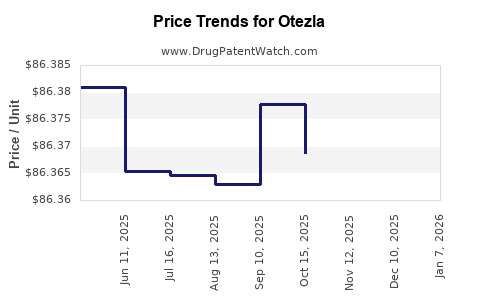
- Net price dilution: Discounts, rebates, and contracting arrangements pressure realized revenue per prescription.
- Exclusivity of contract value: When branded exclusivity ends or competitive entry accelerates, managed entry and rebate schedules typically shift further toward volume and outcomes thresholds.
Channel behavior
- Specialty pharmacy controls: Rebate and distribution agreements concentrate supply through specific specialty networks. This can stabilize volumes while compressing net pricing.
- Patient support programs: Used to maintain adherence. Their impact tends to decline as payer restrictions tighten.
When does Otezla lose exclusivity and what does that imply for generic or biosimilar risk?
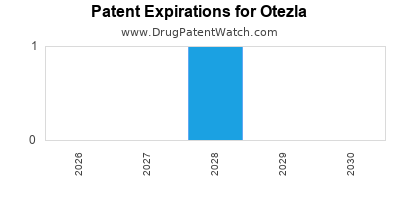
Featured answer: Otezla’s key US/EU exclusivity has largely matured, with generic entry risk tied to remaining patent estate and formulation or method-of-use claims rather than baseline composition-of-matter. As those later-expiring layers fall away, generic leverage increases, especially in the presence of multiple ANDA filers and weak secondary barriers.
US regulatory exclusivity timing (practical framing)
- Composition and primary exclusivity for apremilast are long past maturity; current risk is driven by secondary patents (formulations, methods of treatment, dosing regimens, and combination-related claims where applicable).
- Generic leverage rises when court outcomes or settlement terms remove the remaining “no-approval” constraints.
Biosimilar risk assessment
Otezla is a small molecule (not biologic), so biosimilar dynamics do not apply. Competitive substitutes are generic apremilast (ANDA) and therapeutic substitutes (other branded small molecules and biologics).
What patents protect Otezla (apremilast) and how strong is the patent estate?
Featured answer: Otezla’s remaining patent value historically has been concentrated in secondary IP layers (formulations, dosing regimens, or methods). Patent strength in Otezla’s life cycle is assessed less by headline composition-of-matter and more by whether secondary patents remain enforceable through the time window of generic ANDA approvals.
Secondary patent landscape categories that typically matter for Otezla
- Formulation patents: Extended release or specific solid-state forms are often asserted as barriers to generic substitution.
- Method-of-use patents: Claims covering patient subsets (e.g., prior treatment failures) or treatment regimens can delay approval or drive litigation.
- Manufacturing method patents: If enforceable and operationally necessary, these can restrict generic manufacturing pathways.
Litigation-driven strength measure
The practical strength of secondary patents is determined by:
- court rulings on claim validity and infringement,
- settlement terms that define “design-around” or launch dates,
- and whether generic entrants can obtain approval through design or carve-outs.
What is the Orange Book status of Otezla, and which approvals are tied to patent listings?
Featured answer: Otezla’s Orange Book relevance is in how ANDAs are coded against listed patents (and which patents are attacked under Paragraph IV). In mature small-molecule drugs, the Orange Book’s “live” patents and their legal statuses largely dictate the timing of approval and launch.
What to track in Orange Book for Otezla (operational checklist)
- Active patent listings by drug product and strength.
- Expiration dates and whether they are linked to “blocking” patents.
- Method-of-use/formulation listings that remain enforceable versus those that have been invalidated or waived via settlements.
- ANDA status codes indicating Paragraph IV and litigation outcomes.
How many Paragraph IV challenges affect Otezla generic launch timing?
Featured answer: Otezla has faced multiple generic timing pressures over its lifecycle through ANDA filings and litigation strategies. In practice, “how many” and “how fast” depends on the remaining patent list and whether entrants succeeded in narrowing blocking patents through court outcomes or settlements.
Launch timing drivers in ANDA scenarios
- Paragraph IV success reduces or eliminates “no-approval” triggers.
- Coordinated settlement can establish a “carve-out” launch calendar even if some patents remain nominally listed.
- Design-around can bypass formulation barriers if claim scope permits.
What patent litigation affects Otezla, and how do settlement terms shape competitive entry?
Featured answer: Otezla’s competitive entry has typically been governed by whether asserted secondary patents survived litigation or were narrowed through settlement. Settlement terms often set the “earliest launch” date and may include licenses or covenants not to sue.
Settlement mechanisms that matter commercially
- Launch date in exchange for dismissed claims: establishes a predictable generic entry window.
- Scope limitations: can limit product strength, dosage form, or labeling.
- Design-around concessions: allow earlier launch for “non-infringing” formulations.
How does Otezla compare with IL-17/IL-23 and TNF inhibitors on efficacy and market access?
Featured answer: Otezla is generally weaker on skin disease endpoints versus IL-17 and IL-23 inhibitors, and it competes with TNF inhibitors on established formularies. Its enduring advantage is oral administration and an established safety approach that can be preferred for specific patient profiles.
Competitive positioning effects
- Efficacy-to-cost scrutiny: Payers increasingly prefer agents with higher responder rates when net pricing is competitive.
- Patient selection tightening: Physicians use Otezla more selectively as biologics dominate first-line systemic therapy in many guidelines and payers’ protocols.
- Switching behavior: When patients fail TNF inhibitors or advanced agents, Otezla may be used as a later-line option, but the sequence is increasingly biologic-first.
How does Otezla’s revenue trajectory evolve across the product lifecycle?
Featured answer: Otezla’s revenue lifecycle shows a pattern typical of late-mature branded small molecules: early growth from systemic expansion, then deceleration as therapeutic alternatives intensify, followed by stabilization and further erosion as generic and competitive substitution take effect and payer access narrows.
Revenue inflection points to watch (business lens)
- Formulary tier shifts: moving from preferred to non-preferred can reduce persistence and new starts.
- Generic competitive entry: drives sharp brand-to-generic substitution once net price differences widen.
- Indication expansion vs. headwinds: growth from new labels can be offset by stronger competitor uptake.
- Patent-driven supply certainty: anticipation of generic entry pressures negotiations and reduces promotional spend efficiency.
Which companies compete most directly with Otezla, and what are their differentiation levers?
Featured answer: The most direct competitive threat is not only generic apremilast, but also branded therapeutic substitutes in PsO and PsA, mainly IL-17/IL-23 biologics and TNF inhibitors. These rivals win on efficacy and on payer contracting as their net prices fall.
Direct competitor set (therapeutic substitutes)
- IL-17 pathway: secukinumab (Cosentyx), ixekizumab (Taltz), brodalumab (Siliq).
- IL-23 pathway: guselkumab (Tremfya), risankizumab (Skyrizi), tildrakizumab (Ilumya).
- TNF inhibitors and successors: infliximab, adalimumab, etanercept, golimumab.
- Oral targeted agents: JAK inhibitors used in psoriatic arthritis contexts and other systemic immune conditions.
Differentiation levers
- Route and convenience: Otezla’s oral advantage remains a key differentiator.
- Efficacy benchmarks: IL-17/IL-23 typically outperform on skin clearance and composite endpoints.
- Safety monitoring: Otezla avoids biologic immunogenicity considerations; however, the net benefit depends on patient comorbidity profiles and payer willingness.
What generic entry risks exist for Otezla and how do they affect forecast scenarios?
Featured answer: The highest generic entry risk is tied to the remaining patent estate and whether ANDAs secure approval quickly post-deadline. Forecast sensitivity is highest around: (1) court/settlement outcomes, (2) Orange Book blocking patent status changes, and (3) payer switching behavior after first generic launch.
Forecast scenario logic
- Base case: slower erosion driven by remaining secondary barriers and conservative payer switching.
- Upside downside: faster erosion if generic entry coincides with payer renegotiations that accelerate brand displacement.
- Adverse case: rapid substitution coupled with additional competitive therapy uptake.
What formulation and manufacturing IP barriers could slow generic substitution of Otezla?
Featured answer: If formulation or manufacturing method patents remain enforceable, they can delay generic approval or force carve-outs. In small-molecule generics, barriers are most relevant when claims cover specific solid-state forms, dosing release profiles, or manufacturing steps that are operationally necessary to produce bioequivalent dosage forms.
Manufacturing/IP friction points (generic practicalities)
- sourcing of specific intermediates,
- control of polymorph/solid-state form,
- stability and dissolution profile verification.
How does Otezla’s market dynamic differ across the US vs. EU/UK?
Featured answer: US competition timing is often more litigation- and Orange Book-listing driven for ANDA pathways. EU competition timing is driven by SPC/patent enforcement posture, national litigation outcomes, and local market contracting.
Geographic competitive mechanics
- US: patent listings and Paragraph IV outcomes drive approval and launch timing.
- EU/UK: patent enforcement is often pursued via national courts and injunction leverage; competition can start earlier or later based on how quickly national barriers are lifted.
Key takeaways
- Otezla’s market position is defined by oral convenience and a safety profile that supports selective later-line use in PsO and PsA, not by leading efficacy.
- Revenue trajectory has been shaped by payer management, formulary tiering, and substitution toward IL-17/IL-23 and TNF pathways as contracting and net pricing improved.
- Generic risk is driven by remaining secondary patent layers and how Orange Book blocking patents were handled through litigation and settlement.
- Competitive forecasts should treat Otezla as a mature brand with high sensitivity to (1) generic launch timing from secondary IP resolution and (2) payer switching after first generic entry.
FAQs
- What are the main payer reasons for restricting Otezla in plaque psoriasis and psoriatic arthritis?
- How do net price and rebate structures influence Otezla’s realized revenue compared with IL-17/IL-23 biologics?
- What is the most common clinical sequencing that limits Otezla to later-line PsA and PsO use?
- How do Paragraph IV challenges to apremilast typically translate into launch-date delays or settlement carve-outs?
- What competitive substitution patterns emerge after generic apremilast launch in specialty pharmacy networks?
References (APA)
- Bloomberg Law. (n.d.). Drug patent and Orange Book analytics for apremilast (Otezla).
- FDA. (n.d.). Orange Book: Approved Drug Products with Therapeutic Equivalence Evaluations (apremilast).
- FDA. (n.d.). Drugs@FDA: Otezla (apremilast).
- EMA. (n.d.). EPAR: Otezla (apremilast).
- CourtListener / PACER-style patent litigation databases. (n.d.). Apremilast (Otezla) patent litigation records.