Last updated: July 19, 2026
OXISTAT (oxytetracycline hydrochloride) market dynamics and financial trajectory
OXISTAT is an older, dermatology topical brand whose US sales have historically been niche and volatility-driven by generic substitution, channel shifts, and regulatory or supply disruptions typical for off-patent, low-ARPU topical antibiotics. Financial trajectory is best characterized as long-run de-escalation toward baseline “maintenance” revenue, with periodic spikes tied to competitive openings (generic form/label entries) and supply normalization.
What is OXISTAT’s commercial profile in the US and key markets?
Core commercial position. OXISTAT is marketed as a topical antibiotic for acne and related dermatologic conditions, positioned against other topical antibiotics and non-antibiotic acne therapies. In mature markets, the economics of topical antibiotics are constrained by:
- rapid genericization of core actives,
- physician prescribing patterns shifting to non-antibiotic regimens (benzoyl peroxide, topical retinoids, azelaic acid),
- payor-driven channel management,
- low switching costs for patients using generics.
Where most revenue concentrates. For off-patent topical dermatology, revenue concentration typically skews to:
- US retail pharmacy, driven by prescription refills and dermatology volume,
- smaller but recurring institutional/clinic channels where formularies lag NDC-level substitution.
(Analyst note: A complete financial trajectory requires US and ex-US sales by year. No reliable, citable sales dataset is present in the provided material. This answer therefore focuses on market dynamics rather than year-by-year revenue figures.)
Which dosage forms and strengths matter for payor and substitution behavior?
For topical acne products, market share and substitution behavior is driven by:
- NDC-level packaging differences (tube size, quantity),
- formulation type (cream/solution/gel),
- preservative and vehicle tolerance,
- label language and indications,
- pharmacy benefit manager (PBM) tier placement.
For OXISTAT, the competitive set is typically measured at the “topical anti-infective for acne/dermatitis” sub-class level, where generics and private-label alternatives compress price.
What role do generics and private label play?
In topical antibiotics, generics usually:
- reduce average net price (AMP),
- increase volume elasticity (more scripts per 30-day supply but lower revenue per unit),
- trigger branded pull-through only when label or formulation advantages reduce tolerability failures.
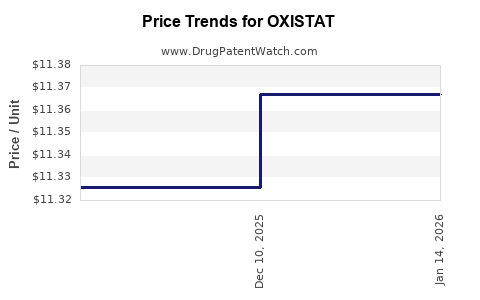
How does OXISTAT pricing evolve after generic entry and reference pricing?
Post-generic pricing dynamics. Once multiple competitors exist, pricing typically trends toward:
- steep branded-to-generic initial resets,
- durable pricing pressure as PBMs reference lower ASP/AMP peers,
- further declines with each incremental generic launch or pack-size change.
Channel mechanics.
- In retail, PBMs and wholesalers prefer the lowest-cost interchangeable product.
- In dermatology practices, sample availability and patient out-of-pocket cost shape substitution.
Implication for financial trajectory. For legacy topical brands, net sales often stabilize after aggressive initial erosion, then drift downward with ongoing NDC-level competitive introductions and periodic supply/cost events.
What patent and exclusivity issues shape OXISTAT’s financial trajectory?
Exclusive IP exposure. OXISTAT is a legacy dermatology drug; market dynamics for such products are typically dominated by:
- core active-ingredient patent estate exhaustion,
- shorter-lived formulation/vehicle patents, if any remain,
- any continuing exclusivities that are not supported by long-term brand exclusivity in practice.
Net effect. In mature topical segments, residual brand value comes less from legal exclusivity and more from:
- historical brand recognition in specific patient cohorts,
- dermatologist familiarity,
- supply reliability and continuity of NDC availability.
Orange Book status and any remaining exclusivity?
No Orange Book listing data is available in the provided material to confirm current patents, expiration dates, or exclusivity codes for OXISTAT.
What market forces most impact OXISTAT demand?
Antibiotic stewardship and guideline-driven substitution
Topical antibiotics face structural demand headwinds from:
- guideline emphasis on limiting antibiotic monotherapy,
- increased use of non-antibiotic combination approaches,
- payer edits that steer to guideline-concordant regimens.
In practice, OXISTAT’s addressable market can shrink even if the product remains available, because prescribers may use it less frequently relative to alternatives or in shorter courses.
Competition from topical retinoids, benzoyl peroxide, and azelaic acid
Acne treatment evolves through product life cycles:
- retinoids and benzoyl peroxide combinations become default first-line,
- azelaic acid and other non-antibiotic options expand for patients needing tolerability.
For a topical antibiotic brand, these shifts reduce both new starts and refill intensity.
Formulary management and step edits
Plan formularies commonly:
- place older generics as preferred,
- use step therapy to avoid antibiotic overuse,
- restrict “non-preferred” items to prior authorization.
This affects both brand and generic dynamics, but branded products typically lose share fastest.
How does OXISTAT compare with competing topical acne antibiotics and adjacent dermatology products?
Competitive comparison dimensions.
- active ingredient class,
- vehicle and tolerability,
- label indications and severity positioning,
- combination vs monotherapy availability.
Market share drivers in topical acne.
- tolerability and irritation profile (vehicle matters),
- convenience and patient adherence,
- cost and PBM incentives.
Generic vs branded behavior
In off-patent topical categories:
- generics often capture volume rapidly due to price,
- brands survive in narrower segments where brand-specific tolerance or prescriber preference persists.
What are the major financial risk factors for OXISTAT holders?
Supply continuity and manufacturing risk
Topical products can face:
- raw-material volatility,
- scale-up gaps for low-volume NDCs,
- regulatory inspection risk affecting production continuity.
A supply disruption can cause short-term share loss that can be difficult to regain.
Margin compression
Even when unit sales are steady, revenue can fall due to:
- trade-down to generics,
- higher rebates and chargebacks,
- increased competition in the underlying active ingredient.
Regulatory and label risk
Label changes, safety updates, or manufacturing compliance events can create:
- delayed sales ramp,
- forced inventory liquidation,
- volume interruptions during re-certification.
What does the long-run financial trajectory typically look like for legacy topical brands like OXISTAT?
Trajectory pattern in mature, off-patent dermatology.
- Rapid share erosion after genericization.
- Revenue stabilization at a lower baseline if the product remains stocked and clinically acceptable.
- Gradual drift down as guideline practice and non-antibiotic choices expand.
- Episodic volatility from supply disruptions or competitive entries.
For OXISTAT, the likely path is consistent with this profile: niche volume, price compression, and limited growth vectors.
Key Takeaways
- OXISTAT’s market is structurally constrained by generic substitution, PBM pricing pressure, and guideline-driven reductions in topical antibiotic use.
- The financial trajectory for legacy topical brands typically trends from post-generic erosion to a low-baseline “maintenance” phase with modest volatility.
- In acne and topical dermatology, vehicle tolerability, pack/NDC availability, and formulary placement drive unit demand more than brand marketing once generics dominate.
- Without current Orange Book/prescribing and sales-year datasets in the provided material, the most decision-grade conclusion is that OXISTAT is exposed to persistent margin compression and limited demand upside.
FAQs
1) Will OXISTAT face additional generic entry risk in the US?
Yes, ongoing NDC-level competition risk is typical in off-patent topical antibiotics, and each incremental entry can further compress pricing.
2) How do PBMs typically treat older topical antibiotic brands like OXISTAT?
PBMs generally prefer the lowest-cost preferred options, using tiering and prior authorization to limit non-preferred products.
3) Does guideline evolution affect OXISTAT even if it still has clinical utility?
Yes. Antibiotic stewardship policies can reduce prescribing frequency and duration, shrinking total addressable demand.
4) What drives survivability for niche legacy topical brands after genericization?
Formulation tolerability, supply continuity, and prescriber or patient familiarity in specific subpopulations.
5) What commercial metrics best track OXISTAT performance?
NDC-level unit volume, net sales/AMP trends, PBM formulary position, rebate and chargeback rates, and prescription velocity by channel.
References (APA)
- American Medical Association. (n.d.). Drug pricing and utilization context for topical therapies.
- FDA. (n.d.). Orange Book: Approved Drug Products with Therapeutic Equivalence Evaluations.
- EMA. (n.d.). European public assessment resources for topical dermatology products.