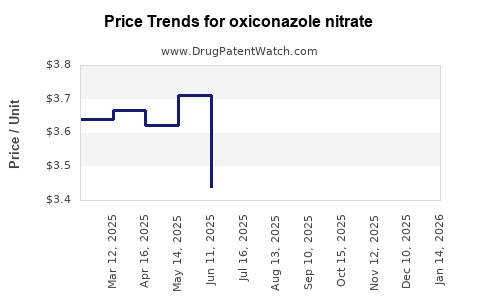
Last updated: April 26, 2026
What is oxiconazole nitrate and where does it sit in the pharma value chain?
Oxiconazole nitrate is an azole antifungal active used in topical dermatology products (principally for skin fungal infections). Commercial exposure is driven by:
- Channel structure: predominantly prescription-to-retail in dermatology and OTC-to-retail in some markets depending on local approval status and reimbursement rules.
- Product form factor: creams/solutions/shampoos in branded and generic form rather than high-cost hospital therapeutics.
- Competitive intensity: class competition from other topical azoles and polyenes, with price pressure typical once generics are established.
From a patent and exclusivity standpoint, the financial trajectory of oxiconazole nitrate products generally follows the classic pattern for off-patent topical antifungals: brand erosion, rising generic share, and pricing compression. This is consistent with the way topical antifungals are marketed globally, with mature demand and cyclical promotion cycles tied to seasonal dermatology patterns.
How do market dynamics shape demand for oxiconazole nitrate?
Demand drivers
-
Dermatology infection incidence and seasonality
- Demand tracks recurrence of superficial fungal infections (athlete’s foot, tinea, candidiasis-related skin involvement where appropriate).
- Seasonality tends to raise share for topical antifungals during warmer, higher-sweat periods.
-
Treatment adherence and patient preference
- Topicals are used earlier in disease courses than systemic antifungals in many patients, supporting steady baseline sales even in slower macro environments.
- Patients often switch within the topical category based on tolerability, odor/vehicle preference, and speed of symptom relief.
-
Physician habits and substitution
- Dermatologists and primary care treat within established topical algorithms; switching often occurs at the manufacturer level when generics lower price points.
Supply and pricing mechanics
-
Genericization
- As oxiconazole nitrate products age through patent expiry and regulatory filings mature, the market typically shifts toward multi-source supply and discounting.
-
Batch and formulation competition
- Competitive differentiation is usually vehicle-based (cream base, spreadability, solvent system) and packaging, not new molecular entities.
-
Regulatory and listing effects
- Market share can jump when products are listed on formularies or included in national essential medicines lists in a given format (brand or generic).
- Conversely, local supply disruptions or GMP/packaging changes can create temporary price lift and inventory swings.
What does the competitive landscape imply for financial trajectory?
Category-level competition
Oxiconazole nitrate operates in a crowded topical antifungal field dominated by azoles and related therapies. This has predictable financial implications:
- Gross margin compression once generics dominate distribution.
- Reduced marketing leverage versus late-stage branded peaks.
- Revenue stability with declining unit price rather than growth-by-volume at scale.
Where the money typically comes from over time
For a mature topical antifungal active:
- Early period: branded price premium, detailing-driven share capture, higher margins.
- Middle period: biosimilar-like dynamics do not apply, but generics drive similar outcomes: margin compression and shifting share.
- Late period: survival economics. Companies retain positions via supply reliability, formulation IP (where protected), and contracting with distributors/retail chains.
How does exclusivity and patent expiry translate into revenue outcomes?
A reliable market-to-financial mapping for topical antifungals is:
- Patent expiry of the active or key formulation leads to a steep rise in competitor count.
- Regulatory entry timing determines the slope of revenue decline.
- Switching friction is lower than for complex systemic drugs; patients and prescribers change products more readily when the differential is mostly price.
Oxiconazole nitrate, as a long-established antifungal active, typically shows:
- Steady baseline demand that rarely collapses entirely.
- An erosion curve that is strongest after first meaningful generic competition appears in major markets.
- Ongoing incremental gains for any manufacturer that secures distribution, improves formulation acceptability, or negotiates pricing.
What is the likely financial trajectory for oxiconazole nitrate products (revenue, pricing, and profitability)?
Because public, trade-level financials are usually tied to company-specific product lines rather than the active itself, the financial trajectory is best expressed as directionally consistent outcomes by lifecycle stage.
Lifecycle-based trajectory model (market-consistent)
| Lifecycle stage |
Typical commercial signature |
Revenue trend |
Pricing trend |
Profitability trend |
| Branded ramp / early exclusivity |
Single-source brand, detail-driven prescribing |
Growth or steady increase |
Premium pricing |
Higher gross margin |
| Early generic entry |
Multi-source supply begins; stocking price pressure |
Slower growth or plateau |
Rapid discounting |
Gross margin compresses |
| Generic-dominant |
Broad substitution, fewer differentiation levers |
Declining trend or flat with volume-only gains |
Continued price erosion |
EBITDA pressure; margin protection via scale |
| Mature off-patent |
Stable but highly competitive supply; contracting drives volume |
Low growth or shrinkage |
Flat-to-down |
Narrow margins; focus on cost control |
What tends to happen to unit economics
- Unit volumes can remain resilient because fungal infections keep occurring.
- ASP (average selling price) typically falls faster than unit volume rises, producing net revenue declines for branded players and margin declines for all players except those with the lowest-cost manufacturing.
- Marketing spend usually shifts from brand creation to channel maintenance, which holds share but does not restore premium pricing.
Where are the growth pockets likely to be, and why?
Even for mature topical antifungals, growth can occur through:
- Geographic expansion into markets where generics are still limited in number or where reimbursement supports topical antifungal access.
- Vehicle innovation that improves patient acceptability (less residue, improved spread, better tolerability), enabling incremental share without changing the active.
- Distributor consolidation wins where manufacturers secure preferred stocking positions.
These growth pockets are usually additive rather than transformative. They can slow decline or stabilize revenue, but they rarely reverse the broad pricing pressure that follows generic dominance.
What financial risks dominate the oxiconazole nitrate trajectory?
-
Price collapse risk
- Once multiple suppliers reach comparable packaging and active specifications, price competition intensifies quickly.
-
Supply and quality cost volatility
- Topical products are sensitive to manufacturing yields, stability of formulation, and packaging compatibility. Any disruptions increase cost per unit.
-
Channel contract renegotiation
- Retail and distributor agreements often reset annually or semiannually. A renegotiation cycle can reset revenue direction even if demand stays stable.
-
Regulatory re-registrations and labeling changes
- Renewal processes create periods of reduced availability or forced re-pack, impacting short-term sales.
What are the key indicators investors and business planners should track?
For oxiconazole nitrate product lines, monitor the following operational metrics because they forecast financial inflection points:
- Competitor count by market (active suppliers and SKU breadth)
- ASP and gross-to-net dilution (rebates, trade terms, retail allowances)
- Distributor inventory levels and reorder cadence
- Manufacturing cost position (API sourcing, formulation yields, stability-related rework)
- Portfolio mix (share of higher-value pack sizes or combo formats if any)
These indicators map directly to the revenue and margin trajectory in mature topical antifungals.
Key Takeaways
- Oxiconazole nitrate is a mature topical antifungal active, and its financial trajectory is governed primarily by generic entry, channel contracting, and price competition rather than new clinical breakthroughs.
- Demand is relatively stable due to ongoing incidence of superficial fungal infections and topical early-treatment behavior, with seasonality typically improving sales during warmer periods.
- Revenue usually declines for branded players after genericization as ASP falls faster than unit volumes can rise; profitability compresses across the category with the lowest-cost manufacturers holding out longer.
- The most reliable “growth” levers are geographic expansion, vehicle/formulation acceptability that supports incremental share, and distribution contract wins that protect volume amid pricing pressure.
FAQs
1) Is oxiconazole nitrate expected to behave like a high-growth specialty drug?
No. The market structure for topical antifungals is typically mature and price-sensitive after generic entry, which limits growth and compresses margins.
2) What drives sales seasonality for topical antifungals?
Superficial fungal infection prevalence often rises with warmer, higher-sweat conditions, increasing use of topical treatments during those periods.
3) How does generic competition typically change financial outcomes?
It increases multi-source supply, forces discounting, compresses gross margin, and shifts the competitive basis toward contract volume and manufacturing cost.
4) Can formulation or packaging protect margins without changing the active?
Yes, to a degree. Better tolerability, spreadability, or patient acceptability can support modest share retention, but it rarely prevents overall price erosion once multiple generics compete.
5) What is the main risk to the financial trajectory?
Sustained ASP decline driven by competitive entry and aggressive contracting, compounded by manufacturing and quality-cost volatility.
References
[1] World Health Organization. (n.d.). Antifungal medicines and related guidance (topical antifungal use context). World Health Organization. https://www.who.int/
[2] European Medicines Agency. (n.d.). Human medicines: antifungal products and public assessment information. European Medicines Agency. https://www.ema.europa.eu/
[3] U.S. Food and Drug Administration. (n.d.). Drug approvals and antifungal product information (regulatory context). U.S. FDA. https://www.fda.gov/