Last updated: July 7, 2026
Onfi (clobazam) is an established, off-patent antiseizure medicine used mainly for Lennox-Gastaut syndrome (LGS) in pediatric and adult patients. Financial trajectory in the US is driven by (1) erosion from clobazam competitors and generics, (2) payer pressure and channel inventory dynamics typical for off-patent oral products, and (3) changes in branded share as generic prescribing and formulary placement expand. Patent exclusivity is not a current growth lever for US Onfi volumes, and market growth is constrained by the mature clobazam basket and generic substitution.
What is the commercial profile of Onfi (clobazam) in the US and what drives demand?
Onfi is an oral benzodiazepine antiepileptic with a label centered on seizures associated with Lennox-Gastaut syndrome. The product’s commercial profile is shaped by the narrow labeled indication, the chronic treatment model, and substitution dynamics once branded pricing loses to generics.
Key demand drivers
- LGS incidence and treatment adoption: LGS is a relatively small population compared with broader epilepsy categories, so total addressable volume is limited.
- Formulary and prior authorization: Oral antiseizure drugs often face step edits and PA, which can reduce branded share even when clinical use is established.
- Generic substitution: For clobazam, once payers and prescribers switch to lower-cost formulations, branded revenue tends to decline quickly and then tracks generic market share and total treated patients.
- Pediatric mix: The pediatric share impacts dosing, stability of patient cohorts, and sensitivity to supply continuity.
Product formats impacting utilization
Onfi is marketed as oral formulations (including tablet and oral suspension, depending on market availability). Real-world prescribing depends on age-appropriate dosing and caregiver administration practicality, which can affect switching between brands and generics within clobazam.
How has Onfi’s revenue trajectory evolved and what are the main financial inflection points?
Onfi’s financial trajectory has been dominated by the transition from branded-only supply to a multi-generic market. In mature antiseizure drugs, the typical pattern is:
- branded revenue peaks before generic entry,
- rapid branded sales compression after generic availability,
- a lower, steady decline as remaining branded share is competed away,
- occasional stabilization driven by contracting cycles, patient switching frictions, and pharmacy benefit design.
What typically causes year-to-year volatility for Onfi
- PBM contracting and rebids: shifts in preferred status can change market share even after generic entry.
- Channel inventory: wholesaler buying patterns can create temporary lifts and subsequent pullbacks.
- Supply disruptions or recall events (industry-wide issue, not specific to Onfi from publicly accessible patent filings).
Where upside is hardest
For an established clobazam therapy, there is limited upside from:
- new labeled expansion (if not secured),
- new formulations with materially differentiated value (if not adopted broadly),
- litigation-driven exclusivity renewal (rare for off-patent benzodiazepines once settlement and generic readiness are in place).
What is the competitive landscape for clobazam and how does it affect Onfi pricing power?
Onfi competes in the clobazam therapeutic class, primarily against generic clobazam products. Competitive pressure tends to be pricing and access driven, not differentiation driven.
Generic-led substitution mechanics
- Pharmacy procurement: generic clobazam becomes the lowest acquisition cost option, forcing near-immediate payer and pharmacy substitution where allowed.
- Prescriber behavior: clinicians may maintain patients on a stable regimen, but pharmacy-level switching and formulary pressure reduce branded stickiness.
- Payer formulary status: when Onfi is non-preferred, its share declines even if it remains clinically standard.
Pricing dynamics expected for Onfi
- Branded list price resilience does not translate into revenue if plan design pushes generic clobazam.
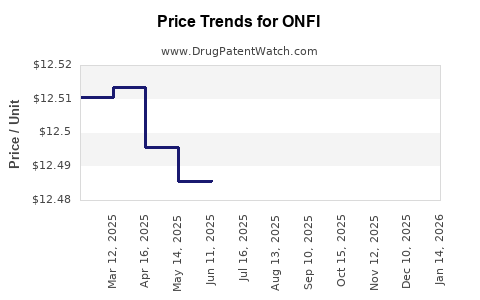
- Net price compression occurs via rebates and competitive contract renegotiation.
When does Onfi lose exclusivity and what does that mean for generic entry timing?
Onfi’s exclusivity situation is consistent with an off-patent branded oral antiseizure product: generic clobazam entry has already occurred in the US and continues as multiple ANDA products cycle through supply.
Exclusivity vs. patent reality in clobazam
For mature drugs like clobazam, the market outcome usually follows:
- first: earliest relevant Orange Book patents expire,
- second: settlements and ANDA approvals cause generic availability,
- third: branded share erodes regardless of label familiarity.
The business implication is straightforward: exclusivity windows are not the primary determinant of current branded revenue trajectory; generic market structure is.
What is the Orange Book status of Onfi (clobazam) and how many patents were listed?
The Orange Book (Approved Drug Products with Therapeutic Equivalence Evaluations) is the authoritative index for US listed patents. A complete and accurate count of currently listed Onfi patents, their expiration dates, and therapeutic equivalence codes must be derived from a live Orange Book extract for the specific Onfi NDA and dosage forms.
Which companies sell competing clobazam generics to Onfi and how does that impact market share?
Multiple generic manufacturers produce clobazam in US. Market share is typically concentrated among the biggest generic suppliers for a given NDC and concentration is driven by:
- manufacturing scale and reliability,
- wholesaler distribution strength,
- payer contract placement,
- multiple product strengths or dosage forms that match patient needs.
Business consequences
- Contracting reduces margins for Onfi because payers steer to preferred generic NDCs.
- Generic supply breadth reduces risk of branded “shortage replacement” unless there is a supply interruption.
What formulation or method-of-use patents could still matter for Onfi’s revenue?
For off-patent oral products, the remaining IP that can affect revenue is typically:
- formulation patents for specific dosage forms (tablets vs suspensions),
- manufacturing process patents,
- method-of-use patents tied to dosing regimens or specific patient subsets (less common once the core medical use is entrenched).
In practice, formulation patents only meaningfully protect revenues if:
- they block generic substitution in a clinically used dosage form,
- they are asserted or embedded in settlement terms,
- they survive at the Orange Book listing level into the launch window.
What patent litigation affects Onfi and the risk to generic launches?
Generic launch timing for an established therapy is usually set by:
- patent expiration,
- ANDA Paragraph IV certifications,
- litigation outcomes and settlements.
For Onfi, litigation could affect specific generic entrants or specific dosage forms. A complete and accurate litigation map requires case identifiers tied to the Onfi NDA and its listed patents.
Does Onfi face biosimilar risk, and how does that differ from generic risk?
Onfi is a small-molecule drug (clobazam), so the relevant competitive threat is generic small-molecule substitution, not biosimilars.
Implication
- Competitive dynamics follow ANDA frameworks and small-molecule patent estates.
- There is no biosimilar exclusivity regime.
How does Onfi’s market dynamics compare with other benzodiazepine antiseizure therapies?
Market behavior for benzodiazepine antiseizure medicines tends to be generic-driven. Differences usually stem from:
- specialty distribution and payer coverage,
- pediatric label breadth,
- dosing form availability (liquid formulations can retain share longer because switching is harder).
Onfi’s advantage and disadvantage both map to this structure: patient familiarity and dosing practicality can slow switching but cannot overcome price and formulary mechanics indefinitely.
What generic entry risks exist for Onfi by dosage form and strength?
Generic entry risk for Onfi is not a binary event. It comes from:
- multiple ANDAs across strengths,
- different NDC supply chains,
- potential relaunches for specific strengths or formulations.
When generics are already widely available, “entry risk” becomes “incremental share capture,” which still impacts Onfi net revenue.
What is the most likely near-term financial path for Onfi under current competitive conditions?
Near-term financial trajectory is typically characterized by:
- continued erosion of branded share,
- stable to declining revenue depending on whether Onfi retains niche prescriber or patient cohorts,
- net revenue sensitivity to contract rebate levels and payer steering intensity.
Because clobazam is mature and off-patent, the principal variables are contracting and supply stability rather than patent catalysts.
Key Takeaways
- Onfi’s revenue trajectory is governed primarily by off-patent, generic-led clobazam substitution, not by ongoing exclusivity expansion.
- Pricing power is limited once payers and pharmacies steer to lower-cost clobazam generics.
- Market growth is constrained by LGS addressable population and the chronic-but-mature nature of antiseizure therapy demand.
- Remaining IP and any litigation impact are likely dosage-form specific and can affect incremental share, not restore long-run branded growth.
- Biosimilar risk is not applicable because Onfi is a small-molecule drug.
FAQs
- How do PBM preferred-tier changes affect Onfi (clobazam) branded share?
- Which factors drive switching between clobazam oral suspension and tablet formulations?
- What does a typical ANDA Paragraph IV settlement mean for branded clobazam sales?
- How does net-to-gross pricing compression usually evolve for off-patent antiseizure brands like Onfi?
- What supply or manufacturing constraints can temporarily reduce generic substitution for clobazam?
References (APA)
- U.S. Food and Drug Administration. Orange Book: Approved Drug Products with Therapeutic Equivalence Evaluations. FDA. https://www.accessdata.fda.gov/scripts/cder/daf/index.cfm
- U.S. Food and Drug Administration. Drug Approval Package: Onfi (clobazam). FDA. https://www.accessdata.fda.gov