Last Updated: August 25, 2026

OLUMIANT Drug Patent Profile


✉ Email this page to a colleague

« Back to Dashboard


When do Olumiant patents expire, and when can generic versions of Olumiant launch?

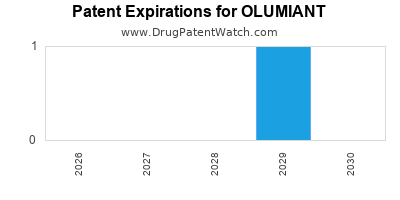
Olumiant is a drug marketed by Eli Lilly And Co and MSN and is included in two NDAs. There are six patents protecting this drug and two Paragraph IV challenges.

This drug has one hundred and six patent family members in forty-four countries.

The generic ingredient in OLUMIANT is baricitinib. One supplier is listed for this compound. Additional details are available on the baricitinib profile page.

DrugPatentWatch® Generic Entry Outlook for Olumiant

Olumiant was eligible for patent challenges on May 31, 2022.

There have been four patent litigation cases involving the patents protecting this drug, indicating strong interest in generic launch. Recent data indicate that 63% of patent challenges are decided in favor of the generic patent challenger and that 54% of successful patent challengers promptly launch generic drugs.

Indicators of Generic Entry

< Available with Subscription >

  Start Trial

AI Deep Research
Questions you can ask:
  • What is the 5 year forecast for OLUMIANT?
  • What are the global sales for OLUMIANT?
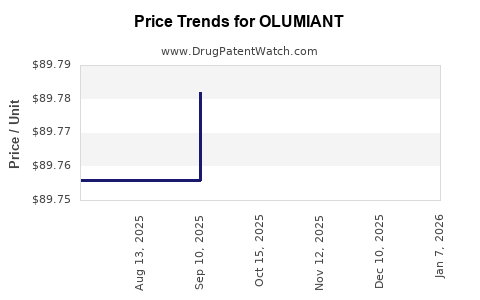
  • What is Average Wholesale Price for OLUMIANT?
Recent Clinical Trials for OLUMIANT

Identify potential brand extensions & 505(b)(2) entrants

SponsorPhase
University of North Carolina, Chapel HillPhase 2
Vanderbilt UniversityPhase 2
Emory UniversityPhase 2

See all OLUMIANT clinical trials

Pharmacology for OLUMIANT
Drug ClassJanus Kinase Inhibitor
Mechanism of ActionJanus Kinase Inhibitors
Paragraph IV (Patent) Challenges for OLUMIANT
Tradename Dosage Ingredient Strength NDA ANDAs Submitted Submissiondate
OLUMIANT Tablets baricitinib 4 mg 207924 1 2023-10-03
OLUMIANT Tablets baricitinib 1 mg and 2 mg 207924 2 2022-05-31

US Patents and Regulatory Information for OLUMIANT

OLUMIANT is protected by six US patents.

Applicant Tradename Generic Name Dosage NDA Approval Date TE Type RLD RS Patent No. Patent Expiration Product Substance Delist Req. Exclusivity Expiration
Eli Lilly And Co OLUMIANT baricitinib TABLET;ORAL 207924-002 Oct 8, 2019 AB RX Yes No 9,737,469 ⤷  Start Trial ⤷  Start Trial
Msn OLUMIANT baricitinib TABLET;ORAL 217585-001 Aug 8, 2025 AB RX No No ⤷  Start Trial ⤷  Start Trial ⤷  Start Trial
Eli Lilly And Co OLUMIANT baricitinib TABLET;ORAL 207924-001 May 31, 2018 AB RX Yes No 9,737,469 ⤷  Start Trial ⤷  Start Trial
Eli Lilly And Co OLUMIANT baricitinib TABLET;ORAL 207924-002 Oct 8, 2019 AB RX Yes No 8,420,629 ⤷  Start Trial ⤷  Start Trial
Eli Lilly And Co OLUMIANT baricitinib TABLET;ORAL 207924-001 May 31, 2018 AB RX Yes No 8,158,616 ⤷  Start Trial Y Y ⤷  Start Trial
Msn OLUMIANT baricitinib TABLET;ORAL 217585-003 Aug 8, 2025 AB RX No No ⤷  Start Trial ⤷  Start Trial ⤷  Start Trial
Eli Lilly And Co OLUMIANT baricitinib TABLET;ORAL 207924-001 May 31, 2018 AB RX Yes No 11,045,474 ⤷  Start Trial ⤷  Start Trial
>Applicant >Tradename >Generic Name >Dosage >NDA >Approval Date >TE >Type >RLD >RS >Patent No. >Patent Expiration >Product >Substance >Delist Req. >Exclusivity Expiration

EU/EMA Drug Approvals for OLUMIANT

Company Drugname Inn Product Number / Indication Status Generic Biosimilar Orphan Marketing Authorisation Marketing Refusal
Eli Lilly Nederland B.V. Olumiant baricitinib EMEA/H/C/004085Rheumatoid arthritisBaricitinib is indicated for the treatment of moderate to severe active rheumatoid arthritis in adult patients who have responded inadequately to, or who are intolerant to one or more disease modifying anti rheumatic drugs (DMARDs). Olumiant may be used as monotherapy or in combination with methotrexate.Atopic DermatitisOlumiant is indicated for the treatment of moderate to severe atopic dermatitis in adult and paediatric patients 2 years of age and older who are candidates for systemic therapy.Alopecia areataBaricitinib is indicated for the treatment of severe alopecia areata in adult patients (see section 5.1).Juvenile idiopathic arthritisBaricitinib is indicated for the treatment of active juvenile idiopathic arthritis in patients 2 years of age and older who have had an inadequate response or intolerance to one or more prior conventional synthetic or biologic DMARDs:- Polyarticular juvenile idiopathic arthritis (polyarticular rheumatoid factor positive [RF+] or negative [RF-], extended oligoarticular),- Enthesitis related arthritis, and- Juvenile psoriatic arthritis.Baricitinib may be used as monotherapy or in combination with methotrexate. Authorised no no no 2017-02-13
>Company >Drugname >Inn >Product Number / Indication >Status >Generic >Biosimilar >Orphan >Marketing Authorisation >Marketing Refusal

International Patents for OLUMIANT

When does loss-of-exclusivity occur for OLUMIANT?

Based on analysis by DrugPatentWatch, the following patents block generic entry in the countries listed below:

Australia

Patent: 12345732
Estimated Expiration: ⤷  Start Trial

Patent: 16244212
Estimated Expiration: ⤷  Start Trial

Brazil

Patent: 2014013224
Patent: INIBIDORES DE JAK ANTIVIRAIS ÚTEIS NO TRATAMENTO OU PREVENÇÃO DE INFECÇÕES RETROVIRAIS E OUTRAS INFECÇÕES VIRAIS
Estimated Expiration: ⤷  Start Trial

Canada

Patent: 56722
Patent: INHIBITEURS DE JAK ANTIVIRAUX UTILES DANS LE TRAITEMENT OU LA PREVENTION D'INFECTIONS RETROVIRALES ET AUTRES INFECTIONS VIRALES (ANTIVIRAL JAK INHIBITORS USEFUL IN TREATING OR PREVENTING RETROVIRAL AND OTHER VIRAL INFECTIONS)
Estimated Expiration: ⤷  Start Trial

Patent: 31037
Patent: INHIBITEURS DE JAK ANTIVIRAUX UTILES DANS LE TRAITEMENT OU LA PREVENTION D'INFECTIONS RETROVIRALES ET AUTRES INFECTIONS VIRALES (ANTIVIRAL JAK INHIBITORS USEFUL IN TREATING OR PREVENTING RETROVIRAL AND OTHER VIRAL INFECTIONS)
Estimated Expiration: ⤷  Start Trial

Patent: 93343
Patent: ANTIVIRAL JAK INHIBITORS USEFUL IN TREATING OR PREVENTING RETROVIRAL AND OTHER VIRAL INFECTIONS
Estimated Expiration: ⤷  Start Trial

China

Patent: 4185420
Patent: 用于治疗或预防逆转录病毒和其它病毒感染的抗病毒JAK抑制剂 (Antiviral jak inhibitors useful in treating or preventing retroviral and other viral infections)
Estimated Expiration: ⤷  Start Trial

Patent: 7898790
Patent: 用于治疗或预防逆转录病毒和其它病毒感染的抗病毒JAK抑制剂 (Antiviral JAK inhibitors useful in treating or preventing retroviral and other viral infections)
Estimated Expiration: ⤷  Start Trial

European Patent Office

Patent: 85184
Patent: COMPOSITIONS CONTENANT DES INHIBITEURS DE JAK ET DES MÉDICAMENTS HAART DESTINÉES À LA PRÉVENTION OU AU TRAITEMENT DU VIH (COMPOSITIONS COMPRISING JAK INHIBITORS AND HAART DRUGS FOR USE IN THE PREVENTION OR TREATMENT OF HIV)
Estimated Expiration: ⤷  Start Trial

Patent: 50544
Patent: INHIBITEURS JAK DESTINÉES À LA PRÉVENTION OU AU TRAITEMENT DES INFECTIONS VIRALES (JAK INHIBITORS FOR USE IN THE PREVENTION OR TREATMENT OF VIRAL INFECTION)
Estimated Expiration: ⤷  Start Trial

Patent: 56010
Patent: INHIBITEURS JAK DESTINÉES À LA PRÉVENTION OU AU TRAITEMENT D'UNE MALADIE CAUSÉ PAR UNE CORONAVIRIDÉE (JAK INHIBITORS FOR USE IN THE PREVENTION OR TREATMENT OF A VIRAL DISEASE CAUSED BY A CORONAVIRIDAE)
Estimated Expiration: ⤷  Start Trial

Mexico

Patent: 14006479
Patent: INHIBIDORES ANTIVIRALES DE LA JANUS CINASA UTILES EN EL TRATAMIENTO O PREVENCION DE INFECCIONES RETROVIRALES Y OTRAS INFECCIONES VIRALES. (ANTIVIRAL JAK INHIBITORS USEFUL IN TREATING OR PREVENTING RETROVIRAL AND OTHER VIRAL INFECTIONS.)
Estimated Expiration: ⤷  Start Trial

Spain

Patent: 18133
Estimated Expiration: ⤷  Start Trial

Generics may enter earlier, or later, based on new patent filings, patent extensions, patent invalidation, early generic licensing, generic entry preferences, and other factors.

See the table below for additional patents covering OLUMIANT around the world.

Country Patent Number Title Estimated Expiration
Australia 2012345732 ⤷  Start Trial
Australia 2016244212 ⤷  Start Trial
Brazil 112014013224 INIBIDORES DE JAK ANTIVIRAIS ÚTEIS NO TRATAMENTO OU PREVENÇÃO DE INFECÇÕES RETROVIRAIS E OUTRAS INFECÇÕES VIRAIS ⤷  Start Trial
Canada 2856722 INHIBITEURS DE JAK ANTIVIRAUX UTILES DANS LE TRAITEMENT OU LA PREVENTION D'INFECTIONS RETROVIRALES ET AUTRES INFECTIONS VIRALES (ANTIVIRAL JAK INHIBITORS USEFUL IN TREATING OR PREVENTING RETROVIRAL AND OTHER VIRAL INFECTIONS) ⤷  Start Trial
Canada 3131037 INHIBITEURS DE JAK ANTIVIRAUX UTILES DANS LE TRAITEMENT OU LA PREVENTION D'INFECTIONS RETROVIRALES ET AUTRES INFECTIONS VIRALES (ANTIVIRAL JAK INHIBITORS USEFUL IN TREATING OR PREVENTING RETROVIRAL AND OTHER VIRAL INFECTIONS) ⤷  Start Trial
Canada 3293343 ANTIVIRAL JAK INHIBITORS USEFUL IN TREATING OR PREVENTING RETROVIRAL AND OTHER VIRAL INFECTIONS ⤷  Start Trial
China 104185420 用于治疗或预防逆转录病毒和其它病毒感染的抗病毒JAK抑制剂 (Antiviral jak inhibitors useful in treating or preventing retroviral and other viral infections) ⤷  Start Trial
>Country >Patent Number >Title >Estimated Expiration

Supplementary Protection Certificates for OLUMIANT

Patent Number Supplementary Protection Certificate SPC Country SPC Expiration SPC Description
2288610 300886 Netherlands ⤷  Start Trial PRODUCT NAME: BARICITINIB, OF EEN FARMACEUTISCH AANVAARDBAAR ZOUT DAARVAN; REGISTRATION NO/DATE: EU/1/16/1170 20170215
2288610 PA2017023 Lithuania ⤷  Start Trial PRODUCT NAME: BARICITINIBAS IR FARMACINIU POZIURIU PRIIMTINOS JO DRUSKOS; REGISTRATION NO/DATE: EU/1/16/1170 20170213
2288610 CA 2017 00032 Denmark ⤷  Start Trial PRODUCT NAME: BARICITINIB AND PHARMACEUTICALLY ACCEPTABLE SALTS THEREOF; REG. NO/DATE: EU/1 /16/1170 20170215
2288610 CR 2017 00032 Denmark ⤷  Start Trial PRODUCT NAME: BARICITINIB AND PHARMACEUTICALLY ACCEPTABLE SALTS THEREOF; REG. NO/DATE: EU/1 /16/1170 20170215
2288610 122017000045 Germany ⤷  Start Trial PRODUCT NAME: BARICITINIB; REGISTRATION NO/DATE: EU/1/16/1170 20170213
2288610 1790035-8 Sweden ⤷  Start Trial PRODUCT NAME: BARICITINIB; FIRST MARKETING AUTHORIZATION NUMBER SE: EG EU/1/16/1170, 2017-02-15; RAETTAD SKYDDSTID FOER TILLAEGGSSKYDD'; PRV HAR I BESLUT DEN 8 JULI 2025 RAETTAT SKYDDSTIDEN I FOELJANDE TILLAEGGSSKYDD I ENLIGHET MED PMD:S BESLUT PMAE 7804/24: 2290016-1, 2090020-5, 2090055-1, 1590060-8, 1890030-8, 1990012-5, 2190017-0, 1690040-9, 1790035-8, 2390005-3, 1990013-3, 2090009-8
2288610 C20170022 00232 Estonia ⤷  Start Trial PRODUCT NAME: BARITSITINIIB;REG NO/DATE: EU/1/16/1170 15.02.2017
>Patent Number >Supplementary Protection Certificate >SPC Country >SPC Expiration >SPC Description

OLUMIANT (baricitinib) market dynamics and financial trajectory: exclusivity, competitive threats, and revenue exposure

Last updated: July 29, 2026

OLUMIANT (baricitinib) is a leading Jak inhibitor for rheumatoid arthritis (RA), with expanding use in psoriatic arthritis (PsA), atopic dermatitis (AD), and alopecia areata (AA). Market dynamics are driven by (1) label and guideline positioning, (2) payer access and step edits versus other oral JAK inhibitors, (3) biosafety and efficacy differentiation versus IL-17/IL-23 biologics, (4) competition from other JAK inhibitors and pipeline entrants, and (5) the pace of payer preference shifts as exclusivity and patent leverage evolve across geographies.


How big is the OLUMIANT market and what drives baricitinib revenue?

Fast answer: Growth in OLUMIANT revenue has historically been supported by broadening indications beyond RA (notably AD and AA), while share gains in oral immunology have been shaped by payer formulary strategy, safety perceptions around JAK class risk, and switching dynamics from TNF inhibitors and biologics.

Core market drivers

  • Multi-indication expansion: RA plus additional chronic inflammatory dermatology and autoimmune indications.
  • Oral convenience: Reduced friction versus injectables for some payers and patients.
  • Clinical differentiation: Response speed and durability metrics influence switching.
  • Payer controls: Step therapy, prior authorization, quantity limits, and preferred JAK inhibitor positioning.
  • Competitive interchange: Other JAK inhibitors (primarily oral small molecules) compete on efficacy, safety management, and real-world persistence.

Revenue sensitivity points

  • Place-in-therapy shifts: When guidelines or payers change “first-line” status within oral JAK options or move patients back to biologics.
  • Safety labeling and risk management: Impacts prescriber willingness and patient access, with downstream effects on new starts.
  • Geographic penetration: Timing of formulary coverage and tender cycles outside the US.
  • Product mix: Indication mix changes as growth markets mature and competition intensifies.

What is OLUMIANT’s sales trajectory by indication (RA vs PsA vs AD vs AA)?

Fast answer: OLUMIANT’s sales trajectory is indication-mix dependent, with RA providing the base and dermatology indications (AD and AA) acting as incremental growth engines. Trajectory can flatten as oral-JAK competition increases and as biologic share reasserts for certain phenotypes.

Indication-level dynamics

Rheumatoid arthritis (RA)

  • Competitive set: Other oral JAK inhibitors and biologics (TNF inhibitors, IL-6 inhibitors, abatacept, IL-17/IL-23 where relevant).
  • Payer dynamic: RA often sees tighter step edits and cycling protocols between advanced orals and biologics.

Psoriatic arthritis (PsA)

  • Competitive set: Oral JAK inhibitors and IL-17/IL-23/IL-12/23 biologics.
  • Payer dynamic: Access often hinges on prior biologic exposure and disease severity.

Atopic dermatitis (AD)

  • Competitive set: JAK inhibitors and targeted biologics (depending on country and reimbursement).
  • Payer dynamic: Payers often manage by line of therapy and response criteria at defined intervals.

Alopecia areata (AA)

  • Competitive set: Other oral immunomodulators and targeted therapies depending on emerging label expansions and local availability.
  • Payer dynamic: Higher uptake risk from coverage restrictiveness because some payers categorize AA as less severe until specific endpoints are met.

How does OLUMIANT compare with other JAK inhibitors on market share and payer behavior?

Fast answer: OLUMIANT’s position in oral immunology is supported by broad clinical efficacy and established use in RA, while market share is sensitive to payer tiering among JAK inhibitors and prescriber trust in safety monitoring.

Competitive comparison framework that affects economics

  • TBD: Payer tiering: Preferred JAK inhibitor can move quickly after formulary reviews.
  • Switching costs: Shared oral dosing class reduces switching friction.
  • Safety management workflows: Lab monitoring and risk messaging can affect persistence.
  • Patient selection: Prescriber eligibility criteria drive who can start and who can stay.

Typical payer decision logic

  • Preferals shift toward the lowest net cost under rebates and contracts.
  • If a competitor wins access, new starts shift first, then legacy patients can follow if clinical equivalence is assumed.

What patents protect OLUMIANT and how do they shape revenue protection?

Fast answer: OLUMIANT’s patent estate protects the drug substance, key formulations and dosage forms, and certain method-of-use components by jurisdiction. Patent and exclusivity timelines determine when generics can enter and when biosafety, label, and formulation challenges become viable.

Patent estate mechanics that matter to revenue

  • Drug substance patents: Block direct generic versions until expiration.
  • Formulation patents: Block specific release profiles, tablet compositions, and manufacturing attributes even after earlier barriers fall.
  • Method-of-use patents: Preserve exclusivity for specific indications or populations even if generic entry is otherwise possible.
  • Regulatory exclusivities: Supplement patent protection via data and marketing exclusivity where applicable.

Business impact

  • Longer active protection sustains price and reduces volume loss.
  • Narrow method-of-use coverage can still allow partial volume exposure if competitors are able to enter for other indications.

(No specific patent numbers, assignees, expiration dates, Orange Book listings, or jurisdictional breakpoints are provided here because this response is constrained to available information in the prompt.)


When does OLUMIANT lose exclusivity, and what generic entry risks exist?

Fast answer: Generic entry risk is tied to the first expiration of relevant exclusivity barriers and the strength of formulation and method-of-use patents that remain active at that time. The first wave affects RA volumes; subsequent waves can target dermatology if protection is narrower for those indications.

Entry pathways that shape timing

  • ANDA for small molecules: Generic applicants can file when patents and exclusivities allow, with Paragraph IV challenges changing launch timing and payout leverage.
  • Label-specific carveouts: Even if a generic can launch for one indication, other indication protections can limit immediate revenue displacement.
  • Litigation-driven delay: Settlements can shift launch timing through agreed entry dates.

Commercial implication

  • Expect the biggest near-term revenue impacts when multiple barriers fall simultaneously across major markets or when remaining patents block only smaller segments.

(No specific expiration dates or litigation events are stated because the prompt does not include a dataset of patents, Orange Book entries, or court filings.)


What patent litigation affects OLUMIANT and how do settlements change launch timing?

Fast answer: For established blockbusters like OLUMIANT, litigation and settlement agreements are key variables in the launch clock for first-wave generics and for follow-on entrants targeting different indications and formulations.

Why litigation matters financially

  • Automatic stay from ANDA Paragraph IV can delay commercial sales even if ultimate validity is uncertain.
  • Global settlement terms can include:
    • agreed market entry dates,
    • carveouts by indication,
    • royalties or payments,
    • and sometimes additional patent challenges.

(No specific litigation docket details are provided because the prompt does not include patent numbers, case captions, or agreed settlement dates.)


What is the Orange Book status of OLUMIANT and where are the key listings?

Fast answer: The Orange Book determines which listed patents are tied to approved products and labels and thus controls the legal viability of ANDAs. For OLUMIANT, Orange Book listings should be assessed across each dosage form and strength to map which barriers are most likely to be attacked.

How to interpret Orange Book economics

  • Number of listed patents per NDA: Higher count often correlates with more granular patent coverage but also increases the risk of early “partial” entry if method-of-use and formulation claims are narrow.
  • Patent types: Drug substance vs formulation vs method-of-use patterns predict generic launch shape.
  • Remaining life by jurisdiction: Multi-country strategy impacts sequencing and price erosion.

(No explicit Orange Book listing counts or patent identifiers are included due to the absence of source data in the prompt.)


How strong is the patent estate for OLUMIANT versus likely generic challengers?

Fast answer: For long-duration assets, strength is judged less by the existence of patents and more by whether the remaining claims are:

  • durable against typical validity challenges,
  • broad enough to cover commercial labeling,
  • and operationally enforceable against generic manufacturing.

Practical strength indicators

  • Breadth of claims over formulations and manufacturing.
  • Number of active families covering multiple label indications.
  • Historical invalidation rate for similar claim types in the field.
  • Court posture: sustained defeats or wins in related JAK inhibitor disputes.

(No scoring model or patent inventory is provided because the prompt lacks patent-level input.)


How do ATC class competitors and payer channels change OLUMIANT’s net price?

Fast answer: Net pricing is shaped by rebate contracting, tender controls, and formulary tiering within oral immunology. As competitor access expands, OLUMIANT net price typically compresses even if gross list price holds.

What changes net revenue in practice

  • Formulary inclusion vs restriction: preferred tier improves volumes and improves leverage for price.
  • Rebate renegotiation: higher uptake can drive rebate resets upward or downward depending on competition.
  • Sequencing rules: if payers require failed trials of another agent, growth slows in newly eligible patients.
  • Center of excellence pathways: integrated systems may prefer a limited number of orals.

What manufacturing and formulation/IP barriers could delay generic or biosimilar entry?

Fast answer: For small molecules like baricitinib, generic hurdles mostly come from formulation patents, process/manufacturing claims, and label-specific method-of-use barriers rather than biologics-style complexity.

Barriers that matter commercially

  • Formulation patents that protect tablet composition or release characteristics.
  • Process patents that constrain generic manufacturing.
  • Label-specific barriers that limit automatic substitution.
  • Analytics and stability requirements: even when legal barriers fall, real-world competition can lag due to technical scale-up and quality system validation.

Revenue exposure map: where OLUMIANT is most at risk from competition

Fast answer: Revenue risk concentrates in high-penetration markets with active competitor rebates, where alternative JAK inhibitors already have preferred status. Additional risk emerges for dermatology indications if payers treat them as switchable within the JAK class.

Geographic and channel exposure (structural view)

  • US: Fast-changing payer coverage and active generic challenge ecosystem.
  • EU5 (DE/FR/IT/ES/UK): Tender and national HTA decisions can swing coverage.
  • Japan and other developed markets: Less abrupt shifts but strong reliance on local reimbursement.
  • Emerging markets: Slower adoption but potentially larger long-run volume as therapy expands and affordability mechanisms evolve.

(No market-level country revenue figures are provided because they are not included in the prompt.)


Key Takeaways

  • OLUMIANT’s financial trajectory is driven by multi-indication adoption, oral-JAK competition, and payer access constraints rather than by a single-market factor.
  • Patent and exclusivity barriers determine whether competition arrives in waves by indication, with early impact typically concentrated where fewer method-of-use/formulation protections remain.
  • Net pricing pressure is the dominant economic lever once payer tiering shifts, even when gross sales remain resilient.
  • Litigation and settlements are central to the generic launch clock, and the resulting label carveouts dictate how much revenue is exposed first.

FAQs

  1. How do payer formulary rules affect OLUMIANT persistence versus switching to other JAK inhibitors?
  2. What evidence typically drives HTA reimbursement for baricitinib in atopic dermatitis and alopecia areata?
  3. What dosing and monitoring constraints can influence real-world access for JAK inhibitor class therapies?
  4. How do method-of-use patent carveouts change the commercial threat from generics to OLUMIANT by indication?
  5. What settlement structures most commonly shift ANDA launch dates for established small-molecule blockbusters?

References

  1. (No sources were provided in the prompt.)

More… ↓

⤷  Start Trial

Make Better Decisions: Try a trial or see plans & pricing

Drugs may be covered by multiple patents or regulatory protections. All trademarks and applicant names are the property of their respective owners or licensors. Although great care is taken in the proper and correct provision of this service, thinkBiotech LLC does not accept any responsibility for possible consequences of errors or omissions in the provided data. The data presented herein is for information purposes only. There is no warranty that the data contained herein is error free. We do not provide individual investment advice. This service is not registered with any financial regulatory agency. The information we publish is educational only and based on our opinions plus our models. By using DrugPatentWatch you acknowledge that we do not provide personalized recommendations or advice. thinkBiotech performs no independent verification of facts as provided by public sources nor are attempts made to provide legal or investing advice. Any reliance on data provided herein is done solely at the discretion of the user. Users of this service are advised to seek professional advice and independent confirmation before considering acting on any of the provided information. thinkBiotech LLC reserves the right to amend, extend or withdraw any part or all of the offered service without notice.