Last updated: August 5, 2026
NUVESSA is a single-dose vaginal metronidazole gel for bacterial vaginosis, marketed in the U.S. by Lupin Pharmaceuticals. Its commercial position depends on convenience rather than clinical novelty: NUVESSA uses a 1.3% metronidazole formulation administered once, while the established generic MetroGel-Vaginal product generally requires five days of treatment. Public filings do not disclose NUVESSA revenue separately, so its financial trajectory must be assessed through market structure, product differentiation, generic competition, portfolio strategy and regulatory exposure.
What is NUVESSA and who markets it?
NUVESSA contains metronidazole 1.3% in a 5-gram vaginal gel applicator. The FDA approved it on February 12, 2018, for the treatment of bacterial vaginosis in adult females.[1]
| Item |
NUVESSA |
| Active ingredient |
Metronidazole |
| Strength |
1.3% vaginal gel |
| Dosage form |
Vaginal gel |
| Administration |
One 5-gram dose at bedtime |
| Indication |
Bacterial vaginosis |
| U.S. approval |
February 12, 2018 |
| NDA |
NDA 208463 |
| U.S. commercial company |
Lupin Pharmaceuticals |
| Product type |
Branded prescription anti-infective |
| Biosimilar exposure |
None |
NUVESSA is not a biologic and has no biosimilar risk. Its direct competitive risk comes from generic vaginal metronidazole, clindamycin products and alternative oral therapies.
Lupin acquired the U.S. rights to several women’s-health products from Evofem Biosciences in 2023, including products associated with the former Evofem commercial portfolio.[2] NUVESSA is strategically relevant to Lupin because it fits the company’s U.S. specialty and women’s-health businesses, although Lupin does not report NUVESSA sales as a separate line item.
What is the FDA regulatory status of NUVESSA?
NUVESSA remains an FDA-approved prescription treatment for bacterial vaginosis. The approval was based on clinical studies evaluating the single-dose 1.3% formulation against placebo.[1]
The product label limits the indication to bacterial vaginosis. It is not approved for trichomoniasis, pelvic inflammatory disease or other vaginal infections. The main label risks are consistent with metronidazole products and include vulvovaginal candidiasis, headache, nausea, diarrhea and local irritation.
What exclusivity did NUVESSA receive?
NUVESSA was approved as a new dosage form of an established active ingredient. The relevant FDA regulatory protection was therefore shorter than the five-year exclusivity typically associated with a new chemical entity. The principal statutory exclusivity period was three years for the qualifying clinical investigations supporting approval, running from the February 2018 approval date.[1]
That regulatory exclusivity would have ended in February 2021. Commercial protection after that date depends primarily on patents, formulation differentiation, brand equity, contracting and market access.
What patents protect NUVESSA?
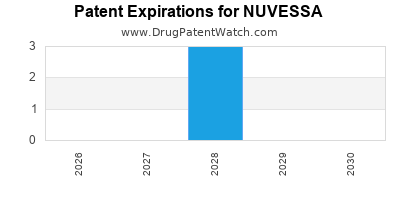
NUVESSA’s commercial protection is more difficult to evaluate than its FDA approval status because Lupin does not separately describe the product’s patent estate in its public financial reporting.
The relevant intellectual-property categories are:
- The metronidazole active ingredient, which is long off patent.
- The 1.3% vaginal gel formulation.
- The single-dose delivery regimen.
- Manufacturing and composition claims.
- Method-of-use claims directed to bacterial vaginosis.
The active ingredient provides no meaningful exclusivity. Any remaining patent value therefore depends on formulation, dosage, delivery and use claims.
What is the Orange Book status of NUVESSA?
FDA approval records identify NUVESSA under NDA 208463. Orange Book patent listings, if active, would determine the formal timing and certification requirements for an ANDA applicant. The approval itself does not establish a current market monopoly because the three-year regulatory exclusivity period expired in 2021.
A patent listing would not necessarily prevent generic approval. An ANDA applicant could submit a Paragraph IV certification against listed patents, wait for patent expiry, or pursue a non-infringing formulation and labeling strategy.
How strong is the NUVESSA patent estate?
NUVESSA has a moderate commercial patent profile rather than the protection associated with a new molecular entity.
Strengths
- A single-dose formulation can support composition, concentration and regimen claims.
- A branded formulation may be harder to copy exactly than conventional metronidazole gel.
- The product has an established FDA-approved indication and a defined delivery system.
- A generic applicant must address the formulation and labeling requirements of the reference product.
Weaknesses
- Metronidazole is an inexpensive, mature generic active ingredient.
- The principal therapeutic mechanism is well established.
- Competing generic vaginal metronidazole products are widely available.
- A generic company may design around a narrow formulation claim.
- The patient population is treated in a highly price-sensitive anti-infective category.
The practical strength of NUVESSA’s estate depends on the scope and enforceability of any listed patents, not merely on the existence of formulation patents. No public Lupin filing reports a material NUVESSA patent dispute or a separate valuation for the product.
When did NUVESSA lose regulatory exclusivity?
NUVESSA’s three-year approval-related exclusivity ended in February 2021. The expiration did not automatically trigger generic entry. A generic entrant still needs an approved ANDA, an acceptable formulation and a viable commercial strategy.
| Milestone |
Date or status |
| FDA approval |
February 12, 2018 |
| Expected end of three-year regulatory exclusivity |
February 12, 2021 |
| Patent-driven entry |
Depends on listed patents and litigation |
| Biosimilar pathway |
Not applicable |
| Current competitive risk |
Generic vaginal metronidazole and alternative BV therapies |
Which products compete with NUVESSA?
NUVESSA competes in a fragmented bacterial-vaginosis market.
| Product or class |
Active ingredient |
Main competitive issue |
| NUVESSA |
Metronidazole 1.3% vaginal gel |
Single-dose convenience, branded price |
| Generic MetroGel-Vaginal |
Metronidazole 0.75% |
Lower price, established prescribing |
| Vandazole and generic equivalents |
Metronidazole 0.75% |
Established vaginal metronidazole option |
| Clindamycin vaginal cream |
Clindamycin |
Alternative antibiotic class |
| Solosec |
Secnidazole |
Single-dose oral administration |
| Oral metronidazole |
Metronidazole |
Low cost and broad physician familiarity |
| Oral clindamycin |
Clindamycin |
Alternative systemic treatment |
NUVESSA’s principal advantage is dosing convenience. Its principal disadvantage is price. A patient or payer may not value a single vaginal dose enough to offset the cost difference versus generic five-day metronidazole.
Solosec is a particularly relevant comparator because it also offers single-dose treatment. The products differ in route of administration: NUVESSA is vaginal, while Solosec is an oral granule formulation. This creates a positioning distinction based on tolerability, patient preference and prescriber behavior rather than only on dosing frequency.
What formulation patents protect NUVESSA?
The formulation’s commercial value lies in combining:
- Metronidazole at a 1.3% concentration.
- A vaginal gel vehicle.
- A 5-gram single-dose applicator.
- Local delivery for bacterial vaginosis.
- A treatment regimen that avoids multiple daily applications.
These characteristics can create formulation and method-of-use patent opportunities. They do not eliminate generic risk. An ANDA applicant may challenge listed patents, use a different excipient system, or pursue an alternative product that satisfies FDA requirements without infringing enforceable claims.
The single-dose design also creates manufacturing and packaging requirements. Those requirements may raise entry costs modestly, but they are not comparable to the manufacturing barriers associated with sterile injectables, complex biologics or highly specialized drug-device combinations.
Has NUVESSA faced Paragraph IV challenges or litigation?
There is no widely reported public NUVESSA Paragraph IV settlement or high-profile patent litigation comparable to disputes involving major oncology, immunology or cardiovascular brands.
That absence has two commercial interpretations. It may indicate that NUVESSA sales are too small to justify costly litigation, or that prospective generic entrants have not identified a sufficiently attractive market opportunity. It does not prove that the product has long-term patent protection.
For NUVESSA, the most likely generic-entry pathway is an ANDA challenge followed by either:
- A negotiated entry date;
- A launch at risk after patent analysis;
- A non-infringing formulation;
- Or delayed entry until relevant patents expire.
No public settlement agreement establishes a confirmed generic launch date for NUVESSA.
What is NUVESSA’s financial trajectory?
Lupin does not report NUVESSA net sales, gross profit or operating income as a standalone product metric in its public annual-report disclosures.[2] The product is therefore best characterized as a niche branded asset with limited directly observable revenue data.
Revenue drivers
NUVESSA revenue depends on:
- Prescription volume for bacterial vaginosis.
- The percentage of patients receiving branded treatment.
- Payer coverage and prior authorization.
- Copay support and commercial contracting.
- Physician preference for single-dose therapy.
- Competition from generic metronidazole.
- Lupin’s ability to cross-sell within women’s health.
Revenue constraints
The product faces several structural limits:
- Bacterial vaginosis is commonly treated with low-cost generic antibiotics.
- Metronidazole has no meaningful active-ingredient exclusivity.
- Many prescribers already use generic five-day vaginal gel or oral therapy.
- A single-dose premium may be difficult to sustain without favorable formulary placement.
- The product has no disclosed blockbuster-scale revenue base.
- Market expansion depends more on share migration than on new disease creation.
Likely financial profile
NUVESSA is more likely to generate a stable, specialized revenue stream than a rapid-growth trajectory. Growth would require increased branded prescribing, improved payer access or broader adoption of single-dose vaginal therapy. Decline would follow generic substitution, loss of formulary coverage or reduced promotional investment.
Lupin’s acquisition and commercialization strategy can improve the product’s economics by using an existing sales infrastructure. The company can spread marketing and distribution costs across multiple women’s-health products. That benefit does not remove the underlying pricing pressure.
What generic entry risks exist for NUVESSA?
The generic-entry risk is high on a long-term basis and moderate in the near term, subject to patent status and ANDA activity.
High-risk factors
- Mature active ingredient.
- Generic alternatives already available in the same therapeutic category.
- Limited clinical differentiation.
- Expired regulatory exclusivity.
- Straightforward vaginal-gel manufacturing relative to complex products.
- Price-sensitive payer environment.
Factors that may delay entry
- Narrow formulation patents.
- Orange Book-listed patents with meaningful remaining life.
- ANDA development costs relative to expected sales.
- Limited commercial value for a low-volume product.
- Patient or prescriber preference for the specific single-dose formulation.
A generic company may not challenge NUVESSA immediately if the expected market is too small. In that case, the absence of entry reflects economics rather than strong patent protection.
How does NUVESSA compare with generic MetroGel-Vaginal?
| Factor |
NUVESSA |
Generic MetroGel-Vaginal |
| Metronidazole concentration |
1.3% |
Generally 0.75% |
| Treatment schedule |
Single dose |
Typically five days |
| Brand status |
Branded |
Generic |
| Price |
Premium |
Low |
| Main benefit |
Convenience |
Affordability and familiarity |
| Patent exposure |
Formulation and regimen claims |
Mature generic product |
| Payer position |
Requires coverage justification |
Usually preferred |
| Commercial outlook |
Niche branded product |
Durable low-cost competitor |
NUVESSA can maintain a position where adherence, convenience or aversion to oral therapy matters. It is less competitive when payers prioritize lowest acquisition cost.
What licensing deals affect NUVESSA?
The most relevant transaction is Lupin’s acquisition of U.S. rights to products connected with Evofem’s women’s-health portfolio. Public disclosures do not provide a separate purchase price, royalty stream or NUVESSA valuation.[2]
No publicly disclosed licensing arrangement establishes a material third-party royalty burden for NUVESSA. The lack of product-level disclosure prevents a precise assessment of transfer pricing, milestone obligations or contribution margin.
What is the commercial outlook for NUVESSA?
NUVESSA’s outlook is defensive and portfolio-dependent.
The product can retain value through single-dose convenience, women’s-health specialization and Lupin’s commercial infrastructure. Its growth ceiling is constrained by generic metronidazole, limited differentiation and the absence of active-ingredient exclusivity.
The most probable commercial scenarios are:
| Scenario |
Conditions |
Result |
| Base case |
Continued branded prescribing and stable coverage |
Stable niche revenue |
| Upside case |
Strong single-dose adoption and favorable payer access |
Moderate volume and price improvement |
| Downside case |
Generic entry, formulary exclusion or reduced promotion |
Rapid price and volume erosion |
| Strategic case |
Portfolio bundling with other women’s-health products |
Improved sales efficiency without major category expansion |
Key Takeaways
- NUVESSA is a single-dose, 1.3% metronidazole vaginal gel approved by FDA in 2018 for bacterial vaginosis.
- Lupin markets the product in the United States.
- Its three-year FDA regulatory exclusivity expired in February 2021.
- The product has no biosimilar risk because metronidazole is a small-molecule drug.
- Its commercial protection depends on formulation, dosage and method-of-use patents rather than the active ingredient.
- Generic vaginal metronidazole is the principal competitive threat.
- Lupin does not separately report NUVESSA revenue, making precise financial modeling unavailable from public filings.
- NUVESSA is best viewed as a niche branded asset with stable-to-declining long-term economics unless single-dose convenience supports sustained premium pricing.
- No widely reported Paragraph IV settlement or major NUVESSA patent litigation establishes a confirmed generic launch date.
FAQs
Is NUVESSA stronger than generic metronidazole?
NUVESSA is more convenient because it uses a single dose, but generic metronidazole is usually less expensive and more likely to receive preferred payer coverage.
Can NUVESSA be used to treat yeast infections?
No. NUVESSA is an antibacterial metronidazole product approved for bacterial vaginosis. It is not an antifungal treatment for candidiasis.
Is NUVESSA a biologic drug?
No. NUVESSA is a conventional small-molecule drug and is not subject to biosimilar competition.
Does NUVESSA have five-year FDA exclusivity?
No. The product contains the established active ingredient metronidazole and received the type of limited regulatory exclusivity associated with its qualifying clinical investigation and new dosage form, rather than five-year new-chemical-entity exclusivity.
Could a generic NUVESSA launch without copying the exact formulation?
Yes. A generic applicant may pursue an approved formulation and labeling approach that does not infringe enforceable formulation or method-of-use patent claims, subject to FDA approval and applicable patent certifications.
References
-
U.S. Food and Drug Administration. (2018). NUVESSA (metronidazole) vaginal gel, 1.3%: Prescribing information and approval information. FDA.
-
Lupin Limited. (2024). Annual report 2023-2024. Lupin Limited.