Last updated: September 4, 2026
NUEDEXTA is the only FDA-approved therapy specifically indicated for pseudobulbar affect, or PBA. The product combines dextromethorphan hydrobromide and a low dose of quinidine sulfate. Its commercial position has been supported by an absence of direct FDA-approved substitutes, a focused neurology sales infrastructure, and treatment demand across amyotrophic lateral sclerosis, multiple sclerosis, dementia, stroke, traumatic brain injury, and other neurologic conditions.
Otsuka Pharmaceutical acquired NUEDEXTA developer Avanir Pharmaceuticals for approximately $3.5 billion in 2015. NUEDEXTA revenue was commercially meaningful before the transaction, but Otsuka does not consistently report the product as a separate public revenue line. The principal long-term market risks are patent expiry, potential ANDA litigation, payer restrictions, safety-related prescribing friction, and eventual competition from generic dextromethorphan/quinidine products.
What is NUEDEXTA and which patients does it treat?
NUEDEXTA contains dextromethorphan hydrobromide and quinidine sulfate in fixed-dose capsules. The FDA approved the product in 2010 for the treatment of PBA in adults.
PBA is characterized by involuntary and often disproportionate episodes of laughing or crying. It occurs in patients with neurologic diseases or brain injury. The condition is distinct from major depressive disorder, although it can be misdiagnosed as depression, emotional lability, or another psychiatric disorder.
The recommended dosage is:
| Treatment period |
Dosage |
| Initial treatment |
One capsule daily for seven days |
| Maintenance treatment |
One capsule every 12 hours |
| Maximum labeled dose |
Two capsules daily |
Dextromethorphan is the pharmacologically active component. Quinidine inhibits CYP2D6-mediated metabolism of dextromethorphan, increasing and prolonging its exposure. The same mechanism creates clinically important drug-interaction and cardiac-safety considerations.
What conditions are associated with NUEDEXTA demand?
NUEDEXTA demand is linked to several large patient populations:
- Amyotrophic lateral sclerosis
- Multiple sclerosis
- Alzheimer’s disease and other dementias
- Parkinson’s disease
- Stroke
- Traumatic brain injury
- Other central nervous system disorders
The product’s commercial opportunity depends on diagnosis and treatment rates rather than on a single disease market. PBA is underdiagnosed, and many potential patients are managed with off-label antidepressants or receive no specific pharmacologic treatment.
How large is the NUEDEXTA market?
NUEDEXTA occupies a niche specialty-pharmaceutical market rather than a conventional high-volume primary-care market. Its economic value comes from high annual treatment cost, chronic use, and limited branded competition.
Public estimates have placed the number of Americans with PBA in the millions, although prevalence estimates vary by underlying neurologic condition and diagnostic methodology. The addressable treated population is substantially smaller because of underdiagnosis, competing treatment approaches, contraindications, and payer controls.
The market has four main commercial characteristics:
- High unmet diagnostic need. PBA symptoms overlap with depression, anxiety, behavioral disorders, and dementia-related symptoms.
- Specialty prescribing. Neurologists, psychiatrists, rehabilitation physicians, and long-term-care clinicians are important prescribers.
- Chronic treatment potential. Patients may remain on treatment for extended periods if symptom control is clinically meaningful.
- Limited direct competition. No other FDA-approved product has the same PBA indication and dextromethorphan-quinidine mechanism.
NUEDEXTA is exposed to substitution from generic antidepressants and other off-label treatments. Those alternatives generally have lower acquisition cost, which can limit reimbursement and create step-therapy requirements.
What is the financial trajectory of NUEDEXTA?
Before the Otsuka transaction, Avanir reported strong growth driven largely by NUEDEXTA. Avanir’s fiscal 2014 revenue was approximately $113.6 million, compared with approximately $80.4 million in fiscal 2013, according to company filings. The product was the company’s central commercial asset.
Otsuka announced the acquisition of Avanir in December 2014 and completed it in February 2015 for approximately $3.5 billion. The price reflected the value of an approved specialty product with growing prescriptions and additional commercial opportunity in PBA.
| Financial milestone |
Approximate value or date |
| Avanir fiscal 2013 revenue |
$80.4 million |
| Avanir fiscal 2014 revenue |
$113.6 million |
| Otsuka acquisition announcement |
December 2014 |
| Otsuka acquisition completion |
February 2015 |
| Acquisition consideration |
Approximately $3.5 billion |
| FDA NUEDEXTA approval |
October 2010 |
After the acquisition, Otsuka’s reporting structure made standalone NUEDEXTA revenue difficult to track. Otsuka Holdings reports consolidated pharmaceutical results and selected product information, but public filings do not consistently provide a full annual NUEDEXTA revenue series.
The acquisition price therefore cannot be evaluated from NUEDEXTA sales alone. Otsuka acquired Avanir’s commercial organization, product rights, development programs, regulatory infrastructure, and potential lifecycle opportunities. The transaction also gave Otsuka a U.S. neurology asset that complemented its broader central nervous system portfolio.
What factors drive NUEDEXTA revenue?
Revenue growth is influenced by:
- New PBA diagnoses
- Neurologist awareness and screening
- Refill persistence
- Commercial insurance coverage
- Medicare and Medicaid reimbursement
- Prior authorization requirements
- Copay assistance
- Long-term-care adoption
- Penetration of ALS, multiple sclerosis, dementia, and stroke populations
Revenue pressure comes from the product’s cost relative to off-label antidepressants, safety screening requirements, discontinuation after inadequate response, and potential generic entry.
What patents protect NUEDEXTA?
NUEDEXTA is protected by patents covering the dextromethorphan-quinidine combination, pharmaceutical compositions, dosing, and related treatment methods. The principal commercial patent estate has historically centered on U.S. patents assigned to Avanir Pharmaceuticals and later controlled by Otsuka.
Public patent records have included the following U.S. patents associated with the product or its active combination:
| Patent |
General subject matter |
Publicly reported expiration timeframe |
| U.S. Patent No. 7,659,282 |
Dextromethorphan and quinidine combination |
2026 timeframe |
| U.S. Patent No. 8,227,491 |
Combination and pharmaceutical use claims |
2026 timeframe |
| U.S. Patent No. 8,338,462 |
Combination formulation or use claims |
2026 timeframe |
| U.S. Patent No. 8,486,972 |
Additional composition or method claims |
Later than core patent in some listings |
Patent term and Orange Book status can differ because of patent-term adjustment, patent-term extension, terminal disclaimers, pediatric exclusivity, and changes to listed claims. The FDA Orange Book is the controlling commercial reference for patents listed against an approved drug product and for expiration information used in ANDA certification analysis.
What formulations are protected by NUEDEXTA patents?
The relevant intellectual-property strategy has focused on the fixed-dose combination of:
- Dextromethorphan hydrobromide
- Quinidine sulfate
- Specific dosage strengths
- Oral capsule formulations
- Pharmacokinetic enhancement through CYP2D6 inhibition
- Treatment of PBA
Formulation protection is commercially important because a generic applicant may attempt to design around claims directed to a particular ratio, dosage, release profile, salt form, capsule composition, or method of administration.
When does NUEDEXTA lose exclusivity?
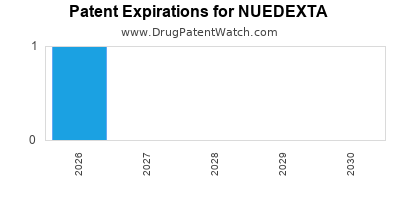
NUEDEXTA’s core U.S. patent protection is concentrated around the 2026 period based on publicly reported patent records. FDA regulatory exclusivity is separate from patent protection and has already expired.
The product’s initial five-year new chemical entity exclusivity did not provide a long-term barrier because NUEDEXTA combines previously known active ingredients. The product’s commercial protection has therefore depended mainly on patents, brand recognition, payer relationships, and the complexity of launching an equivalent combination product.
A generic applicant can seek FDA approval before patent expiry by filing:
- A Paragraph III certification, accepting delayed launch until patent expiry
- A Paragraph IV certification, asserting that listed patents are invalid, unenforceable, or not infringed
- A section viii statement, carving out a patented method of use from the proposed labeling
The practical entry date depends on the patents listed at the time of filing, the type of certification, litigation, settlement terms, and any 180-day first-filer exclusivity.
What is the Orange Book status of NUEDEXTA?
NUEDEXTA is listed in the FDA Orange Book as a prescription drug with patent information associated with its approved product. Orange Book listings are important because they determine the patent certifications available to ANDA applicants and can trigger the Hatch-Waxman 30-month stay if the reference sponsor files an infringement action within the statutory period.
The commercial significance of an Orange Book patent depends on:
- Whether the patent remains unexpired
- Whether the patent claims the drug, formulation, or approved method of use
- Whether the generic applicant certifies against it
- Whether the sponsor sues within 45 days
- Whether the patent survives litigation
- Whether the generic product can obtain approval with a labeling carve-out
NUEDEXTA’s patent estate is narrower than that of a complex biologic, but the combination product can still create technical and legal barriers if the listed claims cover the relevant strength, formulation, or administration schedule.
Which companies are challenging NUEDEXTA exclusivity?
The public record has included periodic generic interest in dextromethorphan hydrobromide and quinidine sulfate. The most consequential challengers would be ANDA applicants seeking approval for an equivalent combination capsule.
A definitive public assessment of challenger identity, Paragraph IV filing date, litigation outcome, and launch entitlement depends on current FDA, district court, and Federal Circuit records. Generic risk should therefore be analyzed through the Orange Book, FDA approval database, PACER filings, and settlement disclosures rather than through prescription-market rumors.
The main scenarios are:
| Scenario |
Commercial effect |
| No approved ANDA before core patent expiry |
Continued branded sales until generic approval |
| Paragraph IV challenge defeated |
Patent term largely preserved |
| Paragraph IV settlement with delayed launch |
Predictable erosion date |
| Successful early challenge |
Potential launch before listed patent expiry |
| Multiple generic approvals |
Rapid price and volume erosion |
| Single generic entrant |
Lower price pressure but meaningful share loss |
What patent litigation affects NUEDEXTA?
NUEDEXTA litigation risk is driven primarily by Hatch-Waxman challenges. The likely disputes concern claim construction, obviousness, written description, enablement, infringement, and the scope of any method-of-use carve-out.
A generic applicant may argue that:
- The dextromethorphan-quinidine combination was obvious
- The claimed dosage or ratio lacks patentable distinction
- The asserted claims do not cover the proposed product
- The product label can omit the patented PBA indication
- The relevant patents are invalid or unenforceable
The sponsor may respond that the combination produces a non-obvious pharmacokinetic profile, that the dosage regimen is clinically distinct, or that the generic product would induce infringement through labeling and marketing.
Publicly reported litigation should be separated from routine patent listings. A listed patent does not establish that an ANDA challenge has been filed, and an ANDA filing does not establish that a generic will launch.
How strong is the NUEDEXTA patent estate?
NUEDEXTA has a moderate commercial patent estate. Its strengths are the product’s approved combination, the specific pharmacokinetic role of quinidine, and the potential difficulty of matching the branded product’s labeling and clinical positioning.
Its weaknesses are the age of the active ingredients, the predictable expiration of core patents, the possibility of obviousness attacks, and the potential for a generic applicant to design around formulation or method claims.
| Patent-estate factor |
Assessment |
| Novel active ingredients |
Weak |
| Fixed-dose combination value |
Moderate |
| Formulation differentiation |
Moderate |
| Method-of-use protection |
Potentially meaningful |
| Biologic manufacturing barrier |
Not applicable |
| Generic manufacturing complexity |
Low to moderate |
| Core patent duration |
Limited, concentrated near 2026 |
| Brand and prescriber loyalty |
Moderate |
| Direct approved competition |
Limited |
NUEDEXTA does not have the manufacturing barriers associated with monoclonal antibodies, sterile injectables, or complex delivery systems. Generic production is likely to be more accessible than biosimilar development, although proving pharmaceutical equivalence and matching the reference product’s active-ingredient exposure remains necessary.
What generic entry risks exist for NUEDEXTA?
The highest-risk period begins when core Orange Book patents expire or when a successful Paragraph IV challenge removes them as a barrier.
A generic launch would likely produce:
- Immediate price competition
- Increased payer substitution
- Reduced branded refill share
- Greater formulary pressure
- Lower gross-to-net economics
- Possible channel disruption in long-term-care accounts
Brand erosion could be faster than for a highly differentiated biologic because the product is an oral capsule with established active ingredients. It could be slower than for a standard primary-care tablet because PBA diagnosis is specialist-driven and treatment continuity may matter to patients and caregivers.
A carve-out strategy could permit generic approval for indications not covered by a valid method-of-use patent while leaving some branded use protected. That outcome would reduce, but not eliminate, generic substitution risk.
How does NUEDEXTA compare with competing treatments?
NUEDEXTA has no direct FDA-approved branded competitor for PBA. Its practical competitors are off-label medicines and nonpharmacologic management.
| Treatment category |
FDA-approved specifically for PBA? |
Cost position |
Competitive impact |
| NUEDEXTA |
Yes |
High relative to generics |
Reference treatment |
| SSRIs |
No |
Low |
Common off-label alternative |
| Tricyclic antidepressants |
No |
Low |
Used selectively |
| Supportive behavioral management |
No |
Low direct cost |
May reduce drug demand |
| Generic dextromethorphan/quinidine |
Potential future competitor |
Expected lower than brand |
Main post-exclusivity threat |
NUEDEXTA’s clinical differentiation is strongest when a clinician recognizes PBA as a separate neurologic symptom complex and seeks the only FDA-approved therapy. Its reimbursement position is weaker when payers treat the condition as manageable with low-cost antidepressants.
What is the FDA regulatory status of NUEDEXTA?
The FDA approved NUEDEXTA for PBA in 2010. It is an approved prescription product, not a biologic, and biosimilar competition is not applicable.
Key regulatory issues include QT prolongation, CYP2D6 inhibition, drug interactions, and contraindications involving certain cardiac conditions and concomitant medicines. The label also limits use in patients for whom quinidine-related cardiac or interaction risks outweigh expected benefit.
Regulatory maintenance does not create a new market exclusivity period by itself. Label changes, supplemental applications, or postmarketing actions can affect commercial positioning but do not automatically extend the underlying patent estate.
What licensing deals and ownership changes affect NUEDEXTA?
The central ownership transaction was Otsuka’s acquisition of Avanir. Otsuka obtained control of NUEDEXTA and Avanir’s related development assets. The transaction changed the product from the core asset of a publicly traded specialty company into one product within a global pharmaceutical portfolio.
There is no comparable public licensing transaction that has displaced Otsuka as the principal commercial owner of NUEDEXTA in the United States. Any regional licenses, distribution arrangements, or future generic settlements would need to be evaluated separately from the Avanir acquisition.
What revenue exposure does Otsuka have to NUEDEXTA?
NUEDEXTA is strategically important but not likely to be one of Otsuka’s largest consolidated revenue drivers. Otsuka’s financial exposure is diluted by its larger portfolio, including central nervous system, renal, cardiovascular, and oncology products.
The company’s exposure has three components:
- Current NUEDEXTA net sales.
- Profit contribution from the U.S. specialty channel.
- Franchise value before generic competition.
Because Otsuka does not consistently disclose a full standalone sales history, investors should avoid treating third-party prescription estimates as reported revenue. The key valuation question is the duration of branded cash flows before generic entry and the extent to which Otsuka has identified replacement growth from newer products.
What is the likely NUEDEXTA launch scenario after patent expiry?
The most probable commercial sequence is:
- Continued branded sales while enforceable Orange Book patents remain.
- ANDA activity as the principal patent-expiry date approaches.
- Possible Paragraph IV litigation or settlement.
- One or more generic approvals after patent resolution or expiry.
- Rapid payer-driven substitution.
- Declining branded prescriptions and net price.
- Residual brand demand from patients with stable response, prescriber preference, or limited generic access.
A single generic entrant could produce substantial loss of share without immediately eliminating all brand revenue. Multiple approved generics would create more severe price and volume pressure.
Key Takeaways
- NUEDEXTA is the only FDA-approved treatment specifically indicated for PBA.
- Otsuka acquired Avanir for approximately $3.5 billion in 2015.
- Avanir reported approximately $113.6 million in fiscal 2014 revenue before the acquisition.
- Otsuka does not consistently disclose standalone NUEDEXTA revenue.
- Core U.S. patent protection has been publicly associated with the 2026 timeframe.
- The primary exclusivity threat is an ANDA containing a Paragraph IV certification.
- Biosimilar risk does not apply because NUEDEXTA is a small-molecule oral combination product.
- The product has no direct FDA-approved branded competitor, but low-cost off-label antidepressants constrain pricing.
- Generic entry could produce rapid payer substitution because the product uses established small-molecule ingredients.
- Future NUEDEXTA value depends on diagnosis growth, refill persistence, reimbursement, patent enforcement, and the timing of generic approval.
FAQs
Is NUEXTA a biologic with biosimilar exposure?
No. NUEDEXTA is an oral small-molecule combination of dextromethorphan hydrobromide and quinidine sulfate. Its principal competitive threat is generic substitution through the ANDA pathway, not biosimilar competition.
Does NUEDEXTA have orphan-drug exclusivity?
NUEDEXTA’s commercial protection has primarily relied on patents and its FDA-approved indication. The product was not generally treated as a conventional orphan-drug exclusivity story comparable to products approved for narrowly defined rare diseases.
Can a generic launch before all NUEDEXTA patents expire?
Potentially. A generic could launch after a successful Paragraph IV challenge, under a settlement agreement, through a section viii labeling carve-out, or after the relevant patent claims are held invalid or not infringed.
Is quinidine in NUEDEXTA clinically active or only a formulation component?
Quinidine is used primarily to inhibit CYP2D6 metabolism and increase dextromethorphan exposure. It also creates the product’s principal cardiac and drug-interaction safety considerations.
What is the most important commercial metric for NUEDEXTA after patent expiry?
The most important metric is the timing and number of approved ANDA products, followed by payer substitution rates. Prescription volume alone will not show the full impact because branded net price and gross-to-net discounts can deteriorate rapidly after generic entry.
References
-
Avanir Pharmaceuticals, Inc. (2014). Annual report pursuant to Section 13 or 15(d) of the Securities Exchange Act of 1934 for the fiscal year ended September 30, 2014. U.S. Securities and Exchange Commission.
-
Food and Drug Administration. (2010). NUEDEXTA prescribing information. U.S. Department of Health and Human Services.
-
Food and Drug Administration. (2024). Approved drug products with therapeutic equivalence evaluations: Orange Book. U.S. Department of Health and Human Services.
-
Otsuka Holdings Co., Ltd. (2015). Otsuka Pharmaceutical to acquire Avanir Pharmaceuticals. Corporate press release.
-
U.S. Patent and Trademark Office. (2024). Patent Center and Patent Examination Data System records for U.S. Patents Nos. 7,659,282, 8,227,491, 8,338,462, and 8,486,972. U.S. Department of Commerce.