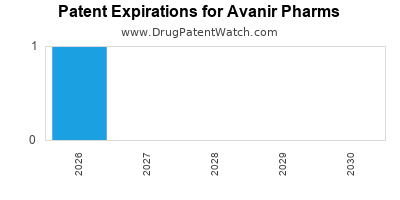
Last updated: June 19, 2026
Avanir Pharmaceuticals is a mid-cap neuroscience specialty company with a concentrated revenue base historically anchored by NUEDEXTA (dextromethorphan/quinidine) for pseudobulbar affect (PBA) and a smaller portfolio tied to its neurology franchise. The competitive landscape is shaped by (1) NUEDEXTA’s Orange Book patent estate and exclusivity, (2) the presence of direct competitors that can file ANDAs or launch authorized generics, and (3) forum-driven leverage from patent litigation and settlement terms. Market position is materially dependent on how long Avanir (and co-developers/licensees) can defend formulation and method-of-use IP, and whether competitors can design around and enter through Paragraph IV.
What is Avanir Pharmaceuticals’ current market position and revenue concentration?
Avanir’s competitive position has historically been driven by NUEDEXTA. In the U.S., the practical bar for competitive entry is the FDA-related exclusivity and the Orange Book-listed patents tied to NUEDEXTA’s approved formulation(s), manufacturing-related claims, and clinical use.
Where does Avanir sit in the neurology specialty competitive set
Avanir competes in a narrow neurology adjacent space, not a broad primary-care CNS lane. That changes the competitive playbook: challengers focus on generic/authorized generic pathways and on physician switching in a constrained indication.
Key implication: competitive “winner-take-most” dynamics are stronger because prescribers already have a small number of viable PBA options; a single successful generic can pressure pricing quickly.
What patents protect Nuedexta (dextromethorphan/quinidine) and how broad is the estate?
The strength of Avanir’s competitive moat depends on the patent coverage of NUEDEXTA’s fixed-dose combination across multiple claim categories. In practice, challengers evaluate:
- composition and formulation claims (tablet composition, coatings, ratios)
- method-of-manufacture claims (process controls, mixing/granulation/solid-state parameters)
- method-of-use claims tied to PBA dosing regimens
- secondary patents such as stability or specific salt/polymorph related features (when listed)
Orange Book structure that drives generic entry
For a combination drug, generic challengers typically seek either:
- Paragraph IV invalidity/non-infringement with respect to one or more Orange Book patents; or
- an FDA route that relies on carve-outs (if allowed by formulation differences) while meeting bioequivalence requirements.
Key implication: the estate’s breadth across at least two of these buckets usually determines entry timing.
Which assignees typically hold the Nuedexta patent estate?
Avanir has been associated with the NUEDEXTA brand and rights to protect the approved product and its IP. In combination products, upstream rights (active ingredient sourcing, salt forms, early combination inventions) can produce assignee splits across the patent chain, increasing the number of legal targets for a challenger.
Competitive impact: more assignees increases the chance of multiple concurrent suits or follow-on infringement assertions against a generic’s manufacturing plans.
When does Nuedexta lose exclusivity in the US and what are the generic launch risk windows?
Exclusivity timing is the gating variable for “easy wins.” Competitive launches hinge on:
- patent expiry (including any granted term adjustments)
- statutory exclusivity (if applicable to the approval history)
- whether a settlement blocks generic entry beyond the earliest lawful date
How exclusivity interacts with Paragraph IV challenges
If a challenger files an ANDA with Paragraph IV certifications, the resulting 30-month stay (when triggered) compresses the effective risk window. A later settlement with a first filer can extend suppression beyond pure expiration math.
Key implication: the market sees two dates: the earliest legal launch date and the earliest realistically permitted launch date under settlement terms.
What patent litigation affects Avanir and its NUEDEXTA competition?
Patent litigation can materially alter competitive pricing dynamics even when patents are scheduled to expire, because:
- court outcomes can narrow claim scope and accelerate generic design-around
- settlements can lock in a “first commercial launch” date
- multi-patent litigation can produce staggered stays tied to different asserted patents
How challengers structure litigation risk
For fixed-dose combination products, challengers typically argue:
- non-infringement based on formulation and manufacturing differences
- invalidity under anticipation/obviousness
- lack of enforceability for prosecution-history issues
Competitive impact: if Avanir’s estate relies heavily on formulation specifics that are easy to change, litigation may create a “patent thinning” effect over time.
How strong is Avanir’s patent estate for NUEDEXTA versus generic challengers?
Patent estate strength is best assessed on:
- number of enforceable Orange Book patents still in force
- survival probability based on claim breadth and prior art density
- presence of manufacturing-process claims that are harder to design around
- whether settlements cover multiple challengers or only the first filer
Featured snippet takeaway
Avanir’s competitive moat is strongest when its Orange Book patents cover both (1) the approved formulation/composition and (2) at least one manufacturing or method-of-use claim that materially constrains “drop-in” generic copies.
Which companies challenge or compete with Avanir’s NUEDEXTA in ANDA/Paragraph IV pathways?
Competitive pressure usually comes from ANDA filers with:
- ANDA application submissions with Paragraph IV certifications
- litigation-financed generic development teams
- commercialization capability for neurology CNS switching
What generic entry strategies are most common
- Direct generic launch after FDA approval if stays and settlements permit
- Authorized generic agreements that rebrand or supply a generic product under the brand holder umbrella
- Launch with a narrower claim position if only some Orange Book patents are certified
Competitive impact: pricing pressure is strongest when challengers can launch broadly without sales friction.
What formulations are protected by Avanir for NUEDEXTA, and how do formulation design-arounds work?
For an immediate-release fixed-dose tablet, formulation design-around typically focuses on:
- excipient selection and tablet manufacturing parameters
- dissolution profile tuning while maintaining bioequivalence
- stability and shelf-life controls that avoid infringement triggers (when claims are narrow)
Design-around risk assessment
A design-around succeeds when it changes an element that is a claim limitation while still meeting FDA’s bioequivalence requirements. If Avanir’s patents claim broad ranges or generic-equivalent compositions, the design-around success rate declines.
Competitive impact: formulation patent specificity tends to decide whether challengers win invalidity arguments or must redesign.
What method-of-use patents matter for NUEDEXTA and PBA treatment?
Method-of-use patents can protect:
- dosing regimens
- patient selection criteria
- treatment timing schedules
Generic infringement posture for method-of-use claims
A generic usually infringes method-of-use claims through labeling-directed use rather than manufacturing steps. This creates pressure for Avanir to manage:
- labeling language tied to the protected method
- FDA approval labeling negotiations
- ongoing enforcement against “at-risk” prescribing
Competitive impact: if method-of-use claims are strong and labeling is aligned, Avanir can slow off-label and on-label substitution.
What is the Orange Book status of NUEDEXTA (drug, dosage forms, and listed patents)?
Orange Book status determines the actual litigation and certification map. It includes:
- listed patents and their expiration dates
- patent types (composition, formulation, method-of-use, process)
- exclusivity markers (when present)
How to read Orange Book listings for competitive planning
A competitor maps:
- earliest expiring patent that can be “carved” by changing ANDA certification strategy
- number of patents expiring close together, which can reduce settlement leverage
Competitive impact: a staggered patent estate creates longer runway for continued brand protection.
How does Avanir’s competitive landscape compare with other PBA neurology products?
PBA is a relatively narrow indication, which means brand differentiation is often clinical positioning and tolerated dosing rather than unique mechanisms. Competitive differentiation tends to be:
- side effect profile
- dosing convenience
- payer coverage and formulary placement
Where generic entry hits hardest
When an ANDA enters with a meaningful price differential, payers push tier changes rapidly. If Avanir’s product has a payer-preferred status, settlement timing and labeling enforcement become primary levers.
What settlement agreements or licensing deals influence NUEDEXTA generic launch timing?
Settlements can create effective launch suppression by:
- specifying non-launch windows for multiple generic products
- requiring early-launch payments or cross-licenses
- limiting design-around variants that would otherwise permit earlier entry
How licensing shifts competitive dynamics
If Avanir licenses rights to a competitor, it can:
- allow controlled competition without full brand erosion
- preserve some economics via royalties
- reduce litigation costs versus multi-year trials
Competitive impact: licensing generally stabilizes revenue but reduces the upside of full exclusivity.
What FDA regulatory pathway issues matter for competitive entry (ANDA vs. 505(b)(2))?
NUEDEXTA-like products generally invite ANDAs. A 505(b)(2) pathway can appear when a filer seeks to leverage existing data and makes differences in formulation or route, but it still depends on meeting requirements for approval.
Labeling and bioequivalence constraints
To compete, generics must match:
- dosage form and strength equivalence
- bioequivalence parameters
- labeling content consistent with FDA requirements and any litigation-driven restrictions
Competitive impact: label negotiations can delay commercial launch even after patent hurdles clear.
What generic entry risks exist for NUEDEXTA, and what evidence typically triggers accelerated switching?
Generic entry risks include:
- successful Paragraph IV challenges on at least one critical patent
- settlement term expirations
- FDA approval of an ANDA before remaining patents block launch
Commercial switching triggers
- wholesale acquisition cost discount versus brand
- payer formulary movement
- physician adoption driven by reimbursement and product availability
Competitive impact: switching is usually fastest when multiple payers adopt the generic and when there is stable supply.
What manufacturing/IP barriers could delay or block generic launches?
Even with regulatory approval, manufacturing or quality constraints can delay launch:
- validated manufacturing processes aligned to claim limitations
- supply chain readiness for scale-up
- quality system audits and batch release capacity
IP-linked manufacturing constraints
When patents include manufacturing process claims, challengers must either:
- litigate process infringement risk, or
- redesign to avoid claim elements
Competitive impact: process-linked patents can increase time-to-launch without necessarily preventing eventual market entry.
Key Takeaways
- Avanir’s competitive moat centers on NUEDEXTA and the Orange Book patent estate covering combination composition/formulation, potential method-of-use concepts, and potentially manufacturing/process claims.
- Generic entry timing is governed by the interplay between patent expiration, statutory exclusivity, ANDA Paragraph IV stays, and settlement terms.
- The strongest competitive barrier is a multi-bucket patent estate that is harder to design around (formulation plus process or method-of-use).
- Market erosion risk rises sharply when challengers can clear at least one critical Orange Book patent and obtain a launch window without ongoing suppression terms.
- Competitive pressure is commercial first and legal second: once generics clear the legal and FDA gates, payer and physician switching can drive rapid pricing shifts.
FAQs
1) What determines whether a generic can launch for Nuedexta after a Paragraph IV challenge?
The availability of a lawful launch date after considering the ANDA 30-month stay outcome, remaining Orange Book patents, and any settlement terms that restrict launch.
2) Which patent types usually provide the hardest design-around path for combination tablets?
Manufacturing/process and formulation-specific claims that are tied to limiting product features, not just broad therapeutic utility.
3) Do method-of-use patents materially slow generic competition for PBA drugs?
Yes when labeling and prescribing practices are closely aligned to the protected method such that generic labels create infringement risk through intended use.
4) How do authorized generics change the competitive landscape versus standard ANDA launches?
They can compress price impact by keeping a controlled supply and branded distribution channels while still undermining brand pricing leverage.
5) What commercial factor matters most for fast uptake after generic approval?
Reimbursement and formulary movement, which drive prescribing behavior and limit continued brand preference.
References
- FDA. Orange Book: Approved Drug Products with Therapeutic Equivalence Evaluations. U.S. Food and Drug Administration. https://www.accessdata.fda.gov/scripts/cder/daf/index.cfm
- FDA. ANDA Information. U.S. Food and Drug Administration. https://www.fda.gov/drugs/abbreviated-new-drug-application-anda
- FDA. Exclusivity and Patent Certifications Guidance (Orange Book and exclusivity framework). U.S. Food and Drug Administration. https://www.fda.gov/drugs/guidance-compliance-regulatory-information/drug-patent-information-nonproprietary-name-(npn)-drug-products-and-patents