You're using a free limited version of DrugPatentWatch: Upgrade for Complete Access

Last Updated: December 19, 2025

NEXTERONE Drug Patent Profile


✉ Email this page to a colleague

« Back to Dashboard


When do Nexterone patents expire, and when can generic versions of Nexterone launch?

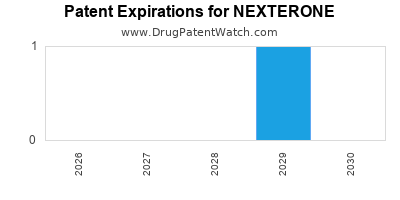
Nexterone is a drug marketed by Baxter Hlthcare and is included in one NDA. There is one patent protecting this drug and one Paragraph IV challenge.

This drug has thirty-one patent family members in thirteen countries.

The generic ingredient in NEXTERONE is amiodarone hydrochloride. There are fifteen drug master file entries for this compound. Thirty-seven suppliers are listed for this compound. Additional details are available on the amiodarone hydrochloride profile page.

AI Deep Research
Questions you can ask:
  • What is the 5 year forecast for NEXTERONE?
  • What are the global sales for NEXTERONE?
  • What is Average Wholesale Price for NEXTERONE?
Drug patent expirations by year for NEXTERONE
Drug Prices for NEXTERONE

See drug prices for NEXTERONE

Recent Clinical Trials for NEXTERONE

Identify potential brand extensions & 505(b)(2) entrants

SponsorPhase
OHSU Knight Cancer InstitutePhase 2
University of CalgaryPhase 4
Rockefeller UniversityPhase 4

See all NEXTERONE clinical trials

Paragraph IV (Patent) Challenges for NEXTERONE
Tradename Dosage Ingredient Strength NDA ANDAs Submitted Submissiondate
NEXTERONE Injection amiodarone hydrochloride 150 mg/100 mL 022325 1 2025-06-24

US Patents and Regulatory Information for NEXTERONE

NEXTERONE is protected by one US patents.

Applicant Tradename Generic Name Dosage NDA Approval Date TE Type RLD RS Patent No. Patent Expiration Product Substance Delist Req. Exclusivity Expiration
Baxter Hlthcare NEXTERONE amiodarone hydrochloride INJECTABLE;INJECTION 022325-001 Dec 24, 2008 DISCN Yes No 7,635,773 ⤷  Get Started Free Y ⤷  Get Started Free
Baxter Hlthcare NEXTERONE amiodarone hydrochloride INJECTABLE;INJECTION 022325-002 Nov 16, 2010 RX Yes Yes 7,635,773 ⤷  Get Started Free Y ⤷  Get Started Free
Baxter Hlthcare NEXTERONE amiodarone hydrochloride INJECTABLE;INJECTION 022325-003 Nov 16, 2010 RX Yes Yes 7,635,773 ⤷  Get Started Free Y ⤷  Get Started Free
>Applicant >Tradename >Generic Name >Dosage >NDA >Approval Date >TE >Type >RLD >RS >Patent No. >Patent Expiration >Product >Substance >Delist Req. >Exclusivity Expiration

Expired US Patents for NEXTERONE

Applicant Tradename Generic Name Dosage NDA Approval Date Patent No. Patent Expiration
Baxter Hlthcare NEXTERONE amiodarone hydrochloride INJECTABLE;INJECTION 022325-003 Nov 16, 2010 6,869,939 ⤷  Get Started Free
Baxter Hlthcare NEXTERONE amiodarone hydrochloride INJECTABLE;INJECTION 022325-001 Dec 24, 2008 5,134,127 ⤷  Get Started Free
Baxter Hlthcare NEXTERONE amiodarone hydrochloride INJECTABLE;INJECTION 022325-002 Nov 16, 2010 6,869,939 ⤷  Get Started Free
Baxter Hlthcare NEXTERONE amiodarone hydrochloride INJECTABLE;INJECTION 022325-001 Dec 24, 2008 6,869,939 ⤷  Get Started Free
Baxter Hlthcare NEXTERONE amiodarone hydrochloride INJECTABLE;INJECTION 022325-001 Dec 24, 2008 5,376,645 ⤷  Get Started Free
>Applicant >Tradename >Generic Name >Dosage >NDA >Approval Date >Patent No. >Patent Expiration

International Patents for NEXTERONE

See the table below for patents covering NEXTERONE around the world.

Country Patent Number Title Estimated Expiration
Mexico 375873 COMPOSICIONES DE ETER SULFOALQUILICO-CICLODEXTRINA. (SULFOALKYL ETHER CYCLODEXTRIN COMPOSITIONS) ⤷  Get Started Free
Spain 2378306 ⤷  Get Started Free
China 105288650 ⤷  Get Started Free
Russian Federation 2113442 PURIFIED DERIVATIVES OF SULFOALKYL ETHERS OF CYCLODEXTRINE OR THEIR MIXTURE, CLATRATE COMPLEX OF CYCLODEXTRINE DERIVATIVES WITH MEDICINAL, AND PHARMACEUTICAL COMPOSITION ⤷  Get Started Free
South Korea 101314803 ⤷  Get Started Free
Australia 646020 ⤷  Get Started Free
>Country >Patent Number >Title >Estimated Expiration

Market Dynamics and Financial Trajectory for Nexterone

Last updated: July 27, 2025


Introduction

Nexterone, commercially known as amiodarone, is a potent anti-arrhythmic medication primarily indicated for the treatment and prevention of serious cardiac arrhythmias. Since its market entry, Nexterone has maintained a significant position within the cardiovascular therapeutics segment due to its efficacy and broad application. Analyzing the current market environment, its competitive landscape, revenue potential, regulatory factors, and future growth prospects provides vital insight for stakeholders and investors alike.


Pharmaceutical Profile and Market Position

Nexterone’s active ingredient, amiodarone, is recognized for its distinctive pharmacokinetics and broad anti-arrhythmic spectrum. Its unique mechanism, involving multiple ion channel modulations, underpins its clinical utility in managing atrial fibrillation, ventricular tachycardia, and fibrillation. Despite its high efficacy, safety concerns—such as pulmonary toxicity, thyroid dysfunction, and hepatotoxicity—have necessitated careful prescribing practices, influencing market size and product positioning.

Market penetration is bolstered by its longstanding presence and extensive clinical evidence supporting its efficacy. The drug is available via both brand-name formulations and generics, influencing pricing strategies and market share.


Market Dynamics Influencing Nexterone

1. Clinical Guidelines and Adoption Rates

Updated clinical guidelines issued by organizations like the American Heart Association (AHA) and European Society of Cardiology (ESC) continue to endorse amiodarone for specific arrhythmic conditions, reinforcing its utilization. However, the emergence of alternative agents, such as sotalol and dofetilide, and newer anti-arrhythmics with improved safety profiles, exert competitive pressure. The integration of non-pharmacological interventions like catheter ablation, especially for atrial fibrillation, also impacts drug reliance.

2. Regulatory Landscape

Regulatory agencies, including the U.S. Food and Drug Administration (FDA), closely monitor amiodarone’s safety profile. Recent updates, including boxed warnings and REMS programs, aim to mitigate adverse effects, potentially influencing prescribing habits. Nonetheless, its well-established efficacy sustains market presence, particularly where guidelines favor pharmacological management.

3. Market Segmentation and Geographic Variances

North America remains the dominant market for Nexterone, attributed to high cardiovascular disease prevalence and advanced healthcare infrastructure. Europe exhibits moderate growth, constrained by regional regulatory variations and anti-arrhythmic drug preferences. Emerging markets in Asia and Latin America present expansion opportunities due to increasing cardiovascular awareness, aging populations, and expanding healthcare coverage, albeit with challenges stemming from regulatory approvals and pricing sensitivities.

4. Competitive Landscape

While generic versions of amiodarone have widened access, innovative formulations such as IV or sustained-release variants influence market shares. Patent expirations and biosimilar entrants further shape competition, often resulting in price erosions but expanding overall market size.

5. Technological and Scientific Advances

Emerging therapies, including implantable devices and gene therapies for arrhythmia management, may disrupt traditional pharmacotherapy markets. Nevertheless, due to established clinical practice and therapy inertia, amiodarone’s role remains significant, especially in acute or resource-constrained settings.


Financial Trajectory Analysis

1. Revenue Streams and Market Size

Globally, the anti-arrhythmic drugs market, which includes Nexterone, was valued at approximately USD 2.7 billion in 2022 and is projected to grow at a Compound Annual Growth Rate (CAGR) of around 4.2% through 2028 (source: GlobalData). Amiodarone accounts for a substantial portion, owing to its widespread use and cost-effectiveness.

In North America, Nexterone's revenue is characterized by stable demand, partially offset by safety-related prescription declines observed over recent years. In Europe and emerging economies, revenue growth hinges on regulatory approvals, market access, and shifting treatment protocols.

2. Pricing Dynamics

Generic competition has precipitated price reductions, with branded formulations experiencing a premium. The pricing elasticity is moderated by safety concerns and formulary constraints. Additionally, health system reimbursements significantly influence net revenue, especially in institutional settings.

3. Cost Considerations

Manufacturing costs for Nexterone remain relatively stable owing to established production processes. However, ongoing investments in safety monitoring, compliance, and marketing influence overall margins. Strategic partnerships and licensing agreements can impact revenue sharing models.

4. Investment and R&D Outlook

Although amiodarone is an established drug, continuous research aims to mitigate adverse effects through novel formulations or combinations, potentially opening new revenue avenues. Investment in these areas could bolster long-term financial resilience.


Future Growth Prospects

Optimistic projections point toward incremental growth driven by increasing arrhythmia prevalence, particularly in aging populations. The expanding scope of indications, such as for atrial fibrillation post-cardiac surgery, could augment demand.

However, safety concerns and the development of alternative therapies may temper growth expectations. Companies investing in optimized formulations, combination therapies, or innovative delivery methods are positioned for competitive advantage.

Regulatory pathways for biosimilars or reformulated derivatives could further influence the financial trajectory. Moreover, strategic expansion into emerging markets offers qualitative growth opportunities, conditioned upon overcoming regulatory and reimbursement hurdles.


Regulatory and Policy Impacts

Health regulatory policies emphasizing drug safety awareness will continue to shape Nexterone’s market access. Increasing adoption of electronic health records (EHR) and clinical decision support tools may influence prescribing trends, favoring or deterring its use.

Pharmacovigilance initiatives and adverse event reporting enhancements maintain high safety standards, potentially impacting prescribing frequencies and sales.


Key Challenges and Opportunities

Challenges:

  • Safety profile concerns influencing prescriber behavior.
  • Competition from newer anti-arrhythmics and device-based therapies.
  • Pricing pressures from generic entries.
  • Regulatory variations across markets affecting access.

Opportunities:

  • Expansion into developing markets with growing cardiovascular burdens.
  • Development of safer, long-acting formulations.
  • Integration with digital health tools for optimized patient management.
  • Collaborations for combination therapies leveraging amiodarone's efficacy.

Conclusion

Nexterone remains a cornerstone in arrhythmia pharmacotherapy, underpinned by robust clinical data and widespread clinical adoption. While current market dynamics suggest steady, incremental growth, the landscape’s evolution depends on safety management, technological innovations, and strategic geographic expansion. Stakeholders must navigate regulatory complexities and competitive pressures diligently to capitalize on emerging opportunities, ensuring sustainable financial performance in an increasingly sophisticated therapeutics environment.


Key Takeaways

  • Stable Market Position: Nexterone maintains a significant share within anti-arrhythmic drugs, supported by decades of clinical use.
  • Safety and Regulation: Safety concerns influence prescribing habits, balanced by regulatory oversight and pharmacovigilance.
  • Growth Opportunities: Emerging markets and potential reformulations offer avenues for expansion amid demographic shifts.
  • Competitive Landscape: Generic competition and new therapies shape pricing strategies and market share.
  • Strategic Focus: Innovating safer formulations and leveraging digital health integration can bolster long-term profitability.

FAQs

1. How does the safety profile of Nexterone impact its market share?
Safety concerns, notably pulmonary toxicity and thyroid issues, prompt cautious prescribing and monitoring, which can limit aggressive market expansion but sustain demand among clinicians familiar with managing risks.

2. What is the impact of generic amiodarone formulations on Nexterone’s revenue?
Generic versions exert price competition, often leading to reduced revenues for branded formulations. However, they increase overall access and volume, partially offsetting profit declines.

3. Are there upcoming innovations that could replace Nexterone as the preferred anti-arrhythmic?
Emerging therapies, including novel oral agents with improved safety profiles and device-based interventions, may alter the treatment landscape, though amiodarone’s broad efficacy ensures continued relevance.

4. How do regulatory environments across different regions influence Nexterone’s market prospects?
Regulatory stringency varies, affecting approval, reimbursement, and prescribing patterns. Navigating these complexities is essential for market expansion, especially in emerging economies.

5. What strategies can companies employ to maximize revenue from Nexterone?
Focusing on expanding geographic reach, developing safer formulations, and integrating digital health initiatives while managing safety concerns can optimize financial outcomes.


Sources:

  1. GlobalData Reports on Cardiovascular Drugs Market
  2. American Heart Association Guidelines (2022)
  3. U.S. FDA Drug Safety Communications (2022)
  4. MarketResearch.com Reports on Anti-arrhythmic Drugs (2022)
  5. European Society of Cardiology Guidelines (2021)

More… ↓

⤷  Get Started Free

Make Better Decisions: Try a trial or see plans & pricing

Drugs may be covered by multiple patents or regulatory protections. All trademarks and applicant names are the property of their respective owners or licensors. Although great care is taken in the proper and correct provision of this service, thinkBiotech LLC does not accept any responsibility for possible consequences of errors or omissions in the provided data. The data presented herein is for information purposes only. There is no warranty that the data contained herein is error free. We do not provide individual investment advice. This service is not registered with any financial regulatory agency. The information we publish is educational only and based on our opinions plus our models. By using DrugPatentWatch you acknowledge that we do not provide personalized recommendations or advice. thinkBiotech performs no independent verification of facts as provided by public sources nor are attempts made to provide legal or investing advice. Any reliance on data provided herein is done solely at the discretion of the user. Users of this service are advised to seek professional advice and independent confirmation before considering acting on any of the provided information. thinkBiotech LLC reserves the right to amend, extend or withdraw any part or all of the offered service without notice.