You're using a free limited version of DrugPatentWatch: Upgrade for Complete Access

Last Updated: December 19, 2025

NEXAVAR Drug Patent Profile


✉ Email this page to a colleague

« Back to Dashboard


Which patents cover Nexavar, and what generic alternatives are available?

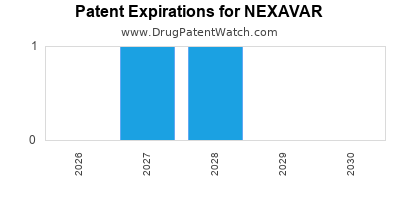
Nexavar is a drug marketed by Bayer Hlthcare and is included in one NDA. There are two patents protecting this drug and one Paragraph IV challenge.

This drug has eighty-nine patent family members in thirty-nine countries.

The generic ingredient in NEXAVAR is sorafenib tosylate. There are thirteen drug master file entries for this compound. Eight suppliers are listed for this compound. Additional details are available on the sorafenib tosylate profile page.

AI Deep Research
Questions you can ask:
  • What is the 5 year forecast for NEXAVAR?
  • What are the global sales for NEXAVAR?
  • What is Average Wholesale Price for NEXAVAR?
Drug patent expirations by year for NEXAVAR
Drug Prices for NEXAVAR

See drug prices for NEXAVAR

Recent Clinical Trials for NEXAVAR

Identify potential brand extensions & 505(b)(2) entrants

SponsorPhase
Disruptive PharmaEARLY_PHASE1
CTC Clinical Trial Consultants ABEARLY_PHASE1
Guangzhou First People's HospitalPhase 2/Phase 3

See all NEXAVAR clinical trials

Pharmacology for NEXAVAR
Drug ClassKinase Inhibitor
Mechanism of ActionProtein Kinase Inhibitors
Paragraph IV (Patent) Challenges for NEXAVAR
Tradename Dosage Ingredient Strength NDA ANDAs Submitted Submissiondate
NEXAVAR Tablets sorafenib tosylate 200 mg 021923 1 2014-02-28

US Patents and Regulatory Information for NEXAVAR

NEXAVAR is protected by four US patents.

Applicant Tradename Generic Name Dosage NDA Approval Date TE Type RLD RS Patent No. Patent Expiration Product Substance Delist Req. Exclusivity Expiration
Bayer Hlthcare NEXAVAR sorafenib tosylate TABLET;ORAL 021923-001 Dec 20, 2005 AB RX Yes Yes ⤷  Get Started Free ⤷  Get Started Free Y Y ⤷  Get Started Free
Bayer Hlthcare NEXAVAR sorafenib tosylate TABLET;ORAL 021923-001 Dec 20, 2005 AB RX Yes Yes ⤷  Get Started Free ⤷  Get Started Free Y ⤷  Get Started Free
>Applicant >Tradename >Generic Name >Dosage >NDA >Approval Date >TE >Type >RLD >RS >Patent No. >Patent Expiration >Product >Substance >Delist Req. >Exclusivity Expiration

Expired US Patents for NEXAVAR

Applicant Tradename Generic Name Dosage NDA Approval Date Patent No. Patent Expiration
Bayer Hlthcare NEXAVAR sorafenib tosylate TABLET;ORAL 021923-001 Dec 20, 2005 ⤷  Get Started Free ⤷  Get Started Free
>Applicant >Tradename >Generic Name >Dosage >NDA >Approval Date >Patent No. >Patent Expiration

International Patents for NEXAVAR

When does loss-of-exclusivity occur for NEXAVAR?

Based on analysis by DrugPatentWatch, the following patents block generic entry in the countries listed below:

Argentina

Patent: 4234
Patent: COMPOSICION FARMACEUTICA PARA EL TRATAMIENTO DEL CANCER
Estimated Expiration: ⤷  Get Started Free

Canada

Patent: 01955
Patent: COMPOSITION PHARMACEUTIQUE COMPRENANT UNE DIPHENYLUREE SUBSTITUEE PAR UN OMEGA-CARBOXYARYLE POUR LE TRAITEMENT DU CANCER (PHARMACEUTICAL COMPOSITION COMPRISING AN OMEGA- CARBOXYARYL SUBSTITUTED DIPHENYL UREA FOR THE TREATMENT OF CANCER)
Estimated Expiration: ⤷  Get Started Free

Generics may enter earlier, or later, based on new patent filings, patent extensions, patent invalidation, early generic licensing, generic entry preferences, and other factors.

See the table below for additional patents covering NEXAVAR around the world.

Country Patent Number Title Estimated Expiration
Croatia P20100674 ⤷  Get Started Free
Argentina 054234 COMPOSICION FARMACEUTICA PARA EL TRATAMIENTO DEL CANCER ⤷  Get Started Free
South Korea 20070020158 ⤷  Get Started Free
Slovenia 1140840 ⤷  Get Started Free
>Country >Patent Number >Title >Estimated Expiration

Supplementary Protection Certificates for NEXAVAR

Patent Number Supplementary Protection Certificate SPC Country SPC Expiration SPC Description
1140840 06C0034 France ⤷  Get Started Free PRODUCT NAME: SORAFENIB TOSYLATE, ET AUTRES SELS PHARMACEUTIQUEMENT ACCEPTABLES DE SORAFENIB; REGISTRATION NO/DATE IN FRANCE: EU/1/06/342/001 DU 20060719; REGISTRATION NO/DATE AT EEC: EU/1/06/342/001 DU 20060719
1140840 122006000059 Germany ⤷  Get Started Free PRODUCT NAME: SORAFENIB UND PHARMAZEUTISCH VERTRAEGLICHE SALZE DAVON; REGISTRATION NO/DATE: EU/1/06/342/001 20060719
1140840 91280 Luxembourg ⤷  Get Started Free 91280, EXPIRES: 20210720
1140840 PA 2006 008, C 1140840 Lithuania ⤷  Get Started Free PRODUCT NAME: SORAFENIBAS IR FARMACINIU PO?I?RIU PRIIMTINOS JO DRUSKOS; REGISTRATION NO/DATE: EU/1/06/342/001 20060719
>Patent Number >Supplementary Protection Certificate >SPC Country >SPC Expiration >SPC Description

Market Dynamics and Financial Trajectory for NEXAVAR

Last updated: August 21, 2025

Introduction

NEXAVAR (sorafenib) represents a pivotal oral multikinase inhibitor, chiefly utilized in the treatment of advanced hepatocellular carcinoma (HCC), renal cell carcinoma (RCC), and differentiated thyroid carcinoma (DTC). Since its FDA approval in 2005, NEXAVAR has established itself within the targeted oncology drug landscape, navigating complex market dynamics shaped by clinical efficacy, competitive pressures, regulatory landscapes, and evolving treatment paradigms. Analyzing its current market position and projected financial trajectory offers vital insights for stakeholders in pharmaceutical development, investment, and healthcare management.

Market Dynamics of NEXAVAR

1. Therapeutic Market Landscape

NEXAVAR primarily competes in niche but rapidly expanding oncology segments:

  • Hepatocellular carcinoma: Globally, HCC remains the sixth most common cancer and the third leading cause of cancer-related mortality, with an estimated 906,000 new cases in 2020 [1]. The limited efficacy of traditional chemotherapies has propelled the preference for targeted therapies like sorafenib, positioning NEXAVAR as a front-line treatment since its approval.

  • Renal cell carcinoma: RCC accounts for approximately 3% of adult malignancies, with clear cell subtype constituting the majority. The advent of targeted therapies has shifted treatment protocols from cytokine-based therapies to kinase inhibitors like NEXAVAR.

  • Differentiated thyroid carcinoma: Though less prevalent, radioactive iodine-refractory DTC has seen NEXAVAR as a sanctioned option, further diversifying its market scope.

2. Competitive Landscape

Key competitors include:

  • Lenvatinib (Lenvima): Approved for HCC and thyroid cancers, often positioned as a superior alternative to sorafenib due to differing efficacy profiles.

  • Regorafenib (Stivarga): Used in second-line treatment for HCC and RCC, offering competition in treatment sequencing.

  • Cabozantinib (Cabometyx): Notable for expanded indications, such as medullary thyroid carcinoma, and rivaling sorafenib’s efficacy.

  • Emerging therapies: Immunotherapies like nivolumab and pembrolizumab are increasingly incorporated into treatment regimens, challenging the market share of kinase inhibitors.

3. Regulatory and Pricing Dynamics

  • Regulatory approvals: NEXAVAR holds approvals across numerous countries, but regulatory environments vary, affecting market access. Notably, the introduction of biosimilars or generics can erode market share.

  • Pricing and reimbursement: Cost-effectiveness remains crucial. In payor-driven markets such as the US and Europe, reimbursement policies influence utilization rates. Patent expiry and resultant generics could significantly reduce prices, impacting revenue streams.

4. Geographic Market Penetration

  • North America and Europe: Mature markets with high penetration; however, growth is constrained by emerging competition and biosimilar entry.

  • Asia-Pacific: A significant growth opportunity driven by high HCC prevalence, expanding healthcare infrastructure, and increasing adoption of targeted therapies.

  • Emerging markets: Growth is facilitated by increasing disease burden and expanding healthcare budgets but faces challenges such as affordability and infrastructure limitations.

5. Clinical and Scientific Developments

Recent trials explore NEXAVAR's combination with immunotherapies (e.g., atezolizumab), aiming to improve efficacy in HCC and other cancers, potentially redefining its market position. The evolving evidence base influences both clinical guidelines and treatment algorithms, impacting demand.

Financial Trajectory of NEXAVAR

1. Revenue Trends

  • Historical revenue: NEXAVAR generated approximately $700 million globally in 2018, with strong markets in the US and Europe before plateauing due to patent protections and emerging generics.

  • Recent performance: Sales have faced downward pressure with patent expirations, biosimilar competition, and the advent of alternative therapies. A decline of roughly 10-15% annually observed in the last few years is anticipated if no new indications or formulations emerge.

2. Impact of Patent Expiry and Generics

  • The patent for sorafenib expired in key markets like the EU in 2016 and in the US in 2017, leading to the entry of generics which significantly reduced pricing and revenue.

  • This erosion is projected to continue, with forecasts indicating a decline in branded revenue to below $200 million globally by 2025 unless new indications or improved formulations are introduced.

3. Pipeline and Indication Expansion

  • Combination therapies: Trials combining sorafenib with immune checkpoint inhibitors could repurpose the drug and extend its lifecycle. Positive outcomes may revive sales and attract new procurement.

  • New formulations: Development of sustained-release formulations or enhanced delivery mechanisms could command premium pricing and expand indications.

4. Licensing and Market Access Strategies

  • Licensing agreements in emerging markets bolster revenues.

  • Strategic collaborations for combination therapies and companion diagnostics can facilitate wider adoption and secure market share.

5. Cost and Investment Considerations

  • R&D investments for new indications or formulations require significant capital but are crucial for reversing sales declines.

  • Regulatory costs and market access strategies significantly influence the financial trajectory, particularly in markets with stringent approval processes.

Key Factors Shaping Future Market and Financial Performance

Factor Impact on NEXAVAR Trend Outlook
Patent expirations Market share erosion Negative, unless mitigated
Emergence of immunotherapies Increased competition Competitive pressure intensifies
Clinical trials for new combos Opportunity for repositioning Potential positive
Regional market growth Expanding adoption Positive, especially APAC
Pricing pressure Revenue decline Likely to persist

Strategic Outlook for 2023-2028

  • Short-term: Revenue declines due to patent expiries; companies focus on biosimilar market strategies.

  • Mid-term: Successful demonstration of combination therapies or new indications could stabilize or grow revenues.

  • Long-term: Diversification into novel formulations and integration into combination regimens may extend the product’s lifecycle.

Conclusion

NEXAVAR's market dynamics are shaped by patent expiries, intense competition, and evolving therapeutic landscapes. Its financial future hinges on successful pipeline innovations, strategic collaborations, and adaptation to emerging treatment paradigms. While combining traditional kinase inhibition with immunotherapy offers promising avenues, the landscape remains highly competitive, necessitating vigilant market analysis and agile strategic planning.


Key Takeaways

  • Market saturation and patent expirations have led to revenue declines, emphasizing the importance of innovation and pipeline development for NEXAVAR.

  • Emerging immunotherapy combinations could rejuvenate sales, positioning NEXAVAR as part of synergistic treatment regimens.

  • Geographic expansion, particularly in Asia-Pacific, offers growth potential driven by increasing HCC prevalence and healthcare infrastructure development.

  • Prices and reimbursement policies remain key determinants; biosimilar entry pressures margins and future profitability.

  • Strategic focus on combination therapies and new formulations is vital for extending product lifecycle and financial viability.


FAQs

1. How has patent expiration affected NEXAVAR's market share and revenue?
Patent expiration in key markets has facilitated biosimilar entry, leading to significant reductions in pricing and volume, causing an estimated revenue decline of 10-15% annually since 2016 in established markets.

2. What are the main competitive threats to NEXAVAR in the oncology market?
Rival kinase inhibitors like lenvatinib, regorafenib, and cabozantinib, alongside emerging immunotherapies such as nivolumab, threaten NEXAVAR’s market share, especially given their comparable or superior efficacy profiles and expanding indications.

3. Can combination therapies involving NEXAVAR extend its market presence?
Yes. Clinical trials exploring NEXAVAR combined with immune checkpoint inhibitors have shown promise, potentially leading to new approvals and restoring growth avenues.

4. What regions offer the highest growth potential for NEXAVAR?
The Asia-Pacific region, due to high HCC burden and expanding healthcare systems, provides significant growth opportunities, complemented by emerging markets with increasing treatment adoption.

5. What strategic moves should manufacturers consider to enhance NEXAVAR’s financial trajectory?
Focusing on pipeline diversification, developing new formulations, exploring combination regimens, and forging strategic regional partnerships are essential for mitigating revenue decline and capturing new market segments.


Sources:

[1] Global Cancer Observatory (GLOBOCAN) 2020. International Agency for Research on Cancer.

More… ↓

⤷  Get Started Free

Make Better Decisions: Try a trial or see plans & pricing

Drugs may be covered by multiple patents or regulatory protections. All trademarks and applicant names are the property of their respective owners or licensors. Although great care is taken in the proper and correct provision of this service, thinkBiotech LLC does not accept any responsibility for possible consequences of errors or omissions in the provided data. The data presented herein is for information purposes only. There is no warranty that the data contained herein is error free. We do not provide individual investment advice. This service is not registered with any financial regulatory agency. The information we publish is educational only and based on our opinions plus our models. By using DrugPatentWatch you acknowledge that we do not provide personalized recommendations or advice. thinkBiotech performs no independent verification of facts as provided by public sources nor are attempts made to provide legal or investing advice. Any reliance on data provided herein is done solely at the discretion of the user. Users of this service are advised to seek professional advice and independent confirmation before considering acting on any of the provided information. thinkBiotech LLC reserves the right to amend, extend or withdraw any part or all of the offered service without notice.