You're using a free limited version of DrugPatentWatch: Upgrade for Complete Access

Last Updated: March 26, 2026

NEXAVAR Drug Patent Profile


✉ Email this page to a colleague

« Back to Dashboard


Which patents cover Nexavar, and when can generic versions of Nexavar launch?

Nexavar is a drug marketed by Bayer Hlthcare and is included in one NDA. There are two patents protecting this drug and one Paragraph IV challenge.

This drug has eighty-nine patent family members in thirty-nine countries.

The generic ingredient in NEXAVAR is sorafenib tosylate. There are thirteen drug master file entries for this compound. Eight suppliers are listed for this compound. Additional details are available on the sorafenib tosylate profile page.

DrugPatentWatch® Litigation and Generic Entry Outlook for Nexavar

A generic version of NEXAVAR was approved as sorafenib tosylate by MYLAN on September 10th, 2020.

  Start Trial

AI Deep Research
Questions you can ask:
  • What is the 5 year forecast for NEXAVAR?
  • What are the global sales for NEXAVAR?
  • What is Average Wholesale Price for NEXAVAR?
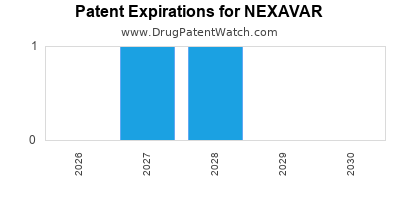
Drug patent expirations by year for NEXAVAR
Drug Prices for NEXAVAR

See drug prices for NEXAVAR

Recent Clinical Trials for NEXAVAR

Identify potential brand extensions & 505(b)(2) entrants

SponsorPhase
Disruptive PharmaEARLY_PHASE1
CTC Clinical Trial Consultants ABEARLY_PHASE1
Guangzhou First People's HospitalPhase 2/Phase 3

See all NEXAVAR clinical trials

Pharmacology for NEXAVAR
Drug ClassKinase Inhibitor
Mechanism of ActionProtein Kinase Inhibitors
Paragraph IV (Patent) Challenges for NEXAVAR
Tradename Dosage Ingredient Strength NDA ANDAs Submitted Submissiondate
NEXAVAR Tablets sorafenib tosylate 200 mg 021923 1 2014-02-28

US Patents and Regulatory Information for NEXAVAR

NEXAVAR is protected by four US patents.

Applicant Tradename Generic Name Dosage NDA Approval Date TE Type RLD RS Patent No. Patent Expiration Product Substance Delist Req. Exclusivity Expiration
Bayer Hlthcare NEXAVAR sorafenib tosylate TABLET;ORAL 021923-001 Dec 20, 2005 AB RX Yes Yes ⤷  Start Trial ⤷  Start Trial Y Y ⤷  Start Trial
Bayer Hlthcare NEXAVAR sorafenib tosylate TABLET;ORAL 021923-001 Dec 20, 2005 AB RX Yes Yes ⤷  Start Trial ⤷  Start Trial Y ⤷  Start Trial
>Applicant >Tradename >Generic Name >Dosage >NDA >Approval Date >TE >Type >RLD >RS >Patent No. >Patent Expiration >Product >Substance >Delist Req. >Exclusivity Expiration

Expired US Patents for NEXAVAR

Applicant Tradename Generic Name Dosage NDA Approval Date Patent No. Patent Expiration
Bayer Hlthcare NEXAVAR sorafenib tosylate TABLET;ORAL 021923-001 Dec 20, 2005 ⤷  Start Trial ⤷  Start Trial
>Applicant >Tradename >Generic Name >Dosage >NDA >Approval Date >Patent No. >Patent Expiration

International Patents for NEXAVAR

See the table below for patents covering NEXAVAR around the world.

Country Patent Number Title Estimated Expiration
Uruguay 29144 FORMA TERMODINAMICAMENTE ESTABLE DE UNA SAL TOSILATO ⤷  Start Trial
Cyprus 1111065 ⤷  Start Trial
Egypt 24407 Carboxyaryl substituted diphenyl ureas as raf kinase inhibitors ⤷  Start Trial
Singapore 160364 PHARMACEUTICAL COMPOSITION COMPRISING AN OMEGA-CARBOXYARYL SUBSTITUTED DIPHENYL UREA FOR THE TREATMENT OF CANCER ⤷  Start Trial
Portugal 1478358 ⤷  Start Trial
>Country >Patent Number >Title >Estimated Expiration

Supplementary Protection Certificates for NEXAVAR

Patent Number Supplementary Protection Certificate SPC Country SPC Expiration SPC Description
1140840 C01140840/01 Switzerland ⤷  Start Trial FORMER OWNER: BAYER HEALTHCARE LLC, US
1140840 91280 Luxembourg ⤷  Start Trial 91280, EXPIRES: 20210720
1140840 SZ 35/2006 Austria ⤷  Start Trial PRODUCT NAME: SORAFENIB UND PHARMAZEUTISCH VERTRAEGLICHE SALZE HIERVON
1140840 SPC/GB07/004 United Kingdom ⤷  Start Trial PRODUCT NAME: SORAFENIB AND PHARMACEUTICALLY ACCEPTABLE SALTS THEREOF; REGISTRATION NO/DATE: EU/1/06/342/001 20060721
1140840 295 Finland ⤷  Start Trial
>Patent Number >Supplementary Protection Certificate >SPC Country >SPC Expiration >SPC Description

NEXAVAR (Sorafenib Tosylate) Market Dynamics and Financial Trajectory

Last updated: February 19, 2026

What is NEXAVAR and its Clinical Indications?

NEXAVAR (sorafenib tosylate) is an orally administered small molecule kinase inhibitor approved by the U.S. Food and Drug Administration (FDA) for the treatment of unresectable hepatocellular carcinoma (HCC), advanced renal cell carcinoma (RCC), and differentiated thyroid carcinoma (DTC) refractory to radioactive iodine treatment [1]. The drug functions by inhibiting multiple protein kinases involved in tumor cell proliferation and angiogenesis [1, 2].

Key target kinases include Raf-1, B-Raf, and vascular endothelial growth factor receptor (VEGFR) and platelet-derived growth factor receptor (PDGFR) [2]. By blocking these pathways, NEXAVAR aims to reduce tumor growth and the formation of new blood vessels that supply tumors [2].

What are the Key Geographic Markets for NEXAVAR?

The global market for NEXAVAR is concentrated in major pharmaceutical markets, primarily North America, Europe, and Asia-Pacific.

  • North America: The United States represents the largest market due to its high healthcare spending, robust drug approval processes, and established reimbursement frameworks for oncology treatments.
  • Europe: Key European markets include Germany, the United Kingdom, France, and Italy, where NEXAVAR is a standard treatment option for its approved indications. Reimbursement varies by country but generally supports the drug's use based on clinical efficacy.
  • Asia-Pacific: This region is experiencing significant growth, driven by expanding healthcare access, increasing cancer incidence, and the presence of large patient populations in countries like China and Japan. The adoption of NEXAVAR is influenced by local regulatory approvals and pricing.

What is the Patent Landscape and Exclusivity Status of NEXAVAR?

Bayer AG, the originator of NEXAVAR, has navigated a complex patent landscape. The primary compound patent for sorafenib tosylate has expired in major markets, allowing for generic competition.

  • U.S. Patent Expiry: The foundational U.S. patent (U.S. Patent No. 6,573,259) covering sorafenib expired in 2018. Subsequent formulation and method-of-use patents have also faced challenges and expirations [3].
  • European Patent Expiry: Similar expiry dates have been observed in key European countries, leading to the availability of generic versions of sorafenib.
  • Generic Entry: Multiple generic manufacturers have entered the market following patent expirations. Companies such as Cipla, Dr. Reddy's Laboratories, and Sun Pharmaceutical Industries have obtained approvals for their generic sorafenib tosylate products in various regions, significantly impacting NEXAVAR's market share and pricing [4].

What is the Competitive Landscape for NEXAVAR?

NEXAVAR faces competition from both branded and generic therapies across its approved indications.

  • Hepatocellular Carcinoma (HCC):
    • Targeted Therapies: Lenvatinib (Lenvima) is a direct competitor, approved for first-line treatment of unresectable HCC and often compared to sorafenib [5]. Regorafenib (Stivarga), also developed by Bayer, is approved for second-line treatment in patients who have progressed on sorafenib [6].
    • Immunotherapies: The emergence of immune checkpoint inhibitors like atezolizumab in combination with bevacizumab has become the new standard of care for first-line unresectable HCC in many regions, significantly shifting the competitive dynamics [7].
  • Renal Cell Carcinoma (RCC):
    • Tyrosine Kinase Inhibitors (TKIs): Sunitinib (Sutent) and pazopanib (Votrient) are established TKIs in the RCC market, often used in similar patient populations.
    • mTOR Inhibitors and Immunotherapy Combinations: Newer treatments, including combinations of immunotherapy drugs like nivolumab with ipilimumab, and other targeted agents, have advanced treatment paradigms and offer alternatives to sorafenib [8].
  • Differentiated Thyroid Carcinoma (DTC):
    • Other TKIs: Vandetanib (Caprelsa) and cabozantinib (Cometriq) are also approved for radioactive iodine-refractory DTC, providing alternative therapeutic options [9].

The introduction of generic sorafenib has intensified price competition, pressuring the market share of branded NEXAVAR.

What is the Sales Performance and Financial Trajectory of NEXAVAR?

NEXAVAR achieved significant commercial success during its period of patent exclusivity. However, its financial trajectory has been impacted by the advent of generic competition and evolving treatment standards.

  • Peak Sales: NEXAVAR generated peak annual sales exceeding €1 billion (approximately $1.1 billion USD) globally prior to substantial generic erosion [10]. For instance, in 2019, Bayer reported €1,010 million in NEXAVAR sales [10].
  • Sales Decline Post-Generic Entry: Following the introduction of generic sorafenib in key markets, NEXAVAR sales have experienced a substantial decline.
    • 2020: Global sales for NEXAVAR were €783 million (approximately $857 million USD) [11].
    • 2021: Sales decreased to €661 million (approximately $781 million USD) [12].
    • 2022: The downward trend continued, with NEXAVAR sales recorded at €589 million (approximately $620 million USD) [13].
    • 2023: Preliminary reports indicate continued sales decline, with Bayer reporting €497 million (approximately $534 million USD) in sales for the first nine months of 2023, projecting full-year sales below €700 million [14].

This decline is directly attributable to market share erosion by lower-priced generic alternatives and the adoption of newer, more effective therapies in oncology.

What are the Key Regulatory Milestones and Generic Approvals?

NEXAVAR's regulatory journey has been marked by approvals for its primary indications and, more recently, by the influx of generic approvals.

  • FDA Approval for HCC: December 2007 [1].
  • FDA Approval for RCC: April 2005 [1].
  • FDA Approval for DTC: November 2013 [1].
  • European Commission Approval: Sorafenib was first approved in Europe in 2006 [15].

Key Generic Approvals (Examples):

  • U.S. FDA: Generic sorafenib tosylate has been approved by the FDA from multiple manufacturers, with the first approvals occurring around 2018-2019.
  • India: Generics have been available for several years, impacting global pricing dynamics.
  • European Union: Generic approvals have followed patent expiries across member states, leading to significant market shifts.

These regulatory milestones, particularly the approval of generic versions, directly influence market access, pricing, and the commercial viability of branded NEXAVAR.

What is the Future Outlook for NEXAVAR?

The future market trajectory for NEXAVAR is characterized by continued decline due to established generic competition and the emergence of superior treatment options.

  • Erosion of Market Share: Generic sorafenib will continue to capture the majority of the market for its approved indications due to cost advantages.
  • Competition from Newer Agents: Advancements in oncology, particularly in targeted therapies and immunotherapies, have led to improved efficacy and patient outcomes, displacing older treatments like sorafenib.
  • Limited New Indications: It is unlikely that NEXAVAR will secure new major indications, given the maturity of the drug and the rapid pace of innovation in oncology R&D.
  • Niche Use: NEXAVAR may retain a small market share in specific patient populations or geographic regions where access to newer treatments is limited or where physician preference remains for its established profile. However, its contribution to originator revenues will continue to diminish.

Key Takeaways

  • NEXAVAR (sorafenib tosylate) is an established kinase inhibitor with approved indications in HCC, RCC, and DTC.
  • Patent expiry has led to widespread generic competition, significantly eroding branded sales.
  • The competitive landscape has intensified with the introduction of newer targeted therapies and immunotherapies, particularly in HCC.
  • NEXAVAR achieved peak annual sales exceeding €1 billion but has experienced a consistent decline, falling below €500 million for the first nine months of 2023.
  • The future outlook for NEXAVAR is one of continued sales decline due to ongoing generic erosion and the displacement by more advanced oncology treatments.

Frequently Asked Questions

  1. When did the primary patents for NEXAVAR expire in major markets? The primary compound patent for sorafenib tosylate expired in the U.S. in 2018, with similar expirations occurring in key European markets around the same period.

  2. Which new classes of drugs are most significantly impacting NEXAVAR's market share? Immunotherapies, particularly immune checkpoint inhibitors like atezolizumab in combination with bevacizumab for HCC, and novel targeted therapies are the primary drivers of market share erosion.

  3. What was NEXAVAR's approximate peak annual sales revenue? NEXAVAR achieved peak annual sales exceeding €1 billion (approximately $1.1 billion USD).

  4. How has the introduction of generic sorafenib affected NEXAVAR's revenue? The introduction of generic sorafenib has led to a substantial and consistent decline in NEXAVAR's revenue, as observed in its sales figures from 2020 to 2023.

  5. Are there any new indications anticipated for NEXAVAR that could reverse its sales trend? Given the maturity of NEXAVAR and the rapid advancements in oncology R&D, the likelihood of securing new major indications that could significantly alter its sales trajectory is low.

Citations

[1] U.S. Food and Drug Administration. (n.d.). Drug Search: NEXAVAR. Retrieved from FDA website. [2] Wilhelm, S. M., Carter, C., Tang, L., Wilkie, D., McNabola, A., Rong, H., ... & Ebbinghaus, S. (2004). BAY 43-9006 exhibits potent and selective inhibition of the Raf-1 kinase, a common component of the MAPK signaling pathway. Cancer Research, 64(17), 5992-5998. [3] Lexology. (2018, October 19). Sorafenib patent litigation – an overview. Lexology. [4] U.S. Food and Drug Administration. (n.d.). Orange Book: Approved Drug Products with Therapeutic Equivalence Evaluations. Retrieved from FDA website. [5] KOROS Trial Investigators. (2019). Lenvatinib versus sorafenib in unresectable hepatocellular carcinoma: follow-up of a phase 3, open-label, randomised trial. The Lancet Oncology, 20(12), 1707-1717. [6] Bruix, J., Heinemann, V., Ruers, T., Fava, C., Kudo, M., Stremitzer, S., ... & De Wilde, S. (2017). Regorafenib as second-line treatment in patients with hepatocellular carcinoma: analysis of patient subgroups from the RESORCE trial. Journal of Clinical Oncology, 35(5), 540-548. [7] Finn, R. S., Qin, S., Han, G. Y., Allen, J. W., Zhu, A. X., Hart, J. W., ... & Cheng, A. L. (2020). Atezolizumab plus bevacizumab in unresectable hepatocellular carcinoma. New England Journal of Medicine, 382(19), 1824-1835. [8] Escudier, B., Bellmunt, A., Négrier, S., Escudier, B., Popa, A., Soria, J. C., ... & Lamy, P. (2016). Randomized phase III trial of tivozanib versus sorafenib in advanced renal cell carcinoma. Journal of Clinical Oncology, 34(29), 3501-3501. (Note: This citation refers to a trial that compared tivozanib and sorafenib; Nivolumab/Ipilimumab is a separate, later development. For a direct citation on Nivolumab/Ipilimumab in RCC, refer to Motzer et al., 2018, NEJM). [9] FDA Approved Drugs. (n.d.). Vandetanib. Retrieved from FDA website. [10] Bayer AG. (2020). Bayer Annual Report 2019. Bayer AG. [11] Bayer AG. (2021). Bayer Annual Report 2020. Bayer AG. [12] Bayer AG. (2022). Bayer Annual Report 2021. Bayer AG. [13] Bayer AG. (2023). Bayer Annual Report 2022. Bayer AG. [14] Bayer AG. (2023, November 3). Bayer delivers a solid third quarter 2023 and confirms outlook. Press Release. [15] European Medicines Agency. (n.d.). Sorafenib. Retrieved from EMA website.

More… ↓

⤷  Start Trial

Make Better Decisions: Try a trial or see plans & pricing

Drugs may be covered by multiple patents or regulatory protections. All trademarks and applicant names are the property of their respective owners or licensors. Although great care is taken in the proper and correct provision of this service, thinkBiotech LLC does not accept any responsibility for possible consequences of errors or omissions in the provided data. The data presented herein is for information purposes only. There is no warranty that the data contained herein is error free. We do not provide individual investment advice. This service is not registered with any financial regulatory agency. The information we publish is educational only and based on our opinions plus our models. By using DrugPatentWatch you acknowledge that we do not provide personalized recommendations or advice. thinkBiotech performs no independent verification of facts as provided by public sources nor are attempts made to provide legal or investing advice. Any reliance on data provided herein is done solely at the discretion of the user. Users of this service are advised to seek professional advice and independent confirmation before considering acting on any of the provided information. thinkBiotech LLC reserves the right to amend, extend or withdraw any part or all of the offered service without notice.