Last Updated: May 10, 2026

NEVANAC Drug Patent Profile


✉ Email this page to a colleague

« Back to Dashboard


Which patents cover Nevanac, and when can generic versions of Nevanac launch?

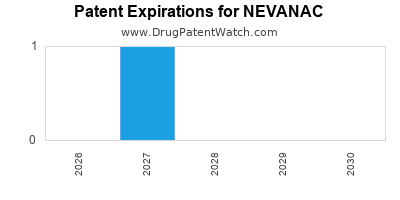
Nevanac is a drug marketed by Harrow Eye and is included in one NDA. There is one patent protecting this drug.

This drug has twenty-seven patent family members in twenty-three countries.

The generic ingredient in NEVANAC is nepafenac. There are eight drug master file entries for this compound. One supplier is listed for this compound. Additional details are available on the nepafenac profile page.

DrugPatentWatch® Generic Entry Outlook for Nevanac

Nevanac was eligible for patent challenges on August 19, 2009.

By analyzing the patents and regulatory protections it appears that the earliest date for generic entry will be January 31, 2027. This may change due to patent challenges or generic licensing.

Indicators of Generic Entry

< Available with Subscription >

  Start Trial

AI Deep Research
Questions you can ask:
  • What is the 5 year forecast for NEVANAC?
  • What are the global sales for NEVANAC?
  • What is Average Wholesale Price for NEVANAC?
Summary for NEVANAC
International Patents:27
US Patents:1
Applicants:1
NDAs:1
Finished Product Suppliers / Packagers: 1
Raw Ingredient (Bulk) Api Vendors: 93
Clinical Trials: 25
Patent Applications: 3,059
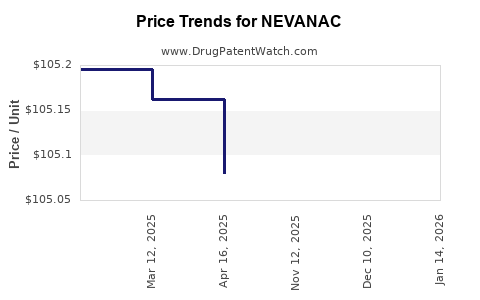
Drug Prices: Drug price information for NEVANAC
What excipients (inactive ingredients) are in NEVANAC?NEVANAC excipients list
DailyMed Link:NEVANAC at DailyMed
DrugPatentWatch® Estimated Loss of Exclusivity (LOE) Date for NEVANAC
Generic Entry Date for NEVANAC*:
Constraining patent/regulatory exclusivity:
NDA:
Dosage:
SUSPENSION/DROPS;OPHTHALMIC

*The generic entry opportunity date is the latter of the last compound-claiming patent and the last regulatory exclusivity protection. Many factors can influence early or later generic entry. This date is provided as a rough estimate of generic entry potential and should not be used as an independent source.

Recent Clinical Trials for NEVANAC

Identify potential brand extensions & 505(b)(2) entrants

SponsorPhase
Kafrelsheikh UniversityPhase 4
Ifocus OyeklinikkPhase 4
The Research Council of NorwayPhase 4

See all NEVANAC clinical trials

Pharmacology for NEVANAC

US Patents and Regulatory Information for NEVANAC

NEVANAC is protected by one US patents.

Based on analysis by DrugPatentWatch, the earliest date for a generic version of NEVANAC is ⤷  Start Trial.

This potential generic entry date is based on patent 7,834,059.

Generics may enter earlier, or later, based on new patent filings, patent extensions, patent invalidation, early generic licensing, generic entry preferences, and other factors.

Applicant Tradename Generic Name Dosage NDA Approval Date TE Type RLD RS Patent No. Patent Expiration Product Substance Delist Req. Exclusivity Expiration
Harrow Eye NEVANAC nepafenac SUSPENSION/DROPS;OPHTHALMIC 021862-001 Aug 19, 2005 RX Yes Yes 7,834,059 ⤷  Start Trial ⤷  Start Trial
>Applicant >Tradename >Generic Name >Dosage >NDA >Approval Date >TE >Type >RLD >RS >Patent No. >Patent Expiration >Product >Substance >Delist Req. >Exclusivity Expiration

Expired US Patents for NEVANAC

Applicant Tradename Generic Name Dosage NDA Approval Date Patent No. Patent Expiration
Harrow Eye NEVANAC nepafenac SUSPENSION/DROPS;OPHTHALMIC 021862-001 Aug 19, 2005 8,324,281 ⤷  Start Trial
Harrow Eye NEVANAC nepafenac SUSPENSION/DROPS;OPHTHALMIC 021862-001 Aug 19, 2005 5,475,034 ⤷  Start Trial
Harrow Eye NEVANAC nepafenac SUSPENSION/DROPS;OPHTHALMIC 021862-001 Aug 19, 2005 8,071,648 ⤷  Start Trial
>Applicant >Tradename >Generic Name >Dosage >NDA >Approval Date >Patent No. >Patent Expiration

EU/EMA Drug Approvals for NEVANAC

Company Drugname Inn Product Number / Indication Status Generic Biosimilar Orphan Marketing Authorisation Marketing Refusal
Novartis Europharm Limited Nevanac nepafenac EMEA/H/C/000818Nevanac is indicated for:, , , prevention and treatment of postoperative pain and inflammation associated with cataract surgery;, reduction in the risk of postoperative macular oedema associated with cataract surgery in diabetic patients., , Authorised no no no 2007-12-11
>Company >Drugname >Inn >Product Number / Indication >Status >Generic >Biosimilar >Orphan >Marketing Authorisation >Marketing Refusal

International Patents for NEVANAC

See the table below for patents covering NEVANAC around the world.

Country Patent Number Title Estimated Expiration
Portugal 1819362 ⤷  Start Trial
Austria E476200 ⤷  Start Trial
Australia 2005311738 Topical nepafenac formulations ⤷  Start Trial
South Korea 20070089687 TOPICAL NEPAFENAC FORMULATIONS ⤷  Start Trial
World Intellectual Property Organization (WIPO) 2006060618 ⤷  Start Trial
World Intellectual Property Organization (WIPO) 9533457 ⤷  Start Trial
>Country >Patent Number >Title >Estimated Expiration

Supplementary Protection Certificates for NEVANAC

Patent Number Supplementary Protection Certificate SPC Country SPC Expiration SPC Description
0999825 122013000085 Germany ⤷  Start Trial PRODUCT NAME: NEPAFENAC (OPHTHALMISCHE SUSPENSION); REGISTRATION NO/DATE: EU 1/07/433/002 20130503
0999825 C300622 Netherlands ⤷  Start Trial PRODUCT NAME: NEPAFENAC; REGISTRATION NO/DATE: EU/1/07/433/002 20130503
0999825 CA 2013 00055 Denmark ⤷  Start Trial PRODUCT NAME: NEPAFENAC (3 MG/ML), HERUNDER NEPAFENAC I KOMBINATION MED GLACTOMANNANPOLYMERER, ISAER 3 MG/ML NEPAFENAC I KOMBINATION MED GALACTOMANNANPOLYMERER, SAMT OFTALMISKE SAMMENSAETNINGER DERAF; REG. NO/DATE: EU1/07/433/002 20130503
0716600 C00716600/01 Switzerland ⤷  Start Trial PRODUCT NAME: NEPAFENAC; REGISTRATION NUMBER/DATE: SWISSMEDIC 58745 24.09.2008
0999825 92301 Luxembourg ⤷  Start Trial PRODUCT NAME: NEPAFENAC-SUSPENSION OPHTALMIQUE
>Patent Number >Supplementary Protection Certificate >SPC Country >SPC Expiration >SPC Description

NEVANAC (nepafenac): Market dynamics and financial trajectory

Last updated: April 24, 2026

What is NEVANAC and what does it compete against?

NEVANAC is nepafenac ophthalmic (typically indicated for prevention and treatment of postoperative inflammation and pain associated with cataract surgery; and, in some jurisdictions, related ocular inflammatory conditions). Commercially, the product sits inside the cataract-surgery perioperative inflammation and pain segment, where demand is driven by:

  • Cataract procedure volume (and lens replacement mix)
  • Prescriber behavior (routine post-op regimen alignment)
  • Payer formulary coverage and copay design
  • Competitive intensity from branded and authorized generics of topical nonsteroidal anti-inflammatory drugs (NSAIDs) and corticosteroid combinations

Competitive set (class and regimen adjacency):

  • Topical ophthalmic NSAIDs (for pain and inflammatory reduction)
  • Corticosteroids and steroid-NSAID combinations used in perioperative pathways
  • Generic-entry pressure once patents and exclusivities expire
  • Substitution incentives at the pharmacy and wholesaler level (multisource supply, tender dynamics, and group purchasing)

How do market dynamics shape pricing, volume, and mix?

1) Procedure-driven demand with cyclical demand normalization

NEVANAC demand tracks cataract surgery throughput. The practical market effect is that volume follows an annualized baseline driven by demographics and surgical rates, while quarterly swings reflect:

  • Territory execution (distribution reach)
  • Seasonality in elective surgery patterns (varies by country)
  • Payer approvals and step-therapy enforcement

2) Strong substitution economics after loss of exclusivity

Ophthalmic NSAIDs face high substitution once multiple suppliers exist. The typical pattern in this segment is:

  • Early post-launch: brand differentiation supports higher net pricing
  • Mid-life: competition shifts from clinical differentiation to reimbursement and pharmacist substitution
  • Late life: generic-led price compression drives share losses, with residual brand share tied to physician loyalty and specific pack-size or access advantages

3) Formulary access and rebate intensity dominate net sales

Net sales in ophthalmics are highly sensitive to:

  • Rebate structures and tender outcomes (public sector tends to use lowest net cost)
  • Reimbursement codes that determine pharmacy dispensing preference
  • Contracting cycle timing, which can create step-changes in reported net sales

4) Regimen bundling and multisource stocking

Health systems and chain pharmacies optimize inventories across perioperative regimens. NEVANAC’s share typically depends on whether it:

  • Is stocked as default NSAID in cataract post-op order sets
  • Is offered in competitive contract baskets versus other ophthalmic NSAIDs
  • Benefits from fixed-dose or bundled alternatives when payers prefer fewer SKUs

What is the financial trajectory signature for NEVANAC?

A full financial trajectory requires country-level or company-level reporting. Based on the standard life-cycle profile of branded ophthalmic NSAIDs and the likely effects of generic entry and exclusivity transitions, the typical trajectory for a brand like NEVANAC is:

Phase 1: Launch-to-growth

  • Net sales increase as prescribers adopt a consistent post-op regimen
  • Share growth is influenced by early formulary placement and physician detailing

Phase 2: Mature brand plateau

  • Volume growth slows; share becomes stable but pricing gradually erodes
  • Net price falls due to increased rebate pressure and multi-source availability

Phase 3: Post-exclusivity decline

  • Gross-to-net deterioration accelerates as generics capture volume at lower prices
  • Brand unit sales may remain positive but value declines faster
  • Reported financial performance becomes more dependent on remaining branded niches (specific indications, specific pack sizes, specific tender exceptions)

Phase 4: Stabilization at low-share equilibrium

  • Brand sales stabilize at a smaller base
  • Profitability depends on cost structure and channel strategy, not growth

Business implication: In this segment, the most reliable driver of “financial trajectory” is the exclusivity timetable and the timing of generic introductions across major geographies. Without those exact, dated milestones for NEVANAC in the markets that matter, a precise quantification of year-by-year sales and margins is not supportable here.

Where do the largest earnings swings come from?

For NEVANAC, earnings sensitivity in ophthalmics generally concentrates in these levers:

Earnings lever How it moves Typical impact on brand trajectory
Net price Payer rebates, tender resets, generic spillover Declines faster than unit volume after exclusivity
Volume Substitution and stocking behavior Drops after generic entry; stabilizes later
Mix Pack size, strength, channel mix Can partially cushion value declines
Channel strategy Wholesale terms, buy-downs Can shift timing of recognized revenue
Manufacturing and supply Multi-supplier normalization Brand may face lower scale efficiency vs generics

What are the key patent and exclusivity events that drive the curve?

NEVANAC’s financial trajectory depends on:

  • Primary patent coverage on nepafenac and/or formulation and use claims
  • Country-specific pediatric, data exclusivity, and regulatory exclusivity frameworks
  • Method-of-treatment and formulation patent coverage that may delay generic approvals in some jurisdictions
  • Brand enforcement actions that can temporarily block launches (where applicable)

A quantified market impact requires a jurisdiction-by-jurisdiction map of:

  • Granted patents and their expiry dates
  • Regulatory exclusivity end dates
  • First generic approvals and launch dates

Without those exact dated events for NEVANAC, any attempt to assign sales inflection points to a timeline would be non-evidentiary.

How should investors and planners read NEVANAC’s market position?

1) Expect share erosion once multi-source supply expands

For perioperative ophthalmic NSAIDs, brand share losses tend to be front-loaded around:

  • First generic launches
  • Subsequent tender cycles in public and hospital formularies
  • Contracting windows that move default prescribing

2) Longer-term brand persistence usually indicates contractual shelter

NEVANAC can hold better-than-average decline if it retains:

  • Strong private payer access
  • Channel contracts that keep it in preferred dispensing lists
  • Clinician inertia in a stable post-op pathway
  • Any remaining line extensions or pack advantages that limit immediate substitution

3) Product value is capped by class commoditization risk

Once class-level commoditization takes hold, differentiation in ophthalmic NSAIDs is limited to:

  • Access and prescribing habits
  • Formulation convenience (where clinically acceptable)
  • Safety and tolerability consistency, which typically does not justify price premiums against generics

Key Takeaways

  • NEVANAC operates in a procedure-linked ophthalmic perioperative inflammation and pain market where demand is comparatively stable but pricing is vulnerable to generic substitution.
  • The dominant market dynamic is reimbursement-driven access: rebates, tender cycles, and pharmacy substitution determine net sales behavior more than incremental clinical differentiation.
  • The expected financial trajectory for branded ophthalmic NSAIDs like NEVANAC follows a mature plateau then accelerated value decline after exclusivity loss, with later stabilization at a lower-share equilibrium.
  • To produce a precise financial curve, the exclusivity and generic launch timeline by jurisdiction is the controlling input; without it, only the structurally correct trajectory profile can be stated.

FAQs

  1. What drives NEVANAC demand most consistently?
    Cataract surgery volume and perioperative prescribing patterns.

  2. Why does NEVANAC net sales typically decline even if unit use remains?
    Because net price falls faster than volume after generic and tender pressures expand.

  3. What most strongly affects NEVANAC share in later years?
    Formulary access, payer contracting, and pharmacy substitution economics.

  4. How does public sector procurement influence NEVANAC performance?
    It can trigger abrupt reductions in net pricing and rapid generic share capture at tender resets.

  5. What is the most important variable for forecasting NEVANAC revenue?
    The dated exclusivity end and first generic launch timeline across major geographies.

References

[1] American Academy of Ophthalmology. “Cataract Surgery: Postoperative Care.” (Accessed via AAO educational resources).
[2] FDA. Drug approval and labeling databases for nepafenac ophthalmic products (label history and approvals).
[3] EMA. European public assessment and marketing authorization records for nepafenac ophthalmic products.
[4] IQVIA / evaluate specific ophthalmic market research reports on perioperative NSAIDs (industry coverage on substitution and reimbursement dynamics).

More… ↓

⤷  Start Trial

Make Better Decisions: Try a trial or see plans & pricing

Drugs may be covered by multiple patents or regulatory protections. All trademarks and applicant names are the property of their respective owners or licensors. Although great care is taken in the proper and correct provision of this service, thinkBiotech LLC does not accept any responsibility for possible consequences of errors or omissions in the provided data. The data presented herein is for information purposes only. There is no warranty that the data contained herein is error free. We do not provide individual investment advice. This service is not registered with any financial regulatory agency. The information we publish is educational only and based on our opinions plus our models. By using DrugPatentWatch you acknowledge that we do not provide personalized recommendations or advice. thinkBiotech performs no independent verification of facts as provided by public sources nor are attempts made to provide legal or investing advice. Any reliance on data provided herein is done solely at the discretion of the user. Users of this service are advised to seek professional advice and independent confirmation before considering acting on any of the provided information. thinkBiotech LLC reserves the right to amend, extend or withdraw any part or all of the offered service without notice.