Last updated: September 1, 2026
Nateglinide is an off-patent oral antidiabetic marketed originally as Starlix by Novartis. Its commercial trajectory follows the standard lifecycle of a short-acting insulin secretagogue: initial branded adoption, rapid erosion after generic entry, and continued low-cost use in selected type 2 diabetes patients. The product has limited growth potential because newer therapies offer stronger cardiovascular, renal, weight, and hypoglycemia advantages.
Nateglinide remains commercially relevant as a generic drug, but it is no longer a major branded revenue contributor. Public filings do not generally disclose current nateglinide revenue separately. Its value is concentrated in low-cost generic supply, established regulatory dossiers, and niche prescribing rather than proprietary pricing power.
What is nateglinide and how is it used?
Nateglinide is an oral meglitinide insulin secretagogue used with diet and exercise to improve glycemic control in adults with type 2 diabetes. It stimulates rapid, short-duration insulin release from pancreatic beta cells, primarily around mealtimes.
The U.S. product was originally approved as Starlix tablets in 60 mg and 120 mg strengths. The labeled regimen is generally taken before meals, with dosing adjusted according to glycemic response and meal patterns (U.S. Food and Drug Administration [FDA], 2000).
What is nateglinide’s therapeutic positioning?
Nateglinide has several clinical characteristics:
| Attribute |
Nateglinide profile |
| Drug class |
Meglitinide |
| Primary use |
Type 2 diabetes |
| Administration |
Oral, before meals |
| Original brand |
Starlix |
| Original sponsor |
Novartis |
| U.S. approval |
2000 |
| Main pharmacology |
Short-acting insulin secretion |
| Generic status |
Available |
| Biosimilar relevance |
None |
| Principal commercial weakness |
Inferior strategic position versus newer diabetes therapies |
Nateglinide can be useful for patients who require flexible mealtime dosing or who cannot tolerate certain other glucose-lowering agents. Its short action may reduce prolonged insulin stimulation compared with some sulfonylureas, although hypoglycemia remains a relevant risk.
The principal limitation is that nateglinide does not provide the outcome benefits associated with newer classes such as SGLT2 inhibitors and GLP-1 receptor agonists. It also lacks the weight-loss profile of GLP-1 therapies and does not provide the broad cardiovascular and renal positioning now used by leading diabetes products.
When did nateglinide lose market exclusivity?
Nateglinide lost meaningful U.S. market exclusivity after expiration of its core composition-of-matter patent and the subsequent emergence of generic competition. Starlix was approved in 2000, while the principal U.S. patent estate originated from early 1990s filings.
What patents protected Starlix and nateglinide?
The principal early U.S. patent associated with nateglinide is U.S. Patent No. 5,463,068, covering benzoic-acid derivatives, including nateglinide-related compounds. The patent was issued in 1995 and had an ordinary 20-year term measured from the relevant filing date, placing expiration in the early 2010s. FDA Orange Book records and patent-term rules determine the operative listed expiration for each approved product and patent family (FDA, 2024a; U.S. Patent and Trademark Office [USPTO], 2024).
The commercial protection package also included later patents relating to formulations, pharmaceutical compositions, and methods of treatment. Those patents did not preserve substantial long-term exclusivity once generic applicants were able to challenge or design around the remaining listed claims.
| Patent category |
Commercial role |
Current impact |
| Composition-of-matter claims |
Protected the active compound and related chemical class |
Expired or no longer commercially controlling |
| Pharmaceutical composition claims |
Covered tablet formulations or compositions |
Limited post-generic protection |
| Method-of-use claims |
Covered treatment of type 2 diabetes or glucose control |
Narrower enforcement value |
| Manufacturing claims |
Covered preparation or process technology |
Potential supplier barrier, but not a broad market barrier |
The exact Orange Book listing and expiration status should be assessed by product and patent number rather than inferred from the original approval date. The central business conclusion remains unchanged: nateglinide is an off-patent small molecule with no active U.S. composition-of-matter exclusivity supporting premium pricing.
What is the FDA regulatory status of nateglinide?
Nateglinide is an FDA-approved small-molecule drug. It is not a biologic and therefore does not use the biosimilar pathway.
What is the Orange Book status of nateglinide?
The Orange Book historically listed Starlix and associated patent information. Generic nateglinide products are approved through abbreviated new drug applications, or ANDAs, relying on the reference product’s safety and efficacy findings (FDA, 2024a; FDA, 2024b).
Current regulatory characteristics include:
- FDA-approved oral tablets.
- Generic approval through the ANDA pathway.
- No biosimilar or interchangeable-biologic pathway.
- No meaningful remaining new chemical entity exclusivity.
- Labeling centered on glycemic control in adults with type 2 diabetes.
- Generic substitution governed by state pharmacy law and product-specific FDA ratings.
Nateglinide’s regulatory burden is lower than that of biologics or complex injectables. The principal requirements are manufacturing compliance, bioequivalence, stability, dissolution, quality control, and consistent active pharmaceutical ingredient supply.
How many patents currently cover nateglinide?
Nateglinide may remain associated with historical patents, formulation claims, foreign rights, and manufacturing filings, but the number of documents in a patent family does not equal enforceable commercial exclusivity.
A practical assessment is:
| Protection layer |
Current commercial strength |
| Core molecule |
Low; historical patents expired |
| Standard immediate-release tablets |
Low |
| Novel formulation opportunities |
Potentially moderate if supported by new clinical or pharmacokinetic data |
| Manufacturing process |
Moderate in a narrow supplier-specific context |
| Method of treatment |
Low to moderate, depending on claim scope and jurisdiction |
| U.S. generic blocking power |
Low |
Nateglinide is not an attractive target for conventional life-cycle management unless a sponsor can establish a clinically meaningful advantage, such as reduced hypoglycemia, less frequent dosing, improved adherence, or a new delivery profile. A patent on a routine tablet reformulation would face substantial obviousness and commercial-adoption risk.
What generic entry risks exist for nateglinide?
Generic entry risk is already realized rather than prospective. The market has moved from a single branded product to multiple low-price suppliers.
Which companies have challenged or replaced Starlix?
Generic competition has historically included manufacturers such as Teva, Mylan/Viatris, and other ANDA sponsors, depending on strength, market period, and distribution channel. Generic availability should be verified by current FDA product records and commercial wholesaler listings because approvals, discontinuations, and supply status change over time.
The likely generic-entry pattern was:
- ANDA filings challenged remaining listed patents or relied on patent expiration.
- First generic approval created sharp price pressure.
- Additional approvals reduced the value of first-mover status.
- Pharmacy substitution shifted volume away from Starlix.
- The market became procurement-driven, with price and supply reliability determining share.
What is the litigation status for nateglinide?
Nateglinide is not associated with a current, high-value U.S. patent litigation campaign comparable to litigation involving major branded oncology, immunology, or diabetes products. Any historical Paragraph IV disputes would have had their main commercial effect before or around generic launch.
The relevant litigation risk today is operational rather than exclusionary:
- ANDA patent certification disputes involving residual listed patents.
- Product liability claims related to hypoglycemia or prescribing.
- Manufacturing and quality enforcement.
- Supply interruptions affecting generic manufacturers.
- False-marking or patent-infringement exposure for narrow formulation claims.
There is no material biosimilar litigation risk because nateglinide is a chemically synthesized small molecule.
What formulations are protected by nateglinide patents?
The original commercial product is an immediate-release oral tablet. Formulation protection historically provided secondary barriers but did not create durable market exclusivity after the core compound patents expired.
Potential formulation concepts include:
- Immediate-release tablets.
- Modified-release or extended-release tablets.
- Fixed-dose combinations with other antidiabetic agents.
- Orally disintegrating tablets.
- Improved dissolution or stability formulations.
- Patient-specific dosing systems.
These approaches face a difficult commercial test. Nateglinide is already inexpensive and used in a mature market. A new formulation would require clinical evidence showing a meaningful benefit over low-cost generic tablets. A marginal convenience improvement is unlikely to support substantial pricing.
How does nateglinide compare with competing diabetes drugs?
Nateglinide competes across several therapeutic and economic dimensions.
| Drug class |
Examples |
Advantages over nateglinide |
Disadvantages relative to nateglinide |
| Metformin |
Generic metformin |
Lower cost, broad first-line use, established outcomes |
Gastrointestinal intolerance |
| Sulfonylureas |
Glimepiride, gliclazide, glipizide |
Very low cost, durable familiarity |
Longer hypoglycemia exposure, weight gain |
| DPP-4 inhibitors |
Sitagliptin, linagliptin |
Convenient once-daily dosing, low hypoglycemia risk |
Higher cost; limited weight effect |
| SGLT2 inhibitors |
Empagliflozin, dapagliflozin |
Cardiovascular and renal benefits |
Higher cost, genital infections, volume effects |
| GLP-1 receptor agonists |
Semaglutide, dulaglutide |
Weight loss and strong glucose lowering |
Injection or specialized oral dosing, high cost |
| Insulin |
Multiple products |
Strong glucose-lowering capacity |
Hypoglycemia, injections, monitoring burden |
| Nateglinide |
Generic nateglinide |
Flexible mealtime dosing, low generic cost |
Multiple daily doses, hypoglycemia, no major outcome advantage |
Nateglinide’s most defensible niche is price-sensitive treatment where mealtime flexibility matters and newer agents are inaccessible, contraindicated, or not reimbursed. Its competitive position is weak in premium and outcomes-based formularies.
What is the market size and financial trajectory for nateglinide?
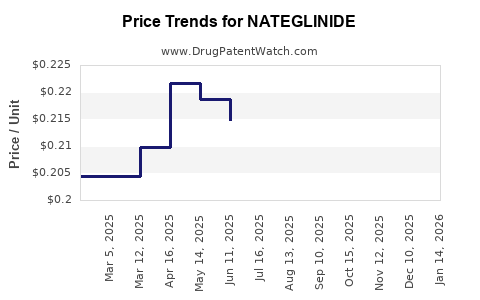
Public company filings generally do not report nateglinide revenue as a separate current product line. The product’s financial trajectory can therefore be assessed through lifecycle economics rather than a reliable standalone global revenue figure.
How did nateglinide revenue change after generic entry?
The expected revenue curve was:
| Lifecycle period |
Commercial condition |
Financial effect |
| 2000 to pre-generic period |
Starlix launch and branded prescribing |
Revenue growth from new product adoption |
| Late branded period |
Competition from metformin, sulfonylureas, and newer agents |
Slower growth and declining strategic priority |
| Generic-entry period |
ANDA approvals and pharmacy substitution |
Rapid price and share erosion |
| Mature generic period |
Multiple suppliers and commodity pricing |
Low unit economics, stable niche volume |
| Current market |
Generic maintenance use |
Limited revenue growth, supply-chain driven |
The commercial decline began before generic entry because diabetes treatment increasingly shifted toward agents with better convenience, lower hypoglycemia risk, weight benefits, or cardiovascular and renal outcomes. Genericization then accelerated price erosion.
For the original innovator, nateglinide’s financial value declined through:
- Loss of price control.
- Reduced physician differentiation.
- Pharmacy substitution.
- Portfolio deprioritization.
- Competition from newer Novartis and non-Novartis products.
- Lower promotional return on investment.
For generic manufacturers, value depends on volume, contract access, manufacturing cost, and supply reliability. Nateglinide is unlikely to support high-margin growth unless a supplier achieves temporary market concentration through competitor exits or shortages.
What revenue exposure does nateglinide create for manufacturers?
Nateglinide has low revenue exposure for diversified pharmaceutical companies. A product-specific manufacturing interruption could affect patients and contracted volume, but it is unlikely to materially affect the financial results of a large diversified drug company.
The highest exposure exists for:
- Small generic companies with concentrated portfolios.
- API manufacturers dependent on limited customers.
- Contract manufacturers with dedicated tablet capacity.
- Distributors carrying narrow diabetes inventories.
The lowest exposure exists for multinational companies whose diabetes revenue is concentrated in GLP-1, SGLT2, insulin, or other higher-value products.
How strong is the nateglinide patent estate?
The patent estate is weak for market-exclusion purposes and moderate only for narrow technical claims.
What are the main patent-strength factors?
| Factor |
Assessment |
| Patent age |
Old |
| Core composition claims |
Expired or commercially exhausted |
| Generic substitution risk |
High |
| Formulation differentiation |
Possible but difficult to monetize |
| Method-of-use protection |
Narrow and vulnerable to design-around |
| Manufacturing barriers |
Supplier-specific rather than market-wide |
| Litigation leverage |
Low |
| Licensing leverage |
Low |
| Geographic variation |
Material, especially outside the U.S. |
| New product potential |
Limited without clinical differentiation |
A new entrant should not assume that historical Starlix patents block generic or reformulated development. Patent-family review must separate expired U.S. rights from active foreign rights, abandoned applications, and claims that do not cover the intended dosage form.
What licensing deals affect nateglinide?
No major current licensing transaction is central to the nateglinide market. The product was historically commercialized under Novartis ownership and distribution arrangements, but it is now primarily a generic procurement product.
Potential transaction value is concentrated in:
- ANDA assets.
- Regional marketing rights.
- API supply agreements.
- Contract manufacturing.
- Authorized-generic arrangements.
- Distribution contracts.
A licensing deal involving nateglinide would likely be tactical rather than a major platform transaction. Its rationale would depend on manufacturing efficiency, geographic access, or portfolio bundling rather than patent exclusivity.
What geographic markets still matter for nateglinide?
Nateglinide’s commercial status varies by jurisdiction. Patent expiry, generic approval, reimbursement, local treatment guidelines, and brand discontinuation differ across markets.
Where is nateglinide most commercially defensible?
The product is most likely to retain demand in markets where:
- Generic drug prices are low.
- Diabetes formularies remain cost-sensitive.
- Primary-care physicians continue using older oral agents.
- Access to GLP-1 or SGLT2 therapies is restricted.
- Treatment guidelines preserve a role for short-acting secretagogues.
- Local manufacturers can supply low-cost tablets.
Its prospects are weaker in markets with rapid uptake of newer diabetes therapies and aggressive cardiovascular-risk management.
Geographic diligence should review:
- Active national marketing authorizations.
- Local patent registers.
- Reimbursement status.
- Brand versus generic share.
- Local manufacturing requirements.
- Import restrictions.
- Tender pricing.
- Pharmacovigilance obligations.
What generic launch scenarios are plausible for nateglinide?
Because generic entry has already occurred, the relevant scenarios concern mature-market behavior.
Scenario 1: Stable low-price generic market
Multiple manufacturers maintain supply, prices remain low, and nateglinide retains a small maintenance share in type 2 diabetes.
Scenario 2: Supplier consolidation
Manufacturers exit because of low margins, leaving fewer suppliers. Prices may rise temporarily, but the product remains structurally commoditized.
Scenario 3: Temporary shortage-driven pricing
A manufacturing or API disruption creates short-term scarcity. Competitors with available inventory gain volume and may obtain temporary pricing leverage.
Scenario 4: Continued therapeutic displacement
Prescribing shifts further toward SGLT2 inhibitors, GLP-1 receptor agonists, DPP-4 inhibitors, and combination products. Nateglinide volume declines gradually even if generic supply remains available.
The most probable long-term case is gradual volume erosion with intermittent supply-driven volatility and no return to branded-style margins.
Key Takeaways
- Nateglinide is an FDA-approved, off-patent oral antidiabetic marketed originally as Starlix.
- Its core commercial exclusivity expired in the early 2010s, and generic competition is established.
- The product has no biosimilar risk because it is a chemically synthesized small molecule.
- Current patent strength is low for broad market exclusion and limited to narrow formulation, method, or manufacturing claims.
- Public companies generally do not disclose current nateglinide revenue separately.
- The financial trajectory is one of branded decline followed by low-margin generic maturity.
- Nateglinide competes primarily on price and flexible mealtime dosing.
- SGLT2 inhibitors and GLP-1 receptor agonists have displaced it in higher-value treatment segments because of superior outcome and weight-management positioning.
- Licensing and acquisition value is limited unless tied to manufacturing, regional distribution, or portfolio consolidation.
- The principal current risks are generic price erosion, therapeutic substitution, supplier exits, and supply interruptions.
FAQs About Nateglinide Patents, Revenue, and Market Competition
Is nateglinide still sold under the Starlix brand?
Starlix is no longer a major branded commercial product in the U.S. market. Nateglinide is primarily encountered through generic products and regional commercial arrangements.
Can a company obtain new patents on nateglinide?
Yes, a company may seek patents on a genuinely novel formulation, dosing method, combination, manufacturing process, or delivery system. The claims would need to satisfy novelty, nonobviousness, enablement, and written-description requirements.
Does nateglinide have pediatric exclusivity?
Nateglinide was approved for adult type 2 diabetes treatment. No significant current pediatric exclusivity period drives its commercial status.
Is nateglinide a substitute for semaglutide or empagliflozin?
It is not a therapeutic equivalent in clinical positioning. Nateglinide is a low-cost oral insulin secretagogue, while semaglutide and empagliflozin have broader weight, cardiovascular, or renal value propositions in appropriate patients.
What is the biggest investment risk in the nateglinide market?
The biggest risk is structural obsolescence rather than patent litigation. Low pricing, limited differentiation, declining use of older secretagogues, and competition from outcome-oriented diabetes therapies constrain revenue growth.
References
-
U.S. Food and Drug Administration. (2000). Starlix (nateglinide) prescribing information and approval materials. FDA Drugs@FDA.
-
U.S. Food and Drug Administration. (2024a). Approved drug products with therapeutic equivalence evaluations. FDA Orange Book.
-
U.S. Food and Drug Administration. (2024b). Approved drug products database and abbreviated new drug application guidance. FDA.
-
U.S. Food and Drug Administration. (2024c). Nateglinide tablet labeling. DailyMed.
-
U.S. Patent and Trademark Office. (2024). Patent term adjustment and patent term calculation guidance. USPTO.
-
American Diabetes Association Professional Practice Committee. (2024). 9. Pharmacologic approaches to glycemic treatment: Standards of care in diabetes. Diabetes Care, 47(Supplement 1).