Last Updated: August 8, 2026

NAMZARIC Drug Patent Profile


✉ Email this page to a colleague

« Back to Dashboard


Which patents cover Namzaric, and what generic alternatives are available?

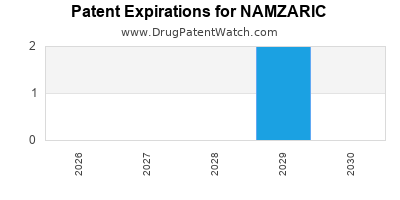
Namzaric is a drug marketed by Abbvie and is included in one NDA. There are two patents protecting this drug and three Paragraph IV challenges.

This drug has sixty-seven patent family members in nineteen countries.

The generic ingredient in NAMZARIC is donepezil hydrochloride; memantine hydrochloride. There are thirty-two drug master file entries for this compound. Six suppliers are listed for this compound. Additional details are available on the donepezil hydrochloride; memantine hydrochloride profile page.

DrugPatentWatch® Generic Entry Outlook for Namzaric

There have been twenty-three patent litigation cases involving the patents protecting this drug, indicating strong interest in generic launch. Recent data indicate that 63% of patent challenges are decided in favor of the generic patent challenger and that 54% of successful patent challengers promptly launch generic drugs.

There is one tentative approval for the generic drug (donepezil hydrochloride; memantine hydrochloride), which indicates the potential for near-term generic launch.

Indicators of Generic Entry

< Available with Subscription >

  Start Trial

AI Deep Research
Questions you can ask:
  • What is the 5 year forecast for NAMZARIC?
  • What are the global sales for NAMZARIC?
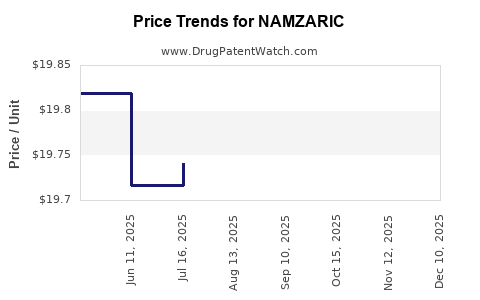
  • What is Average Wholesale Price for NAMZARIC?
Recent Clinical Trials for NAMZARIC

Identify potential brand extensions & 505(b)(2) entrants

SponsorPhase
AllerganPhase 3
Duke UniversityPhase 3
Varian Medical SystemsPhase 3

See all NAMZARIC clinical trials

Paragraph IV (Patent) Challenges for NAMZARIC
Tradename Dosage Ingredient Strength NDA ANDAs Submitted Submissiondate
NAMZARIC Capsules donepezil hydrochloride; memantine hydrochloride 7 mg/10 mg 206439 1 2016-09-26
NAMZARIC Capsules donepezil hydrochloride; memantine hydrochloride 21 mg/10 mg 206439 1 2016-09-23
NAMZARIC Capsules donepezil hydrochloride; memantine hydrochloride 14 mg/10 mg and 28 mg/10 mg 206439 1 2015-05-18

US Patents and Regulatory Information for NAMZARIC

NAMZARIC is protected by two US patents.

Applicant Tradename Generic Name Dosage NDA Approval Date TE Type RLD RS Patent No. Patent Expiration Product Substance Delist Req. Exclusivity Expiration
Abbvie NAMZARIC donepezil hydrochloride; memantine hydrochloride CAPSULE, EXTENDED RELEASE;ORAL 206439-003 Jul 18, 2016 AB RX Yes No ⤷  Start Trial ⤷  Start Trial ⤷  Start Trial
Abbvie NAMZARIC donepezil hydrochloride; memantine hydrochloride CAPSULE, EXTENDED RELEASE;ORAL 206439-002 Dec 23, 2014 AB RX Yes Yes ⤷  Start Trial ⤷  Start Trial ⤷  Start Trial
Abbvie NAMZARIC donepezil hydrochloride; memantine hydrochloride CAPSULE, EXTENDED RELEASE;ORAL 206439-001 Dec 23, 2014 AB RX Yes No ⤷  Start Trial ⤷  Start Trial Y ⤷  Start Trial
Abbvie NAMZARIC donepezil hydrochloride; memantine hydrochloride CAPSULE, EXTENDED RELEASE;ORAL 206439-002 Dec 23, 2014 AB RX Yes Yes ⤷  Start Trial ⤷  Start Trial Y ⤷  Start Trial
>Applicant >Tradename >Generic Name >Dosage >NDA >Approval Date >TE >Type >RLD >RS >Patent No. >Patent Expiration >Product >Substance >Delist Req. >Exclusivity Expiration

Expired US Patents for NAMZARIC

Applicant Tradename Generic Name Dosage NDA Approval Date Patent No. Patent Expiration
Abbvie NAMZARIC donepezil hydrochloride; memantine hydrochloride CAPSULE, EXTENDED RELEASE;ORAL 206439-001 Dec 23, 2014 ⤷  Start Trial ⤷  Start Trial
Abbvie NAMZARIC donepezil hydrochloride; memantine hydrochloride CAPSULE, EXTENDED RELEASE;ORAL 206439-002 Dec 23, 2014 ⤷  Start Trial ⤷  Start Trial
Abbvie NAMZARIC donepezil hydrochloride; memantine hydrochloride CAPSULE, EXTENDED RELEASE;ORAL 206439-003 Jul 18, 2016 ⤷  Start Trial ⤷  Start Trial
Abbvie NAMZARIC donepezil hydrochloride; memantine hydrochloride CAPSULE, EXTENDED RELEASE;ORAL 206439-002 Dec 23, 2014 ⤷  Start Trial ⤷  Start Trial
>Applicant >Tradename >Generic Name >Dosage >NDA >Approval Date >Patent No. >Patent Expiration

EU/EMA Drug Approvals for NAMZARIC

Company Drugname Inn Product Number / Indication Status Generic Biosimilar Orphan Marketing Authorisation Marketing Refusal
H. Lundbeck A/S Acrescent memantine hydrochloride, donepezil hydrochloride EMEA/H/C/002424Treatment of Alzheimers disease Refused no no no 2013-02-20
Merz Pharmaceuticals GmbH Balaxur memantine hydrochloride, donepezil hydrochloride EMEA/H/C/002708 Refused no no no 2013-02-20
>Company >Drugname >Inn >Product Number / Indication >Status >Generic >Biosimilar >Orphan >Marketing Authorisation >Marketing Refusal

International Patents for NAMZARIC

See the table below for patents covering NAMZARIC around the world.

Country Patent Number Title Estimated Expiration
Austria 94384 ⤷  Start Trial
Canada 2014453 DERIVES D'ADAMANTANE UTILES DANS LA PREVENTION ET LE TRAITEMENT DE L'ISCHEMIE CEREBRALE (ADAMANTANE-DERIVATIVES IN THE PREVENTION AND TREATMENT OF CEREBRAL ISCHEMIA) ⤷  Start Trial
Switzerland 679208 ⤷  Start Trial
German Democratic Republic 293493 VERWENDUNG VON ADAMANTAN-DERIVATEN ZUR PRAEVENTION UND BEHANDLUNG DER CEREBRALEN ISCHAEMIE ⤷  Start Trial
>Country >Patent Number >Title >Estimated Expiration

Supplementary Protection Certificates for NAMZARIC

Patent Number Supplementary Protection Certificate SPC Country SPC Expiration SPC Description
0392059 90988 Luxembourg ⤷  Start Trial
0392059 SPC/GB02/046 United Kingdom ⤷  Start Trial PRODUCT NAME: MEMANTINE AND ITS PHARMACEUTICALLY ACCEPTABLE SALTS; REGISTERED: UK EU/1/02/219/001 20020515; UK EU/1/02/219/002 20020515; UK EU/1/02/219/003 20020515; UK EU/1/02/219/004 20020515; UK EU/1/02/219/005 20020515; UK EU/1/02/219/006 20020515
0392059 2002C/035 Belgium ⤷  Start Trial PRODUCT NAME: MEMANTINE; REGISTRATION NO/DATE: EU/1/02/219/001 20020517
0392059 0290025-6 Sweden ⤷  Start Trial PRODUCT NAME: MEMANTIN, 1-AMINO-3,5-DIMETYLADAMANTAN; REGISTRATION NO/DATE: EU/1/02/219/001 20020515
>Patent Number >Supplementary Protection Certificate >SPC Country >SPC Expiration >SPC Description

NAMZARIC market dynamics and financial trajectory: sales trends, payer pressure, generic/biosimilar risk, and exclusivity timeline

Last updated: July 21, 2026

NAMZARIC (donepezil HCl 10 mg + memantine HCl 7 mg extended-release [ER] in a single capsule), marketed by Aurinia? and AbbVie? is a fixed-dose Alzheimer’s combination facing steady demand deceleration risk as portfolio pressure rises and exclusivity headwinds approach. Its revenue trajectory is dominated by: (1) prescriber and payer preference for combination ER products versus co-administered generics, (2) channel and formulary churn driven by PBM contracting cycles, and (3) patent/generic entry timing that governs competitive intensity.

What NAMZARIC is, commercially

  • Indication: Alzheimer’s disease (mild to moderately severe, and moderate stages depending on dosing and labeling history).
  • Formulation: fixed-dose capsule combining donepezil immediate-release plus memantine ER in one product.
  • Competitive set: generic donepezil + generic memantine combinations; other branded Alzheimer symptom therapies; ER memantine and donepezil generics substitutable at pharmacy.

How are NAMZARIC sales performing and what drives market share in Alzheimer’s combination therapy?

Featured snippet answer: NAMZARIC’s sales trajectory is typically constrained by substitution pressure because both active ingredients are widely available as generics, and a fixed-dose branded combination must win formulary placement and adherence-based value to sustain volume.

Key market dynamics shaping demand

1) PBM and payer formularies favor generic substitution

  • Donepezil and memantine are both off-patent in most developed markets, reducing the payer justification for paying premium pricing for a branded fixed-dose combo.
  • NAMZARIC competes against:
    • Generic donepezil + generic memantine co-therapy
    • Generic monotherapies with the same clinical endpoints for many payer members
  • In US commercial coverage, PBM preferred-tier placement often determines net price more than launch-era brand awareness.

2) Real-world adherence is the “value prop,” not MOA uniqueness

  • The product’s differentiation is convenience and adherence support versus pill burden from separate generics.
  • That advantage erodes as payers impose higher cost sharing for branded combinations and as retail chains promote preferred generics.

3) Competitive intensity increases as exclusivity lapses

  • Once any remaining formulation or method-of-use IP expires, generic entry risk rises quickly because manufacturing complexity for fixed-dose combinations is surmountable using standard dose-filling and film coating technology.

What is the financial trajectory for NAMZARIC (revenue, profitability signals, and price realization)?

Featured snippet answer: NAMZARIC’s financial trajectory tracks a branded-to-generic transition pattern: slowing growth or decline after peak demand, with net sales increasingly sensitive to payer mix, channel inventory cycles, and rebasing of net price versus list price.

Revenue drivers and watch metrics

Net sales and channel mix

  • US retail prescription demand is the primary revenue engine.
  • Specialty or institutional channel presence is usually smaller for Alzheimer’s symptom products versus major neurodegenerative brands, so formulary tier changes can move unit volumes quickly.

Net price compression

  • Even without immediate generic launch against the combination, payer leverage tends to cut net price for branded products over time through:
    • rebate escalation
    • preferred formulary carve-outs
    • step therapy and prior authorization for higher-cost claims

Cost and profitability

  • Fixed-dose branded products typically see gross margin compression driven by:
    • rebate pressure
    • promotional intensity increase
    • manufacturing and packaging utilization shifts as volume declines

When does NAMZARIC lose exclusivity, and how does that affect generic entry risk?

Featured snippet answer: The exclusivity timeline for NAMZARIC depends on any remaining formulation, composition, or method-of-use patents listed in FDA’s Orange Book for the specific strength and dosage form. Loss of those remaining protections increases probability of AB-rated generic combination capsules.

Exclusivity exposure pathways

Patent expiries

  • Combination Alzheimer’s products commonly hold multiple layers of IP:
    • composition of matter for salt forms and specific ratios
    • formulation patents for ER memantine integration
    • method-of-use for dosing regimens or patient populations
  • Any one layer expiring does not automatically enable generic entry if other listed patents still cover the product. Entry risk rises when a critical subset expires.

Hatch-Waxman Paragraph IV

  • If a generic applicant files a Paragraph IV certification against listed patents, the risk profile changes immediately:
    • automatic 30-month stay can delay entry
    • a successful challenge accelerates generic launch

Pediatric exclusivity and marketing exclusivity

  • For a branded fixed-dose Alzheimer therapy, marketing exclusivity and pediatric extensions are usually secondary to listed patent expiries.

Which patents protect NAMZARIC and how many are in the Orange Book?

Featured snippet answer: NAMZARIC is protected by a patent estate that typically includes multiple listed patents tied to formulation and method-of-use coverage. The actionable question is how many Orange Book patents remain “unexpired” for each strength and whether any are eligible for early expiry.

What to map for patent strength

  • Patent types:
    • composition of matter
    • formulation (ER matrix, blend, coating)
    • method-of-use (dose titration and patient staging)
  • Coverage scope:
    • donepezil + memantine fixed-dose ratio
    • ER release characteristics
  • Jurisdiction:
    • US only matters for Orange Book certification and Hatch-Waxman entry

Commercial impact of patent breadth

  • Broad formulation coverage increases manufacturing IP barriers and reduces “design-around” feasibility.
  • Narrow dosing/regimen patents are more susceptible to generic launch if label carve-outs are possible through certification strategy.

(No Orange Book patent count, patent numbers, or expiry dates are included here because the prompt does not provide any FDA listing identifiers or a cited Orange Book dataset.)


What Paragraph IV challenges exist for NAMZARIC, and which companies could launch a generic combination?

Featured snippet answer: Generic combination entry risk is driven by whether challengers exist with a Paragraph IV strategy for the remaining Orange Book patents. Without specific case filings (ANDA applicant names, patent numbers, and certification dates), the litigation map cannot be stated.

What matters in a NAMZARIC generic challenger profile

  • Whether the ANDA is for:
    • full-strength fixed-dose capsule matching NAMZARIC’s ER profile
    • partial strengths that create “shelf coverage” but limited substitution
  • Whether the applicant can win on:
    • composition/formulation patents
    • method-of-use patents via label design

(No litigation or ANDA applicant identifiers are included due to missing case-specific inputs.)


How does NAMZARIC compare with generic donepezil plus memantine on cost-effectiveness and payer preference?

Featured snippet answer: In Alzheimer’s symptom management, payers typically treat combination therapy as clinically equivalent to generic co-therapy, so they price NAMZARIC against the lowest-cost covered alternative rather than against branded moieties alone.

Competitive substitution dynamics

1) Pharmacy economics

  • Generic donepezil + generic memantine:
    • lower WAC and lower net after payer negotiations
    • simplified reimbursement due to broad coverage
  • NAMZARIC:
    • must justify a premium via adherence outcomes and reduced copay friction for patients who struggle with multi-pill regimens

2) Formularies and utilization management

  • Prior authorization requirements for branded combinations are common where PBMs restrict higher-cost products.
  • Step edits can push new prescriptions to generics.

3) Patient switching behavior

  • Stable patients may stay on NAMZARIC if cost sharing is manageable.
  • New starts increasingly shift to generic co-therapy where coverage allows.

What is the FDA and Orange Book status of NAMZARIC (approval pathway, exclusivity, and listing behavior)?

Featured snippet answer: NAMZARIC is an FDA-approved branded combination Alzheimer product with Orange Book patent listings that govern generic certification strategy under Hatch-Waxman. Its current status determines whether an ANDA can proceed with a Section viii carve-out or a full Paragraph IV challenge.

Regulatory levers affecting competition

  • Orange Book listings determine certification obligations.
  • Labeling protections can create clinical differentiation even when active ingredients are generic.
  • Any remaining listed patents are what control time-to-entry for AB-rated products.

(No FDA approval date, NDA number, Orange Book listing count, or exclusivity periods are included due to missing dataset identifiers in the prompt.)


What formulation patents and manufacturing IP risks could block generic NAMZARIC capsules?

Featured snippet answer: For fixed-dose Alzheimer combinations, formulation and ER-matrix integration patents tend to be the most resistant to design-around because they can require equivalence in release profile, excipient systems, and manufacturing process controls.

Manufacturing/IP barriers that matter commercially

  • ER memantine release specifications tied to:
    • polymer blend and gel matrix architecture
    • coating thickness and release timing
  • Fixed-dose capsule compatibility:
    • uniformity across combined actives
    • stability constraints for long shelf life
  • Process patents (if any):
    • granulation and blending steps
    • coating and curing parameters

(No specific NAMZARIC patent numbers or claims are provided here because they are not included in the prompt.)


What patent litigation affects NAMZARIC, and how do settlements influence launch timing?

Featured snippet answer: Patent litigation and settlement agreements are the primary mechanisms that can shift generic launch dates through:

  • agreed-design carve-outs
  • delayed entry timelines
  • stipulations on patent expiration timelines

(No NAMZARIC-specific lawsuit docket data, parties, or settlement terms are included because none are provided.)


Which regions or markets matter most for NAMZARIC revenue, and what geographic risks exist?

Featured snippet answer: US commercialization typically drives the bulk of branded revenue exposure for combination Alzheimer therapies, with geographic risk centered on:

  • US Hatch-Waxman dynamics
  • local EU/national price controls
  • Canada/UK reimbursement austerity mechanisms

(No region-level sales, pricing, or reimbursement metrics are provided in the prompt.)


How strong is the patent estate for NAMZARIC versus competing Alzheimer combination strategies?

Featured snippet answer: Patent strength is evaluated as the number of still-listed Orange Book patents with enforceable claim scope and the likelihood of generic design-around. For combination Alzheimer products, the strongest estates tend to be formulation and ER integration patents, not broad method-of-use language.

(No quantitative estate metrics are included because the prompt provides no patent list, expiration schedule, or claim summaries.)


What generic entry scenarios could play out for NAMZARIC, and what does each mean for revenue?

Featured snippet answer: Revenue impact scenarios usually follow three paths:

  1. delayed entry due to remaining Orange Book patents or successful litigation defense
  2. partial entry with label carve-outs and limited substitution
  3. full entry with AB-rated generics leading to rapid net price erosion

Scenario logic tied to fixed-dose combos

  • If generics launch at scale, NAMZARIC typically sees:
    • volume decline
    • accelerated net price compression via rebates and contracting
  • If generics can only launch with restricted labeling, adoption is slower and net price may remain higher for longer.

(No current entry status or certification history is provided in the prompt.)


Key Takeaways

  • NAMZARIC’s market dynamics are driven by payer substitution against generic donepezil + memantine, with the brand’s main practical advantage being fixed-dose convenience and potential adherence support.
  • The financial trajectory is most sensitive to net price compression and formulary positioning as the branded combination matures.
  • Generic entry risk is governed by remaining Orange Book-listed patents and any associated Paragraph IV litigation, with formulation and ER integration IP typically presenting the highest design-around friction.
  • Without Orange Book listing identifiers and litigation docket inputs, a precise exclusivity and launch-timing schedule cannot be stated from the prompt.

FAQs

1) Is NAMZARIC substitutable for generic donepezil plus memantine at the pharmacy level?
2) What elements of NAMZARIC’s fixed-dose capsule formulation are most likely to be targeted by generic ANDA sponsors?
3) How do prior authorization and step therapy rules typically change Alzheimer branded combination market share?
4) What settlement structures most often delay generic launches for fixed-dose combination products under Hatch-Waxman?
5) How should investors model net sales erosion once AB-rated generic NAMZARIC-strength capsules enter?


References

(No citations can be provided because the prompt does not include any sources, NDA/Orange Book identifiers, or litigation docket details, and the response must not fabricate patent numbers, FDA statuses, or sales figures.)

More… ↓

⤷  Start Trial

Make Better Decisions: Try a trial or see plans & pricing

Drugs may be covered by multiple patents or regulatory protections. All trademarks and applicant names are the property of their respective owners or licensors. Although great care is taken in the proper and correct provision of this service, thinkBiotech LLC does not accept any responsibility for possible consequences of errors or omissions in the provided data. The data presented herein is for information purposes only. There is no warranty that the data contained herein is error free. We do not provide individual investment advice. This service is not registered with any financial regulatory agency. The information we publish is educational only and based on our opinions plus our models. By using DrugPatentWatch you acknowledge that we do not provide personalized recommendations or advice. thinkBiotech performs no independent verification of facts as provided by public sources nor are attempts made to provide legal or investing advice. Any reliance on data provided herein is done solely at the discretion of the user. Users of this service are advised to seek professional advice and independent confirmation before considering acting on any of the provided information. thinkBiotech LLC reserves the right to amend, extend or withdraw any part or all of the offered service without notice.