Share This Page
Drug Price Trends for NAMZARIC
✉ Email this page to a colleague
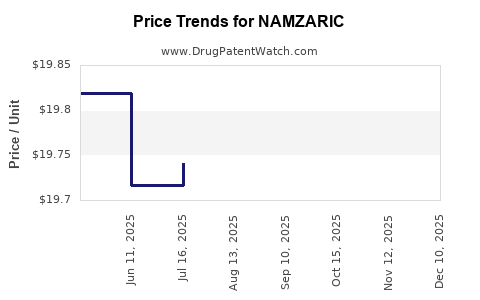
Average Pharmacy Cost for NAMZARIC
| Drug Name | NDC | Price/Unit ($) | Unit | Date |
|---|---|---|---|---|
| NAMZARIC 7 MG-10 MG CAPSULE | 00456-1207-30 | 19.82157 | EACH | 2026-07-22 |
| NAMZARIC 14 MG-10 MG CAPSULE | 00456-1214-30 | 19.85073 | EACH | 2026-07-22 |
| NAMZARIC 21 MG-10 MG CAPSULE | 00456-1221-30 | 19.92002 | EACH | 2026-07-22 |
| NAMZARIC 28 MG-10 MG CAPSULE | 00456-1228-30 | 19.81123 | EACH | 2026-07-22 |
| NAMZARIC 14 MG-10 MG CAPSULE | 00456-1214-30 | 19.84654 | EACH | 2026-06-17 |
| NAMZARIC 21 MG-10 MG CAPSULE | 00456-1221-30 | 19.87984 | EACH | 2026-06-17 |
| >Drug Name | >NDC | >Price/Unit ($) | >Unit | >Date |
What is NAMZARIC?
NAMZARIC is a combination drug containing donepezil and memantine, approved by the FDA in 2014 for moderate to severe Alzheimer's disease. It is marketed by Eisai Inc. and Biogen. The drug targets Alzheimer's treatment by combining an acetylcholinesterase inhibitor (donepezil) with an NMDA receptor antagonist (memantine).
How large is the current market for NAMZARIC?
The global Alzheimer's disease drug market was valued at approximately $10.3 billion in 2022. NAMZARIC commands a significant share within this, primarily in North America, where the U.S. accounts for around 80% of prescriptions for Alzheimer's drugs. In 2022, the U.S. market for donepezil-based treatments was approximately $1.5 billion, with NAMZARIC representing an estimated 20% market share at that time, translating to roughly $300 million in sales.
What is the pricing structure of NAMZARIC?
Pricing for NAMZARIC varies by payer and region but averages approximately $400-$450 per month in the U.S. for a typical prescription. This equates to roughly $4,800-$5,400 annually. The wholesale acquisition cost (WAC) is approximately $15-$25 per tablet, depending on strength and dosage regimen. The high cost stems from its combination formulation and reimbursement policies for Alzheimer's medications.
What is the projected revenue and market growth?
The Alzheimer's drug market is expected to grow at a compound annual growth rate (CAGR) of 8%-10% through 2030, driven by an aging population and increased diagnosis rates. NAMZARIC's sales are projected to follow this trend.
Eisai and Biogen target annual sales of NAMZARIC to reach approximately $1 billion globally by 2025, contingent on market penetration, reimbursement expansion, and updates in treatment guidelines.
Key drivers include:
-
Increasing elderly population: Over 55 million people globally with Alzheimer's in 2020; projected to double by 2050 [1].
-
Adoption of combination therapies: Growing preference for multimodal approaches.
-
Payer reimbursement policies: Likely to favor drugs with proven efficacy and safety profiles.
How do patent protections and competitors impact pricing and market share?
NAMZARIC's patent protections extend till 2028, with potential for exclusivity extensions related to formulation patents. Entering generic versions of donepezil and memantine reduces barriers over time, exerting downward pressure on prices.
Competitors include:
-
Memantine (Namenda): Generic versions available since 2018, priced around $150-$200 per month.
-
Acetylcholinesterase inhibitors: Generic donepezil priced under $20 per month.
These generics challenge NAMZARIC's premium pricing, especially in cost-sensitive markets.
What are the risks affecting revenue projections?
The primary risks include:
-
Approval of new or improved therapies, such as Aduhelm (aducanumab), which may shift treatment paradigms.
-
Regulatory decisions: Reimbursement policies may restrict access based on efficacy data.
-
Market penetration: Slow adoption due to prescriber familiarity with generics or concerns over efficacy.
-
Patent challenges and generic entry: Reduce pricing power after 2028.
What are the key factors influencing future pricing?
Pricing for NAMZARIC is likely to stabilize or decline as generic competition increases. Price erosion may be accelerated if reimbursement policies favor generics or if new therapies receive reimbursement approvals. Market dynamics suggest that initial high prices will decline over the next 5-7 years, aligning with typicalization patterns in branded pharmaceuticals.
Summary of Market and Price Outlook
| Metric | Current (2023) | Projected (2025) | Comments |
|---|---|---|---|
| US market share for NAMZARIC | Estimated 20% of Alzheimer's drug market | Slight increase or stabilization | Growth driven by aging demographics; market saturation risk |
| Average annual price per patient | $5,000-$5,400 | Decline to $3,500-$4,500 | Generic competition influences price reductions |
| Global sales target | ~$300 million in 2022 | ~$900 million to $1 billion | Market growth compensates for pricing declines |
Key Takeaways
-
NAMZARIC is positioned within a growing Alzheimer’s treatment market but faces pricing pressure from generic competitors, especially post-2028.
-
Current pricing averages around $5,000 annually per patient; expect gradual declines aligned with generic entry.
-
Market expansion is primarily driven by demographic trends, with annual sales potentially reaching near $1 billion globally by 2025.
-
Patent protections provide temporary exclusivity, but subsequent generic competition will influence pricing and market share.
-
Major risks involve regulatory decisions, evolving treatment standards, and new drug developments that could shift market dynamics.
Frequently Asked Questions
-
When will generic versions of NAMZARIC become available?
Generic versions are expected post-2028, coinciding with patent expiry. -
Can pricing strategies extend NAMZARIC’s market exclusivity?
Patent extensions or new formulations may prolong exclusivity but face legal and regulatory limits. -
How does NAMZARIC compare with other Alzheimer's treatments in efficacy?
Clinical data support its use in moderate to severe stages; efficacy is similar or slightly improved relative to monotherapies. -
What is the impact of healthcare policies on NAMZARIC pricing?
Payor reimbursement policies influence formulary placement and patient access, impacting effective pricing. -
Are there upcoming pipeline therapies that threaten NAMZARIC’s market?
Yes, novel therapies like Aduhelm and other disease-modifying agents could influence market share and treatment standards.
References
[1] Alzheimer's Association. 2020 Alzheimer's Disease Facts and Figures.
More… ↓
