Last updated: July 31, 2026
Mucinex DM is an over-the-counter combination product containing guaifenesin and dextromethorphan. Guaifenesin loosens mucus, while dextromethorphan suppresses cough. The product competes in the U.S. cough, cold, and flu market against store brands, Robitussin, Delsym, Theraflu, Vicks, and combination products from private-label retailers.
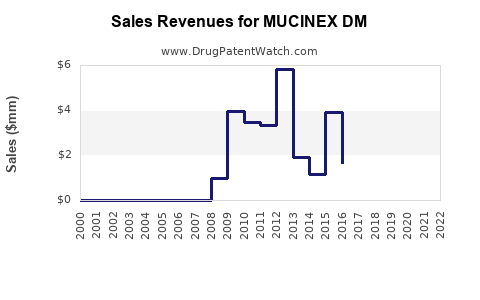
Reckitt owns the Mucinex brand through its Consumer Health business. Product-level revenue, margin, and unit data are not publicly disclosed. The financial trajectory is therefore best assessed through brand ownership, category conditions, pricing, retail distribution, seasonality, and Reckitt’s broader health-business performance.
What is Mucinex DM and how does it work?
Mucinex DM combines two established OTC active ingredients:
| Active ingredient |
Function |
U.S. regulatory category |
| Guaifenesin |
Expectorant that helps loosen respiratory mucus |
OTC cough-cold monograph ingredient |
| Dextromethorphan hydrobromide |
Antitussive that suppresses cough |
OTC cough-cold monograph ingredient |
Mucinex DM is sold in several dosage forms and strengths, including extended-release tablets, liquid products, and pediatric products depending on the market and formulation. The best-known adult extended-release formulations contain either 600 mg guaifenesin/30 mg dextromethorphan or 1,200 mg guaifenesin/60 mg dextromethorphan per tablet.
The product is positioned for cough associated with colds, minor throat irritation, and mucus congestion. It is not an antiviral, antibiotic, or disease-modifying respiratory treatment.
Who owns Mucinex DM?
Reckitt owns Mucinex through its acquisition of Adams Respiratory Therapeutics in 2008. Reckitt paid approximately $2.3 billion for Adams, which also owned respiratory brands including Delsym and Mucinex-related products at the time (Reckitt, 2008).
Mucinex is part of Reckitt’s Consumer Health portfolio, alongside brands such as Durex, Nurofen, Strepsils, Gaviscon, and Enfamil. Reckitt reports performance at category and geographic levels rather than by individual OTC brand. Mucinex revenue is therefore embedded in broader health reporting.
Does Reckitt disclose Mucinex DM revenue?
No. Reckitt does not generally disclose revenue for Mucinex DM as a standalone SKU or for the Mucinex brand in a separate audited line item. Public reporting typically provides:
- Consumer Health revenue by geographic region or category
- Like-for-like sales growth
- Brand and category commentary
- Gross margin and operating profit at group or business-unit level
- Advertising and promotional investment at aggregate levels
Mucinex’s financial contribution must therefore be estimated from brand scale, retail presence, seasonal demand, and category growth rather than from reported product-level revenue.
How large is the Mucinex DM market?
Mucinex DM participates in the U.S. OTC cough and cold market, a large but mature category with high household penetration and intense private-label competition. The relevant market is fragmented across:
- Expectorants
- Cough suppressants
- Combination cough and cold products
- Liquid and tablet delivery formats
- Adult and pediatric products
- National brands and retailer-owned brands
The product’s addressable market is broader than the guaifenesin-dextromethorphan combination alone. Consumers can substitute among single-ingredient products, multi-symptom products, liquids, lozenges, sprays, and non-drug remedies.
Mucinex DM has several commercial advantages:
- It combines two familiar active ingredients in a single product.
- Its extended-release format supports twice-daily dosing.
- The Mucinex name is strongly associated with mucus relief.
- The brand has broad placement in pharmacies, supermarkets, mass merchants, and e-commerce.
- The category benefits from recurring seasonal demand.
Its principal disadvantages are the low technical barriers to competing products and the availability of lower-priced store brands.
What drives Mucinex DM sales?
Respiratory seasonality
Sales rise during the fall and winter respiratory season, when common colds, influenza, respiratory syncytial virus, and other respiratory infections increase demand for symptomatic relief. Revenue can shift materially between quarters because consumers typically purchase cough and cold products in response to acute illness rather than through regular maintenance use.
Infection trends
Influenza and respiratory virus activity influence demand. The COVID-19 pandemic disrupted normal seasonality, reduced some in-person retail activity, and changed consumer purchasing patterns. Later normalization produced uneven comparisons across respiratory seasons.
Retail distribution
Mucinex DM depends on high-volume retail distribution. Important channels include:
- Mass merchants
- Drugstores
- Grocery stores
- Club stores
- Online retailers
- Pharmacy benefit and retail health platforms
Availability at the point of purchase is commercially important because consumers often select an OTC product during an acute illness episode.
Pricing and promotion
National-brand OTC products typically sell at a premium to private-label equivalents. Mucinex can protect part of that premium through brand recognition, packaging, advertising, and perceived efficacy. Promotional intensity, retailer negotiations, and price gaps against store brands directly affect unit volume and gross sales.
Product format
Extended-release tablets support a differentiated convenience claim relative to immediate-release products. Liquids and pediatric formulations address different consumer segments but also create additional packaging, compliance, and supply-chain requirements.
How does Mucinex DM compare with competing products?
| Brand or product |
Primary active ingredient or combination |
Main competitive position |
| Mucinex DM |
Guaifenesin plus dextromethorphan |
Mucus relief plus cough suppression |
| Robitussin DM |
Guaifenesin plus dextromethorphan |
Direct branded combination competitor |
| Delsym |
Extended-release dextromethorphan |
Long-acting cough suppression |
| Plain Mucinex |
Guaifenesin |
Expectorant-only treatment |
| Store-brand DM products |
Usually guaifenesin plus dextromethorphan |
Lower-price substitution |
| Theraflu and similar products |
Multi-ingredient combinations |
Broad symptom coverage |
| Vicks products |
Vary by product |
Brand and formulation competition |
| Lozenges and sprays |
Local anesthetic, menthol, or other ingredients |
Alternative relief formats |
The most direct competition comes from generic and private-label guaifenesin-dextromethorphan products. Delsym competes primarily for consumers seeking longer-lasting cough suppression, while multi-symptom products compete for consumers who want treatment for several cold symptoms in one package.
What is the FDA regulatory status of Mucinex DM?
Mucinex DM is an OTC drug product marketed under the FDA’s nonprescription cough and cold regulatory framework. Guaifenesin and dextromethorphan are recognized OTC active ingredients under the FDA’s cough, cold, allergy, bronchodilator, and antiasthmatic drug regulations in 21 C.F.R. Part 341.
The regulatory structure reduces dependence on an individual product-specific new drug application. A compliant product can generally be marketed under the applicable OTC monograph conditions, including requirements for active ingredients, dosage, labeling, warnings, and claims.
Mucinex DM remains subject to:
- FDA labeling requirements
- Current good manufacturing practice rules
- Product registration and listing obligations
- Adverse-event reporting
- Manufacturing and quality controls
- Restrictions on unsupported therapeutic claims
- Child-safety and misuse warnings
The product is not a biologic and does not face biosimilar competition.
What patents protect Mucinex DM?
The commercial protection for Mucinex DM is primarily based on trademarks, brand equity, formulations, packaging, retail relationships, and marketing rather than on a durable composition-of-matter patent.
Guaifenesin and dextromethorphan are long-established active ingredients. Their basic chemical compositions are not protected by enforceable new-drug patents relevant to ordinary OTC competition. Some specific dosage forms, release profiles, tablets, coatings, or manufacturing methods may have been covered historically by formulation or process patents, but those rights do not create the same barrier as a modern pharmaceutical compound patent.
A definitive product-specific patent assessment would require matching each marketed Mucinex DM SKU against:
- FDA product listings
- U.S. Patent and Trademark Office records
- Formulation and controlled-release patent families
- Assignment records
- Patent expiration data
- Litigation and settlement records
Is Mucinex DM listed in the Orange Book?
Mucinex DM is generally not an Orange Book-style patent-exclusivity product in the same way as an approved prescription drug with an ANDA reference listing. OTC monograph products typically do not rely on Orange Book patent listings to control generic entry.
The absence of a conventional Orange Book patent strategy means that competitors can usually enter by satisfying OTC monograph, labeling, manufacturing, and product-quality requirements rather than by filing a Paragraph IV certification against a listed Mucinex patent.
Are there Paragraph IV challenges to Mucinex DM?
Paragraph IV litigation is not the principal entry mechanism for ordinary OTC monograph versions of Mucinex DM. Paragraph IV certifications apply to abbreviated new drug applications referencing listed patents for an approved drug. A private-label manufacturer marketing a compliant OTC monograph product generally does not need to challenge an Orange Book patent to compete with the brand.
Competitive entry can instead occur through:
- OTC monograph compliance
- Private-label sourcing
- Contract manufacturing
- Retailer procurement
- Reformulation or dosage-form differentiation
- Separate FDA approval where a product does not fit the monograph
This lowers the legal barrier to entry compared with prescription products protected by active-ingredient, formulation, and method-of-use patents.
When does Mucinex DM lose exclusivity?
Mucinex DM does not have a single exclusivity-loss date comparable to a prescription drug’s patent expiration date. The active ingredients have long been available for OTC use, and competing guaifenesin-dextromethorphan products are already marketed.
The relevant commercial exclusivity is brand-based:
| Protection type |
Commercial status |
| Active ingredient exclusivity |
Long expired for the underlying ingredients |
| OTC regulatory exclusivity |
No conventional product-specific monopoly |
| Orange Book patent exclusivity |
Generally not the main protection mechanism |
| Trademark protection |
Ongoing subject to renewal and use |
| Packaging and trade dress |
Potentially ongoing but fact-specific |
| Formulation protection |
May exist for specific products or technologies, subject to expiration |
| Retail and marketing advantage |
Ongoing but vulnerable to price competition |
Mucinex’s defensibility depends on maintaining consumer recognition and distribution rather than preventing all legally compliant substitutes.
What is the financial trajectory for Mucinex DM?
Mucinex DM’s financial trajectory is likely shaped by stable category demand, seasonal volatility, pricing, and margin pressure.
Revenue outlook
Revenue is likely to remain resilient when:
- Respiratory illness activity is elevated
- Retail distribution remains broad
- Brand pricing holds against private-label products
- Advertising supports brand preference
- Supply availability is consistent
Revenue can weaken when:
- Respiratory seasons are mild
- Consumers trade down to store brands
- Retailers reduce shelf space
- Promotional spending rises
- Product shortages disrupt availability
- Consumers shift toward single-ingredient or non-drug alternatives
Margin outlook
Gross-margin performance depends on:
- Active pharmaceutical ingredient costs
- Packaging and freight costs
- Manufacturing utilization
- Retailer trade spending
- Advertising intensity
- Product mix between tablets, liquids, and multipacks
The product’s established formulation and high-volume retail model can support attractive margins, but OTC products are exposed to retailer bargaining power and private-label pricing.
Reckitt portfolio effect
Mucinex is strategically valuable to Reckitt because it provides respiratory-category exposure within a large branded consumer-health portfolio. Its value is not limited to a single SKU. The brand can support cross-selling among expectorants, cough suppressants, children’s products, and seasonal respiratory products.
Reckitt’s broader Consumer Health results, however, cannot be attributed directly to Mucinex DM. Brand-level financial conclusions drawn from group revenue would overstate the available evidence.
What generic entry risks exist for Mucinex DM?
Generic and private-label entry risk is high at the ingredient level and moderate at the brand level.
High ingredient-level risk
Guaifenesin and dextromethorphan are widely available, familiar OTC ingredients. Retailers can source competing products from numerous manufacturers, reducing dependence on Reckitt.
Moderate product-level risk
Extended-release tablets, packaging, labeling, and consumer trust create some differentiation. These factors can slow substitution but do not prevent it.
Lower brand-level risk
Mucinex has strong name recognition and a clear association with mucus relief. Brand preference can support a premium, especially when consumers are purchasing for children or seeking a familiar product during illness.
The most likely competitive scenario is continued coexistence between Mucinex DM and private-label equivalents, with share shifts driven by price, promotion, seasonal demand, and retailer shelf allocation rather than by patent litigation.
What litigation affects Mucinex DM?
There is no widely reported current patent-litigation framework comparable to the litigation surrounding major prescription drugs or biologics. Potential legal exposure for Mucinex DM is more likely to involve:
- Trademark disputes
- False or unsupported advertising claims
- Labeling and regulatory compliance
- Product liability
- Manufacturing-quality issues
- Retail and distribution matters
Any assessment of active litigation must distinguish between disputes involving the Mucinex brand, Reckitt generally, and a specific Mucinex DM formulation. Group-level litigation should not be treated as product-specific litigation without a direct connection to the relevant SKU.
What licensing deals support Mucinex DM?
The brand originated with Adams Respiratory Therapeutics and became part of Reckitt through the 2008 acquisition. Publicly disclosed strategic licensing is less important to Mucinex DM than Reckitt’s ownership of the brand, formulation rights, manufacturing network, and retail relationships.
Contract manufacturers may participate in production, but manufacturing arrangements are not necessarily publicly disclosed or equivalent to a license of core intellectual property.
How strong is the Mucinex DM patent estate?
The patent estate is weaker than that of a patented prescription medicine because:
- The active ingredients are old
- OTC monograph competition is available
- Product-specific Orange Book barriers are generally limited
- Private-label manufacturers can compete on the same active ingredients
- Brand and retail assets are more important than composition patents
The commercial estate is stronger than the patent estate. Consumer recognition, packaging, shelf position, advertising, and distribution can sustain pricing even when legal entry barriers are low.
What manufacturing and supply-chain barriers affect Mucinex DM?
Manufacturing barriers are operational rather than fundamental. A competing manufacturer must manage:
- Pharmaceutical-grade sourcing of guaifenesin and dextromethorphan
- Controlled-release tablet production
- Uniformity and dissolution testing
- Child-resistant packaging where required
- FDA-compliant labeling
- Seasonal inventory planning
- Retail service levels
- Recall and quality systems
Extended-release products can require more process control than simple immediate-release tablets. These requirements raise execution risk but do not create a high barrier for established OTC manufacturers.
Key Takeaways
- Mucinex DM is a Reckitt-owned OTC combination of guaifenesin and dextromethorphan.
- Product-level revenue and profit are not publicly disclosed.
- Its market is mature, seasonal, and highly exposed to private-label competition.
- Brand recognition, extended-release formats, retail distribution, and advertising are the main commercial defenses.
- The active ingredients have no meaningful new-compound exclusivity remaining.
- Orange Book and Paragraph IV litigation are generally not the central competitive mechanisms.
- Patent protection is less important than trademarks, trade dress, formulation know-how, and shelf access.
- Financial performance depends on respiratory-season intensity, pricing, retailer promotions, input costs, and consumer trade-down.
- The most likely generic-entry pattern is continued price competition rather than a single market-opening event.
FAQs
Is Mucinex DM a prescription drug?
No. Mucinex DM is an OTC product marketed under the FDA’s nonprescription cough-and-cold regulatory framework.
Can store brands legally copy Mucinex DM?
Store brands can market products containing the same active ingredients if they comply with applicable FDA monograph, labeling, manufacturing, and quality requirements. They cannot copy Reckitt’s trademarks or confusingly imitate protected branding.
Does Mucinex DM have biosimilar risk?
No. Biosimilars compete with biologic medicines. Mucinex DM contains small-molecule OTC active ingredients and faces generic and private-label substitution instead.
Is Mucinex DM more defensible than plain guaifenesin?
The combination and extended-release format provide greater consumer differentiation than plain guaifenesin, but they do not create a strong barrier to compliant competitors. The brand carries most of the defensibility.
What would most improve Mucinex DM revenue?
The strongest drivers would be an active respiratory season, stable or higher pricing, expanded retail distribution, successful premium product formats, strong advertising efficiency, and limited consumer migration to private-label products.
References
-
Reckitt. (2008). Reckitt Benckiser acquires Adams Respiratory Therapeutics. Reckitt corporate announcement.
-
Reckitt. (2024). Annual report and financial statements 2023. Reckitt plc.
-
U.S. Food and Drug Administration. (n.d.). Cough, cold, allergy, bronchodilator, and antiasthmatic drug products for over-the-counter human use, 21 C.F.R. Part 341.
-
U.S. Food and Drug Administration. (2023). Drug products marketed under the OTC monograph system. FDA.
-
U.S. Food and Drug Administration. (2024). Orange Book: Approved drug products with therapeutic equivalence evaluations. FDA.