Last updated: August 27, 2026
MoviPrep is a mature prescription bowel-preparation product based on polyethylene glycol 3350, electrolytes, and ascorbate. Its commercial value is driven by procedure volume, formulary access, patient tolerability, and manufacturing economics rather than by patent exclusivity. The product has limited publicly disclosed standalone financial data. In the United States, Salix Pharmaceuticals, a division of Bausch Health, markets MoviPrep; Norgine markets the product in multiple international territories. [1][2]
The principal risks are generic substitution, lower-cost polyethylene glycol alternatives, newer low-volume preparations, payer pressure, and the absence of a clearly identifiable long-duration patent barrier. MoviPrep remains commercially relevant in colonoscopy preparation, but its financial trajectory is more consistent with a mature cash-generating product than with a growth-stage branded medicine.
What is MoviPrep and how does it generate revenue?
MoviPrep is an oral solution preparation used to cleanse the colon before colonoscopy and other examinations requiring a clean bowel. Its active formulation combines macrogol 3350, also called polyethylene glycol 3350, with sodium sulfate, sodium chloride, potassium chloride, and ascorbic acid or sodium ascorbate. The product uses an osmotic mechanism that retains water in the gastrointestinal tract and produces catharsis. [1]
Revenue is generated through prescription sales to pharmacies, hospitals, ambulatory surgical centers, and procedure networks. The economic chain has four principal participants:
- The manufacturer or license holder.
- Wholesalers and specialty distributors.
- Pharmacies and institutional purchasers.
- Payers and patients.
MoviPrep is not a biologic and does not have biosimilar exposure. Its competitive threat is conventional generic substitution and migration to other bowel-preparation products.
What therapeutic category does MoviPrep occupy?
| Attribute |
MoviPrep |
| Active ingredient class |
Polyethylene glycol 3350 with electrolytes and ascorbate |
| Therapeutic use |
Bowel cleansing before colonoscopy or comparable procedures |
| Dosage form |
Powder for oral solution |
| Prescription status |
Prescription product |
| Primary market |
Gastrointestinal endoscopy preparation |
| U.S. regulatory holder |
Salix Pharmaceuticals, Ltd., a Bausch Health company |
| International originator/commercial partner |
Norgine |
| Biosimilar exposure |
None |
| Main competitive threat |
Generic and branded bowel-preparation substitution |
What is the FDA regulatory status of MoviPrep?
MoviPrep received U.S. Food and Drug Administration approval under NDA 021881 in 2006. The approved indication is cleansing of the colon in preparation for colonoscopy in adults. The FDA label identifies the principal safety risks as fluid and electrolyte abnormalities, aspiration, mucosal ulceration in certain circumstances, and gastrointestinal adverse reactions. [1]
The product is regulated as a prescription drug rather than as an over-the-counter laxative. Its commercial position depends on continued compliance with the approved labeling, current manufacturing requirements, pharmacovigilance obligations, and supply continuity.
What dosage and administration characteristics affect demand?
MoviPrep is a split-dose bowel preparation. The patient dissolves the powder in water and consumes the resulting solution according to the prescribing instructions, with additional clear liquids. Split dosing is widely used in colonoscopy practice because preparation quality is generally better when the final dose is taken closer to the procedure.
Demand is influenced by:
- The number of colonoscopies performed.
- Adoption of split-dose protocols.
- Patient acceptance of taste and volume.
- Physician and endoscopy-center order sets.
- Payer coverage and copayment.
- Availability of lower-volume alternatives.
- Local shortages or wholesaler inventory.
A bowel-preparation product usually has limited ability to increase price without losing formulary position because physicians have multiple clinically accepted alternatives.
How large is the MoviPrep market?
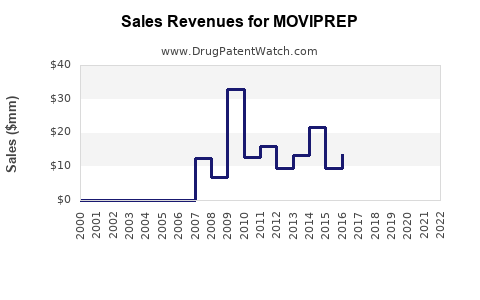
No audited, standalone global revenue figure for MoviPrep is publicly reported by Norgine, Bausch Health, or Salix. Bausch reports financial results by broader business segments, including Salix, rather than consistently disclosing MoviPrep net sales as a separate line item. Norgine is privately held and does not provide the same level of public product-level reporting as a listed pharmaceutical company. [2][3]
The relevant market is the broader prescription bowel-preparation market. It includes:
- Polyethylene glycol-electrolyte preparations.
- Low-volume sulfate-based preparations.
- Sodium picosulfate products.
- Oral sulfate solution products.
- Tablet-based preparations.
- Generic formulations.
MoviPrep competes in a procedure-driven market. Colonoscopy demand is tied to screening recommendations, diagnostic procedures, gastroenterology capacity, hospital utilization, and population age. Demand can grow even when an individual product loses share, but growth in the category does not guarantee growth for MoviPrep.
What is the financial trajectory of MoviPrep?
MoviPrep’s financial trajectory has four phases.
Launch and early adoption
The product entered the U.S. market as a branded prescription alternative to larger-volume polyethylene glycol-electrolyte preparations. Its commercial proposition centered on bowel-cleansing efficacy, split dosing, and a formulation designed to reduce the amount of solution consumed relative to certain older preparations.
Brand expansion
During the branded period, value came from physician familiarity, distribution, promotion, and payer coverage. The product benefited from recurring colonoscopy demand rather than from chronic-use prescriptions. This limits annual prescription frequency per patient but creates a large procedure-linked customer base.
Mature-market pressure
The current business is exposed to generic competition and therapeutic substitution. As the original product patents and regulatory exclusivity periods cease to constrain competitors, branded pricing becomes harder to sustain. Net revenue can decline even when unit demand remains stable because of:
- Generic substitution.
- Rebates and discounts.
- Formulary exclusions.
- Institutional purchasing pressure.
- Competitive contracting.
- Product switching to lower-volume or tablet-based preparations.
Portfolio cash-flow phase
Mature bowel-preparation products can remain profitable when manufacturing costs are controlled and the brand retains physician recognition. The financial model is usually based on stable procedure volume, efficient supply, and limited promotional spending. The product’s value is therefore more likely to be measured by contribution margin and portfolio fit than by high top-line growth.
When does MoviPrep lose exclusivity?
MoviPrep has no single current exclusivity date that determines market entry in the way a recently approved innovative drug does. FDA regulatory exclusivity and patent exclusivity are separate concepts.
The five-year new chemical entity exclusivity framework generally does not provide a long-duration barrier for a formulation based on established ingredients such as polyethylene glycol and electrolytes. Any product-specific exclusivity would depend on the approval pathway and the regulatory status of the relevant application. [4]
The commercial barriers are therefore more important than an unexpired composition-of-matter patent. They include:
- FDA approval of competing abbreviated new drug applications.
- Demonstrated pharmaceutical equivalence.
- Manufacturing scale.
- Retail and wholesale distribution.
- Pharmacy substitution rules.
- Contracts with endoscopy centers and payers.
- Brand recognition and physician familiarity.
What patents protect MoviPrep?
The original MoviPrep patent estate was directed primarily to the composition and use of bowel-cleansing formulations. The practical value of those rights has diminished with age. Publicly available FDA and patent records should be reviewed for any later-issued formulation, process, or use patents tied to the specific approved product and market. The commercial record does not support treating MoviPrep as a product protected by a current, broad, long-duration composition-of-matter patent.
For business analysis, the relevant conclusion is that MoviPrep’s defensibility is weak to moderate on patent grounds and stronger on execution grounds. Manufacturing know-how, supplier qualification, product quality, distribution, and customer contracts can delay or limit substitution without creating statutory exclusivity.
What is the Orange Book status of MoviPrep?
The FDA Orange Book identifies approved drug products and, where applicable, listed patents and exclusivity information. MoviPrep’s Orange Book position should be assessed at the NDA level, including the current holder of NDA 021881 and any listed patents that remain unexpired. [4]
For generic-entry analysis, the key questions are:
| Orange Book issue |
Commercial relevance |
| Listed patents |
Determine whether an ANDA applicant must certify to active patent claims |
| Patent expiry |
Establish the earliest potential legal launch date |
| Regulatory exclusivity |
May delay ANDA approval independently of patents |
| Reference listed drug status |
Determines the product used for ANDA comparison |
| Labeling carve-outs |
Can allow generic approval without infringing a method-of-use claim |
| Paragraph IV certification |
Can trigger patent litigation and a 30-month stay |
An Orange Book listing does not by itself guarantee a durable barrier. Patent scope, claim validity, enforceability, and the applicant’s certification determine the practical effect.
Which companies are challenging MoviPrep?
MoviPrep faces competition from generic manufacturers and from branded bowel-preparation companies. The relevant competitive set includes products marketed by:
- Bausch Health and Salix.
- Norgine.
- Sebela Pharmaceuticals.
- Ferring Pharmaceuticals.
- Generic manufacturers supplying polyethylene glycol-electrolyte and sulfate-based products.
- Manufacturers of tablet-based colonoscopy preparations.
The competitive challenge is not limited to direct copies. A patient may be switched from MoviPrep to a chemically different preparation if the physician, payer, or endoscopy center considers the alternative clinically acceptable.
How does MoviPrep compare with competing bowel preparations?
| Product or category |
Main commercial advantage |
Main limitation relative to MoviPrep |
| MoviPrep |
Established brand and split-dose use |
Mature product with generic and branded substitutes |
| Generic PEG-electrolyte solutions |
Lower acquisition cost |
Often associated with higher solution volume |
| SUPREP |
Lower-volume sulfate-based regimen |
Different formulation and electrolyte considerations |
| PLENVU |
Lower-volume PEG-based regimen |
May command a premium and faces payer restrictions |
| SUTAB |
Tablet administration |
Higher tablet burden and different prescribing considerations |
| Sodium picosulfate products |
Lower-volume convenience |
Different tolerability and safety considerations |
Clinical choice depends on preparation quality, patient comorbidities, renal and cardiac status, tolerability, cost, and physician preference. A low-volume product can take share from MoviPrep even without being therapeutically identical.
What generic entry risks exist for MoviPrep?
Generic entry risk is high relative to the risk profile of a newly patented drug. The market contains established generic technologies, and the active ingredients are well known. A generic applicant can compete through an ANDA if it demonstrates pharmaceutical equivalence and bioequivalence or satisfies the applicable FDA requirements for the reference product. [4]
The principal generic-entry scenarios are:
Direct AB-rated substitution
A therapeutically equivalent generic can be substituted at the pharmacy under state law and payer policy. This is the most direct threat to branded net sales.
Institutional formulary replacement
Hospitals, ambulatory surgical centers, and endoscopy groups can adopt a lower-cost alternative across a procedure network. This can reduce volume without requiring patient-by-patient pharmacy substitution.
Partial brand retention
MoviPrep may retain demand among physicians who value familiarity, patient instructions, or perceived tolerability. The brand can remain commercially viable while losing the majority of price-sensitive prescriptions.
Price segmentation
The originator may preserve a premium position in selected channels while offering rebates or contracting concessions elsewhere. This can stabilize units but compress net price.
Are there Paragraph IV challenges or MoviPrep patent lawsuits?
A Paragraph IV challenge is a certification by an ANDA applicant that a listed patent is invalid, unenforceable, or will not be infringed. A challenge can result in patent litigation and, in qualifying circumstances, a 30-month stay of FDA approval. [4]
No current, product-defining Paragraph IV case should be assumed without checking the FDA Orange Book, FDA Paragraph IV litigation records, and federal court dockets. MoviPrep is a mature product, so any historic patent litigation would have greater relevance to the timing of earlier generic entry than to the product’s present long-term growth outlook.
The absence of a current high-profile case would not eliminate generic risk. Generic manufacturers can enter after patent expiry, after successful patent challenges, through non-infringing labeling, or following settlement agreements.
Do settlement agreements affect MoviPrep generic launch timing?
A settlement can establish an agreed generic launch date, license rights, supply terms, or other commercial conditions. It may also resolve litigation without creating immediate competition. Any MoviPrep settlement analysis must distinguish:
- The date of settlement.
- The agreed entry date.
- The patents covered.
- Whether the agreement includes a license.
- Whether the generic is authorized or licensed.
- Whether the Federal Trade Commission reviewed the arrangement.
Historic settlement terms are not a substitute for the current market-entry date because later patent expiry, subsequent ANDA approvals, and additional manufacturers can change the competitive position.
What manufacturing and intellectual-property barriers protect MoviPrep?
Manufacturing barriers are more relevant than discovery-stage intellectual property. The formulation requires controlled blending, packaging, stability testing, and reliable sourcing of multiple salts and excipients. Quality failures can affect supply and trigger regulatory action.
The principal barriers are:
- Validated formulation and filling processes.
- Consistent raw-material quality.
- Moisture control for powdered sachets.
- Stability through shelf life.
- Packaging that protects the powder from humidity.
- FDA-compliant manufacturing sites.
- Qualified suppliers and backup capacity.
- Distribution to pharmacies and procedure centers.
These barriers can support market continuity but generally do not prevent a capable generic manufacturer from competing. They create execution risk rather than durable exclusivity.
What licensing deals affect MoviPrep?
MoviPrep has an international commercialization history involving Norgine and regional commercial rights. In the United States, Salix has marketed the product within the Bausch Health portfolio. [2][5]
License economics can affect profitability through:
- Royalties to the underlying rights holder.
- Territory-specific pricing.
- Supply agreements.
- Minimum purchase commitments.
- Manufacturing responsibilities.
- Marketing obligations.
- Transfer-pricing arrangements.
Neither Norgine nor Bausch publicly reports a complete product-level schedule of MoviPrep royalties, transfer prices, or territory-by-territory sales. The existence of a licensing relationship therefore matters strategically, but public disclosures do not support a precise calculation of product-level operating profit.
How strong is the MoviPrep patent estate?
MoviPrep’s patent estate is best characterized as mature and limited in forward-looking strength.
| Patent-estate factor |
Assessment |
| Composition-of-matter protection |
Weak for current exclusivity analysis |
| Formulation protection |
Potentially relevant but likely narrow and age-dependent |
| Method-of-use protection |
May affect label scope if claims remain enforceable |
| Manufacturing patents |
Could create targeted barriers, not broad market exclusion |
| Regulatory exclusivity |
Limited compared with a new chemical entity |
| Trade secrets |
Relevant to process control and quality |
| Brand and channel access |
More important than patent life |
The estate can still matter in litigation if a specific claim remains unexpired. It is unlikely to support a long-term premium comparable to a protected specialty drug or biologic.
What revenue exposure does MoviPrep create for Bausch Health and Norgine?
MoviPrep creates recurring but comparatively concentrated exposure to the colonoscopy market. Revenue rises with procedure volume and falls when patients or institutions switch products. The product does not create the broad chronic-prescription exposure associated with cardiovascular, metabolic, or immunology drugs.
For Bausch Health, MoviPrep is part of the Salix gastrointestinal portfolio. Bausch reports Salix at the segment level, which prevents investors from isolating MoviPrep revenue, gross margin, or year-over-year volume from public consolidated disclosures. [2]
For Norgine, MoviPrep is part of a broader European and international specialty-pharmaceutical portfolio. Norgine’s private ownership structure limits public visibility into product-level sales and profitability. [5]
Financial sensitivity is therefore best modeled using operational assumptions rather than reported MoviPrep revenue:
- Colonoscopy procedure growth.
- Branded prescription share.
- Generic substitution rate.
- Net price after rebates.
- Manufacturing cost per sachet.
- Distribution and royalty expense.
- Geographic mix.
- Supply interruptions.
- Competitive product launches.
What are the likely MoviPrep generic launch scenarios?
The most likely long-term scenario is continued erosion in branded share with residual demand in selected channels. Three launch outcomes are commercially relevant.
Early multi-source entry
Several approved generics enter within a short period. Pharmacy substitution accelerates, pricing declines, and the brand becomes a contracting product.
Limited initial entry
One or two generic suppliers enter, but manufacturing capacity or distribution remains constrained. MoviPrep retains a larger share for a longer period, though net pricing still weakens.
Therapeutic substitution without direct generic replacement
Payers and procedure centers move patients to alternative branded or generic bowel preparations. MoviPrep loses volume even if direct generic availability is limited.
The highest-value commercial defense is usually channel retention rather than patent litigation: endoscopy-center contracts, reliable supply, patient support, physician familiarity, and competitive net pricing.
How does MoviPrep compare with Plenvu and other products?
MoviPrep has an established market position but competes against products designed to address the same patient concern: the burden of consuming bowel-preparation solution.
Plenvu competes directly on low-volume positioning within a PEG-based framework. SUPREP competes through a sulfate-based, lower-volume regimen. SUTAB offers tablets, which can appeal to some patients but requires ingestion of a substantial number of tablets and accompanying water. Generic PEG solutions compete primarily on price and broad availability.
MoviPrep’s relative strengths are familiarity, established prescribing experience, and a known split-dose regimen. Its weaknesses are maturity, limited pricing power, and exposure to both direct and indirect substitution.
Key Takeaways
- MoviPrep is a mature prescription bowel-preparation product, not a growth-stage protected drug.
- Salix/Bausch Health markets MoviPrep in the United States; Norgine has major international commercial rights.
- Public companies do not separately disclose complete MoviPrep revenue or profit figures.
- The principal market drivers are colonoscopy volume, payer coverage, patient tolerability, and endoscopy-center purchasing.
- Generic and therapeutic substitution pose greater risks than biosimilar competition.
- The patent estate appears mature; current commercial defensibility depends more on manufacturing, distribution, contracts, and brand recognition.
- The most probable financial trajectory is stable-to-declining branded revenue with continued contribution from retained prescriptions and selected institutional channels.
- A precise valuation requires product-level sales, gross-to-net deductions, royalty terms, current Orange Book data, and verified litigation records, none of which are fully disclosed in issuer filings.
FAQs
Is MoviPrep still commercially available?
MoviPrep remains an FDA-approved prescription bowel-preparation product, with availability depending on market, manufacturer, distributor inventory, and local formulary access. [1]
Does MoviPrep have a generic equivalent?
The market includes generic and therapeutically substitutable bowel-preparation products. Whether a specific product is pharmaceutically equivalent and substitutable for MoviPrep depends on FDA approval status and state pharmacy-substitution rules.
Is MoviPrep covered by Medicare?
Coverage depends on the Medicare benefit involved, the prescription plan, formulary terms, and the product’s classification. Patients may face different coverage outcomes for pharmacy-dispensed bowel preparations and procedure-related services.
What is the main commercial advantage of MoviPrep?
Its main advantages are established physician familiarity, a recognized split-dose regimen, and integration into existing colonoscopy preparation protocols.
Could MoviPrep revenue increase even if market share declines?
Yes. Higher colonoscopy volumes can offset some share loss, although generic substitution, rebates, and lower net prices can still cause branded revenue to decline.
References
-
U.S. Food and Drug Administration. (n.d.). MoviPrep prescribing information, NDA 021881. FDA.
-
Bausch Health Companies Inc. (2023). Annual report pursuant to Section 13 or 15(d) of the Securities Exchange Act of 1934. Bausch Health.
-
U.S. Securities and Exchange Commission. (n.d.). Bausch Health Companies Inc. filings. SEC.
-
U.S. Food and Drug Administration. (n.d.). Approved drug products with therapeutic equivalence evaluations, Orange Book. FDA.
-
Norgine B.V. (n.d.). Company and product information. Norgine.