Share This Page
MOTEGRITY Drug Patent Profile
✉ Email this page to a colleague
When do Motegrity patents expire, and what generic alternatives are available?
Motegrity is a drug marketed by Takeda Pharms Usa and is included in one NDA.
The generic ingredient in MOTEGRITY is prucalopride succinate. There is one drug master file entry for this compound. Nineteen suppliers are listed for this compound. Additional details are available on the prucalopride succinate profile page.
DrugPatentWatch® Litigation and Generic Entry Outlook for Motegrity
A generic version of MOTEGRITY was approved as prucalopride succinate by NOVITIUM PHARMA on December 26th, 2024.
AI Deep Research
Questions you can ask:
- What is the 5 year forecast for MOTEGRITY?
- What are the global sales for MOTEGRITY?
- What is Average Wholesale Price for MOTEGRITY?
Summary for MOTEGRITY
| US Patents: | 0 |
| Applicants: | 1 |
| NDAs: | 1 |
| Finished Product Suppliers / Packagers: | 1 |
| Raw Ingredient (Bulk) Api Vendors: | 169 |
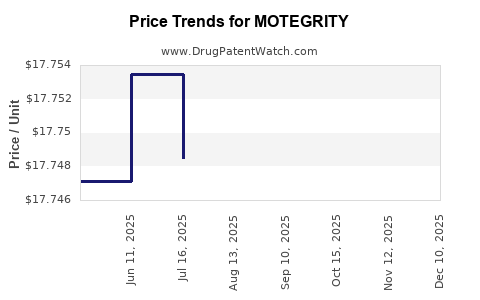
| Drug Prices: | Drug price information for MOTEGRITY |
| What excipients (inactive ingredients) are in MOTEGRITY? | MOTEGRITY excipients list |
| DailyMed Link: | MOTEGRITY at DailyMed |
Pharmacology for MOTEGRITY
| Drug Class | Serotonin-4 Receptor Agonist |
| Mechanism of Action | Serotonin 4 Receptor Agonists |
US Patents and Regulatory Information for MOTEGRITY
MOTEGRITY is protected by zero US patents and one FDA Regulatory Exclusivity.
| Applicant | Tradename | Generic Name | Dosage | NDA | Approval Date | TE | Type | RLD | RS | Patent No. | Patent Expiration | Product | Substance | Delist Req. | Exclusivity Expiration |
|---|---|---|---|---|---|---|---|---|---|---|---|---|---|---|---|
| Takeda Pharms Usa | MOTEGRITY | prucalopride succinate | TABLET;ORAL | 210166-001 | Dec 14, 2018 | AB | RX | Yes | No | ⤷ Start Trial | ⤷ Start Trial | ⤷ Start Trial | |||
| Takeda Pharms Usa | MOTEGRITY | prucalopride succinate | TABLET;ORAL | 210166-002 | Dec 14, 2018 | AB | RX | Yes | Yes | ⤷ Start Trial | ⤷ Start Trial | ⤷ Start Trial | |||
| >Applicant | >Tradename | >Generic Name | >Dosage | >NDA | >Approval Date | >TE | >Type | >RLD | >RS | >Patent No. | >Patent Expiration | >Product | >Substance | >Delist Req. | >Exclusivity Expiration |
Motegrity Market Dynamics, Patent Position, and Financial Trajectory
Motegrity, the U.S. brand for prucalopride succinate, is a prescription treatment for chronic idiopathic constipation in adults. Takeda markets the drug in the United States after acquiring Shire, which developed and launched Motegrity. The product has a differentiated mechanism as a selective 5-HT4 receptor agonist, but its commercial opportunity is constrained by generic competition, a low-cost laxative market, and the absence of separately reported product revenue.
Motegrity’s financial trajectory is therefore best assessed through market access, prescription retention, patent and regulatory timing, pricing, and Takeda’s broader gastrointestinal portfolio rather than through disclosed brand-level sales.
What is Motegrity and how does it compete?
Motegrity contains prucalopride, a selective serotonin type 4 receptor agonist. The FDA approved it in December 2018 for the treatment of chronic idiopathic constipation in adults at a recommended dose of 2 mg once daily. A 1 mg dose is recommended for patients with severe renal impairment. [1]
The product competes in a large but price-sensitive constipation market that includes:
- Over-the-counter polyethylene glycol products.
- Stimulant laxatives.
- Prescription secretagogues such as Linzess, Trulance, and Amitiza.
- Prescription osmotic products such as lactulose.
- Other branded and generic therapies used off label.
Motegrity’s clinical positioning is based on prokinetic activity. Unlike secretagogues, which increase intestinal fluid secretion, prucalopride stimulates colonic motility through selective 5-HT4 receptor activity. That distinction gives Takeda a differentiated product profile, although it does not eliminate payer pressure.
How does Motegrity compare with competing constipation drugs?
| Product | Active ingredient | Primary mechanism | U.S. commercial status | Main competitive issue |
|---|---|---|---|---|
| Motegrity | Prucalopride | Selective 5-HT4 agonist | Branded prescription product | Generic and payer pressure |
| Linzess | Linaclotide | Guanylate cyclase-C agonist | Branded prescription product | Strong established franchise; IBS-C and CIC indications |
| Trulance | Plecanatide | Guanylate cyclase-C agonist | Branded prescription product | Similar prescription positioning |
| Amitiza | Lubiprostone | Chloride-channel activator | Branded and generic exposure | Earlier market entry and price erosion |
| MiraLAX and equivalents | Polyethylene glycol | Osmotic laxative | OTC and generic | Low cost and broad consumer familiarity |
| Lactulose | Lactulose | Osmotic laxative | Generic and branded | Low price, tolerability limitations |
Motegrity is most exposed to substitution when payers require failure of inexpensive laxatives before approving or reimbursing a branded prescription therapy.
What is the FDA regulatory status of Motegrity?
Motegrity received FDA approval on December 14, 2018. The approved indication is chronic idiopathic constipation in adults. The FDA label states that cardiovascular safety was evaluated in clinical development and that the recommended adult dose is 2 mg once daily for patients with normal renal function. [1]
The product is not a biologic. Biosimilar substitution does not apply. Any competitive entry in the United States would occur through the Abbreviated New Drug Application pathway for a small-molecule generic.
Motegrity had five-year new chemical entity exclusivity associated with its FDA approval. Because the approval occurred in December 2018, the principal NCE exclusivity period would have run into December 2023, subject to the statutory calculation and any applicable pediatric extension. FDA regulatory exclusivity and patent protection are separate rights. Expiration of NCE exclusivity does not itself establish that a generic can launch if valid patents or other enforceable barriers remain.
When does Motegrity lose exclusivity?
Motegrity’s commercial exclusivity has multiple components:
| Protection | Relevance to Motegrity | Commercial effect |
|---|---|---|
| FDA NCE exclusivity | Associated with the 2018 approval | Delayed certain ANDA approvals until the exclusivity period ended |
| Listed patents | Must be evaluated through the current FDA Orange Book | Can delay or create litigation risk for generic applicants |
| Pediatric exclusivity | Applies only if FDA grants the six-month extension | Can extend applicable exclusivity periods |
| Regulatory labeling | The approved chronic idiopathic constipation indication | Limits the use of protected labeling in generic applications |
| Formulation and manufacturing rights | May cover specific compositions or processes | Can complicate generic development without necessarily blocking all entry |
A definitive launch date cannot be inferred from the approval date alone. The controlling analysis requires the current Orange Book listings, patent expiration dates, ANDA certifications, litigation records, and any settlements.
What patents protect Motegrity?
Prucalopride was developed and commercialized internationally before its U.S. approval. Patent protection has historically focused on prucalopride compounds, pharmaceutical compositions, dosage forms, and methods of treating constipation. The most important commercial question is whether any listed patent remains enforceable against a U.S. generic applicant and whether the generic applicant filed a Paragraph IV certification.
Patent value is likely lower for broad compound claims that have reached or are approaching expiration. Later-filed formulation, dosing, or manufacturing patents may have greater practical importance if they remain listed and survive litigation, but they generally do not prevent all generic products from entering the market.
What is the Orange Book status of Motegrity?
The FDA Orange Book is the controlling public source for patents listed against approved U.S. drug products. Motegrity’s Orange Book position should be assessed by reviewing:
- The current product entry for Motegrity.
- Any listed patent numbers.
- Patent expiration dates.
- Whether the listing covers the drug substance, formulation, or method of use.
- Any delisting, expiration, or FDA administrative action.
A listed method-of-use patent can create litigation exposure without blocking every possible generic indication. A generic applicant may seek approval with a Section VIII labeling carve-out when the protected use can be omitted and the remaining label supports approval.
The absence of a publicly reported major Motegrity patent dispute would support a lower litigation premium than exists for products with active Paragraph IV cases, preliminary injunction proceedings, or settlements. It would not, by itself, establish that no patent barriers remain.
Which companies are challenging Motegrity?
Publicly disclosed competitive pressure is more likely to come from generic manufacturers than from a biosimilar developer. Relevant potential entrants include large ANDA filers with gastrointestinal portfolios, such as Teva, Viatris, Sandoz, Amneal, Lupin, and Dr. Reddy’s, although an individual company should not be treated as a confirmed Motegrity challenger without an FDA filing, Paragraph IV notice, or court record.
A complete challenge assessment requires evidence of:
- ANDA approval.
- Paragraph IV certification.
- Patent litigation under 35 U.S.C. § 271(e)(2).
- A 30-month stay.
- A settlement or license.
- Commercial launch after patent resolution.
What generic entry risks exist?
Motegrity faces three principal generic-entry scenarios.
| Scenario | Timing | Financial effect |
|---|---|---|
| No approved generic | Delayed by patents, regulatory matters, or weak commercial interest | Takeda retains branded pricing but may face utilization pressure |
| At-risk generic launch | Generic launches before final patent resolution | Rapid price reduction and potential damages litigation |
| Authorized or ordinary generic entry after barriers expire | Launch follows patent and regulatory clearance | Share loss, gross-to-net pressure, and lower net sales |
For a small branded constipation product, generic erosion can be rapid because prescribers and payers have practical alternatives. The erosion curve may be steeper than for specialty drugs with complex administration or narrow specialist distribution.
How strong is the Motegrity patent estate?
Motegrity’s patent estate should be viewed as moderate to weak from a long-term commercial perspective unless later-life formulation or method patents provide enforceable protection. The product is a conventional oral small molecule with no biologic manufacturing complexity and no device-dependent delivery system.
Manufacturing and intellectual-property barriers
Prucalopride does not require the type of sterile biologic manufacturing, cell-line control, or device engineering that can slow generic competition. The main technical barriers are:
- Active pharmaceutical ingredient quality and impurity control.
- Salt form and polymorph control.
- Bioequivalence testing.
- Stability and tablet manufacturing.
- Regulatory documentation for the approved strength and labeling.
These barriers can affect timing and cost, but they are unlikely to create a durable barrier comparable to complex injectables, inhaled products, or biologics.
What is Motegrity’s financial trajectory?
Takeda does not generally disclose standalone Motegrity revenue in its consolidated financial reporting. The company reports revenue by broader business category and product group, which prevents a precise public calculation of Motegrity sales, operating margin, or cash contribution. [2]
The financial trajectory can be modeled in four phases:
Launch and formulary establishment
The 2018 U.S. launch created a new branded option in chronic idiopathic constipation. Early commercial performance depended on physician awareness, payer placement, prior authorization rules, and whether patients had failed OTC treatment.
Expansion within the prescription constipation segment
Growth depends on increasing diagnosis, persistence, and switching from secretagogues or laxatives. Motegrity’s once-daily oral administration supports convenience, but the product competes against established brands with larger promotional footprints.
Mature branded period
At maturity, net revenue is affected by:
- Rebate increases.
- Prior authorization restrictions.
- Mandatory step therapy.
- Gross-to-net deductions.
- Prescription volume.
- Channel mix.
- Competition from branded alternatives and generics.
Post-exclusivity erosion
Once generic prucalopride is available, Takeda’s revenue would likely decline through both volume substitution and price concessions. The speed of decline would depend on the number of approved ANDAs, pharmacy benefit manager formulary treatment, generic supply reliability, and whether Takeda maintains a price premium.
How much revenue is exposed to Motegrity?
Motegrity’s direct revenue exposure is likely limited relative to Takeda’s largest products, including Entyvio, Vyvanse, and several oncology and rare-disease assets. Takeda’s annual reports do not identify Motegrity as a separately material reporting segment or provide a dedicated product revenue line. [2]
The more relevant financial exposure is incremental:
- Brand revenue at risk from generic prucalopride.
- Sales-force and promotional spending.
- Inventory write-down risk around generic launch.
- Contracting concessions before loss of exclusivity.
- Opportunity cost from continued investment in a mature gastrointestinal product.
Motegrity remains strategically relevant because Takeda has a large gastrointestinal franchise. Its value is higher when used to support prescriber relationships and portfolio breadth than when assessed as a standalone blockbuster asset.
What licensing deals affect Motegrity?
Shire was the original U.S. commercial developer, and Takeda acquired Shire in 2019. The transaction transferred Shire’s portfolio, including Motegrity, into Takeda’s gastrointestinal business. [3]
No major publicly disclosed out-licensing transaction is necessary to explain Motegrity’s current U.S. ownership. The principal ownership event is the Shire-Takeda acquisition, not a later Motegrity-specific licensing deal.
International rights may differ by country because prucalopride has been marketed under names including Resolor and has involved regional commercialization arrangements. U.S. economics should not be extrapolated directly from European sales or licensing structures.
What litigation and settlement agreements affect Motegrity?
A litigation review should distinguish between:
- Patent litigation against a generic applicant.
- Product-liability litigation.
- Commercial disputes.
- Patent cases involving prucalopride outside the United States.
- Litigation involving unrelated Takeda gastrointestinal products.
There is no basis to treat a generic challenge, settlement, or launch date as established without a specific court docket, FDA action, or company disclosure. For valuation, any Motegrity settlement should be tested for:
- Entry date.
- Authorized-generic rights.
- Royalty obligations.
- Patent releases.
- Acceleration clauses.
- Supply arrangements.
- Restrictions on the generic’s approved indications.
How does Motegrity compare with Linzess and Trulance?
Motegrity has a distinct mechanism, while Linzess and Trulance operate through guanylate cyclase-C activation. Linzess has broader commercial recognition and an established presence in both chronic idiopathic constipation and irritable bowel syndrome with constipation. Trulance competes in the same prescription segment but has a smaller commercial footprint than Linzess.
| Factor | Motegrity | Linzess | Trulance |
|---|---|---|---|
| Mechanism | Selective 5-HT4 agonist | GC-C agonist | GC-C agonist |
| U.S. approval timing | 2018 | 2012 | 2017 |
| Administration | Once-daily oral tablet | Once-daily oral capsule | Once-daily oral tablet |
| Primary commercial strength | Prokinetic differentiation | Large established franchise | Prescription alternative |
| Generic risk | Small-molecule ANDA risk | Small-molecule ANDA risk | Small-molecule ANDA risk |
| Payer vulnerability | High where OTC step therapy applies | High but supported by scale | High |
| Biological complexity | Low | Low | Low |
Motegrity’s strongest competitive argument is mechanism and patient response. Its weakest commercial position is the availability of inexpensive alternatives and the lack of a complex delivery or manufacturing barrier.
What is the outlook for Motegrity’s market?
Motegrity’s market outlook is stable to declining in revenue terms unless Takeda achieves stronger persistence, favorable reimbursement, or expanded use within constipation treatment pathways. The product can retain a niche among adults who do not respond adequately to laxatives or secretagogues, particularly when motility impairment is clinically relevant.
The principal downside risks are:
- Generic prucalopride approval.
- Loss of preferred formulary status.
- Higher rebates.
- Limited diagnosis and treatment persistence.
- Competition from lower-cost prescription and OTC therapies.
- Patent expiration without a durable formulation moat.
Potential upside is narrower:
- Better payer coverage.
- Higher physician adoption of prokinetic therapy.
- Expanded use after treatment failure.
- Evidence supporting a differentiated patient subgroup.
- Commercial partnerships in markets where Takeda has limited reach.
Key Takeaways
- Motegrity is Takeda’s U.S. brand for prucalopride, approved in 2018 for chronic idiopathic constipation in adults.
- It competes against Linzess, Trulance, Amitiza, lactulose, polyethylene glycol, and other laxatives.
- Takeda does not publicly report standalone Motegrity revenue, preventing a precise brand-level financial model from public company filings.
- The product’s NCE exclusivity was associated with the 2018 FDA approval and extended into 2023, subject to statutory calculations and any pediatric extension.
- Generic entry is the main long-term commercial risk because prucalopride is a conventional oral small molecule.
- Formulation, method-of-use, and manufacturing patents may affect timing, but they are less likely to create a durable barrier than complex-product IP.
- Motegrity’s strategic value is greater as part of Takeda’s gastrointestinal portfolio than as a likely large standalone growth asset.
- The commercial trajectory is most likely mature-to-declining unless reimbursement, persistence, or differentiation improves.
FAQs
Is Motegrity a specialty drug?
No. Motegrity is an orally administered small-molecule prescription drug for chronic idiopathic constipation. It does not have the manufacturing or regulatory characteristics of a biologic specialty product.
Is there a generic version of Motegrity?
Generic availability depends on FDA ANDA approvals, patent certifications, litigation outcomes, and launch timing. NCE exclusivity expiration alone does not establish that a generic is commercially available.
Is Motegrity covered by Medicare Part D?
Coverage varies by plan, formulary tier, prior authorization, and step-therapy requirements. Medicare Part D plans may require use of lower-cost laxatives or alternative prescription therapies first.
Does Motegrity have an orphan-drug designation?
Motegrity is approved for chronic idiopathic constipation, not an orphan indication. The product’s commercial framework is therefore based on standard prescription-drug regulation rather than orphan-drug exclusivity.
What would happen to Motegrity revenue after generic entry?
Revenue would likely decline through lower unit prices, reduced formulary preference, and substitution at the pharmacy. The magnitude and speed would depend on the number of generic entrants and the terms of any patent settlement or authorized-generic arrangement.
References
- U.S. Food and Drug Administration. (2018). Motegrity (prucalopride) prescribing information. https://www.accessdata.fda.gov
- Takeda Pharmaceutical Company Limited. (2024). Annual report 2024. https://www.takeda.com/investors/financial-results/annual-reports/
- Takeda Pharmaceutical Company Limited. (2019). Takeda completes acquisition of Shire. https://www.takeda.com/newsroom/newsreleases/2019/takeda-completes-acquisition-of-shire/
- U.S. Food and Drug Administration. (2024). Approved drug products with therapeutic equivalence evaluations: Orange Book. https://www.fda.gov/drugs/drug-approvals-and-databases/approved-drug-products-therapeutic-equivalence-evaluations-orange-book
More… ↓
