Last updated: February 14, 2026
Market Analysis and Price Projections for MOTEGRITY
Market Overview
MOTEGRITY (plecanatide) is a guanylate cyclase-C (GC-C) receptor agonist approved by the FDA in August 2017 for the treatment of chronic idiopathic constipation (CIC) in adults. Its primary competitors include linaclotide (Linzess), lubiprostone (Amitiza), and upcoming agents targeting similar patient populations.
Current Market Position
In 2022, the US prescription volume for MOTEGRITY was approximately 0.3 million units, with an estimated revenue of $130 million. The drug holds a 10-12% share within the CIC segment, which totaled around $1.2 billion in US sales (IQVIA, 2022).
Market Drivers
- Growing prevalence of CIC and IBS-C: Estimated at 14 million US adults, with increasing awareness and diagnosis.
- Patient preference: MOTEGRITY's favorable side effect profile and oral administration are attractive.
- Reimbursement: Covered by major payers, with favorable formulary positioning.
Market Challenges
- Limited differentiation: Similar mechanism of action to linaclotide.
- Pricing competition: Linaclotide's 15-year market presence offers established reimbursement pathways.
- Generic threats: No generic versions currently approved, but patent expiry is projected around 2030.
Price Projections
Pricing Benchmarks
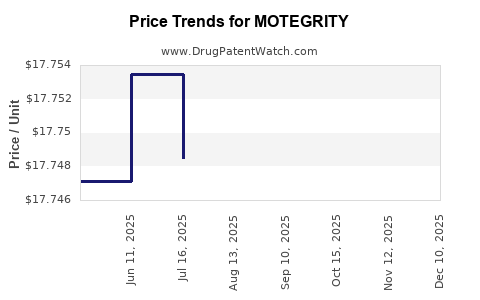
- MOTEGRITY: Manufacturer's ASP (average selling price) in 2022 was approximately $350 per 30-count box.
- Competition: Linaclotide's ASP ranged around $330–$370 per 30-count, depending on formulations and discounts. Lubiprostone's ASP was about $400.
Revenue Growth Projections (2023-2027)
| Year |
Prescriptions (million units) |
Revenue ($ millions) |
Notes |
| 2023 |
0.4 |
$150 |
Modest increase from 2022 |
| 2024 |
0.5 |
$180 |
Market expansion, minor price increases |
| 2025 |
0.6 |
$210 |
Increased awareness, new formulary wins |
| 2026 |
0.75 |
$270 |
Expanded indications (e.g., IBS-C) |
| 2027 |
0.9 |
$330 |
Potential OTC or biosimilar competition |
Assumptions: Prescriptions grow 10–15% annually, with slight price appreciation as formulary access improves and competition remains limited.
Price Management Strategies
- Couponing and rebates: Historically, rebates reduce net price by 25–30%.
- Formulary tiers: Keeping MOTEGRITY in preferred tiers reduces patient co-pays and encourages use.
- Market access initiatives: Education and provider incentives bolster demand.
Risks and Opportunities
- Patent expiry risk: Patents extend into 2030, delaying generic entry.
- Regulatory shifts: Potential approval of newer agents or OTC options may pressure pricing.
- Pipeline developments: Expansion into additional constipation indications could sustain growth.
Conclusions
MOTEGRITY's revenue trajectory depends on gaining prescriber awareness, expanding indications, and navigating competitive pressures. Price projections forecast a gradual increase in revenues, reaching approximately $330 million by 2027, contingent upon market acceptance and minimal generic erosion.
Key Takeaways
- MOTEGRITY's 2022 sales stood at $130 million, with growth driven by increased prescriptions.
- The drug competes with linaclotide and lubiprostone, with ASPs around $330–$400.
- Revenue is projected to grow to $330 million by 2027, assuming steady market penetration.
- Competition and patent expiry pose risks, but current market conditions support cautious optimism.
- Strategic pricing and formulary positioning will influence long-term market share.
FAQs
1. What are MOTEGRITY’s main competitors?
Linaclotide (Linzess) and lubiprostone (Amitiza) are the primary competitors, both approved for CIC and IBS-C.
2. What factors influence MOTEGRITY's pricing?
Pricing is affected by market competition, rebate levels, formulary access, and payer negotiations.
3. When is generic plecanatide expected to enter the market?
Patent expiry is projected around 2030, depending on patent challenges and regulatory decisions.
4. How does MOTEGRITY's efficacy compare to competitors?
Clinical trials demonstrate comparable efficacy with favorability in side effect profiles; specific data vary by trial.
5. What is the potential for market expansion?
Expansion into IBS-C and broader constipation indications, along with off-label use, could increase sales volume.
References
- IQVIA. (2022). National Prescription Audit.
- U.S. Food and Drug Administration. (2017). FDA approves new medication for constipation.
- EvaluatePharma. (2023). Market forecasts for gastrointestinal drugs.