Share This Page
Drug Sales Trends for MIRAPEX ER
✉ Email this page to a colleague
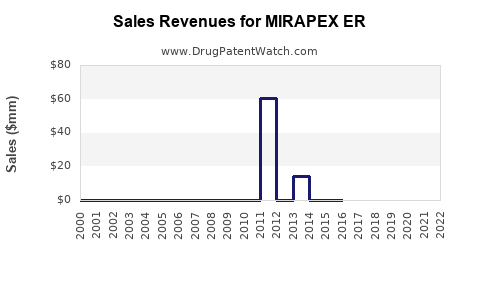
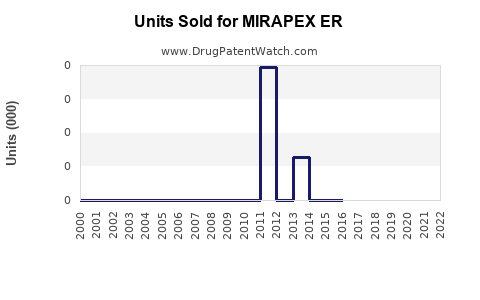
Annual Sales Revenues and Units Sold for MIRAPEX ER
| Drug Name | Revenues (USD) | Units | Year |
|---|---|---|---|
| MIRAPEX ER | ⤷ Start Trial | ⤷ Start Trial | 2022 |
| MIRAPEX ER | ⤷ Start Trial | ⤷ Start Trial | 2021 |
| MIRAPEX ER | ⤷ Start Trial | ⤷ Start Trial | 2020 |
| MIRAPEX ER | ⤷ Start Trial | ⤷ Start Trial | 2019 |
| MIRAPEX ER | ⤷ Start Trial | ⤷ Start Trial | 2018 |
| MIRAPEX ER | ⤷ Start Trial | ⤷ Start Trial | 2017 |
| MIRAPEX ER | ⤷ Start Trial | ⤷ Start Trial | 2016 |
| >Drug Name | >Revenues (USD) | >Units | >Year |
MIRAPEX ER Market Analysis, Sales Projections, Patent Risk, and Generic Competition
MIRAPEX ER, the extended-release formulation of pramipexole dihydrochloride, is a mature Parkinson's disease and restless legs syndrome product with limited remaining commercial value as a branded medicine. U.S. market economics are driven by generic substitution, low pricing, and declining use of dopamine agonists relative to levodopa and newer Parkinson's therapies. A reasonable base-case estimate places global MIRAPEX ER and equivalent extended-release pramipexole sales below $50 million annually, with continued erosion through 2029.
What is MIRAPEX ER and who markets it?
MIRAPEX ER contains pramipexole dihydrochloride in an extended-release tablet. It is a dopamine agonist approved in the United States for:
- Parkinson's disease.
- Moderate-to-severe primary restless legs syndrome, under the immediate-release formulation labeling rather than the same ER commercial positioning.
The original innovator was Boehringer Ingelheim. The U.S. product was approved under NDA 022421 in 2010.[1] MIRAPEX ER was developed to provide once-daily dosing compared with the multiple daily doses required for immediate-release pramipexole.
| Product | Active ingredient | Dosage form | Primary U.S. use | Original sponsor |
|---|---|---|---|---|
| Mirapex | Pramipexole dihydrochloride | Immediate-release tablet | Parkinson's disease; restless legs syndrome | Boehringer Ingelheim |
| MIRAPEX ER | Pramipexole dihydrochloride | Extended-release tablet | Parkinson's disease | Boehringer Ingelheim |
| Generic pramipexole ER | Pramipexole dihydrochloride | Extended-release tablet | Parkinson's disease | Multiple generic manufacturers |
The product is not a biologic, so biosimilar competition is not relevant. Competition comes from generic small-molecule products and alternative Parkinson's therapies.
What is the FDA and Orange Book status of MIRAPEX ER?
The FDA approved MIRAPEX ER in November 2010. The product's commercial position is now mature, and generic versions have entered the U.S. market. FDA labeling identifies the drug as an extended-release pramipexole product for once-daily Parkinson's disease treatment.[1]
The Orange Book remains the principal source for determining active U.S. patents, regulatory exclusivity, and patent certifications. For a mature product such as MIRAPEX ER, the commercial question is less whether the original brand retains market exclusivity and more whether generic approvals, manufacturing scale, and payer substitution have eliminated branded pricing power.
Key regulatory facts include:
| Regulatory item | Assessment |
|---|---|
| U.S. NDA | 022421 |
| FDA approval | 2010 |
| Active ingredient | Pramipexole dihydrochloride |
| Product type | Small-molecule extended-release tablet |
| Biosimilar exposure | None |
| Generic substitution | High |
| Current commercial status | Mature, generic-exposed product |
Public company filings do not generally disclose MIRAPEX ER revenue separately from broader Parkinson's disease portfolios. Product-specific sales must therefore be estimated using prescription volume, payer mix, treatment prevalence, and generic pricing.
When did MIRAPEX ER lose exclusivity?
MIRAPEX ER's commercial exclusivity ended after the expiry of its relevant patent and regulatory protection. The original immediate-release pramipexole franchise had already reached maturity before the extended-release launch. The ER product did not create a durable second-cycle franchise because generic competition eventually reached the U.S. market and compressed price.
Patent analysis should distinguish among:
- The original compound patent for pramipexole.
- Extended-release formulation patents.
- Method-of-use patents covering Parkinson's disease treatment.
- Manufacturing and solid-state patents.
- Regulatory exclusivity associated with the NDA.
The strongest historical protection related to the formulation and release profile rather than the underlying molecule. Once generic manufacturers obtained approval for equivalent extended-release tablets, the remaining formulation barriers lost most of their commercial value.
Publicly available information does not support treating MIRAPEX ER as a product with meaningful current branded exclusivity. The practical market position is generic competition, not protected originator pricing.
What patents protect MIRAPEX ER?
MIRAPEX ER was protected primarily through patents covering extended-release delivery and pharmaceutical compositions. The relevant patent estate was more limited than the patent estates surrounding newer specialty medicines because:
- Pramipexole is an established small molecule.
- The active ingredient has a long clinical history.
- Extended-release tablets are technically reproducible.
- Generic manufacturers can design around individual formulation claims.
- Parkinson's disease method-of-use claims generally provide weaker protection after generic approval.
Patent strength is therefore moderate historically and weak commercially at present. A formulation patent can delay generic entry if it covers a necessary release profile and survives validity challenges. It has less value once an approved generic has entered the market or once physicians can substitute immediate-release pramipexole, levodopa, rotigotine, or other dopamine agonists.
A current transaction or litigation diligence review should verify the live Orange Book entries, patent expiration dates, pediatric extensions, and any Paragraph IV litigation docket. Public information does not indicate a significant ongoing U.S. patent dispute capable of restoring branded exclusivity.
Were there Paragraph IV challenges to MIRAPEX ER?
Generic manufacturers commonly use Paragraph IV certifications when they contend that listed patents are invalid, unenforceable, or not infringed. MIRAPEX ER's generic-entry history should be reviewed through FDA ANDA records and federal court dockets because a Paragraph IV certification can trigger a 30-month stay if the patent holder files suit within the statutory period.
The commercial impact of any historical Paragraph IV challenge was temporary. Once generic approval and substitution became available, the market shifted toward low-cost pramipexole ER. There is no current indication that a Paragraph IV dispute materially constrains supply or preserves a premium price for the branded product.
How large is the MIRAPEX ER market?
The market is small relative to major Parkinson's products. Pramipexole competes with:
- Immediate-release pramipexole.
- Ropinirole and ropinirole extended release.
- Rotigotine transdermal patch.
- Levodopa/carbidopa.
- Rasagiline and other adjunctive therapies.
- Apomorphine and advanced device-based treatments for later-stage disease.
MIRAPEX ER has clinical advantages in once-daily administration and reduced dosing frequency. Those benefits are not sufficient to support a large premium after generic entry. Physicians also increasingly balance dopamine agonists against adverse effects such as somnolence, impulse-control disorders, hallucinations, edema, and orthostatic hypotension.[2]
Estimated market size
The following estimates are analytical scenarios rather than reported company guidance.
| Year | U.S. MIRAPEX ER and generic market | Global market | Expected trend |
|---|---|---|---|
| 2024 | $15 million-$30 million | $30 million-$60 million | Mature generic market |
| 2025 | $13 million-$27 million | $27 million-$54 million | Price erosion |
| 2026 | $11 million-$24 million | $24 million-$49 million | Continued substitution |
| 2027 | $9 million-$21 million | $21 million-$44 million | Lower branded participation |
| 2028 | $8 million-$19 million | $19 million-$40 million | Stable low-value generic demand |
| 2029 | $7 million-$17 million | $17 million-$37 million | Gradual volume decline |
The modeled compound annual decline is approximately 6% to 9%, depending on the degree of generic substitution and the rate at which clinicians move patients to alternative therapies.
What are the MIRAPEX ER sales projections?
A base-case forecast assumes:
- No meaningful reintroduction of branded MIRAPEX ER.
- Stable Parkinson's disease prevalence.
- Gradual decline in dopamine agonist utilization.
- Continued generic price erosion.
- No major supply interruption.
- Limited switching from immediate-release to extended-release therapy.
Under those assumptions, global sales attributable to the MIRAPEX ER extended-release franchise could decline from approximately $30 million-$60 million in 2024 to $17 million-$37 million by 2029.
Scenario analysis
| Scenario | 2029 global sales | Principal assumptions |
|---|---|---|
| Upside | $40 million-$55 million | Higher adherence to once-daily therapy, slower switching to competing classes |
| Base case | $17 million-$37 million | Ongoing generic substitution and moderate volume decline |
| Downside | $8 million-$18 million | Rapid generic price compression and declining dopamine agonist use |
These figures represent market revenue, not originator revenue. Boehringer Ingelheim's branded share could be materially below the total market estimate where generic substitution is established.
How strong is the MIRAPEX ER patent estate?
The patent estate is commercially weak for new investment. Its strengths are limited to the product's established formulation and once-daily delivery profile. Its weaknesses are more significant:
- The active ingredient is old and widely known.
- Generic manufacturers can compete on price.
- Treatment guidelines and clinical practice provide alternatives.
- Extended-release products face formulation design-around risk.
- Method-of-use patents do not prevent treatment with alternative Parkinson's drugs.
- Brand loyalty is limited in a prescription market subject to payer substitution.
A formulation patent could still matter in a narrow jurisdiction or for a specific generic product. It is unlikely to support a broad global exclusivity strategy.
What generic entry risks exist for MIRAPEX ER?
The primary generic risks are price compression and loss of formulary control. Generic manufacturers can enter through abbreviated approval pathways if they demonstrate pharmaceutical equivalence, bioequivalence, and compliance with applicable quality standards.
Competitive risks include:
- Multiple generic suppliers competing for pharmacy and payer contracts.
- Substitution from ER to immediate-release pramipexole.
- Use of ropinirole ER or rotigotine for patients requiring dopamine agonist therapy.
- Greater use of levodopa in older patients or those with advanced disease.
- Lower persistence because adverse-effect concerns limit dopamine agonist use.
Manufacturing barriers are not negligible. Extended-release tablets require controlled dissolution, consistent granulation, robust in-process testing, and reliable supply of the active pharmaceutical ingredient. These requirements can produce short-term shortages, but they are unlikely to create durable market power for one supplier.
How does MIRAPEX ER compare with competing Parkinson's drugs?
| Product | Main advantage | Main commercial constraint |
|---|---|---|
| MIRAPEX ER | Once-daily pramipexole dosing | Generic competition and dopamine agonist safety concerns |
| Immediate-release pramipexole | Low cost and established use | More frequent dosing |
| Ropinirole ER | Once-daily dopamine agonist option | Generic competition |
| Rotigotine patch | Non-oral delivery | Patch cost, skin reactions, generic limitations |
| Levodopa/carbidopa | Strong symptomatic efficacy | Motor complications with long-term use |
| Apomorphine | Rescue or advanced-therapy use | Administration complexity and narrow patient population |
MIRAPEX ER is most exposed to generic ropinirole ER and immediate-release pramipexole. Levodopa is a broader clinical competitor but does not provide a direct formulation substitute.
What licensing deals or litigation affect MIRAPEX ER?
No major current licensing transaction appears to create a material change in the commercial outlook for MIRAPEX ER. The product's value is primarily tied to legacy commercialization and generic supply rather than active business development.
Likewise, no publicly identified litigation appears likely to restore exclusivity or materially increase forecast revenue. Historical patent litigation and Paragraph IV activity may have affected the timing of generic entry, but the product's current revenue profile reflects post-exclusivity economics.
Key Takeaways
- MIRAPEX ER is a mature extended-release pramipexole product approved by the FDA in 2010.
- The product is exposed to generic competition and has limited branded pricing power.
- The U.S. market is likely worth approximately $13 million-$27 million in 2025 across branded and generic extended-release pramipexole.
- Global market revenue could decline from approximately $30 million-$60 million in 2024 to $17 million-$37 million by 2029.
- The patent estate has historical formulation value but weak current commercial strength.
- Biosimilar risk is irrelevant because pramipexole is a small molecule.
- The largest risks are generic price erosion, declining dopamine agonist use, and substitution with immediate-release pramipexole or alternative Parkinson's therapies.
- No current litigation or licensing event appears capable of materially changing the market outlook.
FAQs
Is MIRAPEX ER still sold in the United States?
MIRAPEX ER has a mature commercial position, while extended-release pramipexole remains available through generic manufacturers. Brand availability and pharmacy stocking may vary by market.
What is the generic name for MIRAPEX ER?
The generic name is pramipexole dihydrochloride extended-release tablets.
Is MIRAPEX ER more effective than immediate-release pramipexole?
MIRAPEX ER primarily offers once-daily administration. Clinical efficacy is generally comparable when patients receive equivalent total daily exposure, but tolerability and adherence vary.
Is pramipexole ER a high-growth pharmaceutical market?
No. The market is mature and expected to contract gradually because of generic pricing, alternative therapies, and declining use of dopamine agonists in some patient populations.
Does MIRAPEX ER have biosimilar competition?
No. Biosimilars apply to biologic medicines. MIRAPEX ER is a chemically synthesized small-molecule drug and faces generic, not biosimilar, competition.
References
- U.S. Food and Drug Administration. (2010). MIRAPEX ER (pramipexole dihydrochloride) extended-release tablets: Prescribing information. FDA.
- U.S. Food and Drug Administration. (2023). Drugs@FDA: MIRAPEX ER application and labeling records. FDA.
- U.S. Food and Drug Administration. (2024). Approved drug products with therapeutic equivalence evaluations, 44th ed. FDA.
- National Institute of Neurological Disorders and Stroke. (2024). Parkinson's disease: Treatment and management information. National Institutes of Health.
- U.S. Food and Drug Administration. (2024). Orange Book: Approved drug products with therapeutic equivalence evaluations. FDA.
More… ↓
