Last updated: July 22, 2026
Miralax (polyethylene glycol 3350, PEG 3350; branded osmotic laxative) is largely a generic-commoditized product in the US. The near-term market dynamics are driven less by “patent exclusivity” and more by brand-funded distribution, payer position, switchability to AB-rated generics, and formulation/packaging variations. The financial trajectory in most markets trends with long-lived, stable demand and price pressure from generic entry, with upside concentrated in channel mix, higher-priced delivery formats, and brand relaunches rather than new clinical differentiation.
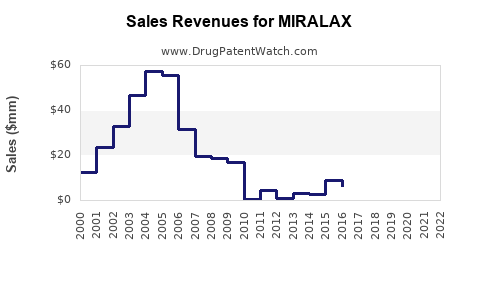
What is Miralax’s market size and how has sales trended?
Featured snippet answer: Miralax is a long-cycle, maintenance-style OTC laxative with mature penetration; sales growth typically follows population and constipation prevalence, while revenue per unit declines as generics expand distribution and as list price resets under payer and wholesale discounting.
US commercialization footprint
- Miralax is sold as an oral osmotic laxative for constipation in adults and children (age indication differs by labeling and product/pack).
- Brand economics are shaped by OTC channel mix:
- Pharmacy chains and club stores often push value brands and private-label PEG products.
- Online and DTC can sustain brand pricing but usually face aggressive couponing and marketplace price competition.
Pricing mechanics that drive financial trajectory
- PEG 3350 is a commodity active ingredient; the brand premium narrows over time.
- Revenue trajectory is typically a function of:
- Unit volume (chronic constipation and caregiver replenishment)
- Net price realization (seasonality, promo intensity, pharmacy reimbursement)
- Pack architecture (single-dose vs multi-dose, powder vs alternative formats in-market)
- Distribution coverage (planogram depth and retailer shelf allocation)
Competitive baseline
- The core competitive set is AB-rated generics and private label PEG 3350 laxatives.
- Brand vs generic differentiation relies on:
- Branding and trust in dosing
- Pack convenience and instructions
- Retail placement and trade terms
How do generic and private-label PEG 3350 products affect Miralax revenue?
Featured snippet answer: Generic and private-label PEG 3350 compress Miralax gross margin and cap long-term revenue growth; the brand retains share through customer loyalty, channel relationships, and package-level merchandising rather than API exclusivity.
Generic entry risk model (economic, not legal)
Because PEG 3350’s active ingredient is widely available in generic form, the “entry” event is largely already realized in most major markets. The remaining risk is iterative:
- deeper price cuts by generics
- increased private-label penetration
- retailer contracting changes that reduce brand shelf space
What historically drives share shifts
- Price-led switches at the pharmacy counter
- Bulk purchases and online subscription listings
- “New look, same ingredient” substitution campaigns by wholesalers and chains
When does Miralax lose exclusivity and how does that change the financial outlook?
Featured snippet answer: For a mature OTC PEG 3350 brand, practical exclusivity is driven by any remaining formulation, method, or packaging IP rather than active-ingredient coverage. Once generics are established, the financial profile becomes “brand-funded economics” rather than “patent-funded economics.”
Patent landscape impact on financial trajectory
- The financial effect of exclusivity loss shows up as:
- lower net pricing via increased promo and retailer rebates
- accelerated share transfer to generics
- reduced ability to sustain premium pack pricing
Practical timeline framing for stakeholders
- Expect front-loaded declines around legal and regulatory milestones, then a plateau where the brand survives on trust and packaging until trade terms tighten further.
What patents protect Miralax and how strong is the remaining estate?
Featured snippet answer: The value-at-risk for Miralax today is primarily incremental IP on specific formulations, dosing systems, or packaging, not the PEG 3350 active ingredient itself, which is long since off active-ingredient exclusivity in commercial reality.
Where remaining IP would matter commercially
- Bottle/carton packaging configurations
- Device-like dosing accessories or convenience formats
- Specific manufacturing/process claims relevant to stability or impurity profiles (only if they block generic manufacturing equivalency in practice)
Litigation and enforceability
- For a commodity active ingredient already genericized, enforcement typically targets narrow product-specific design points rather than broad API manufacturing.
- The economic ceiling on the brand usually aligns with how easily competitors can replicate the consumer-facing product.
What is the Orange Book status of Miralax?
Featured snippet answer: Miralax is a widely marketed OTC product; the Orange Book listing framework mainly supports prescription generics and application-level exclusivity/ANDA triggers. The practical “Orange Book” barrier to genericization for PEG 3350 is limited because the product category is heavily genericized.
US regulatory status implications
- OTC monographs and reformulations can move faster than prescription exclusivity models.
- AB-rating and OTC substitutability reduce payer-like lock-in.
How does Miralax compare with competing laxatives on market dynamics and pricing?
Featured snippet answer: Miralax is part of the osmotic laxative class where competition is both “same-ingredient” (PEG 3350 generics) and “class-based” (other osmotics and stimulant alternatives). Class competition drives share even if the PEG 3350 generic market is stable.
Competitive classes that shift demand
- Other osmotic laxatives (eg, lactulose, magnesium-based agents depending on label)
- Stimulant laxatives (senna, bisacodyl)
- Stool softeners and combination products
- Prescription agents for chronic constipation (where covered): these can siphon segment demand under insurance formularies
Channel-based substitution
- Value shelf strategies in retail pharmacy increase cross-brand switching between osmotics.
- Subscription platforms can concentrate demand around perceived “gentle” profiles, sustaining some brand loyalty.
What generic entry risks exist for Miralax and what would they look like financially?
Featured snippet answer: The biggest remaining generic entry risk is not a single “new entrant,” but continued retail price compression and private-label expansion. Financially, this shows up as net price erosion and gross margin squeeze.
Scenario impacts for stakeholders
- Base case: stable volume, declining net price from incremental promo intensity.
- Downside case: retailer contracts further increase price gap; share transfer accelerates, producing both volume and price pressure.
- Upside case: packaging differentiation or targeted promotional strategy improves net price realization and stabilizes unit economics.
What formulation and packaging changes matter for Miralax’s commercial trajectory?
Featured snippet answer: For mature OTC brands, format and packaging changes are often the most material levers after IP commoditization, because they affect shelf performance, convenience perception, and willingness to pay.
Pack-level drivers
- Dose-count convenience (how quickly consumers can access correct dosing)
- Ease of mixing and tolerability perception
- Child-safe dispensing and caregiver usability
- Multi-pack bundling that supports household replenishment cycles
Manufacturing and supply reliability
- Availability shocks can temporarily shift share to substitutes and then to the brand upon normalization.
- If supply constraints hit, pricing power can spike short term, but it rarely changes long-term trajectory unless tied to structural supply changes.
How do payer and channel dynamics influence Miralax profitability?
Featured snippet answer: Even for OTC, channel dynamics act like payer dynamics through retailer rebates, private-label rules, and pharmacy chain contracting. These mechanisms determine whether Miralax sustains a premium or sells largely at parity.
Trade and retail economics
- Retail pharmacy pricing is driven by:
- wholesale acquisition cost and discounting
- retailer-funded promotional mechanics
- planogram requirements and seasonal constipation promotion cycles
Online economics
- Marketplace pricing is frequently dominated by the lowest-cost PEG 3350 supply chain.
- Brand strength in e-commerce depends on:
- inventory availability
- review perception
- marketing and bundled pricing
- subscription discounts
Does Miralax face biosimilar-like risk?
Featured snippet answer: No. Miralax is a small-molecule active ingredient product; there is no biosimilar regulatory pathway.
What litigation or regulatory events could affect Miralax’s financial trajectory?
Featured snippet answer: For a commodity PEG 3350 OTC brand, litigation events typically have limited effect unless they target narrow product design or manufacturing method claims that block competitive versions.
Event types that matter
- Narrow formulation injunctions that affect commercialization timelines
- Consumer product safety recalls that create temporary demand spikes for substitutes or long-term trust effects
- Supply chain disruptions that force substitution
Key competitive landscape overview for Miralax (US, OTC laxatives)
Featured snippet answer: Competition is dense and mostly driven by AB-equivalent PEG 3350 generics and private-label products, plus class alternatives (other osmotics and stimulant laxatives).
Competitive segments
- Direct active-ingredient substitutes: PEG 3350 generics and private label
- Indirect substitutes: lactulose, magnesium products, stimulant laxatives
- Prescription-driven alternatives for chronic constipation under insurance coverage: demand can shift away from OTC depending on formulary access
Key takeaways
- Miralax’s financial trajectory is driven by mature, stable demand plus continuous net price pressure from PEG 3350 generics and private label.
- The largest commercial lever after commodity IP loss is packaging and channel execution that protects net pricing and share.
- Remaining legal/IP impact is likely incremental (formulation/packaging/method scope), while the dominant driver of revenue and margin is retailer contracting and promotional intensity.
- Expect low “cliff risk” and higher “gradual compression” risk through ongoing price competition.
FAQs
-
What drives Miralax seasonal sales spikes?
Constipation incidence and retail promotion cycles, often with predictable peaks around seasonal behavioral changes and higher OTC demand periods.
-
Which channels are most price-sensitive for Miralax versus which sustain brand premium?
Online marketplaces and club/discount retailers usually show higher price sensitivity; pharmacy chain placement and managed planogram depth can sustain higher net realization.
-
How do private-label PEG 3350 products change Miralax unit economics?
They compress shelf-level willingness to pay and typically force Miralax to increase promo frequency or trade spending to maintain share.
-
Do formulation changes like dosing convenience packs materially affect Miralax growth?
Yes, where they improve shelf performance and reduce friction in dosing for caregivers, they can slow share loss and support better net pricing.
-
How would a supply disruption affect Miralax revenue in the short term?
Short-term brand pricing power can increase, but long-term demand can move to substitutes; recovery depends on how quickly supply normalizes and whether retailers keep substitute brands in prime shelf positions.
References (APA)
- US Food and Drug Administration. (n.d.). Orange Book: Approved Drug Products with Therapeutic Equivalence Evaluations. https://www.accessdata.fda.gov/scripts/cder/daf/
- FDA. (n.d.). Drug Shortages. https://www.fda.gov/drugs/drug-safety-and-availability/drug-shortages