Last Updated: August 10, 2026

MIEBO Drug Patent Profile


✉ Email this page to a colleague

« Back to Dashboard


When do Miebo patents expire, and what generic alternatives are available?

Miebo is a drug marketed by Bausch And Lomb Inc and is included in one NDA. There are six patents protecting this drug.

This drug has one hundred and nine patent family members in sixteen countries.

The generic ingredient in MIEBO is perfluorohexyloctane. One supplier is listed for this compound. Additional details are available on the perfluorohexyloctane profile page.

DrugPatentWatch® Generic Entry Outlook for Miebo

Miebo will be eligible for patent challenges on May 18, 2027. This date may extended up to six months if a pediatric exclusivity extension is applied to the drug's patents.

By analyzing the patents and regulatory protections it appears that the earliest date for generic entry will be May 18, 2028. This may change due to patent challenges or generic licensing.

Indicators of Generic Entry

< Available with Subscription >

  Start Trial

AI Deep Research
Questions you can ask:
  • What is the 5 year forecast for MIEBO?
  • What are the global sales for MIEBO?
  • What is Average Wholesale Price for MIEBO?
Summary for MIEBO
International Patents:109
US Patents:6
Applicants:1
NDAs:1
Finished Product Suppliers / Packagers: 1
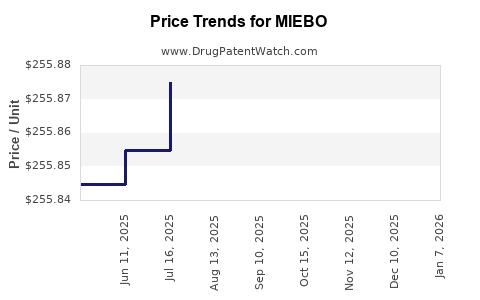
Drug Prices: Drug price information for MIEBO
Patent Litigation and PTAB cases: See patent lawsuits and PTAB cases for MIEBO
What excipients (inactive ingredients) are in MIEBO?MIEBO excipients list
DailyMed Link:MIEBO at DailyMed
DrugPatentWatch® Estimated Loss of Exclusivity (LOE) Date for MIEBO
Generic Entry Date for MIEBO*:
Constraining patent/regulatory exclusivity:

NEW CHEMICAL ENTITY

NDA:
Dosage:

SOLUTION/DROPS;OPHTHALMIC

*The generic entry opportunity date is the latter of the last compound-claiming patent and the last regulatory exclusivity protection. Many factors can influence early or later generic entry. This date is provided as a rough estimate of generic entry potential and should not be used as an independent source.

Pharmacology for MIEBO

US Patents and Regulatory Information for MIEBO

MIEBO is protected by six US patents and one FDA Regulatory Exclusivity.

Based on analysis by DrugPatentWatch, the earliest date for a generic version of MIEBO is ⤷  Start Trial.

This potential generic entry date is based on NEW CHEMICAL ENTITY.

Generics may enter earlier, or later, based on new patent filings, patent extensions, patent invalidation, early generic licensing, generic entry preferences, and other factors.

Applicant Tradename Generic Name Dosage NDA Approval Date TE Type RLD RS Patent No. Patent Expiration Product Substance Delist Req. Exclusivity Expiration
Bausch And Lomb Inc MIEBO perfluorohexyloctane SOLUTION/DROPS;OPHTHALMIC 216675-001 May 18, 2023 RX Yes Yes ⤷  Start Trial ⤷  Start Trial ⤷  Start Trial
>Applicant >Tradename >Generic Name >Dosage >NDA >Approval Date >TE >Type >RLD >RS >Patent No. >Patent Expiration >Product >Substance >Delist Req. >Exclusivity Expiration

International Patents for MIEBO

When does loss-of-exclusivity occur for MIEBO?

Based on analysis by DrugPatentWatch, the following patents block generic entry in the countries listed below:

Australia

Patent: 13314303
Estimated Expiration: ⤷  Start Trial

Patent: 13314370
Estimated Expiration: ⤷  Start Trial

Patent: 16219611
Estimated Expiration: ⤷  Start Trial

Patent: 17200907
Estimated Expiration: ⤷  Start Trial

Patent: 18201364
Estimated Expiration: ⤷  Start Trial

Brazil

Patent: 2015004997
Estimated Expiration: ⤷  Start Trial

Patent: 2015005008
Estimated Expiration: ⤷  Start Trial

Patent: 2019024319
Estimated Expiration: ⤷  Start Trial

Canada

Patent: 83002
Estimated Expiration: ⤷  Start Trial

Patent: 83003
Estimated Expiration: ⤷  Start Trial

Patent: 97744
Estimated Expiration: ⤷  Start Trial

Patent: 42049
Estimated Expiration: ⤷  Start Trial

China

Patent: 4619314
Estimated Expiration: ⤷  Start Trial

Patent: 4755073
Estimated Expiration: ⤷  Start Trial

Patent: 6511322
Estimated Expiration: ⤷  Start Trial

Patent: 3679697
Estimated Expiration: ⤷  Start Trial

Patent: 3679698
Estimated Expiration: ⤷  Start Trial

Patent: 3679699
Estimated Expiration: ⤷  Start Trial

Patent: 3694048
Estimated Expiration: ⤷  Start Trial

Patent: 3952321
Estimated Expiration: ⤷  Start Trial

Denmark

Patent: 95144
Estimated Expiration: ⤷  Start Trial

Patent: 81119
Estimated Expiration: ⤷  Start Trial

European Patent Office

Patent: 95144
Estimated Expiration: ⤷  Start Trial

Patent: 95158
Estimated Expiration: ⤷  Start Trial

Patent: 00722
Estimated Expiration: ⤷  Start Trial

Patent: 81119
Estimated Expiration: ⤷  Start Trial

Patent: 88847
Estimated Expiration: ⤷  Start Trial

Patent: 42537
Estimated Expiration: ⤷  Start Trial

Germany

Patent: 2013012742
Estimated Expiration: ⤷  Start Trial

Patent: 2013012753
Estimated Expiration: ⤷  Start Trial

Hong Kong

Patent: 10041
Estimated Expiration: ⤷  Start Trial

Patent: 10052
Estimated Expiration: ⤷  Start Trial

Japan

Patent: 39152
Estimated Expiration: ⤷  Start Trial

Patent: 53717
Estimated Expiration: ⤷  Start Trial

Patent: 52266
Estimated Expiration: ⤷  Start Trial

Patent: 52366
Estimated Expiration: ⤷  Start Trial

Patent: 40893
Estimated Expiration: ⤷  Start Trial

Patent: 40919
Estimated Expiration: ⤷  Start Trial

Patent: 15527386
Estimated Expiration: ⤷  Start Trial

Patent: 15531344
Estimated Expiration: ⤷  Start Trial

Patent: 16193931
Estimated Expiration: ⤷  Start Trial

Patent: 17048228
Estimated Expiration: ⤷  Start Trial

Patent: 18111704
Estimated Expiration: ⤷  Start Trial

Patent: 18150377
Estimated Expiration: ⤷  Start Trial

Patent: 19001818
Estimated Expiration: ⤷  Start Trial

Patent: 20073535
Estimated Expiration: ⤷  Start Trial

Malaysia

Patent: 5124
Patent: SEMIFLUORINATED ALKANE COMPOSITIONS
Estimated Expiration: ⤷  Start Trial

Patent: 6228
Patent: COMPOSITIONS COMPRISING MIXTURES OF SEMIFLUORINATED ALKANES
Estimated Expiration: ⤷  Start Trial

Mexico

Patent: 0588
Patent: COMPOSICIONES DE ALCANOS SEMIFLUORADOS. (SEMIFLUORINATED ALKANE COMPOSITIONS.)
Estimated Expiration: ⤷  Start Trial

Patent: 0469
Patent: COMPOSICIONES QUE COMPRENDEN MEZCLAS DE ALCANOS SEMIFLUORADOS. (COMPOSITIONS COMPRISING MIXTURES OF SEMIFLUORINATED ALKANES.)
Estimated Expiration: ⤷  Start Trial

Patent: 3182
Patent: COMPOSICIONES QUE COMPRENDEN MEZCLAS DE ALCANOS SEMIFLUORADOS. (COMPOSITIONS COMPRISING MIXTURES OF SEMIFLUORINATED ALKANES.)
Estimated Expiration: ⤷  Start Trial

Patent: 15003228
Patent: COMPOSICIONES DE ALCANOS SEMIFLUORADOS. (SEMIFLUORINATED ALKANE COMPOSITIONS.)
Estimated Expiration: ⤷  Start Trial

Patent: 15003229
Patent: COMPOSICIONES QUE COMPRENDEN MEZCLAS DE ALCANOS SEMIFLUORADOS. (COMPOSITIONS COMPRISING MIXTURES OF SEMIFLUORINATED ALKANES.)
Estimated Expiration: ⤷  Start Trial

Poland

Patent: 95144
Estimated Expiration: ⤷  Start Trial

Patent: 81119
Estimated Expiration: ⤷  Start Trial

Patent: 88847
Estimated Expiration: ⤷  Start Trial

Portugal

Patent: 95144
Estimated Expiration: ⤷  Start Trial

Patent: 81119
Estimated Expiration: ⤷  Start Trial

South Korea

Patent: 1874219
Estimated Expiration: ⤷  Start Trial

Patent: 2115111
Estimated Expiration: ⤷  Start Trial

Patent: 2158400
Estimated Expiration: ⤷  Start Trial

Patent: 2171897
Estimated Expiration: ⤷  Start Trial

Patent: 150054996
Patent: 부분불소화 알칸의 혼합물을 포함하는 조성물 (COMPOSITIONS COMPRISING MIXTURES OF SEMIFLUORINATED ALKANES)
Estimated Expiration: ⤷  Start Trial

Patent: 150054997
Patent: 부분불소화 알칸 조성물 (SEMIFLUORINATED ALKANE COMPOSITIONS)
Estimated Expiration: ⤷  Start Trial

Patent: 160104747
Patent: 부분불소화 알칸의 혼합물을 포함하는 조성물 (COMPOSITIONS COMPRISING MIXTURES OF SEMIFLUORINATED ALKANES)
Estimated Expiration: ⤷  Start Trial

Patent: 180101640
Patent: 부분불소화 알칸 조성물 (SEMIFLUORINATED ALKANE COMPOSITIONS)
Estimated Expiration: ⤷  Start Trial

Spain

Patent: 21226
Estimated Expiration: ⤷  Start Trial

Patent: 45084
Estimated Expiration: ⤷  Start Trial

Patent: 70398
Estimated Expiration: ⤷  Start Trial

Patent: 65828
Estimated Expiration: ⤷  Start Trial

Patent: 74663
Estimated Expiration: ⤷  Start Trial

Generics may enter earlier, or later, based on new patent filings, patent extensions, patent invalidation, early generic licensing, generic entry preferences, and other factors.

See the table below for additional patents covering MIEBO around the world.

Country Patent Number Title Estimated Expiration
Australia 2013314303 ⤷  Start Trial
Australia 2013314370 ⤷  Start Trial
Australia 2016219611 ⤷  Start Trial
Australia 2017200907 ⤷  Start Trial
>Country >Patent Number >Title >Estimated Expiration

MIEBO Market Dynamics, Revenue Growth, Patent Protection and Generic Entry Risk

Last updated: August 4, 2026

MIEBO, Bausch + Lomb’s perfluorohexyloctane ophthalmic solution, has become one of the company’s fastest-growing prescription products. U.S. sales reached approximately $211 million in 2024, compared with about $55 million during its partial 2023 launch period. The product addresses evaporative dry eye disease through direct reduction of tear-film evaporation rather than primarily suppressing ocular inflammation. Its commercial outlook depends on prescription conversion, payer access, repeat use, physician adoption and the timing of generic or competing ophthalmic products.

MIEBO received U.S. Food and Drug Administration approval on May 18, 2023, under NDA 214782. It is approved for the treatment of signs and symptoms of dry eye disease due to Meibomian gland dysfunction in adults. Bausch + Lomb markets the product in the United States, while the underlying technology originated with Novaliq GmbH. (U.S. Food and Drug Administration [FDA], 2023a; Bausch + Lomb, 2025a)

How large is the MIEBO market?

MIEBO operates in the prescription dry-eye market, which includes anti-inflammatory drugs, tear substitutes, secretagogues and products designed to stabilize the tear film.

The commercial target is particularly important because Meibomian gland dysfunction is a common cause of evaporative dry eye. MIEBO is positioned for patients whose symptoms are associated with lipid-layer dysfunction and excessive tear evaporation. The product does not require refrigeration and is administered as one drop in each affected eye four times daily. (FDA, 2023b)

Which products compete with MIEBO?

Product Active ingredient or technology Primary commercial position Competitive relationship
MIEBO Perfluorohexyloctane Tear evaporation reduction; Meibomian gland dysfunction Direct evaporative-dry-eye competitor
Restasis Cyclosporine ophthalmic emulsion Chronic ocular inflammation Indirect and substitution competitor
Xiidra Lifitegrast Ocular inflammation and dry-eye symptoms Indirect and substitution competitor
VEVYE Cyclosporine ophthalmic solution 0.1% Dry-eye disease and inflammation New branded prescription competitor
Tyrvaya Varenicline nasal spray Stimulates natural tear production Mechanistically distinct competitor
Generic cyclosporine products Cyclosporine ophthalmic formulations Lower-cost chronic therapy Payer and formulary competitor
Artificial tears Multiple lubricating agents Symptomatic relief Over-the-counter substitute

MIEBO’s principal differentiation is its nonaqueous, semifluorinated alkane formulation. The product is intended to spread across the ocular surface and reduce evaporation. The commercial proposition is strongest in patients with evaporative disease, inadequate response to lubricants or intolerance of anti-inflammatory treatments.

What were MIEBO’s sales and financial trajectory?

MIEBO generated approximately $211 million of net sales in 2024, compared with approximately $55 million in 2023. The 2023 figure reflected a limited launch period after FDA approval. On that basis, 2024 sales increased by roughly 280%.

Period Approximate MIEBO sales Commercial interpretation
2023 $55 million Partial-year launch
2024 $211 million Full-year expansion and prescription growth
2025 outlook Continued growth expected Dependent on access, adherence and competitive launches

Bausch + Lomb has described MIEBO as a major growth driver within its prescription pharmaceutical portfolio. The product’s revenue contribution remains small relative to the company’s overall sales, but its growth rate is materially higher than that of mature ophthalmic products. Bausch + Lomb reported approximately $5.1 billion in total 2024 revenue. MIEBO therefore represented roughly 4% of company-wide sales, while accounting for a larger share of incremental prescription-pharmaceutical growth. (Bausch + Lomb, 2025a)

What is driving MIEBO prescription growth?

The main commercial drivers are:

  1. Expansion of the U.S. ophthalmology and optometry sales effort.
  2. Increased recognition of Meibomian gland dysfunction as a distinct disease mechanism.
  3. Demand for a treatment directed at tear evaporation rather than only inflammation.
  4. Repeat use in a chronic condition.
  5. Potential use alongside anti-inflammatory dry-eye therapies.
  6. Patient and physician preference for a non-preserved, topical ophthalmic product.

The principal constraints are the four-times-daily dosing schedule, branded-drug pricing, insurance coverage, prior authorization requirements and competition from established generic cyclosporine products.

When does MIEBO lose regulatory exclusivity?

MIEBO’s FDA approval date was May 18, 2023. If the product received five-year new chemical entity exclusivity, the expected regulatory exclusivity period runs through May 18, 2028. An abbreviated new drug application containing a Paragraph IV certification generally could not be filed before the fourth anniversary of approval, or May 18, 2027, subject to the specific FDA regulatory classification and applicable statutory provisions.

FDA milestone Date
NDA approval May 18, 2023
Four-year Paragraph IV filing threshold, if NCE exclusivity applies May 18, 2027
Five-year NCE exclusivity expiration, if applicable May 18, 2028
Earliest potential generic launch Dependent on patent litigation, court findings and settlement terms

Regulatory exclusivity and patent protection are separate. The end of NCE exclusivity would permit certain ANDA filings, but it would not necessarily permit commercial launch if listed patents remain enforceable.

What patents protect MIEBO?

MIEBO’s intellectual-property position is based on patents covering perfluorohexyloctane and related perfluoroalkyl compounds, ophthalmic compositions, and methods of treating ocular-surface disorders. Novaliq GmbH is associated with the underlying technology, while Bausch + Lomb has commercial rights in the United States.

The relevant patent estate can include:

  • Composition-of-matter patents covering perfluoroalkyl compounds.
  • Ophthalmic formulation patents covering nonaqueous solutions.
  • Method-of-use patents covering dry-eye treatment.
  • Patents directed to Meibomian gland dysfunction and tear-film stabilization.
  • Manufacturing and purification patents for pharmaceutical-grade perfluorohexyloctane.

What is the Orange Book status of MIEBO?

MIEBO is an NDA product and can receive Orange Book patent listings under FDA rules. The operative commercial question is not only whether a patent is listed, but also whether the patent claims the approved product, the active ingredient, the formulation or the approved method of use.

Orange Book listings can change through patent additions, corrections, delistings and expiration updates. The principal risk periods are therefore:

  • The 2027-2028 period, when ANDA applicants may begin challenging MIEBO protection.
  • The period after any listed patent expiration.
  • Any litigation period triggered by a Paragraph IV notice.
  • Any settlement date that permits an earlier generic launch.

MIEBO’s patent strength is likely higher for formulation and method-of-use claims than for a basic product concept alone. A generic applicant could attempt to design around claims directed to a particular concentration, excipient profile, dosing regimen or indication. Bausch + Lomb’s protection is stronger if the listed claims cover the product’s core composition rather than only a narrow use.

What Paragraph IV challenges and patent litigation affect MIEBO?

No material public MIEBO Paragraph IV litigation or generic settlement had been disclosed through the latest public company reporting available for the 2024 financial year. That status can change once ANDA applicants reach the statutory filing window.

A Paragraph IV challenge would create several possible outcomes:

Scenario Commercial result
No challenge before patent expiration Branded exclusivity continues until patent expiry
Paragraph IV notice with no lawsuit Generic applicant may face a lower litigation barrier
Bausch + Lomb sues within 45 days Automatic 30-month stay may apply, subject to statutory exceptions
Court upholds patents Generic launch is delayed
Court invalidates or narrows patents Earlier generic entry becomes possible
Settlement with licensed entry date Market entry occurs on the agreed date

The absence of disclosed litigation is positive for near-term revenue visibility, but it does not eliminate later generic risk. High sales growth increases the economic incentive for ANDA applicants to challenge the product.

How strong is the MIEBO patent estate?

MIEBO has a stronger commercial protection profile than a product protected only by a single use patent because its value can be supported by multiple patent categories and regulatory exclusivity. The key question is claim breadth.

Strengths

  • First FDA-approved product specifically positioned around perfluorohexyloctane.
  • Differentiated mechanism for evaporative dry eye.
  • Potential composition, formulation and method-of-use protection.
  • Five-year regulatory exclusivity may delay ANDA filing until 2027.
  • Chronic-use indication supports meaningful revenue during the protected period.

Weaknesses

  • Dry-eye treatment has established branded and generic alternatives.
  • Physicians can substitute therapies without waiting for a direct generic equivalent.
  • Four-times-daily administration may limit adherence.
  • Narrow formulation claims may be vulnerable to design-around strategies.
  • The product is a small-molecule ophthalmic solution, not a biologic, so biosimilar barriers do not apply.

Does MIEBO face biosimilar risk?

No. MIEBO is not a biologic and does not use the biosimilar pathway. Future competition would most likely come through an ANDA for a generic equivalent or through competing branded ophthalmic products.

The practical threat is therefore generic substitution, not biosimilar substitution. A successful ANDA applicant could obtain pharmacy-level substitution depending on state law and payer policy. Branded alternatives such as VEVYE and Tyrvaya would compete through prescribing, formulary placement and sales promotion rather than automatic substitution.

What generic launch scenarios exist for MIEBO?

The most likely generic-entry scenarios are:

  1. No early challenge: MIEBO retains branded share until the earliest relevant patent expiration.
  2. Paragraph IV challenge followed by settlement: A generic receives a negotiated launch date before the last patent expiration.
  3. Successful invalidity or non-infringement challenge: Generic entry occurs after litigation, potentially before 2030.
  4. At-risk launch: A generic launches before final judgment, exposing the applicant to damages if the patents are upheld.
  5. Authorized generic or branded-generic strategy: Bausch + Lomb or a partner launches a lower-priced version to defend volume.

For a chronic ophthalmic product, first-generic price erosion could be material, but the pace may be slower than for high-volume oral drugs because prescribing is concentrated among eye-care specialists and product switching can depend on clinical response.

How does MIEBO compare with Restasis, Xiidra and VEVYE?

MIEBO has a different clinical and commercial profile from Restasis and Xiidra. Restasis and Xiidra primarily compete in inflammatory dry eye, while MIEBO targets tear-film evaporation associated with Meibomian gland dysfunction.

Factor MIEBO Restasis Xiidra VEVYE
Mechanism Reduces tear evaporation Cyclosporine immunomodulation Lifitegrast immunomodulation Cyclosporine solution
Indication Dry eye due to Meibomian gland dysfunction Increased tear production in dry eye Signs and symptoms of dry eye Dry eye disease
Generic pressure Future ANDA risk High, with generic competition Generic competition emerging Limited early lifecycle
Dosing Four times daily Typically twice daily Twice daily Twice daily
Market position Evaporative dry eye Established chronic therapy Established chronic therapy Newer anti-inflammatory option

MIEBO can expand the dry-eye market by identifying patients who do not fit an inflammation-first treatment model. It can also be prescribed sequentially or concurrently with other therapies, although actual combination use depends on physician practice and payer restrictions.

What licensing deals support MIEBO?

Novaliq developed the perfluorohexyloctane technology. Bausch + Lomb entered into a licensing and commercialization relationship with Novaliq and later obtained commercial rights associated with the product. The transaction structure included upfront payments and potential milestone economics tied to development, regulatory approval and commercialization. (Bausch + Lomb, 2022)

The licensing arrangement gives Bausch + Lomb access to an internally differentiated product without originating the underlying molecule. It also creates economic obligations that can reduce the portion of product revenue retained as operating profit. The arrangement remains commercially attractive if MIEBO achieves sustained sales growth before generic entry.

What is the geographic coverage of MIEBO?

The U.S. is the principal commercial market disclosed in Bausch + Lomb’s public reporting. International expansion depends on country-specific approvals, reimbursement decisions and patent rights.

Geographic risks include:

  • Different approval standards for ophthalmic products.
  • Country-level pricing controls.
  • Reimbursement delays.
  • Patent term differences.
  • Local generic and branded competition.
  • Separate distribution and commercialization costs.

U.S. performance is therefore the main indicator of the product’s current commercial value. International launches could extend the revenue curve, but they are unlikely to offset a major U.S. generic event unless the product achieves broad multinational adoption.

Key Takeaways

  • MIEBO generated approximately $211 million in 2024 sales after about $55 million in partial-year 2023 sales.
  • Bausch + Lomb has positioned MIEBO as a growth product for evaporative dry eye and Meibomian gland dysfunction.
  • The product competes mechanistically with lubricants and anti-inflammatory therapies, but it is not a direct clinical substitute for every dry-eye patient.
  • If five-year NCE exclusivity applies, Paragraph IV filings could begin around May 18, 2027, with regulatory exclusivity extending to May 18, 2028.
  • No material public Paragraph IV litigation or settlement had been disclosed through the latest 2024 reporting period.
  • MIEBO is a small-molecule ophthalmic product and faces generic, not biosimilar, risk.
  • Its patent value depends on the breadth and enforceability of composition, formulation and method-of-use claims.
  • Revenue exposure is meaningful for Bausch + Lomb’s prescription portfolio but remains modest relative to total company sales.
  • The key commercial inflection points are payer access, repeat prescribing, international expansion and the first ANDA challenge.

FAQs

Is MIEBO a steroid or an immunosuppressant?

No. MIEBO contains perfluorohexyloctane and is designed to reduce tear evaporation. It is not a corticosteroid, cyclosporine product or lifitegrast product.

Is MIEBO covered by Medicare?

Coverage depends on the specific Medicare Part D plan, formulary placement, prior authorization rules and patient eligibility. Coverage can differ substantially among plans.

Can MIEBO be used with Restasis or Xiidra?

The products have different mechanisms, and physicians may use them in sequence or combination. The FDA-approved labeling does not establish every possible combination regimen.

What company owns MIEBO?

Bausch + Lomb commercializes MIEBO. The underlying perfluorohexyloctane technology originated with Novaliq GmbH under a commercial licensing relationship.

What would cause MIEBO sales to decline before generic entry?

The main risks are payer restrictions, lower persistence caused by four-times-daily dosing, physician preference for cheaper generic therapies, competing branded dry-eye launches and weaker-than-expected differentiation in Meibomian gland dysfunction.

References

  1. Bausch + Lomb Corporation. (2025a). Annual report for the fiscal year ended December 31, 2024. U.S. Securities and Exchange Commission.

  2. Bausch + Lomb Corporation. (2022). Bausch + Lomb enters into agreement with Novaliq for NOV03 for dry eye disease. Company release.

  3. U.S. Food and Drug Administration. (2023a). MIEBO approval letter, NDA 214782. Center for Drug Evaluation and Research.

  4. U.S. Food and Drug Administration. (2023b). MIEBO prescribing information. Center for Drug Evaluation and Research.

  5. U.S. Food and Drug Administration. (2024). Approved drug products with therapeutic equivalence evaluations. Center for Drug Evaluation and Research.

More… ↓

⤷  Start Trial

Make Better Decisions: Try a trial or see plans & pricing

Drugs may be covered by multiple patents or regulatory protections. All trademarks and applicant names are the property of their respective owners or licensors. Although great care is taken in the proper and correct provision of this service, thinkBiotech LLC does not accept any responsibility for possible consequences of errors or omissions in the provided data. The data presented herein is for information purposes only. There is no warranty that the data contained herein is error free. We do not provide individual investment advice. This service is not registered with any financial regulatory agency. The information we publish is educational only and based on our opinions plus our models. By using DrugPatentWatch you acknowledge that we do not provide personalized recommendations or advice. thinkBiotech performs no independent verification of facts as provided by public sources nor are attempts made to provide legal or investing advice. Any reliance on data provided herein is done solely at the discretion of the user. Users of this service are advised to seek professional advice and independent confirmation before considering acting on any of the provided information. thinkBiotech LLC reserves the right to amend, extend or withdraw any part or all of the offered service without notice.