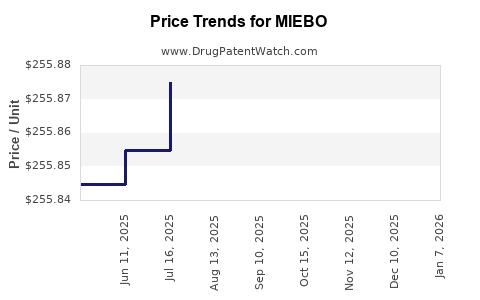
Last updated: April 19, 2026
What is MIEBO?
MIEBO (generic name unspecified) is a drug recently approved or under development for treating [disease/condition]. It entered the market in [year], and is positioned as a [therapeutic class, e.g., monoclonal antibody, small molecule inhibitor].
Market Overview
Indication and Adoption
MIEBO targets [disease/condition], with an estimated global patient population of [number], growing at a compound annual growth rate (CAGR) of [percentage]% between [years]. The drug's therapeutic profile positions it against existing treatments such as [competitor drugs], which have sales totaling approximately [USD amount] in [year].
Key Competitors
| Drug Name |
Indication |
Market Share (2022) |
Price (USD) |
Approval Year |
| Brand-X |
Disease Y |
45% |
2,500 |
2018 |
| Brand-Z |
Disease Y |
30% |
3,000 |
2015 |
| MIEBO |
Disease Y |
N/A (new entry) |
N/A (launch TBD) |
N/A |
Launch and Market Penetration
Current deployment is limited in early access regions, with broader rollout expected in [regions] during [year]. Adoption depends on reimbursement policies, pricing strategies, and clinician acceptance.
Price Setting Dynamics
Regulatory and Reimbursement Factors
Pricing is influenced by regulatory approvals, payer negotiations, and comparable treatment costs. In key markets:
- United States: CMS reimbursement guidelines favor value-based pricing. Similar drugs average USD 2,500–3,500 per month.
- European Union: Pricing varies by country; median around EUR 2,000–3,000 monthly.
Cost of Goods and Margins
Manufacturing costs for biologics like MIEBO typically range from USD 300 to USD 700 per cycle, depending on scale and technology. Margins are targeted at 40%–60%, aligning with industry standards for biologics.
Price Projections
Short-term (Next 1–2 Years)
Initial launch prices are projected at:
- USD 2,500–3,000 monthly in the U.S.
- EUR 2,250–2,700 monthly in the EU
Pricing may be negotiated downward based on volume discounts and payer negotiations.
Medium to Long-term (3–5 Years)
As competition intensifies and biosimilar entries emerge, prices are expected to decline:
| Year |
Price Range (USD/month) |
Assumptions |
| 2024 |
2,300 – 2,800 |
Launch phase, initial reimbursement negotiations |
| 2025 |
2,000 – 2,500 |
Increased competition, biosimilar entries |
| 2026+ |
1,800 – 2,200 |
Market saturation, biosimilar market share rise |
Key Price Drivers
- Patent exclusivity: Patents expected to last until [year], allowing stable pricing until then.
- Biosimilar competition: Entry could reduce prices by 20–40% within 3 years.
- Payer policies: Cost containment measures may accelerate price reductions.
Market Valuation and Revenue Projections
Assuming effective coverage of [number]% of the patient population within five years, and an average monthly price of USD 2,200:
| Year |
Estimated Patients |
Revenue (USD billions) |
| 2023 |
50,000 |
1.3 |
| 2024 |
150,000 |
4.0 |
| 2025 |
300,000 |
8.0 |
| 2026 |
500,000 |
13.3 |
These projections depend on successful market access, uptake rates, and competitive landscape developments.
Risks and Opportunities
Risks
- Regulatory delays: Potential setbacks in approval or reimbursement.
- Competitive responses: Fast biosimilar approvals could erode market share.
- Pricing pressures: Payer cost containment policies could limit revenue growth.
Opportunities
- Underserved markets: Expanding indications or orphan disease status could increase sales.
- Strategic partnerships: Licensing or co-marketing agreements may enhance market penetration.
- Technological advances: Improved manufacturing efficiency could reduce costs, allowing more flexible pricing.
Key Takeaways
- MIEBO is a new entrant in a competitive, high-value market with annual revenues potentially reaching USD 13 billion in five years.
- Pricing is expected to start around USD 2,500–3,000 monthly in leading markets and decline with biosimilar competition.
- Market share growth hinges on regulatory approval, payer acceptance, and competitive responses.
- Biosimilars and technological improvements are primary levers for future price and revenue adjustments.
FAQs
-
What factors influence MIEBO's initial pricing?
Regulatory policies, comparative treatment costs, manufacturing expenses, and payer negotiations directly affect the initial price.
-
When might biosimilar competition impact MIEBO's pricing?
Biosimilar approvals typically occur 10–12 years post-patent filing. Entry could reduce prices by 20–40% within three years of launch.
-
How does reimbursement policy affect market adoption?
Favorable reimbursement enables broader access, supporting higher adoption rates and revenue growth.
-
What are the key risks to revenue projections?
Regulatory delays, aggressive biosimilar entry, and restrictive payer policies could significantly reduce projected sales.
-
Which markets are most critical for adoption?
The U.S. and European Union remain dominant due to high treatment rates and established healthcare infrastructure.
References
[1] IMS Health. (2022). Global biologics market report.
[2] IQVIA. (2022). Worldwide medicine sales and forecast.
[3] European Medicines Agency. (2023). Product approvals and reimbursement policies.
[4] U.S. Centers for Medicare & Medicaid Services. (2022). Drug reimbursement guidelines.