Last updated: July 12, 2026
Executive summary: Methazolamide’s commercial footprint is small and structurally constrained. The drug’s value proposition is largely tied to legacy, low-volume use-cases, with limited likelihood of sustained growth. Financial trajectory is driven less by new clinical upside and more by patent/exclusivity remnants, compounding substitution, and generic availability. For near-to-midterm planning, revenue risk centers on generic erosion and supply volatility rather than blockbuster expansion.
What is methazolamide used for commercially and how does demand behave?
Methazolamide is a carbonic anhydrase inhibitor used in conditions where reducing aqueous humor production is relevant, most notably glaucoma (and related ocular pressure management). It is also used in other acid-base and diuretic-adjacent contexts depending on local prescribing patterns.
How stable is methazolamide demand vs. newer competitors?
In practice, demand stability depends on:
- Whether ophthalmology practices treat methazolamide as a fallback when preferred options (including alternative carbonic anhydrase inhibitors and branded/systemically positioned regimens) are limited by cost or formulary access.
- The extent to which local formularies prefer other agents (for example, acetazolamide in many settings) and whether methazolamide is considered interchangeable.
- Availability and pricing in each market, since carbonic anhydrase inhibitors are often exposed to fast generic substitution.
Key demand dynamics
- Low-dose, chronic/episodic use: dosing can be recurring, but patient numbers are typically limited relative to mainstream markets.
- Formulary and reimbursement sensitivity: when methazolamide is non-preferred, usage declines even if clinical fit remains.
- Substitution pressure: if acetazolamide or other options are easier to source or cheaper, methazolamide’s volume tends to track price and availability rather than new utility claims.
What is the Orange Book status of methazolamide and what does it imply for competition?
Featured snippet answer: Methazolamide’s U.S. competitive posture is shaped by whether any Orange Book-listed patents remain in force for a specific approved NDA/ANDA product.
How to interpret Orange Book exposure for methazolamide
For market entry, investors and litigators focus on:
- Whether methazolamide is tied to an NDA with active Orange Book patents (composition, formulation, method-of-use).
- Whether multiple ANDAs exist and whether they already cover the relevant strengths/dosage forms.
- Whether any remaining listed patents are enforceable or already expired.
Generic entry and “copycat” risks
If there is no meaningful remaining patent wall, methazolamide competes primarily on:
- Procurement and distribution networks
- Bottle/strength availability and lead times
- Contract pricing with wholesalers and hospital systems
- Compliance supply chain quality
When does methazolamide lose exclusivity and when can generics launch?
Featured snippet answer: Generic launch timing is determined by (1) patent term end dates, (2) regulatory exclusivity (if any applies to a specific product application), and (3) whether any Orange Book patents block FDA approval through 505(b)(2)/505(j) dynamics or Paragraph IV challenges.
Exclusivity timelines that drive financial trajectory
Methazolamide’s financial performance typically exhibits:
- Pre-expiry plateau if a brand/NDA holder still supplies the dominant SKU or if supply constraints exist.
- Sharp decline post-expiry if generic supply expands and pricing compresses.
- Erosion pattern if multiple generic holders compete but intermittent shortages delay full normalization.
What investors should model
- A step-function revenue drop around exclusivity/patent term events.
- Margin compression as competitors enter with lower acquisition and distribution costs.
- Potential temporary lift if a competitor shortage occurs, followed by reversion.
What patents protect methazolamide and how strong is the patent estate?
Featured snippet answer: Methazolamide’s patent strength matters less for blockbuster-grade value and more for whether additional entrants can offer equivalent product quickly.
Patent estate components to evaluate
For a small-market drug like methazolamide, the enforceable estate usually clusters in:
- Formulation patents (stability, specific excipient systems, or manufacturing-related compositions)
- Method-of-use patents (narrow clinical claims, if any)
- Process/manufacturing patents (scale-up, purification, or crystallization methods)
How patent strength translates into economics
- Strong, late-expiring formulation or process patents can keep supply limited and support pricing.
- Weak or already-expired patents allow rapid multi-source generic competition, driving margin collapse.
Which companies sell methazolamide and how does the competitive landscape affect price?
Featured snippet answer: Methazolamide’s market price is driven by how many generic suppliers can reliably provide consistent product supply at scale.
Competition mechanics
- Multi-source generic environment: more SKUs and more tender activity lead to lower net prices.
- Limited suppliers: fewer sources can preserve price but raises shortage risk.
- Wholesale inventory cycles: ocular and hospital channels often restock based on demand signals, creating temporary price spikes if supply tightens.
What generic entry risks exist for methazolamide?
Featured snippet answer: Generic entry risk is mainly “supply-led,” meaning the financial impact comes from who can file, who can manufacture, and who can ship consistently, rather than from high-stakes Paragraph IV litigation common in blockbuster markets.
Paragraph IV and litigation exposure
Paragraph IV challenges matter if there are active Orange Book patents. In small molecules with older approval history, the predominant risk pattern tends to be:
- Already-genericized market where entry is routine
- Limited or no active patent barriers where litigation is either absent or already resolved historically
Regulatory review timeline effects
Even without major litigation, approval and manufacturing readiness determine:
- When the first generic hits
- Whether follow-on approvals arrive quickly
- Whether product strength/dosage form availability differs across manufacturers
How does methazolamide compare with acetazolamide and other carbonic anhydrase inhibitors?
Featured snippet answer: Methazolamide competes within the carbonic anhydrase inhibitor class where prescribers and formularies often view other agents as substitutes if pricing and availability align.
Commercial substitution drivers
- Cost: cheaper carbonic anhydrase inhibitors win formulary access.
- Access: supply continuity can outweigh minor differences in dosing profiles.
- Clinical habits: ophthalmology and internal medicine prescribers often standardize on agents already established in local practice.
Implications for methazolamide revenue
Unless methazolamide is materially advantaged on cost, availability, or specific patient tolerability in a given payer environment, revenue tends to remain bounded and responsive to price competition.
What formulations are protected by methazolamide patents and what dosage forms matter financially?
Featured snippet answer: The financial unit is the dosage form and strength covered by approvals and any enforceable patents, because competition usually fragments by SKU.
Dosage form considerations
Methazolamide economics typically hinge on:
- Oral tablet availability and strength coverage
- Whether manufacturing partners can support multiple strengths without quality disruptions
- Whether excipient-driven stability enables longer shelf-life, lowering distribution costs
How formulation and manufacturing patents affect margins
- Stability/shelf-life can improve warehouse economics and reduce write-offs.
- Process claims can restrict supply if enforcement is credible.
What patent litigation affects methazolamide and who is at risk?
Featured snippet answer: For methazolamide, litigation risk is conditional on active Orange Book patents tied to specific approved products.
Litigation-driven financial impacts to model
If there is active litigation:
- Delayed generic launch can temporarily protect revenue
- Settlement terms often define carve-outs by strength, dosage form, or exclusivity designations
- Enforceable injunctions can create short-term price premiums
If there is no active litigation:
- The market behaves as routine generic competition
- Revenue becomes a function of procurement and share rather than legal protection
What settlement agreements or licensing deals define methazolamide supply?
Featured snippet answer: Licensing and settlement can affect which manufacturers supply specific strengths, shaping pricing and inventory stability.
Why settlements matter more for small molecules
In a low-revenue drug, settlements can be the difference between:
- Continued single-source supply versus expanded competition
- Durable channel contracts versus rapid price compression
What is the FDA regulatory status of methazolamide and what does it mean for commercialization?
Featured snippet answer: FDA status affects supply continuity via current Good Manufacturing Practice compliance and whether ANDA holders maintain consistent supply.
Commercial commercialization drivers
- Product discontinuations or slowdowns reduce patient access and shrink channel demand.
- Multiple generic sources stabilize supply, lowering net unit prices.
How many patents cover methazolamide and what jurisdictions matter most?
Featured snippet answer: The number of patents matters less than whether patents still constrain generic entry in the primary commercialization market.
Geographic exposure
For small molecules:
- U.S. (Orange Book-driven) is the main determinative market for generic entry timing.
- Europe and other jurisdictions influence long-term supply networks but typically do not change the near-term U.S. competitive impact unless exclusivity affects global manufacturer incentives.
Revenue exposure: what does methazolamide contribute and how does it trend financially?
Executive answer: Methazolamide’s revenue profile is expected to be modest, with limited growth catalysts. The financial trajectory is typically dominated by:
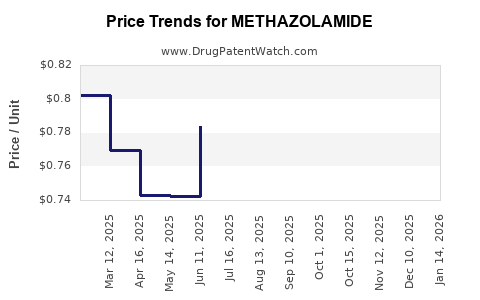
- Price erosion from generic competition
- Volume sensitivity to formulary placement
- Margin swings tied to supply availability and contract terms
What to model in an operating forecast
- Unit price decline rates under multi-source competition
- Contracting and reimbursement cycles in ophthalmology/hospital channels
- Working capital and inventory risk if shelf-life or supply constraints occur
Scenario analysis: what generic launch scenarios exist for methazolamide?
Featured snippet answer: The most relevant scenarios are supply expansion and price compression rather than delayed entry due to long-running exclusivity battles.
Three practical scenarios
-
Rapid multi-source normalization
- Net price drops
- Market share disperses
- Margin compresses, cash contribution declines
-
Partial supply expansion with intermittent shortages
- Price volatility increases
- Limited suppliers retain higher margins intermittently
- Revenue becomes more variable than predictable
-
Near-term product continuity only
- Revenue holds at low levels
- Growth remains constrained by lack of exclusivity and limited patient pool expansion
Key Takeaways
- Methazolamide’s market dynamics are driven by generic substitution and supply continuity, not by late-stage growth catalysts.
- Financial trajectory is shaped by Orange Book/patent status at the product-SKU level and by how quickly additional manufacturers can supply.
- In forecast models, prioritize unit price erosion, tender/contract pricing, and supply-driven volume swings over exclusivity-fueled growth.
- The competitive landscape in carbonic anhydrase inhibitors tends to push methazolamide toward a low-growth, price-sensitive niche unless a specific payer or supply advantage persists.
FAQs
- How does methazolamide pricing typically change after new generic approvals?
- What strength-specific factors most affect methazolamide supply shortages?
- Do methazolamide method-of-use claims typically survive generic competition windows?
- How do hospital formulary decisions impact methazolamide volume compared with community prescribing?
- What are the biggest financial risks for methazolamide manufacturers: litigation, manufacturing capacity, or contract concentration?
References
- FDA. Orange Book: Approved Drug Products with Therapeutic Equivalence Evaluations. U.S. Food and Drug Administration.
- FDA. Drugs@FDA Database. U.S. Food and Drug Administration.