Last updated: August 28, 2026
Macrobid is a mature oral antibiotic containing nitrofurantoin monohydrate and nitrofurantoin macrocrystals. Its commercial trajectory is defined by long-standing generic competition, low manufacturing complexity, stable demand in uncomplicated urinary tract infection, and limited ability to sustain premium pricing. The product has no biosimilar exposure and no meaningful remaining brand exclusivity. Alvogen is the current labeled manufacturer and distributor in the United States.[1]
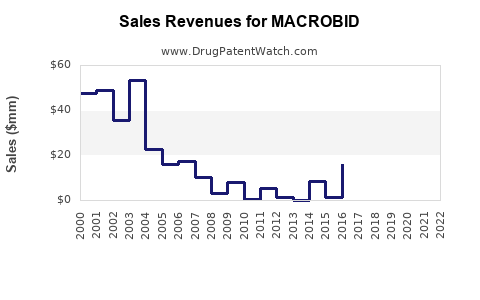
Product-level revenue is not publicly disclosed by Alvogen, a privately held company. The financial profile must therefore be assessed through market structure, prescription demand, generic pricing, regulatory status, and competitive positioning rather than audited Macrobid sales.
What is Macrobid and how is it used?
Macrobid is a 100 mg oral capsule containing an immediate-release component and a sustained-release component of nitrofurantoin. The FDA-approved indication is treatment of acute uncomplicated urinary tract infections caused by susceptible organisms.[1]
| Attribute |
Macrobid |
| Active ingredient |
Nitrofurantoin monohydrate/macrocrystals |
| Dosage form |
100 mg oral capsule |
| Typical adult regimen |
100 mg twice daily for seven days |
| Primary market |
Acute uncomplicated cystitis |
| Regulatory category |
Small-molecule prescription drug |
| FDA application |
NDA 020064 |
| Current U.S. label holder/manufacturer |
Alvogen |
| Generic availability |
Yes |
| Biosimilar exposure |
None |
| Current brand exclusivity |
None of commercial significance |
Nitrofurantoin is concentrated in urine and has limited systemic exposure. That pharmacology supports its role in lower urinary tract infection but limits its use for pyelonephritis and systemic infections.[1]
How large is the Macrobid market?
Macrobid competes in a broad urinary tract infection market rather than in a standalone branded category. The commercially relevant market includes branded Macrobid, generic nitrofurantoin monohydrate/macrocrystals, nitrofurantoin macrocrystals sold under the Macrodantin name and generic equivalents, trimethoprim-sulfamethoxazole, fosfomycin, fluoroquinolones, beta-lactam antibiotics, and, since 2024, pivmecillinam in the United States.[2][3]
Nitrofurantoin demand has remained commercially durable for several reasons:
- It is recommended as a first-line option for many uncomplicated cystitis patients.
- Resistance to nitrofurantoin remains relatively favorable compared with several older oral antibiotics.
- The seven-day Macrobid regimen is convenient relative to older nitrofurantoin formulations.
- Antimicrobial-stewardship policies favor narrow-spectrum agents when clinically appropriate.
- The product is inexpensive and widely available through retail pharmacies.
The market is volume-stable but value-compressed. Prescription demand can remain strong while manufacturer revenue falls because generic substitution reduces average selling prices.
What is the financial trajectory of Macrobid?
Macrobid’s financial trajectory follows the standard lifecycle for an oral small-molecule antibiotic.
| Period |
Commercial condition |
Financial effect |
| Pre-generic period |
Brand-led sales and higher unit pricing |
Higher gross margin and brand value |
| Generic entry |
Multiple ANDA approvals and pharmacy substitution |
Rapid price and share erosion |
| Mature generic period |
High prescription volume and low prices |
Stable but limited revenue pool |
| Current period |
Brand retained for recognition and supply continuity |
Niche branded revenue with low growth |
The largest financial event was the loss of effective market exclusivity after generic entry. Once pharmacies and payers began substituting generic nitrofurantoin, Macrobid’s value shifted from a protected branded asset to a mature product with residual brand demand.
Alvogen does not report Macrobid revenue as a separate line item in publicly available financial disclosures. No reliable public source establishes standalone annual sales, operating profit, or product-level cash flow. The brand’s current economics are likely driven by:
- Low incremental manufacturing cost for a standardized capsule.
- Limited promotional spending.
- Contracting with wholesalers, pharmacy benefit managers, and group purchasing organizations.
- Price pressure from multiple generic suppliers.
- Periodic shortages or supply disruptions that can temporarily improve brand demand or pricing.
The product is commercially defensive rather than a growth asset. Revenue growth is unlikely to come from higher pricing. The more realistic sources of value are manufacturing efficiency, reliable supply, portfolio bundling, and retention of prescriptions that are not automatically substituted.
When did Macrobid lose exclusivity?
Macrobid lost practical market exclusivity years ago through generic entry. The relevant commercial event was not a recent patent expiry but the establishment of an ANDA market for nitrofurantoin monohydrate/macrocrystals.
The original Macrobid patents and associated regulatory protections are expired. Nitrofurantoin itself is an old active ingredient, and the product has been subject to generic competition for many years. The FDA Orange Book does not provide a current commercial basis for treating Macrobid as a patent-protected growth product.[4]
The key distinction is between:
- Patent expiry, which removes enforceable patent barriers.
- Regulatory exclusivity, which can temporarily restrict ANDA approval.
- Commercial exclusivity, which depends on prescribing, reimbursement, supply, and brand recognition.
Macrobid has no meaningful remaining regulatory exclusivity comparable to a newly approved small-molecule drug.
What patents protect Macrobid today?
No current Macrobid patent estate appears to create a material barrier to generic substitution. The core product is an established nitrofurantoin formulation, and its principal composition and formulation protections expired before the current mature-market period.
| IP category |
Current commercial significance |
| Nitrofurantoin active ingredient |
No meaningful patent protection |
| Monohydrate/macrocrystal formulation |
Historical protection; expired |
| 100 mg capsule dosage form |
No meaningful standalone barrier |
| Method-of-use patents |
No material current protection identified |
| Manufacturing process patents |
Potentially relevant to supplier economics, not market exclusivity |
| Device or delivery patents |
Not applicable to the capsule product |
| Pediatric or clinical-use exclusivity |
No material current exclusivity |
Manufacturing know-how can still affect cost, impurity control, particle-size distribution, dissolution, and supply reliability. Those factors can create operational advantages without preventing ANDA competition.
What is the Orange Book status of Macrobid?
Macrobid is an FDA-approved prescription product with generic equivalents. The Orange Book is relevant for identifying the reference listed drug, approved dosage form, therapeutic equivalence codes, and any listed patents or exclusivity periods.[4]
The commercial implications are straightforward:
- Generic manufacturers can rely on the Macrobid reference product through the ANDA pathway.
- Therapeutic-equivalence designations support substitution where state pharmacy law and payer policy permit.
- No current Orange Book exclusivity is expected to block ordinary generic competition.
- Any newly listed patent would require product-specific review and could affect litigation timing, but the mature status of Macrobid makes a new blocking patent unlikely.
Which companies challenge Macrobid through generic competition?
Generic competition comes from manufacturers with approved nitrofurantoin monohydrate/macrocrystals capsules. The U.S. market has historically included large generic companies such as Actavis, Amneal, Lupin, Mylan/Viatris, and other ANDA holders, although the active supplier roster changes over time.[5]
Competitive intensity depends on more than the number of approvals. Important variables include:
- Whether an ANDA holder actively markets the product.
- Whether the supplier participates in Medicaid and commercial contracts.
- Whether it maintains adequate raw-material inventory.
- Whether it can meet FDA manufacturing and dissolution requirements.
- Whether it remains on pharmacy benefit formularies.
- Whether it can avoid or manage drug shortages.
The market can support several approved suppliers while still experiencing episodic shortages if only a small number of manufacturers actively produce commercial quantities.
What formulations are protected by Macrobid?
Macrobid’s commercial differentiation comes from its formulation rather than from a new chemical entity. The capsule combines nitrofurantoin monohydrate and macrocrystals to provide the labeled twice-daily regimen.[1]
The main formulation distinctions are:
| Product |
Formulation |
Commercial distinction |
| Macrobid |
Nitrofurantoin monohydrate/macrocrystals |
100 mg twice-daily capsule |
| Macrodantin |
Nitrofurantoin macrocrystals |
Different release and dosing profile |
| Generic Macrobid equivalents |
Nitrofurantoin monohydrate/macrocrystals |
Therapeutically equivalent alternatives where approved |
Formulation quality remains important. Particle-size control, dissolution, content uniformity, capsule-fill performance, and impurity specifications can affect ANDA approval and batch release. These requirements raise technical execution costs but do not create durable market exclusivity once the formulation is established.
What generic entry risks exist for Macrobid?
Generic entry risk is already realized rather than prospective. The principal risk is continued price erosion and loss of branded volume, not a future patent cliff.
Current generic risks
- Further substitution of brand prescriptions.
- Payer exclusion of Macrobid in favor of lower-cost equivalents.
- Tender-driven price reductions.
- Manufacturing interruptions by one or more suppliers.
- FDA warning letters, recalls, or facility remediation.
- Reduced physician attachment to the brand as generic supply improves.
Residual brand opportunities
Macrobid can retain value where:
- A prescriber specifies the brand.
- A payer formulary provides favorable treatment.
- A pharmacy experiences generic supply disruption.
- Patients or clinicians associate the brand with consistent tolerability or availability.
- The manufacturer offers reliable distribution and contracting support.
These factors can preserve a small branded niche but do not reverse the structural decline in branded pricing.
Is there Paragraph IV litigation involving Macrobid?
Macrobid’s major generic-entry litigation risk is historical. The product has been exposed to generic competition for many years, so the commercial value of a new Paragraph IV challenge is limited unless a new patent is listed or a reformulated product receives separate protection.
Paragraph IV litigation typically matters when:
- The reference product has unexpired Orange Book patents.
- A generic applicant seeks approval before patent expiry.
- The first qualifying challenger may receive 180-day exclusivity.
- The brand owner can obtain an automatic 30-month stay by filing timely patent litigation.
Those conditions do not describe the current core Macrobid opportunity. The relevant risk is ordinary generic competition under the ANDA pathway, not an imminent first-to-market Paragraph IV event.
What licensing deals affect Macrobid?
No major current licensing transaction is publicly associated with Macrobid that materially changes its market outlook. The product is a mature commercial asset, and its value is more likely embedded in a broader product portfolio or distribution arrangement than in a separately disclosed license.
Potential commercial arrangements can involve:
- Brand ownership and manufacturing rights.
- Contract manufacturing.
- Wholesale distribution.
- Authorized generic supply.
- Regional commercialization rights.
- Portfolio acquisitions containing multiple established products.
The absence of a publicly disclosed product-level transaction limits the ability to assign a separate licensing value to Macrobid.
How does Macrobid compare with competing UTI antibiotics?
| Drug |
Main commercial advantage |
Main limitation |
Financial position |
| Macrobid/generic nitrofurantoin |
First-line use, low resistance, low cost |
Limited utility for upper-tract infection; renal restrictions |
Mature, high-volume, low-price |
| Fosfomycin |
Single-dose oral regimen |
Higher unit cost; resistance and access considerations |
Smaller volume, higher unit economics |
| TMP-SMX |
Low cost and long clinical history |
Resistance can limit empirical use |
Mature generic |
| Fluoroquinolones |
Broad activity and tissue penetration |
Safety restrictions and stewardship pressure |
Declining routine cystitis role |
| Pivmecillinam |
New U.S. oral option for uncomplicated UTI |
Early commercial adoption and access development |
Potential growth competitor |
Pivmecillinam creates the most relevant new competitive consideration in the U.S. uncomplicated UTI segment because the FDA approved Pivya in 2024 for susceptible bacterial urinary tract infections in adult women.[3] Its commercial effect is likely to be gradual. Nitrofurantoin’s low cost, established guideline position, and broad generic availability create substantial adoption barriers for a new branded or newly commercialized alternative.
What is the FDA regulatory status of Macrobid?
Macrobid remains an FDA-approved prescription product. The FDA label identifies treatment of acute uncomplicated urinary tract infections and includes warnings related to pulmonary reactions, hepatotoxicity, neuropathy, hemolytic anemia, and use in patients with significant renal impairment.[1]
Regulatory factors affecting commercial demand include:
- Renal function restrictions, which limit use in some patients.
- Safety monitoring for rare but serious pulmonary and hepatic reactions.
- Pregnancy and neonatal considerations.
- Antimicrobial-stewardship recommendations.
- Generic therapeutic-equivalence standards.
- Manufacturing compliance and shortage management.
The product does not face a regulatory event comparable to withdrawal, a boxed-warning expansion, or a pending supplemental indication based on publicly established information.
How strong is the Macrobid patent estate?
The Macrobid patent estate is weak as a current competitive barrier but strong as a historical product platform. Its present value comes from regulatory approval, clinical familiarity, manufacturing capability, and demand persistence.
| Strength factor |
Assessment |
| Core composition patents |
Expired |
| Formulation patents |
Expired or commercially nonblocking |
| Method-of-use protection |
Limited current value |
| Orange Book exclusivity |
None of material commercial significance |
| Manufacturing complexity |
Moderate |
| Regulatory familiarity |
High |
| Generic substitution resistance |
Low |
| Brand recognition |
Moderate |
| Revenue-growth potential |
Low |
The absence of meaningful patent protection does not eliminate commercial value. It changes the basis of competition from exclusivity to cost, quality, supply, contracting, and distribution.
What is the likely Macrobid launch scenario for new generics?
A new generic entrant would not face a traditional patent-blocked launch. Its principal barriers would be commercial:
- Securing FDA approval and therapeutic-equivalence status.
- Establishing a qualified nitrofurantoin supply chain.
- Meeting dissolution and content-uniformity specifications.
- Obtaining pharmacy and payer access.
- Competing against established low-cost suppliers.
- Maintaining production through price compression.
A new entrant could gain share if it offers lower pricing, reliable supply, or access to a contracting channel. It would face limited upside if the market already has adequate generic supply and low reimbursement rates.
What geographic markets matter for Macrobid?
The United States is the most relevant market for Orange Book, ANDA, and branded Macrobid analysis. Outside the U.S., nitrofurantoin is sold under different brand names, national approvals, reimbursement systems, and substitution rules.
Geographic value is shaped by:
- National treatment guidelines.
- Local resistance patterns.
- Generic substitution law.
- Public procurement.
- Availability of nitrofurantoin formulations.
- Renal prescribing rules.
- National pricing controls.
A U.S. patent conclusion should not be extended automatically to Europe, Canada, Latin America, or emerging markets. The active ingredient is old globally, but regulatory and commercial rights remain jurisdiction-specific.
Key Takeaways
- Macrobid is a mature nitrofurantoin product with extensive generic competition.
- Its core patents and practical exclusivity have expired.
- Alvogen is the current U.S. labeled manufacturer and distributor.
- Product-level Macrobid revenue is not publicly disclosed.
- The financial trajectory is one of branded erosion followed by stable, low-margin mature-market sales.
- Current value depends on supply reliability, manufacturing cost, payer access, and brand recognition.
- Generic competition is an existing condition, not a future patent cliff.
- Biosimilars are irrelevant because Macrobid is a small-molecule capsule.
- Pivmecillinam is a new U.S. competitive option, but nitrofurantoin retains cost and guideline advantages.
- The Macrobid patent estate has little current blocking strength; operational execution is more important than intellectual property.
FAQs about Macrobid market value and competition
Does Macrobid still have market exclusivity?
No. Macrobid has no meaningful current exclusivity that prevents generic substitution. Its market position is based on established prescribing and distribution rather than patent protection.
Is Macrobid a high-revenue pharmaceutical product?
No reliable public source reports standalone Macrobid revenue. Its mature generic-market structure indicates a lower-value, low-growth profile compared with protected branded drugs.
Can a generic manufacturer launch Macrobid without patent litigation?
A manufacturer with an approved therapeutically equivalent ANDA can generally compete without facing a current core patent barrier. Product-specific Orange Book information and approval status control the legal analysis.
Does Macrobid compete with Augmentin for urinary tract infections?
Yes, in some prescribing settings, but the products have different spectrum, clinical positioning, dosing, and stewardship considerations. Nitrofurantoin is often preferred for uncomplicated cystitis when clinically appropriate.
Can manufacturing problems create a temporary Macrobid revenue increase?
Yes. A shortage or recall affecting generic suppliers can temporarily increase demand for the branded product or improve pricing. Such gains are usually supply-driven and do not represent durable market expansion.
References
- U.S. Food and Drug Administration. (2022). Macrobid (nitrofurantoin monohydrate/macrocrystals) prescribing information.
- Gupta, K., Hooton, T. M., Naber, K. G., Wullt, B., Colgan, R., Miller, L. G., Moran, G. J., Nicolle, L. E., Raz, R., Schaeffer, A. J., & Soper, D. E. (2011). International clinical practice guidelines for the treatment of acute uncomplicated cystitis and pyelonephritis in women. Clinical Infectious Diseases, 52(5), e103-e120.
- U.S. Food and Drug Administration. (2024). FDA approves new treatment for uncomplicated urinary tract infections.
- U.S. Food and Drug Administration. (2025). Approved drug products with therapeutic equivalence evaluations: Orange Book.
- U.S. Food and Drug Administration. (2025). Drugs@FDA: FDA-approved drugs database.