Last updated: August 18, 2026
Lamisil, the brand name for terbinafine, moved from a high-value prescription antifungal franchise to a mature generic and over-the-counter product. Novartis generated blockbuster-level sales before U.S. oral exclusivity ended in the mid-2000s. Generic terbinafine sharply reduced prescription pricing, while topical Lamisil retained consumer-health value through brand recognition, retail distribution, and nonprescription formulations. Current Lamisil revenue is not separately reported by the product’s successor commercial owners.
What is Lamisil and how is terbinafine used?
Lamisil contains terbinafine, an allylamine antifungal that inhibits squalene epoxidase and disrupts fungal cell-membrane synthesis.
The product has two main commercial forms:
| Product |
Active ingredient |
Main use |
Prescription status |
| Lamisil tablets |
Terbinafine hydrochloride |
Onychomycosis and other dermatophyte infections |
Prescription |
| Lamisil cream, spray, gel and solution |
Terbinafine hydrochloride |
Athlete’s foot, ringworm and jock itch |
Primarily OTC in the U.S. |
| Generic terbinafine tablets |
Terbinafine hydrochloride |
Onychomycosis |
Prescription generic |
| Generic topical terbinafine |
Terbinafine hydrochloride |
Superficial fungal infections |
Prescription and OTC, depending on product |
The FDA approved oral Lamisil tablets for onychomycosis in 1996. The standard adult regimen is 250 mg once daily, commonly administered for six weeks for fingernail infections and 12 weeks for toenail infections. Treatment duration can vary based on nail growth and clinical response. The FDA label includes liver-related warnings and recommends evaluation of liver disease risk before treatment. (FDA, 2023a)
How did Lamisil become a blockbuster drug?
Lamisil expanded rapidly because it offered an effective systemic treatment for toenail fungus, a condition with limited treatment options and a long disease course. Before oral terbinafine, physicians often relied on older systemic antifungals with less favorable efficacy, tolerability or dosing characteristics.
Novartis commercialized Lamisil globally after acquiring the product through its predecessor companies. The brand became one of the company’s largest pharmaceutical assets during the late 1990s and early 2000s.
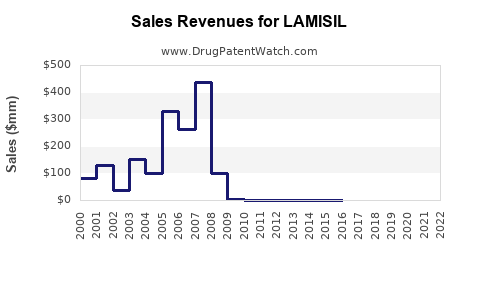
Public company disclosures indicate that Lamisil reached annual sales above $1 billion during its peak commercial period. Novartis reported Lamisil sales of approximately $1.2 billion in 2001, making it one of the company’s major pharmaceutical products. Sales began to decline after generic competition entered key markets and after the product moved through the life cycle from prescription treatment toward mature consumer-health use. (Novartis, 2002)
Historical financial trajectory
| Period |
Financial position |
Main driver |
| Mid-1990s |
Rapid growth |
FDA approval and uptake in onychomycosis |
| Late 1990s |
Blockbuster expansion |
Strong physician prescribing and global launch |
| 2000-2002 |
Peak sales period |
Annual sales around or above $1 billion |
| 2003-2007 |
Decline begins |
Patent expiry, generic filings and price pressure |
| 2008 onward |
Mature-brand phase |
Generic oral terbinafine and OTC topical sales |
| Current period |
No separate public revenue figure |
Product sales embedded in broader portfolios |
The major economic shift was the separation between the oral prescription business and the topical consumer-health business. Generic tablets captured most volume in the oral market, while brand value persisted more strongly in OTC topical products.
When did Lamisil lose exclusivity?
Lamisil lost commercially meaningful exclusivity in the United States when generic manufacturers entered the oral terbinafine market during the 2000s. The relevant protection period was linked to the original terbinafine product and later listed patents, but the practical loss of exclusivity occurred before the end of the decade.
The FDA approved generic terbinafine hydrochloride tablets from multiple manufacturers, including companies such as Mylan, Sandoz, Teva and others. Generic entry reduced the price of oral terbinafine and limited the ability of the brand to maintain prescription-market share.
| Exclusivity component |
Lamisil position |
| New chemical entity exclusivity |
Expired |
| U.S. prescription patent protection |
Expired or commercially exhausted |
| FDA pediatric exclusivity |
No current relevance |
| Orphan-drug exclusivity |
Not applicable |
| OTC topical brand protection |
Primarily trademark, formulation, packaging and marketing protection |
| Current generic barrier |
Low for standard terbinafine tablets |
Exact entry dates varied by jurisdiction and dosage form. The U.S. market no longer has a material patent-based barrier to standard generic terbinafine tablets. FDA Orange Book listings and approved abbreviated new drug applications are the relevant sources for product-specific patent and approval status. (FDA, 2024)
What patents protect Lamisil?
The original Lamisil estate covered terbinafine, pharmaceutical compositions, manufacturing processes and therapeutic uses. The commercially important patent rights have expired in the United States and major European markets.
The patent estate historically included:
- Compound and chemical-composition claims covering terbinafine and related salts.
- Pharmaceutical-composition claims covering tablets and topical formulations.
- Manufacturing-process claims for producing terbinafine.
- Method-of-use claims for treating dermatophyte infections and onychomycosis.
- Formulation and delivery claims for creams, sprays, gels and solutions.
The principal commercial protection was the underlying active-ingredient and product patent position. Once those rights expired, generic manufacturers could market standard oral terbinafine without negotiating a license from Novartis.
Are Lamisil formulation patents still commercially important?
Formulation patents have limited strategic importance for conventional terbinafine products. A cream, spray or solution may have separate formulation and packaging rights, but those rights generally do not block a competing manufacturer from selling terbinafine in a different formulation.
The principal residual protections for branded topical Lamisil products are:
- The Lamisil trademark.
- Product-specific labeling and claims.
- Retail distribution.
- Consumer recognition.
- Packaging and trade dress.
- Formulation-specific patents, where still enforceable.
These protections support brand pricing in OTC channels but do not recreate the exclusivity economics of a patented oral drug.
What is the FDA regulatory status of Lamisil?
Oral Lamisil is an FDA-approved prescription product. Generic terbinafine tablets are approved through the abbreviated new drug application pathway and are therapeutically equivalent to the reference product when assigned an appropriate Orange Book rating.
Topical Lamisil products are sold under both prescription and OTC frameworks. OTC products rely on the FDA monograph system for topical antifungal products, subject to the applicable active ingredient, concentration, dosage form and labeling requirements. (FDA, 2023b)
The regulatory profile has two different economic characteristics:
- Oral terbinafine has established clinical use but carries systemic safety monitoring concerns, especially liver-related warnings.
- Topical terbinafine has a lower regulatory and commercial risk profile but competes in a crowded OTC market.
What is the Orange Book status of Lamisil?
The Orange Book historically listed Lamisil tablets under Novartis-sponsored applications and associated patents. Those listings no longer create a meaningful barrier to generic entry for standard 250 mg terbinafine tablets.
The current market position is defined by:
- Expired core patent protection.
- Multiple approved generic manufacturers.
- No current reference-product exclusivity that supports premium prescription pricing.
- Continued availability of the reference brand in some markets and channels.
- Separate regulatory treatment for OTC topical products.
For business analysis, the Orange Book is more relevant to historical litigation and entry timing than to current market exclusivity. A company evaluating a new terbinafine tablet would primarily face generic price competition rather than an innovator patent barrier.
Which companies compete with Lamisil?
Competition operates across oral antifungals, topical antifungals and newer prescription therapies.
Oral prescription competitors
| Product |
Active ingredient |
Market role |
| Generic terbinafine |
Terbinafine |
Lowest-cost systemic option |
| Sporanox and generic itraconazole |
Itraconazole |
Alternative systemic therapy |
| Diflucan and generic fluconazole |
Fluconazole |
Used in selected fungal infections; less directly interchangeable for onychomycosis |
| Jublia |
Efinaconazole |
Topical onychomycosis treatment |
| Kerydin |
Tavaborole |
Topical onychomycosis treatment |
| Penlac and generic ciclopirox |
Ciclopirox |
Topical nail treatment |
Generic terbinafine is usually the strongest price competitor because it has broad physician familiarity and a relatively short standard course compared with some alternatives. Jublia and Kerydin compete through topical administration and avoidance of systemic exposure, but their commercial value depends on reimbursement and patient willingness to pay.
OTC topical competitors
Lamisil competes with:
- Lotrimin products containing clotrimazole.
- Tinactin products containing tolnaftate.
- Micatin products containing miconazole.
- Store-brand terbinafine, clotrimazole and miconazole products.
- Private-label products sold by pharmacies, supermarkets and mass retailers.
The OTC segment is more sensitive to shelf placement, promotional spending, retailer margins and consumer price than to patent exclusivity.
How strong is the Lamisil patent estate today?
The patent estate is weak as a current barrier to standard generic entry and stronger as a historical explanation of Lamisil’s earlier profitability.
| Patent-estate factor |
Current assessment |
| Core terbinafine compound protection |
Expired |
| Oral tablet protection |
No material current barrier |
| Generic substitution risk |
High |
| Topical formulation protection |
Product-specific and limited |
| Trademark protection |
Relevant for OTC brand pricing |
| Manufacturing know-how |
Potentially useful but not a market-wide barrier |
| Method-of-use protection |
Expired or narrow relative to current generic products |
| Biosimilar relevance |
None |
Terbinafine is a small-molecule drug, not a biologic. Biosimilar competition does not apply. The relevant competitive threat is conventional generic substitution.
What patent litigation and Paragraph IV risks affected Lamisil?
The principal litigation risk arose when generic manufacturers filed abbreviated new drug applications and, where relevant, challenged listed patents under Paragraph IV certifications.
A Paragraph IV certification states that a listed patent is invalid, unenforceable or not infringed. The filing can trigger patent litigation by the reference-product sponsor and can delay generic approval under the Hatch-Waxman framework.
For Lamisil, the commercial consequences of generic challenges were substantial because oral terbinafine had high prescription sales and relatively straightforward tablet manufacturing. Once the relevant patent disputes were resolved or the patents expired, multiple generic companies entered the market.
Current Paragraph IV risk is limited for the original Lamisil product because the core patent estate has expired. Any new litigation would more likely concern:
- A later-developed topical formulation.
- A narrow delivery system.
- A combination product.
- Labeling or trademark disputes.
- Manufacturing-process claims that do not block ordinary generic tablets.
Did Novartis license or sell Lamisil?
Lamisil was primarily a Novartis-originated commercial franchise, with regional distribution, co-promotion and consumer-health arrangements contributing to its global reach.
Novartis later restructured its consumer-health business. In 2014, Novartis and GlaxoSmithKline announced a series of transactions that included the transfer of Novartis consumer-health assets to GSK. The transaction closed in 2015. Lamisil’s consumer-health commercial presence subsequently became associated with the GSK consumer-health business, which later became Haleon following the separation from GSK. (GSK, 2014; Haleon, 2022)
Prescription generic terbinafine is supplied by numerous manufacturers and is not dependent on a continuing license from Novartis or Haleon.
What is the current market dynamic for Lamisil?
The market has split into three economic tiers.
Generic oral terbinafine
This is a high-volume, low-price market. Manufacturers compete primarily on:
- Wholesale acquisition cost.
- Pharmacy contracts.
- Supply reliability.
- Formulation and packaging.
- Regulatory compliance.
- Reimbursement access.
Brand Lamisil has limited leverage because pharmacists can substitute an FDA-rated generic product.
Branded OTC topical Lamisil
The OTC brand retains value through consumer awareness and retailer placement. Its advantages include a recognized name, established efficacy claims and broad distribution. Its disadvantages include low switching costs and competition from private-label terbinafine products.
The key commercial metrics are unit velocity, average retail price, promotional frequency and retailer share, rather than prescription market exclusivity.
Prescription topical onychomycosis products
Products such as efinaconazole and tavaborole compete for patients seeking a non-systemic treatment. These products can support higher prices than generic terbinafine but often face longer treatment courses, adherence challenges and payer restrictions.
What revenue exposure remains for Lamisil?
Novartis no longer reports Lamisil as a standalone growth product. Haleon also reports consumer-health performance at category and geographic levels rather than disclosing a separate Lamisil revenue line.
The remaining economic exposure is therefore concentrated in:
- OTC topical sales.
- Brand licensing or distribution economics.
- Retail-channel margins.
- Geographic markets where generic substitution is weaker.
- Emerging markets with continued brand recognition.
- Combination or specialty topical products.
The historical prescription revenue base has largely transferred to generic manufacturers. The brand’s present value is a mature consumer-health asset, not a patent-protected pharmaceutical franchise.
What generic launch scenarios exist for Lamisil?
The standard generic launch scenario is already established:
- Multiple manufacturers sell terbinafine tablets.
- Pharmacy substitution directs most prescriptions toward lower-cost suppliers.
- Average prices decline as additional manufacturers enter.
- Brand sales contract to residual demand, physician preference and cash-pay patients.
- OTC topical sales remain differentiated through branding rather than patent exclusivity.
A new generic entrant would face low technical development risk but limited margin opportunity. The primary barriers would be manufacturing scale, quality-system performance, supply continuity and payer access.
How does Lamisil compare with competing antifungals?
| Factor |
Generic terbinafine |
Generic itraconazole |
Jublia |
Lamisil OTC topical |
| Patent barrier |
None material |
None material for generic product |
Product-specific patent and exclusivity history |
Trademark and formulation rights |
| Administration |
Oral |
Oral |
Topical |
Topical |
| Systemic exposure |
Yes |
Yes |
Low |
Low |
| Cost position |
Low |
Low to moderate |
High |
Moderate |
| Main advantage |
Established efficacy and price |
Alternative systemic mechanism |
Avoids oral therapy |
Brand recognition and convenience |
| Main commercial risk |
Price erosion |
Drug interactions and tolerability |
Reimbursement and adherence |
Private-label competition |
Key Takeaways
- Lamisil is terbinafine, an established allylamine antifungal.
- The product reached annual sales of roughly $1 billion or more during its peak period.
- U.S. oral exclusivity ended during the 2000s, enabling broad generic entry.
- Generic terbinafine now controls the economics of the oral prescription market.
- Lamisil’s remaining brand value is concentrated in OTC topical products.
- The product has no biosimilar risk because terbinafine is a small molecule.
- Current patent strength is low for standard tablets and limited for conventional topical products.
- Haleon is associated with the later consumer-health business, while multiple generic companies supply oral terbinafine.
- Current revenue is not separately disclosed by Novartis or Haleon.
- The commercial opportunity is mature-brand management, not protection of an active pharmaceutical patent estate.
FAQs
Is Lamisil still patented?
The core patents covering terbinafine and standard oral Lamisil products have expired in the United States and major markets. Current competition is primarily generic.
Can a generic company launch terbinafine without a Lamisil license?
Yes. Approved generic manufacturers can market terbinafine under the applicable abbreviated approval pathway after satisfying FDA requirements and addressing any listed patent obligations.
Does Lamisil have exclusivity for toenail fungus treatment?
No material current exclusivity protects standard oral terbinafine for onychomycosis. The brand retains trademark and consumer recognition rather than active-drug exclusivity.
Is Lamisil owned by Novartis or Haleon?
Novartis originated and commercialized Lamisil. Consumer-health assets transferred through the Novartis-GSK transaction and later became part of Haleon’s consumer-health portfolio. Ownership and distribution can vary by product, territory and channel.
Why is generic terbinafine cheaper than branded Lamisil?
Generic manufacturers do not bear the original discovery and large-scale clinical development costs, and multiple approved suppliers compete for pharmacy and payer volume. That competition drives prescription prices below the branded level.
References
-
Food and Drug Administration. (2023a). Lamisil (terbinafine hydrochloride) tablets prescribing information. U.S. Department of Health and Human Services.
-
Food and Drug Administration. (2023b). OTC antifungal drug products: FDA regulatory information and monograph framework. U.S. Department of Health and Human Services.
-
Food and Drug Administration. (2024). Approved drug products with therapeutic equivalence evaluations: Orange Book. U.S. Department of Health and Human Services.
-
GlaxoSmithKline. (2014). Novartis and GSK announce transformational transaction to create new world-leading consumer healthcare joint venture. GSK plc.
-
Haleon. (2022). Annual report and financial statements 2022. Haleon plc.
-
Novartis. (2002). Annual report 2001. Novartis AG.