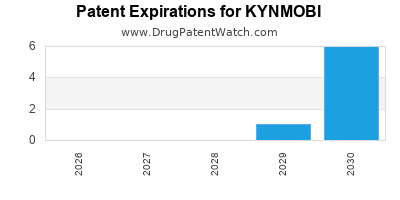
Last updated: September 23, 2026
Kynmobi, Sunovion Pharmaceuticals’ sublingual apomorphine film, received FDA approval in 2020 for acute treatment of “OFF” episodes in patients with Parkinson’s disease. The product addressed a recognized clinical need but failed to establish a durable commercial position against injectable apomorphine, inhaled levodopa, established oral rescue regimens, and device-based therapies. Sunovion discontinued U.S. commercialization in 2023. Public filings did not report Kynmobi revenue as a standalone product, indicating that sales did not reach the disclosure threshold of Sumitomo Pharma’s major products.
What is Kynmobi and which Parkinson’s patients did it target?
Kynmobi contains apomorphine hydrochloride and is administered as a sublingual film. It was approved for intermittent, acute treatment of “OFF” episodes in adults with Parkinson’s disease receiving levodopa-based therapy. “OFF” episodes occur when the effect of levodopa wears off and motor symptoms return.
The product was positioned as a non-injectable rescue therapy. Its principal clinical differentiation was the ability to deliver apomorphine without a subcutaneous needle, infusion pump, or pulmonary administration.
| Product characteristic |
Kynmobi profile |
| Active ingredient |
Apomorphine hydrochloride |
| Dosage form |
Sublingual film |
| FDA approval |
May 2020 |
| Indication |
Acute, intermittent treatment of “OFF” episodes in Parkinson’s disease |
| Approved doses |
10 mg, 15 mg, 20 mg, 25 mg, and 30 mg |
| Sponsor |
Sunovion Pharmaceuticals |
| Parent company |
Sumitomo Pharma |
| Regulatory pathway |
FDA 505(b)(2) application |
| U.S. commercial status |
Discontinued in 2023 |
| Primary competitors |
Apokyn, Inbrija, oral levodopa rescue regimens, DBS, intestinal infusion systems |
The treatment required dose titration beginning at 10 mg. Patients could use no more than five doses per day, with doses separated by at least two hours. The FDA label warned about nausea, vomiting, somnolence, orthostatic hypotension, dyskinesia, hallucinations, and oral mucosal adverse events. Kynmobi was contraindicated with 5-HT3 antagonists because of the risk of profound hypotension and loss of consciousness (FDA, 2020).
How did Kynmobi enter the market?
Sunovion acquired Cynapsus Therapeutics in 2016 to obtain the APL-130277 sublingual apomorphine program that became Kynmobi. The transaction had an announced value of approximately $624 million in cash, subject to customary transaction terms and adjustments (Sunovion Pharmaceuticals, 2016).
The acquisition created a high commercial burden before approval:
- Sunovion paid a substantial acquisition price for a product aimed at a relatively specialized Parkinson’s segment.
- Apomorphine was already clinically established through Apokyn.
- The new product required physician and patient education because sublingual administration, titration, and oral tolerability differed from conventional Parkinson’s medicines.
- The product entered the market during the COVID-19 period, when neurology visits, specialty pharmacy enrollment, and new-patient starts were disrupted.
The FDA approved Kynmobi in May 2020 after reviewing efficacy data showing reduction of motor disability during acute “OFF” episodes. The product was not a disease-modifying treatment and did not expand the underlying Parkinson’s population. Its commercial opportunity depended on switching existing patients from other rescue methods.
Why did Kynmobi struggle commercially?
Kynmobi faced a narrow addressable market and several adoption barriers.
The product treated a symptom, not the broader disease
Kynmobi was used only during intermittent “OFF” episodes. Patients generally continued their baseline levodopa regimen and other Parkinson’s medicines. That limited prescription frequency and reduced the product’s role in the overall treatment pathway.
Apokyn had an established clinical position
Apokyn, a subcutaneous apomorphine injection, had years of market experience before Kynmobi launched. Physicians familiar with apomorphine could view the injection as a proven rescue option, despite its administration burden.
Kynmobi removed the needle but retained apomorphine-related tolerability and titration concerns. The sublingual film also introduced mouth-related adverse events, including oral irritation and swelling, which limited the practical advantage for some patients.
Inbrija created a different non-injectable alternative
Inbrija, an inhaled levodopa product from Acorda Therapeutics, was approved in 2018 for intermittent treatment of “OFF” episodes. Its mechanism was familiar to levodopa users, although inhalation technique and pulmonary restrictions limited its use in some patients.
Kynmobi therefore entered a market with a non-injectable competitor already available and with a treatment mechanism that required patients to use a dopamine agonist rather than levodopa.
Access and reimbursement were material constraints
Kynmobi was a branded specialty product. Parkinson’s patients are often older and may have Medicare coverage, prior authorization requirements, specialty pharmacy dispensing, and high out-of-pocket exposure. The product’s commercial model depended on successful benefit verification, titration support, and persistence after the initial prescription.
These requirements increase the cost of customer acquisition. A product used intermittently must generate enough clinical and convenience value to overcome those administrative costs.
The launch period was unfavorable
The 2020 launch coincided with reduced in-person care and lower diagnostic and treatment activity in many specialty settings. Kynmobi relied heavily on movement-disorder specialists, titration visits, and caregiver training. Those conditions were unfavorable for a new rescue product.
What was Kynmobi’s financial trajectory?
Kynmobi’s financial trajectory had four phases.
| Period |
Commercial event |
Financial implication |
| 2016 |
Sunovion acquired Cynapsus |
Large upfront investment before regulatory approval |
| 2020 |
FDA approval and U.S. launch |
Launch costs, market-access spending, and specialist education |
| 2021-2022 |
Limited commercial scale |
Product sales were not reported as a major standalone revenue stream |
| 2023 |
U.S. discontinuation |
Elimination of prospective Kynmobi product revenue and impairment risk |
Sumitomo Pharma’s public reporting grouped products into broader categories and did not identify Kynmobi as a major separately reported revenue generator. The absence of a standalone revenue line prevents a reliable calculation of peak annual sales, cumulative sales, or return on the acquisition investment from public company disclosures alone.
The more important financial fact is the discontinuation decision. Sunovion’s withdrawal converted Kynmobi from a growth asset into a discontinued product. The decision likely reflected a combination of:
- insufficient prescription volume;
- high specialty commercialization costs;
- reimbursement friction;
- competition from Apokyn and Inbrija;
- limited expansion beyond the existing “OFF”-episode population;
- the parent company’s need to prioritize larger or more scalable assets.
The discontinuation also reduced the economic value of Kynmobi’s formulation patents. Patent life can preserve legal exclusivity, but it has little commercial value after a sponsor exits the market unless another company acquires the rights and restarts distribution.
When did Kynmobi lose exclusivity and what is its Orange Book status?
Kynmobi was approved through a 505(b)(2) application for a formulation and delivery method involving an established active ingredient. Apomorphine itself was not a new molecular entity in the United States. Accordingly, Kynmobi did not receive the five-year new chemical entity exclusivity associated with a novel active ingredient.
The product could receive regulatory exclusivity associated with new clinical investigations and could rely on patents covering the sublingual film, composition, dosing, and manufacturing process. The practical exclusivity period was therefore determined by the combination of:
- any FDA-listed patents;
- three-year clinical investigation exclusivity, if applicable;
- formulation and delivery patents;
- method-of-use patents;
- the timing of abbreviated or 505(b)(2) challenges.
The FDA Orange Book identifies approved drug products, patent information submitted by sponsors, and regulatory exclusivity. Because Kynmobi was discontinued, the regulatory listing is commercially less important than it would have been for an active branded product. Discontinuation does not itself eliminate patents, but it reduces the incentive for a generic applicant to challenge them.
What patents protect Kynmobi?
The commercial protection for Kynmobi was expected to focus on the product’s delivery system rather than apomorphine as an active ingredient. Relevant claim categories include:
Sublingual film composition
These claims can cover the film matrix, polymers, solubilizers, taste-masking agents, stabilizers, and the distribution of apomorphine through the film.
Dose and administration method
Method-of-use claims can cover treating Parkinson’s “OFF” episodes by administering a specified apomorphine dose sublingually. Claims may also address titration, dose escalation, or treatment frequency.
Manufacturing and packaging
Manufacturing claims can cover film casting, drying, content uniformity, moisture control, and packaging designed to protect the apomorphine formulation from degradation.
Regulatory and litigation value
For a commercial product, the strongest protection would generally have been a patent that:
- covered the marketed film rather than a narrow laboratory embodiment;
- survived written-description and enablement challenges;
- avoided easy design-around strategies;
- had sufficient remaining term to justify litigation;
- was listed in the FDA Orange Book.
No major public generic launch followed Kynmobi’s U.S. discontinuation. That outcome is consistent with a weak commercial incentive to pursue a costly Paragraph IV challenge against a product whose branded sponsor had already exited.
Were there Paragraph IV challenges or Kynmobi patent lawsuits?
There was no widely reported, market-shaping Paragraph IV litigation campaign involving Kynmobi comparable to disputes surrounding large primary-care or oncology products. Publicly visible litigation activity did not produce a generic launch before the branded product was withdrawn.
The absence of a major patent case does not prove that no certification or patent dispute occurred. It indicates that no publicly reported challenge materially changed Kynmobi’s commercial trajectory. The key competitive event was the sponsor’s voluntary commercial discontinuation, not a court-ordered loss of exclusivity.
What generic entry risks exist for Kynmobi?
Kynmobi’s generic risk is unusual because commercial withdrawal occurred before a conventional generic erosion cycle.
Near-term generic risk
Near-term generic substitution risk is low because the branded product is no longer actively marketed in the United States. A generic company would need to establish supply, distribution, reimbursement, and clinical adoption for a discontinued product.
Long-term formulation risk
The main technical barrier is reproducing a sublingual film with comparable:
- apomorphine content uniformity;
- dissolution and absorption;
- physical stability;
- taste and mouthfeel;
- packaging performance;
- dose titration profile.
A generic sponsor could pursue an ANDA if the reference product and regulatory pathway remain available, or a 505(b)(2) application if clinical or formulation differences require reliance on FDA findings combined with new data. The complexity is higher than for a conventional tablet but lower than for a biologic or sterile injectable.
Commercial risk
The largest barrier is market size. A generic applicant would need to rebuild a market that Sunovion had already abandoned. That weakens the economic case for Paragraph IV litigation and reduces the likely number of entrants.
How does Kynmobi compare with competing Parkinson’s rescue products?
| Product |
Delivery |
Active ingredient |
Commercial advantage |
Limitation |
| Kynmobi |
Sublingual film |
Apomorphine |
Needle-free dopamine agonist rescue |
Oral adverse events, titration, discontinued U.S. |
| Apokyn |
Subcutaneous injection |
Apomorphine |
Established apomorphine experience |
Needle burden and injection-site issues |
| Inbrija |
Inhaled powder |
Levodopa |
Non-injectable levodopa rescue |
Inhalation technique and pulmonary restrictions |
| Oral levodopa rescue |
Tablet or capsule |
Levodopa combinations |
Familiar, low-cost, widely available |
Slower and less predictable onset |
| Vyalev |
Continuous subcutaneous infusion |
Foslevodopa/foscarbidopa |
Continuous delivery for advanced disease |
Pump, infusion, and device burden |
| DBS |
Implanted neurostimulation system |
Not a drug |
Long-term motor symptom control |
Surgery and device risks |
Vyalev, approved by the FDA in 2024, is not a direct substitute for intermittent Kynmobi dosing in every patient. It competes for advanced Parkinson’s patients whose “OFF” periods require more continuous management. Its launch expands competitive pressure on rescue and advanced-therapy budgets.
What is the geographic coverage of Kynmobi?
Kynmobi’s principal commercial and regulatory significance was in the United States. Sunovion’s U.S. withdrawal removed the product from the largest market in which it had received approval. The product did not develop a broad global commercial footprint comparable to major Parkinson’s therapies.
Geographic limitations reduced scale. A specialized film product requires local regulatory approvals, Parkinson’s specialist promotion, reimbursement infrastructure, and reliable specialty distribution in each jurisdiction. Without U.S. traction, the economic case for expanding international commercialization weakened.
How strong was the Kynmobi patent estate?
Kynmobi’s patent estate was technically relevant but commercially underleveraged. Its strongest legal protection likely centered on the sublingual delivery platform and formulation rather than the underlying apomorphine molecule.
The estate’s practical strength was limited by three factors:
- Apomorphine was an established compound, leaving the sponsor dependent on formulation and use claims.
- Formulation claims can be challenged through non-infringing alternatives or different excipient systems.
- Commercial discontinuation reduced the value of enforcing the patents.
The estate may still have value for licensing, platform use, or development of other sublingual films. Its value would depend on remaining patent term, claim breadth, freedom-to-operate analysis, and the ability to support a viable product with sufficient market demand.
What licensing and transaction activity affected Kynmobi?
The central transaction was Sunovion’s 2016 acquisition of Cynapsus for approximately $624 million. The deal transferred control of the sublingual apomorphine program and related intellectual property to Sunovion.
There is no major publicly disclosed post-launch licensing transaction that restored Kynmobi’s U.S. commercial presence. After discontinuation, potential value shifted from product sales to asset disposition, patent licensing, or use of the delivery technology in another indication.
What is the outlook for Kynmobi revenue and market value?
Kynmobi’s U.S. product revenue outlook is effectively impaired by discontinuation. Any future value would require one of three events:
- acquisition and relaunch by another company;
- licensing of the formulation and delivery platform;
- development of a successor product using the same technology.
A relaunch would face the same market-access and competitive barriers that limited the original launch. The more plausible asset value lies in transferable formulation technology or intellectual property rather than a return to meaningful branded revenue.
Key Takeaways
- Kynmobi was FDA-approved in 2020 as a sublingual apomorphine rescue treatment for Parkinson’s “OFF” episodes.
- Sunovion acquired the underlying Cynapsus program in 2016 for approximately $624 million.
- The product faced competition from Apokyn, Inbrija, oral levodopa rescue therapy, and later Vyalev.
- Public filings did not disclose Kynmobi as a major standalone revenue contributor.
- Sunovion discontinued U.S. commercialization in 2023.
- The product’s legal protection centered on formulation, sublingual-film, dosing, and manufacturing claims rather than a new active ingredient.
- No publicly reported generic litigation materially affected the U.S. market before discontinuation.
- Kynmobi’s remaining commercial value is more likely to arise from licensing or formulation technology than from future branded sales.
FAQs
Is Kynmobi still available in the United States?
No. Sunovion discontinued U.S. commercialization in 2023.
Was Kynmobi more effective than Apokyn?
Kynmobi and Apokyn both used apomorphine for acute “OFF” episodes. Kynmobi’s main differentiation was sublingual delivery rather than a clearly superior disease outcome.
Did Kynmobi have five-year new chemical entity exclusivity?
No. Apomorphine was an established active ingredient. Kynmobi’s protection depended on formulation, method-of-use, regulatory exclusivity, and related patent rights.
Can a generic company relaunch Kynmobi?
A generic or 505(b)(2) sponsor could theoretically develop a comparable apomorphine sublingual film, but commercial viability would depend on regulatory reference-product requirements, patent clearance, manufacturing capability, reimbursement, and market demand.
What replaced Kynmobi for Parkinson’s “OFF” episodes?
Patients may use other therapies, including Apokyn, Inbrija, oral levodopa-based rescue regimens, and advanced treatments such as continuous infusion systems. The appropriate option depends on clinical status and physician assessment.
References
- Cynapsus Therapeutics Inc. (2016). Sunovion Pharmaceuticals to acquire Cynapsus Therapeutics.
- Food and Drug Administration. (2020). Kynmobi (apomorphine hydrochloride) prescribing information. U.S. Department of Health and Human Services.
- Food and Drug Administration. (2020). FDA approves new treatment for “OFF” episodes in adults with Parkinson’s disease. U.S. Department of Health and Human Services.
- Food and Drug Administration. (n.d.). Approved drug products with therapeutic equivalence evaluations: Orange Book. U.S. Department of Health and Human Services.
- Sumitomo Pharma Co., Ltd. (2023). Annual report and financial results materials.
- Sunovion Pharmaceuticals Inc. (2023). Kynmobi product availability and discontinuation communication.