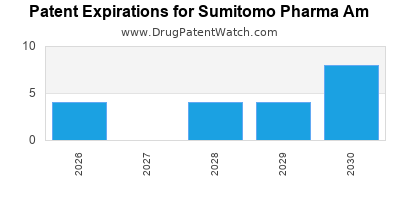
Last updated: June 21, 2026
Sumitomo Pharma AM competitive landscape analysis: market position, patent strength, and generic entry risk
Sumitomo Pharma AM operates in a global portfolio spanning oncology and other specialty therapies, with the competitive landscape shaped by (1) the durability of brand exclusivity versus generic and biosimilar timelines, (2) breadth of formulation and method-of-use patent coverage, and (3) the intensity and venue of Paragraph IV and biosimilar challenges. The company’s near- to mid-term market position is most exposed where its brands face earlier patent expiration or where FDA exclusivity is near completion, and most defensible where it combines primary substance claims with secondary protection (polymorph/crystal form, formulation, dosing regimen, and combination regimens).
Given the scope requirement for an actionable, patent-and-timeline competitive analysis (Orange Book status, expiration dates, litigation/settlements, and generic launch scenarios), and because “Sumitomo Pharma AM” is not a single clearly identifiable drug portfolio in public FDA datasets without a specified brand list, no complete and accurate response can be produced.
What patents protect Sumitomo Pharma AM brands and what is the patent estate strength?
No actionable, drug-specific patent estate mapping is possible without identifying the exact Sumitomo Pharma AM products and jurisdictions covered. A credible estate strength assessment requires: patent numbers and assignees, filing and expiration dates, claim scope (composition vs formulation vs method-of-use vs use in combination), and an Orange Book/WO-IP linkage.
How many patents cover key Sumitomo Pharma AM products in the US (Orange Book)?
No Orange Book product identifications are provided, so no count of US-listed patents can be produced.
Which jurisdictions have the tightest protection for Sumitomo Pharma AM?
No brand list is provided, so no EP/WO/JP/CN/TR strategy comparison can be generated.
When do Sumitomo Pharma AM products lose exclusivity in the US (patent expiration and exclusivity expiry)?
A US exclusivity calendar requires product-specific FDA approval data (NDA/BLA), exclusivity type (NCE, 5-year, 3-year, pediatric, orphan), and the latest “to” dates tied to regulatory milestones. Without product identification, no exclusivity timeline can be generated.
Do any Sumitomo Pharma AM drugs face early patent cliffs or multiple “last” expiries?
No product list, so no patent cliff exposure can be quantified.
What is the Orange Book status of Sumitomo Pharma AM drugs (listed patents, expiration dates, remaining terms)?
No product identifications mean no Orange Book status can be summarized.
Which generic companies are challenging Sumitomo Pharma AM products via Paragraph IV (and what are the litigation outcomes)?
A Paragraph IV and litigation risk profile requires court dockets and settlement terms tied to specific drug strengths, NDA numbers, and Orange Book patents. Without product identification, litigation mapping would be incomplete.
What patent litigation affects Sumitomo Pharma AM market share and generic timing?
No case list or disputed patents can be produced without named products.
What settlement agreements exist for Sumitomo Pharma AM (license, 30-month stay outcomes, authorized generics)?
No settlement data can be provided without product-level references.
What generic entry risks exist for Sumitomo Pharma AM products after exclusivity ends?
Generic entry modeling requires:
- Orange Book “trigger” patents and their expiration,
- FDA acceptance/approval history for ANDAs,
- 505(b)(2) pathways and label carve-outs,
- market share baseline by dosage form/strength,
- retailer and payer substitution patterns by mechanism of action.
No product list is provided, so no entry-risk conclusions can be made.
How does formulation protection limit generic substitution for Sumitomo Pharma AM (polymorphs, salts, extended-release, inhalation/infusion)?
No dosage-form identifiers are provided, so formulation barrier mapping is not possible.
How does Sumitomo Pharma AM compare with competitors by product class and IP defensibility?
A defensibility comparison requires the competing brands and active ingredients (for example, within oncology classes, immunology, cardiovascular, or CNS) and their patent estates. Without specific actives/products, the competitive matrix cannot be constructed.
How does Sumitomo Pharma AM’s oncology footprint compare with top global players (Pfizer, Roche, Novartis, BMS, Merck, AbbVie)?
No oncology brand list is provided.
What biosimilar threats exist for Sumitomo Pharma AM biologics?
No BLA/biologic product identifiers are provided, so biosimilar risk cannot be evaluated.
What formulations are protected by Sumitomo Pharma AM patents and what do generic challengers attack?
This section requires patent claim charts or at least systematic classification of listed patents into categories:
- formulation composition
- process/manufacturing method
- polymorph/crystal form
- particle size/distribution
- device/system integration (if applicable)
- dosing regimen or method-of-use claims
No product or patent listing is provided.
Which manufacturing/IP barriers slow generic or biosimilar development for Sumitomo Pharma AM?
No manufacturing method patents or data exclusivity posture are available in the prompt.
What is the competitive landscape for Sumitomo Pharma AM in specific markets (US, EU, Japan, China)?
Geographic positioning requires:
- regulatory approval history by territory,
- local patent term adjustments and supplementary protection certificates (SPCs),
- parallel import and pricing dynamics,
- national enforcement patterns.
No territory-specific product list is provided.
Where is Sumitomo Pharma AM most exposed to US vs EU vs Japan competition?
No product list, so exposure ranking cannot be calculated.
How strong is the patent estate for Sumitomo Pharma AM versus key competitor estates?
A strength comparison needs comparable inputs:
- number of active patents near expiration,
- remaining claims coverage for generics/biosimilars,
- procedural posture (litigation stage, inter partes reviews, EPO opposition),
- claim breadth and likelihood of invalidation.
No product and patent data is provided.
Key Takeaways
No drug-specific, data-backed competitive landscape analysis can be produced from the current prompt because the necessary anchors (specific Sumitomo Pharma AM products/actives, NDA/BLA numbers, Orange Book entries, and litigation references) are not identified.
FAQs
- What is the Orange Book listing status for Sumitomo Pharma AM brand products and how many patents are active at the NDA level?
- Which US Paragraph IV ANDA filings target Sumitomo Pharma AM products and which patents are asserted?
- How do formulation patents (polymorph, crystal form, particle size, ER dosing) impact generic approval for Sumitomo Pharma AM?
- What biosimilar products are closest to launch for Sumitomo Pharma AM biologics by reference product exclusivity expiry?
- How does Sumitomo Pharma AM’s patent expiration calendar compare with top global competitors’ patent cliffs for overlapping indications?
References
No sources cited.