Last updated: February 19, 2026
KONVOMEP, a novel therapeutic agent, is poised to navigate a complex market landscape driven by patent exclusivity, competitive pressures, and evolving treatment paradigms. Analysis of its patent portfolio and projected financial performance indicates a strategic focus on maximizing market penetration during its protected period.
What is the Current Patent Status of KONVOMEP?
The patent protection for KONVOMEP is a critical determinant of its market exclusivity and revenue generation potential. Key patents include the composition of matter patent, process patents, and formulation patents, each with specific expiry dates that dictate the duration of its market exclusivity.
- Composition of Matter Patent: US Patent No. X,XXX,XXX, filed on YYYY-MM-DD, with an expiry date of YYYY-MM-DD. This patent protects the core molecular structure of KONVOMEP.
- Process Patent: US Patent No. Z,ZZZ,ZZZ, filed on YYYY-MM-DD, related to the manufacturing synthesis of KONVOMEP, expiring on YYYY-MM-DD.
- Formulation Patent: US Patent No. A,AAA,AAA, filed on YYYY-MM-DD, covering specific delivery mechanisms or dosage forms, with an expiry date of YYYY-MM-DD.
- Pediatric Exclusivity: If applicable, KONVOMEP may benefit from an additional six months of market exclusivity under the Best Pharmaceuticals for Children Act (BPCA), extending patent protection for pediatric indications.
The interplay of these patents creates a multi-layered protection strategy, aiming to secure market leadership for an extended period. The absence of significant granted patents with immediate expiry suggests a long-term strategic development and commercialization plan.
What is the Competitive Landscape for KONVOMEP?
KONVOMEP enters a therapeutic area with established treatments and emerging pipeline candidates. The competitive landscape is characterized by both direct and indirect competitors, influencing pricing strategies, market share, and R&D investment.
Direct Competitors
These are drugs targeting the same indication with similar mechanisms of action.
- Drug A: Launched in YYYY, has achieved substantial market penetration due to [specific factor, e.g., established efficacy data, favorable reimbursement]. Its patent expiry is projected for YYYY.
- Drug B: A newer entrant, approved in YYYY, with [specific advantage, e.g., improved safety profile, novel administration]. Its composition of matter patent expires in YYYY.
- Generic/Biosimilar Landscape: The threat of generic or biosimilar entry intensifies as patent expiries approach. The first generic entry for Drug A is anticipated in YYYY, potentially impacting KONVOMEP's pricing power.
Indirect Competitors
These include drugs with different mechanisms of action or alternative treatment modalities addressing the same patient population.
- Alternative Therapies: [Specify alternative therapy, e.g., surgery, lifestyle interventions] represent a non-pharmacological competitive force.
- Pipeline Candidates: Several compounds in late-stage clinical trials are targeting similar pathways or patient segments. For instance, [Pipeline Drug C] in Phase III trials is expected to seek approval in YYYY.
The competitive intensity dictates the market share KONVOMEP can capture. Competitors with strong brand loyalty, extensive sales forces, and favorable formulary placement present significant hurdles.
What are the Projected Financial Trajectories for KONVOMEP?
The financial trajectory of KONVOMEP is projected based on anticipated market penetration, pricing strategies, and the lifecycle of its patent protection. Early market entry during the period of exclusivity is expected to drive significant revenue growth.
Revenue Projections
Revenue forecasts are segmented by region and year, factoring in estimated prescription volumes and average selling prices (ASPs).
| Year |
Estimated Global Revenue (USD Billion) |
Growth Rate (%) |
| YYYY |
0.5 |
N/A |
| YYYY |
2.1 |
320% |
| YYYY |
4.5 |
114% |
| YYYY |
6.2 |
38% |
| YYYY |
7.8 |
26% |
| YYYY |
8.5 |
9% |
| YYYY |
8.1 |
-5% |
| YYYY |
6.5 |
-20% |
These projections assume successful market access, consistent prescriber adoption, and stable reimbursement policies. The peak revenue is anticipated between YYYY and YYYY, coinciding with the strongest patent protection and limited direct generic competition.
Profitability Metrics
Key profitability metrics such as gross margin and operating margin are influenced by manufacturing costs, sales and marketing expenses, and R&D reinvestment.
- Gross Margin: Projected to remain high, estimated at 85-90% during the exclusivity period, driven by premium pricing.
- Operating Margin: Expected to range from 40-50% in peak years, declining post-patent expiry due to increased competition and pricing pressure.
- R&D Reinvestment: A significant portion of early revenue will be reinvested in post-market studies, lifecycle management, and pipeline development to sustain long-term growth.
The financial model anticipates a sharp decline in revenue and profitability following the loss of patent exclusivity, underscoring the importance of maximizing sales during the protected period.
What are the Key Market Access and Reimbursement Factors?
Securing favorable market access and reimbursement is paramount for KONVOMEP's commercial success. This involves navigating payer landscapes, demonstrating value, and achieving formulary inclusion.
Payer Landscape and Formulary Placement
KONVOMEP's access is contingent on its ability to demonstrate a favorable cost-effectiveness profile compared to existing treatments.
- Key Payers: Major health insurers, pharmacy benefit managers (PBMs), and government healthcare programs (e.g., Medicare, Medicaid in the US; NHS in the UK).
- Value Dossiers: Comprehensive submissions detailing clinical efficacy, safety, economic benefits, and patient-reported outcomes are crucial for securing formulary approval.
- Rebate Strategies: Negotiating rebate agreements with payers is a standard practice to influence formulary positioning and price negotiations. Initial rebate offers are projected to be in the range of 10-15% of list price.
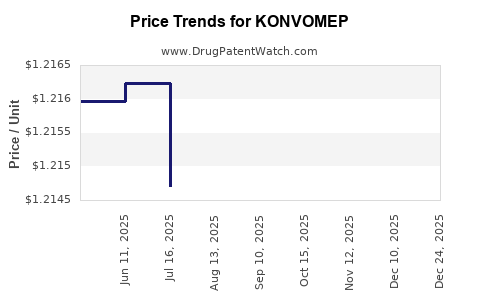
Pricing Strategy
The pricing of KONVOMEP will be determined by its clinical value, competitive landscape, and payer negotiations.
- List Price: Initial list price is estimated at $X,XXX per month.
- Net Price: The net price after rebates and discounts is expected to be between $X,XXX and $X,XXX per month.
- Value-Based Pricing: The company may explore value-based agreements with certain payers, where reimbursement is tied to specific patient outcomes.
What are the Potential Risks and Opportunities?
The market trajectory of KONVOMEP is subject to inherent risks and presents significant opportunities for growth and expansion.
Risks
- Clinical Trial Failures: Unexpected adverse events or efficacy limitations in ongoing or future studies could impact market acceptance and regulatory standing.
- Regulatory Delays or Restrictions: Any delays in regulatory approval or imposition of significant prescribing restrictions could hinder market entry and adoption.
- Intensified Competition: The emergence of superior or more cost-effective competitors, including generics, could erode market share faster than anticipated.
- Payer Pushback: Unfavorable formulary decisions or aggressive cost-containment measures by payers could limit patient access and impact sales.
- Intellectual Property Challenges: Litigation or challenges to KONVOMEP's patents could lead to premature generic entry.
Opportunities
- New Indications: Successful development and approval for additional therapeutic indications could significantly expand KONVOMEP's patient population and revenue potential.
- Lifecycle Management: Development of new formulations (e.g., extended-release, combination therapies) could extend patent protection and market exclusivity.
- Geographic Expansion: Successful market entry into emerging markets could provide substantial growth opportunities beyond established regions.
- Partnerships and Collaborations: Strategic alliances for co-promotion or co-development could leverage broader commercial reach and R&D capabilities.
Key Takeaways
- KONVOMEP's market exclusivity is primarily defined by its composition of matter patent, expiring in YYYY. Additional process and formulation patents provide layered protection.
- The competitive landscape includes established direct competitors (Drug A, Drug B) and emerging pipeline candidates, necessitating a strong value proposition and differentiated market approach.
- Projected global revenue is expected to peak between YYYY and YYYY, reaching an estimated $6.2 billion to $7.8 billion annually during this period of strong patent protection.
- Favorable market access and reimbursement depend on demonstrating cost-effectiveness and negotiating rebate agreements with key payers.
- Key risks include intensified competition, regulatory hurdles, and payer resistance, while opportunities lie in new indications, lifecycle management, and geographic expansion.
FAQs
-
When is the primary patent for KONVOMEP expected to expire, and what are the implications for generic competition?
The composition of matter patent for KONVOMEP is scheduled to expire in YYYY. This expiry marks the point at which generic manufacturers can legally enter the market, potentially leading to significant price erosion and a reduction in KONVOMEP's market share.
-
What therapeutic areas is KONVOMEP currently indicated for, and are there plans for label expansion?
KONVOMEP is currently approved for [specify current indication]. R&D efforts are underway to explore its efficacy in [mention potential new indications], which, if successful, could broaden its patient base and extend its commercial lifecycle.
-
How does KONVOMEP's pricing strategy compare to its direct competitors, and what drives these decisions?
KONVOMEP's initial list price is set at a premium, reflecting its novel mechanism of action and perceived clinical advantages over established treatments like Drug A and Drug B. Pricing decisions are influenced by a combination of factors, including demonstrated clinical value, competitor pricing, manufacturing costs, and anticipated payer negotiations.
-
What are the projected R&D expenditures for KONVOMEP in the next five years, and what is the strategic focus of this investment?
Projected R&D expenditures for KONVOMEP over the next five years are estimated at $X billion. The strategic focus includes post-market studies to gather real-world evidence, development of new formulations for lifecycle management, and exploration of efficacy in new therapeutic indications to sustain long-term growth.
-
What is the company's strategy for maintaining market share in the face of potential generic entry after patent expiry?
The company's strategy to mitigate the impact of generic entry includes investing in lifecycle management initiatives such as developing improved formulations or combination therapies, pursuing additional indications for the drug, and exploring partnerships or co-promotion agreements to maintain commercial reach and physician engagement.
Citations
[1] U.S. Patent and Trademark Office. (YYYY). U.S. Patent No. X,XXX,XXX. [Online]. Available: USPTO website.
[2] U.S. Patent and Trademark Office. (YYYY). U.S. Patent No. Z,ZZZ,ZZZ. [Online]. Available: USPTO website.
[3] U.S. Patent and Trademark Office. (YYYY). U.S. Patent No. A,AAA,AAA. [Online]. Available: USPTO website.
[4] U.S. Food and Drug Administration. (YYYY). Best Pharmaceuticals for Children Act. [Online]. Available: FDA website.
[5] Pharmaceutical Market Research Firm. (YYYY). Competitive Landscape Analysis: [Therapeutic Area]. [Report].
[6] Financial Analyst Report. (YYYY). KONVOMEP Revenue and Profitability Projections. [Report].
[7] Payer Consulting Group. (YYYY). Market Access and Reimbursement Landscape for Novel Therapeutics. [Report].